Axewelledge, a leading exporter from India, specializes in high-quality Bentonite. With a commitment to excellence, we supply premium Bentonite to the Middle East and Southeast Asia markets.


North Angle Complex, 304,
150 Feet Ring Rd, Opposite Ambedkar Nagar BRTS Stop,
Madhav Park, Punit Nagar,
Mavdi, Rajkot, Gujarat 360004
© Axewelledge 2026, All Rights Reserved.
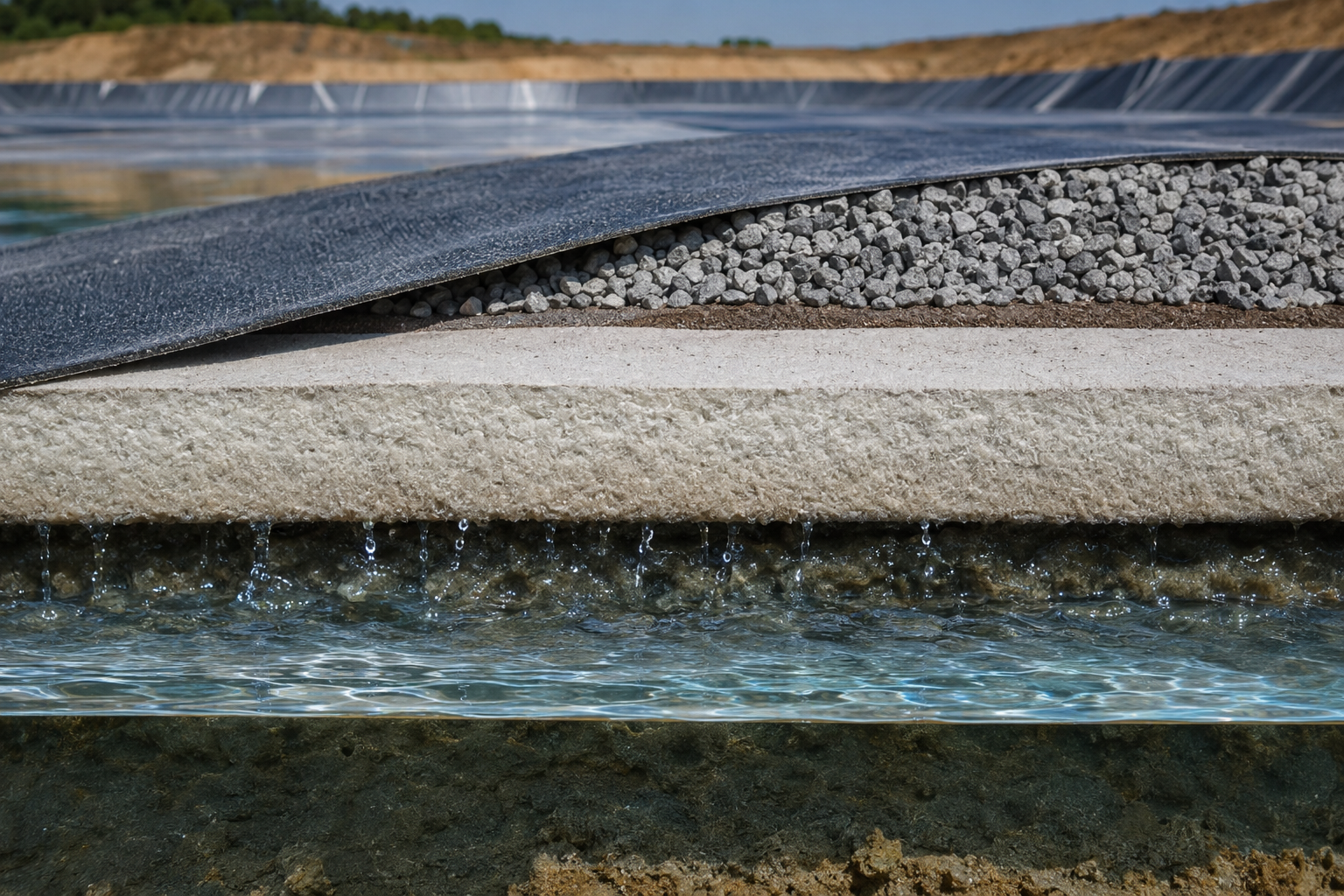
Water management and ground engineering share a stubborn challenge: preventing fluids from going where they shouldn't, or cleaning them up when they're contaminated. Whether you're trying to keep toxic leachate from leaking out of an industrial landfill or pulling heavy metals out of a chemical plant's process stream, the margin for error is razor-thin. Regulatory bodies like the US EPA demand low hydraulic conductivity and strict discharge standards. Engineering teams spend millions trying to hit those numbers.
Yet one of the most reliable tools for both jobs is a natural mineral formed millions of years ago from volcanic ash: sodium bentonite.
At Axewelledge, we mine and process high-grade bentonite reserves to feed demanding infrastructure, environmental, and industrial operations across the globe. In this guide, we'll dive deep into how bentonite works, why its unique crystal structure makes it an elite choice for both geotechnical sealing and wastewater clarification, and how you can optimize its performance on your next job site.
To understand why bentonite performs so exceptionally well in soil barriers and clarification tanks, you have to zoom in to the atomic level. Commercial bentonite is largely composed of montmorillonite, a 2:1 smectite clay mineral. This means each microscopic clay flake consists of an octahedral alumina sheet sandwiched between two tetrahedral silica sheets.
These sheets carry a negative surface charge, balanced by exchangeable cations—typically sodium (Na + ) or calcium (Ca 2+ )—occupying the interlayer spaces between flakes.
Not all bentonite acts the same in the presence of moisture. The specific balancing cation makes a massive difference:
?9 cm/s).
2+ ), holding the clay platelets tightly together. Calcium bentonite swells only 2 to 4 times its dry volume. While useful in applications like cast foundry molds or cat litter, it lacks the expansive sealing power required for critical geotechnical barriers unless chemically activated.
For geotechnical sealing and wastewater flocculation, natural sodium bentonite—such as the high-montmorillonite deposits harvested by Axewelledge—is the gold standard.
When civil engineers talk about containment, they're usually fighting water movement. Hydraulic head pressure forces fluid through porous soil, rock fractures, or concrete joints. Sodium bentonite neutralizes this pressure by swelling into microscopic voids, creating a self-healing hydraulic barrier.
Geosynthetic Clay Liners have revolutionized waste containment over the last three decades. A typical GCL consists of a uniform layer of sodium bentonite granules (roughly 0.7 to 1.0 pounds per square foot) sandwiched between two geotextiles held together by needle-punching or stitch-bonding.
When hydrated under confinement, the bentonite expands within the geotextile matrix. The resulting layer offers hydraulic performance equivalent to several feet of compacted native clay, but at a fraction of the thickness and transport weight.
Key Applications for GCLs:
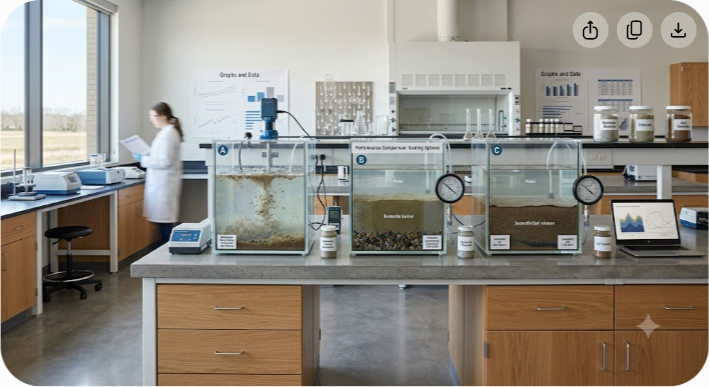
In site remediation and dam foundation engineering, groundwater migration often needs to be cut off entirely across hundreds of linear feet. Soil-Bentonite (SB) slurry cutoff walls provide a continuous vertical barrier deep below the surface.
During excavation, a trench is dug using a long-reach excavator while keeping the slot continuously filled with a 4% to 7% bentonite-water slurry. The slurry serves two distinct purposes:
Once excavated to target depth (often keyed into an impermeable bedrock or clay layer), the trench is backfilled with an engineered mixture of excavated soil, bentonite, and water. The result is a flexible vertical wall featuring hydraulic conductivity values between 1×10 ?7 and 1×10 ?8 cm/s.
Agricultural retention ponds, golf course hazards, industrial fire-water reservoirs, and municipal wastewater lagoons frequently suffer from severe seepage loss. Excavating the site to install thick synthetic liners can be cost-prohibitive.
Bulk sodium bentonite offers a simple, cost-effective alternative through two main application methods:
| Barrier Type | Typical Thickness | Hydraulic Conductivity (K) | Self-Healing Ability | Installation Complexity |
|---|
| Compacted Native Clay | 24 - 36 inches | 1×10 ?7 cm/s | Low | High (Requires massive haulage) |
| HDPE Geomembrane | 60 - 80 mil (1.5 - 2mm) | Near Zero (Unless punctured) | None (Punctures cause major leaks) | High (Requires specialized welding) | | Geosynthetic Clay Liner (GCL) | 0.25 - 0.5 inches | 1×10 ?9 cm/s | High (Swells to close small punctures) | Moderate | | Soil-Bentonite Blended Layer | 4 - 6 inches | 1×10 ?8 cm/s | Very High | Low to Moderate |
Moving from ground engineering to fluid processing, sodium bentonite's structural properties make it just as formidable inside a wastewater treatment plant as in a landfill trench.
Industrial effluent streams—from textile mills, plating lines, food processors, and paper plants—contain complex mixtures of dissolved metals, emulsified oils, organic toxins, and suspended solids. Standard chemical coagulants (like alum or ferric chloride) often struggle with fine colloidal suspensions or emulsified fats. This is where bentonite excels.
The high Cation Exchange Capacity (CEC) of premium sodium bentonite—often ranging from 70 to 100 meq/100g—makes it an exceptionally effective sponge for positively charged heavy metal ions.
When mixed into industrial wastewater, sodium ions in the clay matrix swap places with target heavy metal contaminants:
Target pollutants effectively immobilized by bentonite include:
2+ )
2+ )
2+ )
2+ )
2+ )
vi ) (When organo-modified or combined with reducing agents)
Because the metal ions are bound tightly within the interlayer lattice, the resulting sludge is chemically stable, passing standard Toxicity Characteristic Leaching Procedure (TCLP) tests far more reliably than soft hydroxide sludges.
Free-floating oil can be skimmed using simple API oil-water separators. But emulsified oil—where microscopic droplets are suspended in water by surfactants—refuses to separate naturally.
Organophilic bentonites (bentonites surface-treated with quaternary ammonium compounds) flip the clay's native surface from hydrophilic to hydrophobic. When added to oily wastewater:
2 /g in dispersed state).
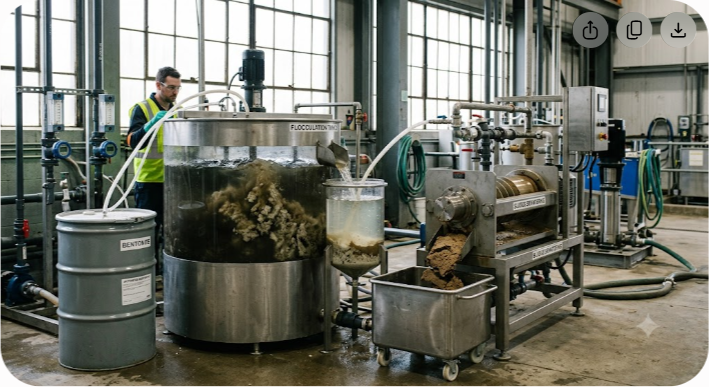
In municipal and industrial clarification tanks, fine suspended solids create turbid water that clogs downstream membrane filters. Combining sodium bentonite with conventional polymers creates a dense, heavy floc that settles quickly.
Unlike light, gelatinous alum flocs that hold excess bound water, bentonite-enhanced flocs are dense and granular. This drastically improves filter cake dewatering in plate-and-frame filter presses, producing drier sludge cakes with significantly reduced disposal costs.
Knowing bentonite's capabilities is only half the battle; proper job site handling and dosage determination dictate real-world success.
2+ or Mg 2+ levels can inhibit swelling through cation exchange. If constructing a slurry wall or pond liner in brackish environments, test the swelling index (mL/2g) using site water prior to installation.
Not all raw clay deposits yield high-performance bentonite. Mineral purity, montmorillonite content, and grinding consistency dictate whether a batch will hit strict hydraulic limits or fall short during compliance testing.
Axewelledge ranks among the top global producers, controlling over 60 million tons of premium high-montmorillonite reserves. Backed by 15+ years of mining and processing expertise, our sodium bentonite products deliver:
Whether you're specifying a GCL liner for a municipal landfill, building a soil-bentonite slurry wall, or designing an industrial effluent pretreatment system, working with a vertically integrated supplier guarantees material consistency from the mine to your facility.
Engineers facing tough environmental regulations don't need complex synthetic solutions when natural mineral chemistry offers such robust performance. Sodium bentonite remains one of earth's most versatile tools for environmental protection. Its unmatched swelling power creates self-healing subsoil barriers, while its exchangeable chemistry neutralizes toxic wastewater streams before discharge.
By matching the right grade of sodium bentonite to your site chemistry and mixing parameters, you can build safer infrastructure, protect valuable groundwater, and meet strict environmental standards with confidence.













Have questions about our products? We're here to help!