Axewelledge, a leading exporter from India, specializes in high-quality Bentonite. With a commitment to excellence, we supply premium Bentonite to the Middle East and Southeast Asia markets.


North Angle Complex, 304,
150 Feet Ring Rd, Opposite Ambedkar Nagar BRTS Stop,
Madhav Park, Punit Nagar,
Mavdi, Rajkot, Gujarat 360004
© Axewelledge 2026, All Rights Reserved.
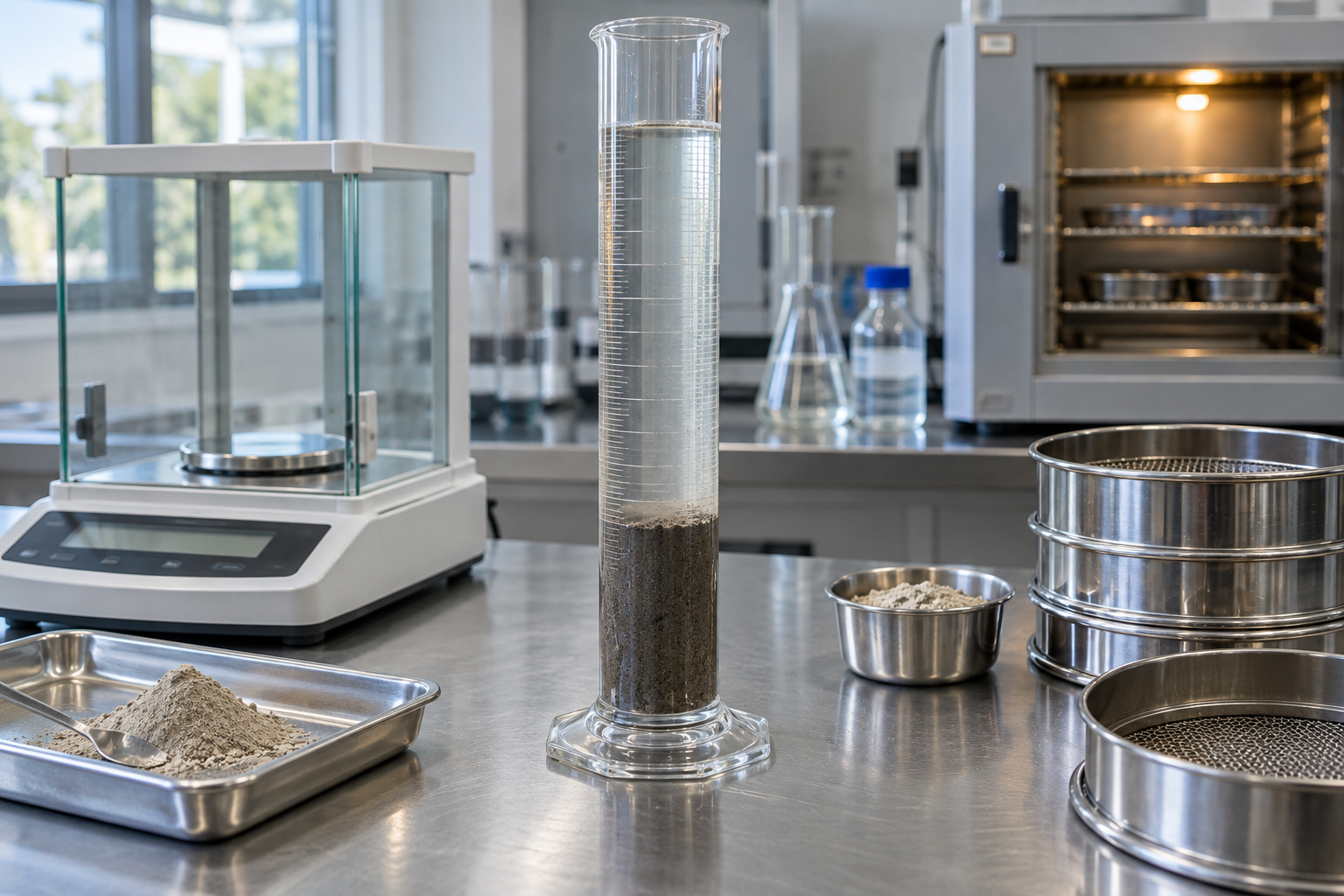
The bentonite swell index is a volume measurement, not a simple percentage. Under ASTM D5890, a measured mass of dried bentonite is allowed to hydrate in reagent water, and the volume occupied by the settled, swollen clay is reported in milliliters per 2 grams of dry clay. A commonly used benchmark is 24 mL/2 g, although the acceptance requirement for a project should always come from the applicable specification rather than from the benchmark alone.
That distinction matters. A higher swell index generally indicates stronger free-swelling behavior, but it does not by itself prove that a bentonite is suitable for every drilling, foundry, civil engineering, or sealing application. Particle size, mineral composition, exchangeable cations, water chemistry, polymer treatment, viscosity, filtration performance, and other properties can all affect how a bentonite performs in service.
For geosynthetic clay liner work, ASTM D5890 is particularly relevant because it evaluates the swelling behavior of the clay mineral component in reagent water. The current ASTM designation is D5890-25. The method is adapted from the United States Pharmacopeia bentonite test, but the ASTM method should not be treated as a universal test for every bentonite product or end use.
This guide explains what the swell index means, how the ASTM D5890 test works, how to interpret the result, where the commonly quoted 24 mL/2 g value comes from, and which testing mistakes can produce misleading results.
The bentonite swell index measures how much volume a known quantity of bentonite occupies after it has been dispersed and hydrated in water under a defined laboratory procedure. The result is normally reported as milliliters per 2 grams (mL/2 g) for the ASTM D5890 procedure.
The test is designed to compare the swelling behavior of clay minerals under controlled conditions. It is especially useful for quality control because two bentonite samples that look similar when dry can behave quite differently once they contact water.
Bentonite swelling is strongly associated with montmorillonite, the principal clay mineral in many bentonites. Its layered structure can accommodate water between clay particles and within the diffuse double layer surrounding charged surfaces. The type and concentration of exchangeable cations also influence this behavior. Sodium-rich bentonite generally develops greater free swelling than calcium-dominated bentonite under comparable conditions.
The practical point is simple: the swell index tells you how strongly a bentonite expands under the conditions of the specified test. It does not measure every aspect of bentonite performance.
A result of 24 mL/2 g means that 2 grams of dry bentonite occupy approximately 24 mL of settled swollen clay at the specified endpoint of the test.
It does not mean that the clay has increased to exactly 12 times its original dry volume. The dry powder and hydrated sediment have very different structures, densities, and amounts of entrained water, so treating the swell index as a simple dry-volume expansion ratio can be misleading.
The 24 mL/2 g figure is widely associated with the historical bentonite classification and GCL quality-control practice derived from the USP method and carried into ASTM D5890. It should be viewed as a reference requirement, not as a universal definition of premium bentonite.
Sodium bentonite contains a larger proportion of exchangeable sodium relative to calcium bentonite. Sodium is monovalent, and its interaction with the negatively charged clay surfaces allows a more extensive diffuse double layer to develop when the clay hydrates. Under suitable water chemistry, particles can separate and form a hydrated structure with substantial apparent volume.
Calcium and other multivalent cations generally compress the diffuse double layer more strongly. As a result, calcium bentonite often shows less free swelling than sodium bentonite.
This difference explains why sodium bentonite is widely used where low hydraulic conductivity and self-sealing behavior are important. It does not mean calcium bentonite is an inferior material in every application. Foundry, absorbent, pelletizing, and other processes may require different properties.
ASTM D5890 is titled Standard Test Method for Swell Index of Clay Mineral Component of Geosynthetic Clay Liners. Its scope is specific: it provides an index method for evaluating the swelling properties of a clay mineral in reagent water and estimating its usefulness for reducing hydraulic conductivity in geosynthetic clay liners.
The current active edition is ASTM D5890-25. The standard states that the method is not applicable to clays containing polymers. That limitation is important when comparing conventional bentonite with polymer-enhanced products.
The procedure is adapted from a United States Pharmacopeia method for bentonite. Because the two methods have a historical relationship, technical articles sometimes describe them as though they are interchangeable. For quality control, however, the exact standard named in the purchase specification or project documentation should be followed.
ASTM D5890 is an index test. It does not directly measure hydraulic conductivity, filtration rate, gel strength, yield point, or drilling-fluid viscosity.
Its value is that swelling behavior is closely related to the way bentonite can hydrate and contribute to the low-permeability behavior expected from the clay component of a GCL. A poor swell result can therefore be a useful warning sign, but a passing swell result does not replace the other tests required for a complete product qualification.
For GCL manufacturing and quality assurance, the swell index can be used alongside moisture, particle-size distribution, bentonite mass per unit area, hydraulic conductivity, fluid-loss behavior, and other specification requirements.
For ASTM D5890, the result is not normally calculated using a percentage formula. The test measures the final volume occupied by a specified 2.0 g dry sample after hydration and settling.
The basic reporting relationship is:
For example, if the settled clay boundary is read at 27 mL after the required hydration period, the reported result is:
If the settled volume is 31 mL, the result is:
There is no need to convert either result into a percentage unless a separate specification specifically asks for a percentage-based calculation.
Start with a representative laboratory sample from the lot being evaluated. Sampling matters because bentonite can vary within a shipment, particularly when different particle-size fractions or mineral zones have been blended.
For production quality control, the sampling plan should be defined before testing begins. A single convenient scoop from the top of a bulk container is not necessarily representative of the entire shipment.
Record the sample identification, lot or batch number, source, date, product grade, and any relevant processing information. Good laboratory records make an unusual result much easier to investigate later.
ASTM D5890 requires powdered clay to be dried to constant weight at 105 plus or minus 5 degrees Celsius. Granular clay is ground so that it passes the specified No. 100 U.S. Standard Sieve, with a minimum specified proportion passing the No. 200 sieve.
The current ASTM D5890-25 edition expresses these sieve sizes as 150 micrometers for No. 100 and 75 micrometers for No. 200. The clay passing the No. 100 sieve is used for the test after drying to constant weight.
Do not casually substitute a different particle-size preparation and then label the result ASTM D5890. Particle size affects hydration behavior, so changing the preparation can change the measured swell.
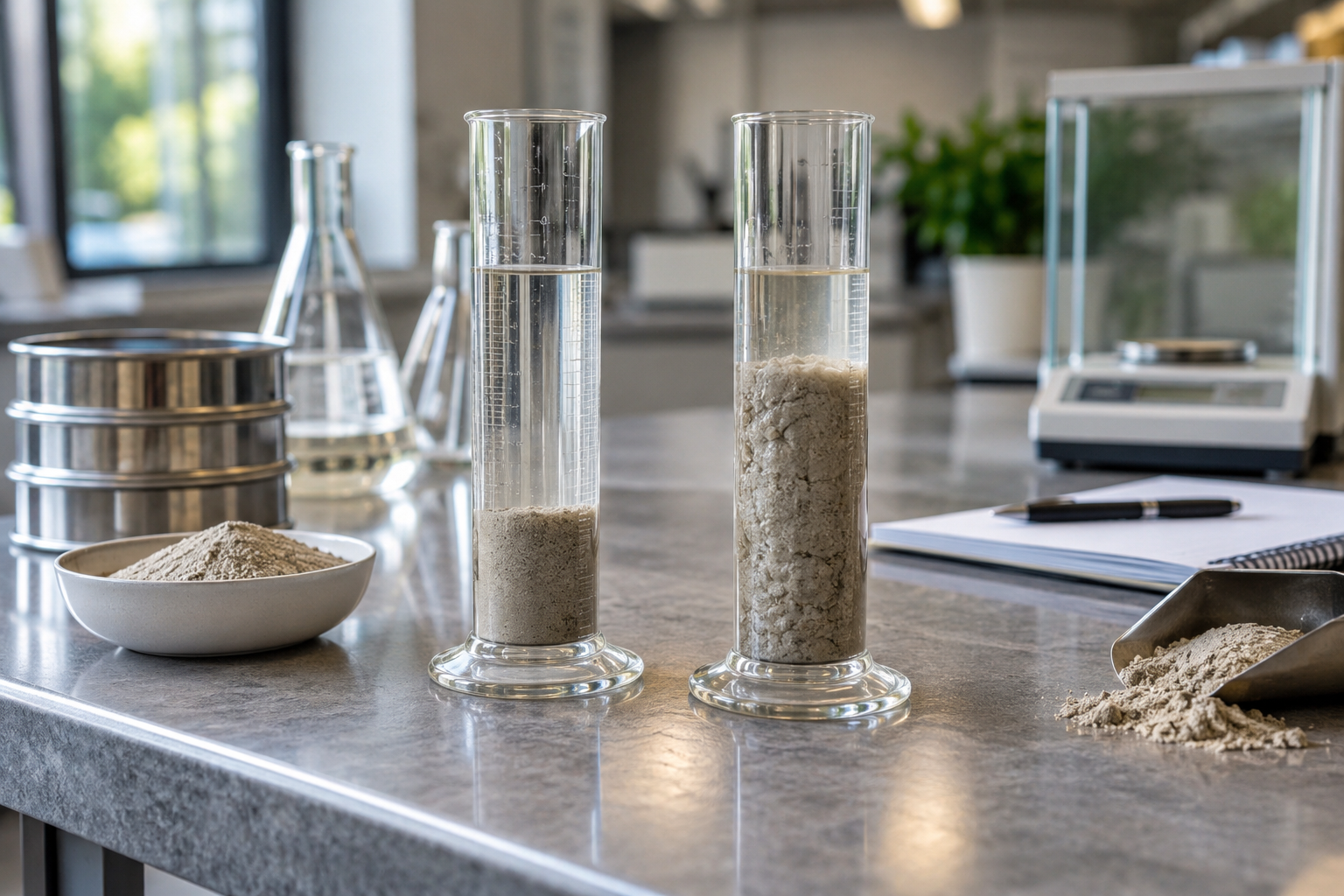
Place the prepared material in the laboratory oven under the temperature conditions specified by the standard. Drying to constant weight is important because residual moisture changes the actual amount of dry bentonite being tested.
After drying, allow the sample to cool under appropriate controlled conditions before weighing. The goal is to determine the dry mass accurately rather than simply heating the material for an arbitrary number of hours.
The common instruction to dry a sample overnight can be useful as a laboratory practice, but the standard requirement is constant weight. Drying time will depend on the sample, equipment, sample depth, and laboratory conditions.
Accurately weigh 2.0 g of the prepared, dry bentonite. Avoid losing fine particles during transfer because even a small mass error can affect the final result.
Use a calibrated balance suitable for the required measurement. Record the actual mass and any relevant balance identification according to the laboratory's quality system.
The test uses reagent water rather than ordinary tap water. Water chemistry matters because dissolved ions can influence clay hydration and swelling.
The bentonite is introduced into a graduated cylinder in small portions so that each portion becomes wetted and settles before the next portion is added. The purpose is to reduce floating powder, trapped air, and incomplete wetting.
The exact addition procedure, timing, vessel dimensions, and water volume should come from the current edition of ASTM D5890 used by the laboratory. Do not replace the standard's procedure with an improvised version and assume that the resulting number is directly comparable.
After the complete sample has been introduced, allow the cylinder to remain undisturbed for the specified period. The clay forms a settled, hydrated mass at the bottom of the cylinder, while clearer water remains above it.
The endpoint is important. Reading the cylinder too early can underestimate the settled volume because hydration and settling may still be changing. Different project specifications can also prescribe particular hydration times, so the laboratory should follow the applicable standard and project requirement rather than choosing a convenient endpoint.
Read the top of the settled clay layer at eye level and record the volume in milliliters. Avoid parallax when reading the graduated cylinder.
The result is reported as the swollen clay volume for the 2.0 g dry sample, expressed in mL/2 g.
For example:
That is the core calculation. The laboratory does not need to turn 28 mL into a percentage to report the ASTM swell index.
Suppose a quality-control laboratory receives a sodium bentonite sample intended for use in a GCL manufacturing process. After the required preparation, the laboratory weighs 2.00 g of dry material and performs the swell test using the applicable ASTM procedure.
After the specified hydration and settling period, the top of the settled clay is read at 29 mL.
The result is therefore:
If the project's minimum requirement is 24 mL/2 g, the sample exceeds that particular threshold. The laboratory can report the result as 29 mL/2 g, along with the method, sample identification, test date, and any other information required by its quality system.
That does not mean the product automatically passes every requirement for the project. A GCL specification may contain separate requirements for bentonite mass, hydraulic conductivity, moisture, peel strength, tensile properties, or other characteristics. The swell index is one quality-control measurement within a larger qualification framework.
No. This is one of the most common sources of confusion when researching bentonite swelling.
In geotechnical soil mechanics, free swell index can refer to a comparative test in which a soil specimen is placed separately in water and a non-polar liquid such as kerosene. The resulting volumes are compared to estimate the degree of free swelling.
A commonly used expression is:
Where:
For example, if Vw is 48 mL and Vk is 12 mL:
This percentage is meaningful for that comparative free-swell method. It should not be substituted for the ASTM D5890 swell index, which is reported as a settled volume in mL/2 g.
If a specification says ASTM D5890, report the ASTM result in its specified units. If it calls for a soil free-swell index, use the soil-testing method named by the specification. The two measurements answer related but different questions.
| Feature | ASTM D5890 Swell Index | Soil Free Swell Index |
|---|---|---|
| Typical application | Clay mineral component of GCLs | Geotechnical soil characterization |
| Common reporting unit | mL/2 g | Percentage |
| Test liquid | Reagent water | Water compared with a non-polar liquid, where specified |
| Main measurement | Settled swollen clay volume | Relative increase in volume in water |
| Sample basis | Prepared clay mineral | Soil specimen prepared according to the relevant soil method |
| Intended interpretation | Swelling behavior relevant to GCL clay quality | Relative expansiveness or free-swelling behavior of soil |
The terminology overlaps, but the methods should not be mixed when reporting product specifications.
Bentonite does not swell in a vacuum. The chemistry of the water surrounding the clay can have a major effect on its behavior.
Fresh, low-ionic-strength water generally permits greater diffuse double-layer development than water containing substantial concentrations of dissolved salts or multivalent ions. Calcium and magnesium, for example, can reduce the degree of swelling compared with sodium-rich conditions.
That is why a bentonite can produce one result with reagent water and a different result when exposed to saline water, leachate, brine, or another site-specific fluid.
For GCL quality control, the standardized reagent-water test provides a controlled comparison. For design work involving unusual liquids, however, engineers may need additional compatibility or hydraulic-conductivity testing using the actual fluid of concern.
Tap water contains dissolved minerals whose concentrations vary from one location to another. If a laboratory uses tap water for a test intended to follow ASTM D5890, the result may not be comparable with results obtained using the specified reagent water.
This is more than a minor laboratory preference. Water chemistry is part of the test conditions.
The phrase "high swelling" is most strongly associated with sodium bentonite, but swelling behavior should always be evaluated against the intended application and test method.
| Property | Sodium-Dominant Bentonite | Calcium-Dominant Bentonite |
|---|---|---|
| Dominant exchangeable cation | Sodium | Calcium |
| Typical free-swelling behavior | Higher | Lower |
| Water interaction | Strong hydration under suitable conditions | More limited swelling under comparable conditions |
| Common applications | GCLs, drilling fluids, sealing, tunneling | Foundry and other industrial applications |
| Quality-control focus | Swell, filtration, rheology, hydraulic performance | Application-specific strength, rheology, absorption, and other properties |
This table is a general comparison, not a specification. Natural bentonite deposits can contain mixtures of exchangeable cations and different proportions of clay and non-clay minerals. Processed or chemically modified products can behave differently again.
A laboratory swell result reflects more than the word "sodium" on a product label. Several variables can influence the measured value.
Montmorillonite content is a major factor because montmorillonite provides much of the swelling behavior associated with bentonite. Other minerals and impurities can dilute the active clay fraction and affect the final result.
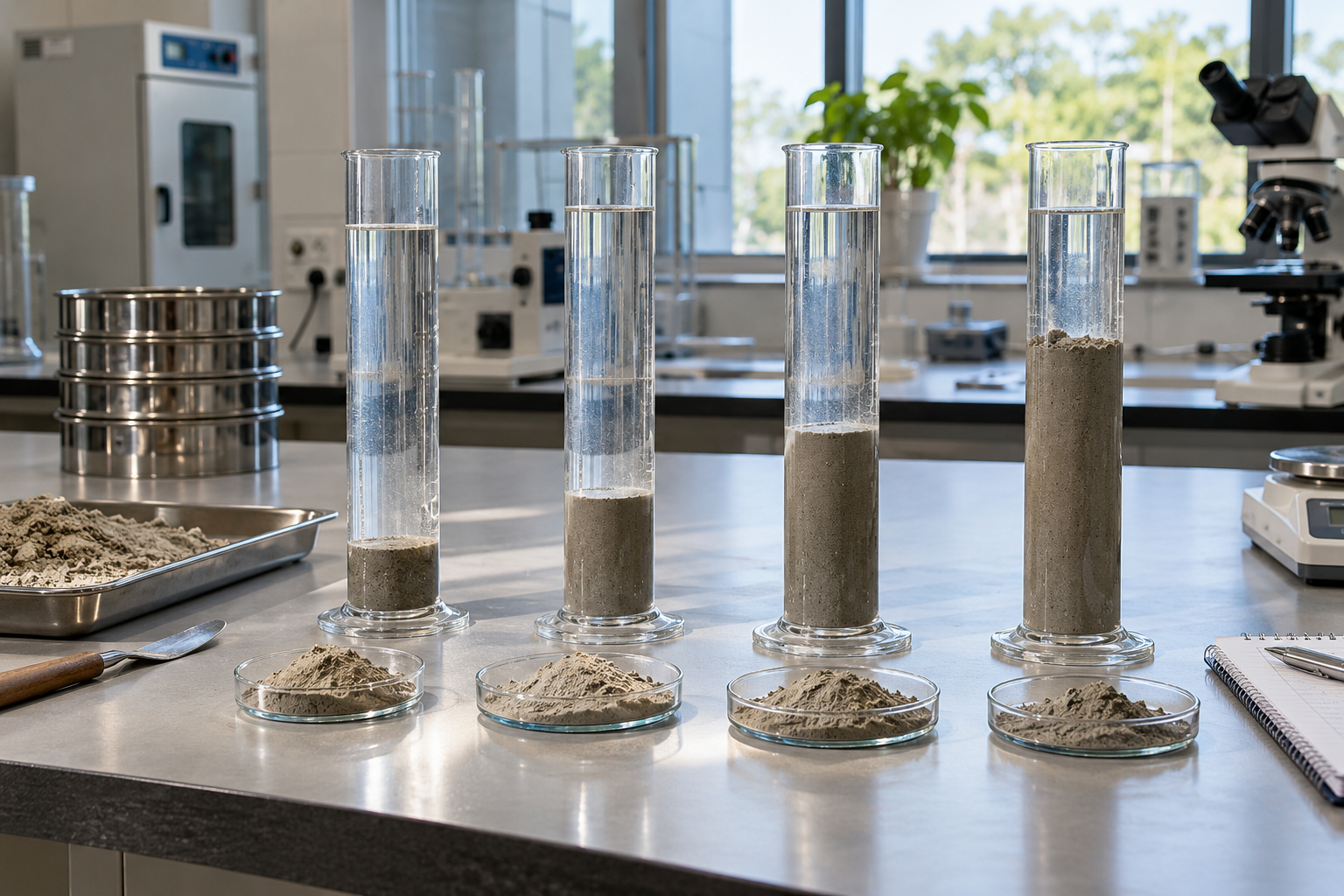
The balance of sodium, calcium, magnesium, and other exchangeable cations affects hydration and interparticle interactions. Sodium-rich material generally has greater free-swelling capacity than calcium-rich material under comparable conditions.
Particle size influences the rate at which water reaches the available clay surfaces. Fine material can hydrate more readily, while larger particles may require more time to hydrate completely.
That is why standardized sample preparation matters. A product tested in its coarse, as-received form cannot automatically be compared with a finely ground laboratory specimen.
Dissolved salts and multivalent ions can suppress swelling. For standardized testing, use the water quality specified by the method. For field applications, consider the chemistry of the actual fluid that will contact the bentonite.
Moisture content, drying conditions, storage history, and contamination can influence test behavior. A laboratory should control these variables rather than treating sample preparation as an afterthought.
Polymer-enhanced bentonites can have performance characteristics that differ substantially from untreated clay. ASTM D5890-25 specifically states that its scope does not apply to clays with polymers, so a polymer-treated product requires the test method and acceptance criteria appropriate to that product.
Most poor laboratory results do not come from complicated mathematics. They come from inconsistent preparation or from using the wrong test for the question being asked.
A high swell index can be valuable, but it is not a complete quality certificate. Drilling-grade bentonite, foundry bentonite, and GCL bentonite can have very different specifications.
For example, a drilling-fluid formulation may require specific rheological and filtration characteristics. A GCL may require swelling behavior together with hydraulic conductivity and other physical properties. Comparing products only by swell volume can therefore lead to the wrong purchasing decision.
ASTM D5890 results are reported as a volume per 2 g of dry clay. The geotechnical free swell index is a different measurement and can be expressed as a percentage.
Always check the test method before interpreting the number.
Water chemistry can change swelling. If the standard calls for reagent water, use it. Do not assume that clear tap water is chemically equivalent.
Grinding a sample more finely than the method permits can change hydration behavior. Testing coarse granules directly can also produce a result that does not represent the standardized method.
The sample preparation is part of the test, not an optional preliminary step.
A result taken before the specified hydration and settling period may not be comparable with a result taken at the correct endpoint. Record the actual test conditions and follow the method consistently.
Graduated-cylinder readings should be taken at eye level. Looking down at the meniscus or settled clay boundary can introduce a reading error, particularly when results are close to a specification limit.
Bentonite fines can cling to containers, tools, and the walls of the graduated cylinder. Losses during weighing or transfer reduce the actual mass under test and can distort the reported result.
A supplier's "swelling index" may have been measured according to a national standard, an internal method, ASTM D5890, or another procedure. Before comparing two numbers, confirm that the test method, sample preparation, water quality, mass basis, and endpoint are comparable.
A good quality-control program treats the swell index as one data point within a defined specification system.
For incoming material, record at least the product name or grade, supplier, lot number, sample date, test method, sample preparation, result, and acceptance criterion. Keep the laboratory result linked to the physical shipment so that an unusual result can be traced back to the source.
For repeated production testing, trend the results over time rather than looking only at pass or fail. A gradual change can be useful even when every individual result remains above the minimum specification. It may indicate changes in ore blending, beneficiation, grinding, drying, or other processing conditions.
Suppose a project specification requires a minimum swell index of 24 mL/2 g under ASTM D5890.
| Test Result | Interpretation Against a 24 mL/2 g Minimum |
|---|---|
| 22 mL/2 g | Below the stated minimum; investigate before acceptance |
| 24 mL/2 g | Meets the stated minimum |
| 27 mL/2 g | Above the stated minimum |
| 32 mL/2 g | Above the stated minimum, but other specifications still apply |
The table illustrates how the result should be used. It does not establish a universal pass/fail range for every bentonite product.
No.
A higher swell value can be desirable when the application depends on swelling and low hydraulic conductivity, but the highest number is not automatically the best material for every process.
Drilling fluids, for example, are evaluated using a combination of rheology, filtration, sand content, moisture, and other properties defined by the applicable grade or specification. Foundry applications may prioritize different characteristics. GCL systems require broader performance verification than a single free-swell measurement.
The right question is not "Which bentonite swells the most?" It is "Which bentonite meets the complete specification for the intended application?"
Bentonite is the active mineral component responsible for much of the sealing function of a geosynthetic clay liner. When hydrated under appropriate conditions, the clay can form a low-permeability layer that restricts water movement.
ASTM D5890 was developed specifically to evaluate the swelling properties of the clay mineral component of GCLs. The test is therefore particularly useful as a quality-control indicator for bentonite intended for these systems.
However, a GCL is a composite product, not simply a bag of bentonite. The finished liner can include geotextiles and other components, and its performance depends on the complete composite system, installation conditions, hydration, confinement, and the chemistry of the liquid contacting the liner.
A swell index result should therefore support, not replace, full GCL qualification and performance testing.
Drilling applications need a broader testing approach. Bentonite is used in drilling fluids because hydrated clay can contribute viscosity, suspension, filtration control, and wellbore-support characteristics.
A swell index can provide useful information about hydration behavior, but drilling-grade specifications commonly rely on additional tests for rheology and filtration. API or ISO requirements applicable to the particular drilling-fluid grade should be used when purchasing or qualifying drilling bentonite.
This is an important distinction for buyers. A bentonite with a strong laboratory swell result is not automatically a compliant drilling-grade product.
For industrial buyers, consistent test results begin before the material reaches the laboratory. A supplier should be able to identify the product grade, production lot, basic specifications, and applicable quality-control tests.
A reliable supply program also helps reduce variation between shipments. For large projects, buyers should establish the acceptance criteria before procurement and agree on the test methods that will be used for incoming inspection.
For a supplier such as Axewelledge, the useful conversation is not simply about claiming that a bentonite has "high swelling." The more meaningful questions are: Which grade is being supplied? What test method is used? What is the typical specification range? How is particle size controlled? How is lot-to-lot consistency monitored? Which additional properties are relevant to the buyer's application?
Those details make a mineral specification useful rather than promotional.
Before accepting a swell index result, check the following:
The bentonite swell index is a controlled measurement of how much volume a specified quantity of bentonite occupies after hydration and settling. For ASTM D5890, the result is reported in mL/2 g, not as a percentage.
ASTM D5890 is specifically intended for evaluating the swelling properties of clay mineral used in geosynthetic clay liners. The current active edition is ASTM D5890-25, and the method includes defined requirements for sample preparation, drying, particle size, reagent water, and measurement.
The frequently quoted 24 mL/2 g value is an important benchmark in GCL-related quality control, but it should not be treated as a universal specification for every bentonite product. Always use the acceptance requirement stated in the relevant project or product specification.
Finally, do not confuse ASTM swell index testing with the percentage-based free swell index used in some geotechnical soil tests. They measure related aspects of swelling but use different procedures and reporting systems.
When bentonite quality matters, the best approach is straightforward: use the correct standard, control the laboratory conditions, document the result, and evaluate swelling alongside the other properties required for the application.













Have questions about our products? We're here to help!