Axewelledge, a leading exporter from India, specializes in high-quality Bentonite. With a commitment to excellence, we supply premium Bentonite to the Middle East and Southeast Asia markets.


North Angle Complex, 304,
150 Feet Ring Rd, Opposite Ambedkar Nagar BRTS Stop,
Madhav Park, Punit Nagar,
Mavdi, Rajkot, Gujarat 360004
© Axewelledge 2026, All Rights Reserved.
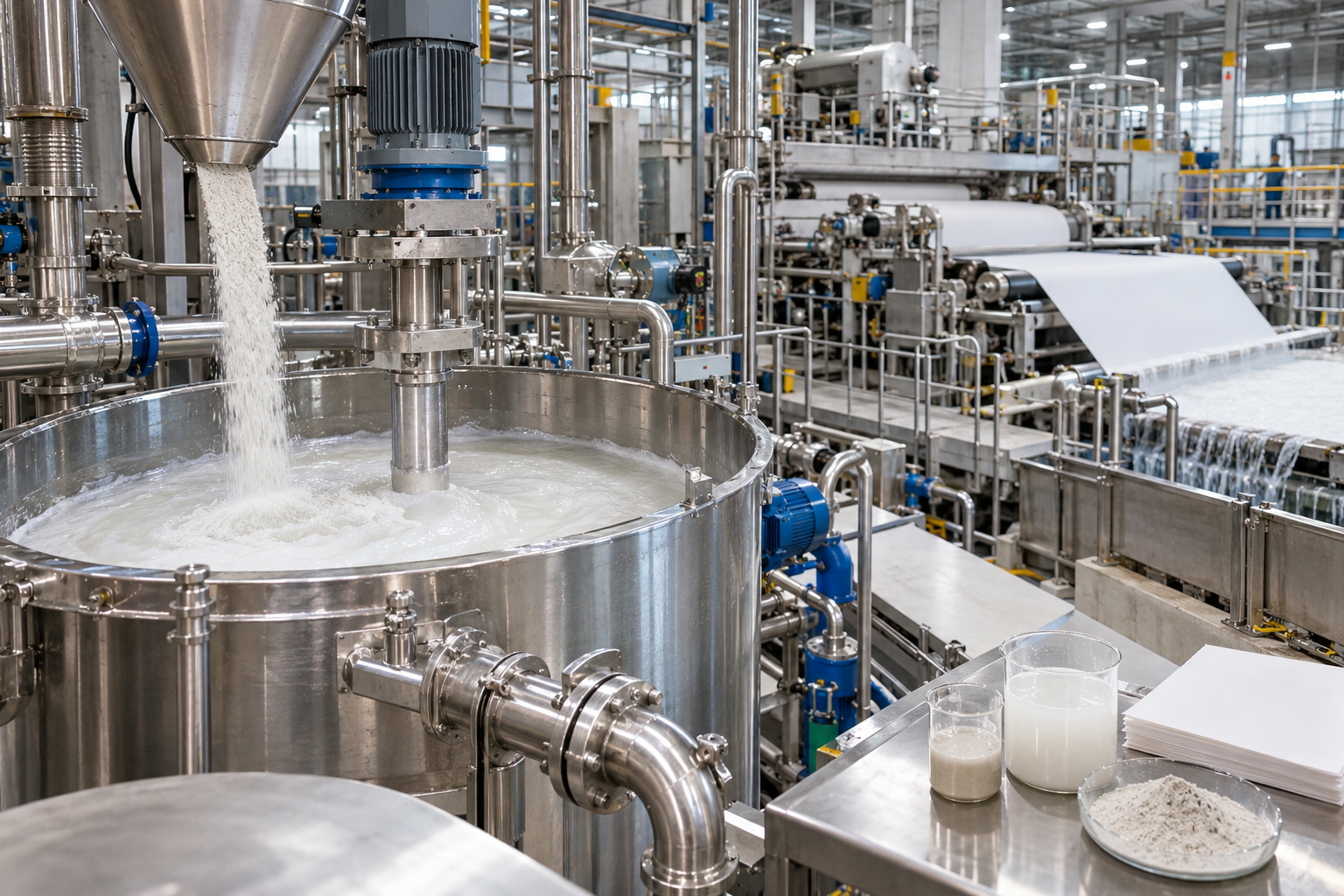
Bentonite has a more specific role in papermaking than simply acting as another mineral additive. In the right wet-end system, finely dispersed bentonite can help improve retention and drainage while supporting control of fines, fillers, pitch, stickies, and white-water chemistry.
The seven important applications covered here are retention and drainage, pitch and contaminant control, formation support, white-water management, recycled-fiber processing, coating and surface formulations, and process stability on high-speed paper machines. The actual result depends on the bentonite grade, mineral characteristics, dosage, furnish, water chemistry, polymer program, shear conditions, and addition point.
That is why there is no universal bentonite recipe for every paper mill. A product that performs well on one machine may deliver a different result on another. The useful question isn't simply whether bentonite works. It's whether a particular bentonite works with the mill's existing process.
Bentonite is a natural clay material dominated by smectite minerals, particularly montmorillonite. Its fine particle size, large surface area, swelling behavior, water interaction, and surface charge make it useful in several industrial processes.
In papermaking, these properties become especially relevant in the wet end, where fiber, fines, fillers, polymers, dissolved substances, colloidal material, and process water interact continuously.
A paper furnish can contain cellulose fibers along with small fiber fragments, mineral fillers, sizing chemicals, retention polymers, dissolved organic substances, and contaminants. Some of these materials are valuable components of the final sheet. If they remain suspended in the process water instead of being retained, the mill can lose raw material and create additional challenges for white-water management.
Bentonite is often used as part of a microparticle retention system, commonly alongside a cationic polymer or another retention program. The mineral interacts with the polymer and fine particles, helping modify the structure of the flocs that reach the forming section.
The practical objective is straightforward: retain useful solids, remove water efficiently, maintain acceptable formation, and keep unwanted material under control.
Retention and drainage are two of the most established reasons for using bentonite in paper production.
During sheet formation, fibers, fines, and fillers are suspended in water. A portion of the finer material is small enough to pass through the forming fabric unless the wet-end chemistry captures it effectively. Losing too much of this material can reduce raw-material efficiency, change sheet properties, and increase the solids load in white water.
Bentonite is commonly used in microparticle retention systems. In one common approach, a retention polymer first interacts with components of the furnish. Bentonite is then added at a later point, where its fine particles interact with the polymer-fiber structures and help modify the resulting flocs.
The objective isn't simply to create the largest possible flocs. Large, tightly formed flocs can improve retention while producing poor formation. A useful retention system has to balance solids capture with the uniform distribution of fibers and fillers across the sheet.
After the fiber web forms, water has to leave the sheet efficiently. Drainage that is too slow can restrict machine performance and increase the load on downstream dewatering equipment.
Bentonite can influence the structure of the flocculated material and help create conditions in which water separates from the fiber suspension more readily. The effect depends on the mineral, dosage, polymer system, mixing conditions, and sequence of chemical addition.
The addition point matters because the bentonite needs to interact with the right components of the furnish before the suspension reaches the forming section. Excessive shear after addition can also change the floc structure and affect the final result.
A proper evaluation should use several measurements rather than relying on a single retention or drainage number. Depending on the machine and paper grade, useful indicators include:
The best dosage is therefore the point where the overall process improves without creating a new problem elsewhere.
Pitch is a broad term used for hydrophobic substances associated with wood and pulping operations. Depending on the furnish and process, these materials can deposit on wires, felts, rolls, screens, pipes, and other machine surfaces.
Paper mills using recovered fiber face an additional contaminant challenge. Recycled furnish can contain pressure-sensitive adhesives, hot melts, inks, coatings, plastics, and other substances commonly grouped under terms such as stickies or dissolved and colloidal material.
These contaminants can contribute to deposits, machine contamination, sheet defects, breaks, and increased cleaning requirements.
Bentonite can play a supporting role in contaminant management because its large surface area and mineral surface chemistry allow it to interact with some fine, colloidal, or hydrophobic substances. Depending on the process, the mineral can help capture or immobilize material that would otherwise continue circulating through the system.
It is important not to describe bentonite as a chemical that simply destroys pitch. Its role is generally based on adsorption, surface interaction, and changes in how contaminants behave within the wet-end system.
Recovered paper is not chemically uniform. The furnish can change with the source and quality of the recovered material, bringing different concentrations of adhesives, inks, coatings, fillers, and other contaminants into the process.
Bentonite may form part of a broader control strategy that also includes screening, cleaning, flotation, dispersants, fixatives, retention polymers, and effective white-water management.
The important point is that bentonite isn't a replacement for mechanical cleaning or proper furnish preparation. It is one tool within a larger process-control program.
Formation describes how evenly fibers and other solids are distributed throughout a paper sheet. Good formation affects appearance, printability, strength uniformity, coating behavior, and other finished-paper properties.
Retention chemistry can create a difficult trade-off here. Increasing retention may sound beneficial, but aggressive flocculation can produce large fiber and filler aggregates. Those aggregates can make the sheet less uniform.
Microparticle systems containing bentonite can help produce smaller and more manageable floc structures under suitable conditions. The system can respond to shear as the furnish moves through the approach flow, allowing the mill to balance retention with formation.
That balance is particularly important for grades where visual uniformity and surface quality are closely controlled.
A paper sheet needs to retain its components without developing obvious clusters of fibers or fillers. If the chemistry produces excessively large flocs, the result can include:
For that reason, maximum retention isn't automatically the target. Controlled retention is more useful.
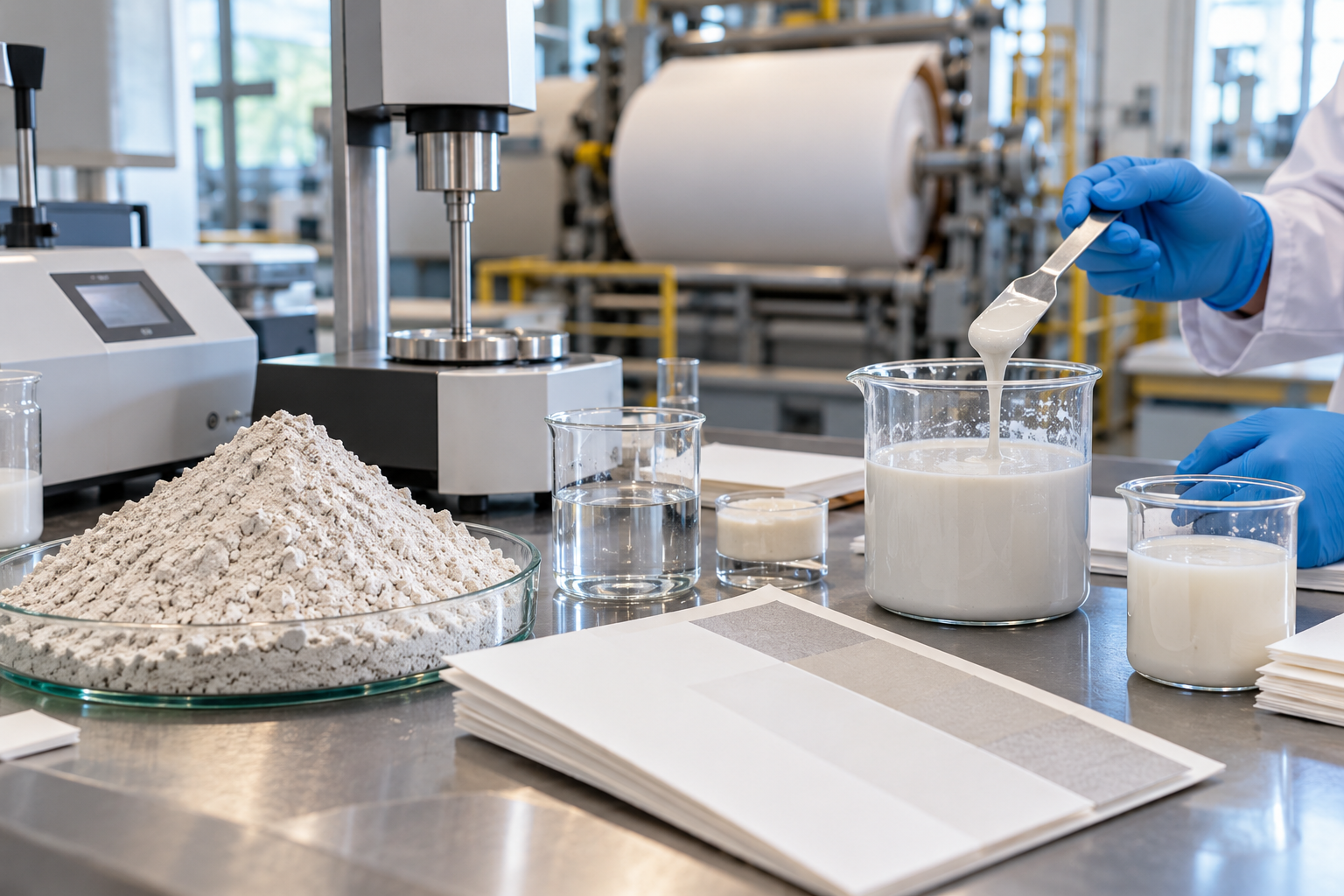
A bentonite microparticle system can help because the mineral interacts with the polymer-fiber network differently from a conventional polymer-only retention program. The actual response varies by furnish, machine, polymer type, filler concentration, and shear history.
A tissue machine, packaging machine, coated-paper machine, and fine-paper machine may therefore require different chemistry even when all four use bentonite.
White water is the process water collected from the forming section and associated parts of a paper machine. It can contain water, fibers, fines, fillers, dissolved substances, colloidal material, and residual process chemicals.
Managing this water is important because modern mills often reuse process water to reduce freshwater consumption. Reuse can improve water efficiency, but it also means that substances not removed from the system may continue circulating and become more concentrated.
An increasing dissolved and colloidal load can affect retention, sizing, deposit formation, foaming, chemical demand, and machine cleanliness.
Bentonite can contribute to white-water management by interacting with fine particles and certain colloidal components, particularly when it is used within a wider retention and fixation program.
Reducing freshwater use changes the chemistry of the entire water loop. The longer process water circulates, the more important it becomes to understand what is entering, what is being retained in the sheet, and what is leaving with the excess water.
A useful troubleshooting process can include:
This approach is more reliable than simply increasing bentonite because the white water appears cloudy. Cloudiness is a symptom, not a diagnosis.
Recycled paper production presents a different chemical environment from many virgin-fiber systems. Recovered furnish can contain old coatings, inks, adhesives, fillers, sizing chemicals, fines, dissolved organic substances, and other material carried over from earlier production cycles.
Bentonite can support recycled-fiber processing through its role in retention, drainage, contaminant management, and wet-end stability.
One practical use is helping retain fine particles that might otherwise circulate in white water or leave the process. Better retention can reduce losses of useful fillers and fines while helping maintain more stable wet-end conditions.
Bentonite can also contribute to a broader strategy for managing stickies and other contaminants. The effectiveness depends strongly on the type of contaminant and on how bentonite interacts with the mill's other chemistry.
| Process factor | Virgin-fiber system | Recycled-fiber system |
|---|---|---|
| Furnish consistency | Often relatively predictable | Can vary with recovered-paper quality |
| Contaminants | Usually fewer contaminants from previous use | Inks, adhesives, coatings, and stickies may be present |
| White-water chemistry | May be simpler to control | Can become more complex as water is reused |
| Retention needs | Important for fines and fillers | Important for fines, fillers, and recovered material |
| Bentonite role | Retention and drainage support | Retention, drainage, and contaminant-management support |
A recycled-fiber mill should therefore evaluate bentonite against its actual furnish. A grade and dosage that performed well on a virgin-fiber machine may not produce the same result in a recovered-paper system.
Bentonite isn't limited to wet-end applications. Certain bentonite grades can also be considered for paper coating and surface formulations where controlled rheology, suspension stability, water interaction, or thickening properties are useful.
Paper coatings are engineered mixtures that can contain pigments such as kaolin or calcium carbonate, binders, dispersants, optical additives, water, and smaller quantities of functional additives.
Bentonite can affect the flow and suspension behavior of such formulations because its fine particles interact strongly with water and other components. A suitable addition may help maintain suspension stability or provide controlled rheological behavior.
There is an important limitation: more bentonite does not necessarily mean a better coating. Excessive viscosity can make pumping and application harder. A major change in rheology can also affect coating uniformity, drying, surface smoothness, and print performance.
Before taking a bentonite-containing formulation to production, evaluate the mineral under the actual formulation conditions. Useful tests include:
Laboratory screening is useful because it allows unsuitable grades to be eliminated before a production trial. It also makes it easier to isolate the effect of the mineral from other formulation changes.
The seventh application is broader than a single property. It concerns process stability.
High-speed paper machines have limited tolerance for unstable wet-end chemistry. Changes in retention, drainage, contaminant concentration, or white-water composition can eventually appear as machine breaks, deposits, quality variation, or unexpected chemical consumption.
A properly designed bentonite microparticle system can help maintain a more controlled relationship between retention and drainage, particularly in furnishes containing significant quantities of fines and fillers.
This can become more relevant as mills pursue higher production rates, lower freshwater use, greater filler utilization, and increased recycled-fiber content.
The objective is not to add another chemical simply because it is available. The objective is to make the process more predictable and easier to control.
The exact mechanism depends on the wet-end program, but the basic principle is well established. Bentonite particles are extremely fine and provide a large surface area relative to their mass. Once properly dispersed and hydrated, they can interact with water, polymers, fibers, fines, fillers, and other particles.
In a microparticle retention system, a retention polymer may first gather components of the furnish into larger structures. Bentonite is then introduced downstream, where the mineral interacts with those structures and changes their behavior.
Shear from pumps, screens, cleaners, and approach-flow equipment can subsequently influence the floc structure before the suspension reaches the forming section.
This is why the addition point matters almost as much as the mineral itself. Adding bentonite at an unsuitable location can limit its interaction with the intended components. Excessive shear after addition can also alter the floc structure.
A useful trial therefore evaluates the complete chemical sequence rather than testing bentonite as an isolated ingredient.
Selecting a bentonite grade based only on the label "sodium bentonite" or a single swelling value isn't enough for papermaking.
Before selecting a product, a mill should consider:
These questions help prevent a common purchasing mistake: selecting a technically good bentonite that doesn't match the actual application.
There is no single dosage that applies to every paper mill. Bentonite demand depends on furnish composition, filler level, retention chemistry, water quality, machine configuration, target paper properties, and the problem being addressed.
Bentonite is generally used in relatively small quantities compared with the total fiber and water flow, but the appropriate amount must be established for the individual process. A generic dosage copied from another mill can be misleading because wet-end chemistry is highly system-dependent.
A practical trial can compare several dosage levels around the existing chemical program. The mill can then evaluate retention, drainage, formation, white-water turbidity, deposits, chemical consumption, and finished-paper properties.
The objective isn't to find the highest possible retention number. If increasing bentonite improves first-pass retention but causes poor formation, deposits, or higher operating costs, the net process result may be worse.
For this reason, dosage should be optimized against the whole system rather than selected from a standard number alone.
Bentonite is usually not a direct replacement for every other wet-end chemical. It is commonly used as one component of a multi-part retention and drainage system.
| Material or system | Typical role | Main consideration |
|---|---|---|
| Bentonite | Microparticle, retention, and drainage support | Needs to match the wet-end chemistry and addition sequence |
| Cationic polymer | Flocculation and charge interaction | Excess can produce large flocs and hurt formation |
| Colloidal silica | Microparticle retention and drainage support | Performance depends strongly on system chemistry |
| Alum | Charge control and sizing support in selected systems | Sensitive to pH and other process conditions |
| Fixatives | Control of dissolved and colloidal contaminants | Usually selected for specific chemistry problems |
The right approach depends on the process problem. Some mills use combinations of these technologies because different chemicals address different parts of the wet-end system.

Bentonites can differ in mineral composition, swelling behavior, particle-size distribution, purity, moisture, dispersion behavior, and processing history. Two products can both be sold as bentonite while behaving differently in a paper-machine system.
Application testing is therefore more useful than choosing a product based only on its general mineral name.
Poor retention isn't always caused by insufficient bentonite. pH, conductivity, polymer charge, filler concentration, addition sequence, shear, and dissolved organic material can all affect performance.
Before increasing dosage, identify what is limiting the current system.
A retention improvement that produces visibly worse formation may not be an improvement at all. White-water measurements should always be considered alongside sheet quality.
If a mill changes polymer type, bentonite dosage, addition point, pH, and filler concentration simultaneously, it becomes difficult to identify which change produced the result.
Controlled trials provide cleaner information and make future optimization easier.
Purchase price doesn't tell the whole story. A less expensive product may require a higher dosage or produce less consistent results. A more useful comparison considers cost per ton of acceptable paper, chemical consumption, machine efficiency, maintenance, and quality.
A structured evaluation reduces the risk of making a large process change without understanding the result.
Start with a measurable issue. Examples include low first-pass retention, slow drainage, high white-water turbidity, pitch deposition, unstable formation, or excessive retention-chemical consumption.
A clear starting problem gives the trial a meaningful success criterion.
Record fiber type, filler content, pH, conductivity, consistency, temperature, and other conditions relevant to the application. For recycled furnish, identify the contaminant types that are most important to the mill.
Laboratory testing can compare several bentonite grades and dosage levels under controlled conditions. The aim is to identify a useful performance range, not simply the highest value for one measurement.
Bentonite commonly works with other wet-end chemistry rather than independently. Test the mineral with the retention polymer and other relevant additives already used by the mill.
Once laboratory results are promising, introduce the selected grade under controlled production conditions. Keep other important variables as stable as practical so the effect of bentonite can be evaluated clearly.
Track retention, drainage, formation, white-water clarity, deposits, chemical consumption, machine speed, and final paper quality. A successful trial should improve useful process indicators without creating significant side effects.
The final question is whether the process becomes more efficient or stable after the full cost is considered. Include product cost, dosage, productivity, maintenance, cleaning requirements, chemical savings, and paper quality.
A mineral that costs slightly more per kilogram may still be economically attractive if it delivers better performance at a lower effective dosage or reduces operating problems.
A suitable paper-industry bentonite should have consistent physical and chemical characteristics from batch to batch. Consistency matters because the papermaking process already contains natural variation in furnish and operating conditions.
Depending on the application, relevant characteristics can include:
The required specification depends on the intended use. A bentonite developed for drilling fluids isn't automatically the right material for a paper-machine microparticle system, even though both products belong to the same mineral family.
For international buyers, supply reliability is also part of product quality. Packaging, shipping conditions, technical documentation, quality-control procedures, and consistency between lots can affect production planning and inventory management.
Bentonite performs through interactions at its particle surfaces, so dispersion is important. If the mineral isn't properly hydrated and dispersed, the available surface area in the process can be lower than expected.
Preparation conditions can therefore influence performance. Water quality, mixing energy, hydration time, slurry concentration, and addition method may all matter.
The correct preparation procedure varies by product and process. A mill should follow the supplier's technical guidance and verify the procedure under its own operating conditions rather than assuming that every bentonite grade should be prepared identically.
Good dispersion is especially important when bentonite is being used as a microparticle in a retention system. The mineral needs to reach the process in a form that allows consistent interaction with the existing chemistry.
Paper mills continue to look for ways to use water, fiber, fillers, energy, and chemicals more efficiently. Increasing recycled content and reducing freshwater consumption can make wet-end control more demanding at the same time.
Bentonite can support some efficiency goals indirectly by improving retention and drainage and reducing the loss of useful fine material to process water. However, it shouldn't automatically be described as a sustainable solution without measuring the complete process effect.
For example, improved retention can reduce fiber and filler losses while maintaining paper quality. But if the same chemistry increases deposits, cleaning frequency, or chemical demand, the overall benefit may be smaller than the initial retention result suggests.
The strongest sustainability claims are therefore based on measured process outcomes rather than broad marketing language.
Yes. Bentonite is used in paper manufacturing primarily as a microparticle in retention and drainage systems. Depending on the formulation and process, it can also support contaminant control, white-water management, formation control, recycled-fiber processing, and selected coating applications. Performance depends on the grade, furnish, chemistry, dosage, and machine conditions.
Bentonite provides a fine mineral surface that can interact with polymers, fibers, fines, fillers, and other wet-end components. Its most common role is supporting retention and drainage. In suitable systems, it can also contribute to pitch and stickies management, white-water control, and formation. The effect depends on how it fits the complete chemical program.
Sodium bentonite can be suitable for selected paper-industry applications when its swelling, dispersion, particle characteristics, and surface properties match the process. The sodium classification alone doesn't guarantee performance. Mills should evaluate mineral composition, particle size, purity, dispersion behavior, and compatibility with the existing retention and wet-end chemistry.
There is no universal dosage for every paper mill. The required amount depends on furnish composition, filler concentration, retention polymer, water chemistry, machine configuration, and the desired result. Mills should establish dosage through laboratory screening and controlled production trials, then optimize it against retention, drainage, formation, deposits, paper quality, and total process cost.
Yes. Bentonite is commonly used in microparticle retention systems and can improve the retention of fines and fillers under suitable wet-end conditions. Its performance depends on the polymer system, furnish chemistry, dosage, shear, and addition point. Too much bentonite can change flocculation behavior and affect formation, so the dosage needs to be optimized for the whole process.
Bentonite can support recycled-paper production because recovered furnish may contain fines, fillers, dissolved substances, adhesives, inks, coatings, and other contaminants. As part of a broader wet-end program, it can contribute to retention, drainage, and contaminant management. The appropriate grade and dosage depend on the recycled furnish, contaminant profile, water chemistry, and existing process chemicals.
A paper mill should look for consistent mineral quality, reliable particle-size characteristics, clear technical specifications, dependable supply, suitable packaging, and application support. Request samples and test the material with the mill's existing chemistry before making a production decision. Application fit and batch consistency matter more than comparing purchase price alone.
The most useful bentonite application isn't necessarily the one that produces the highest retention figure. It's the application that improves the complete papermaking process without creating new operating or quality problems.
Depending on the mill, that may mean retaining more fines and fillers, improving drainage, supporting pitch and recycled-fiber contaminant control, managing white-water chemistry, maintaining formation, or improving process stability on a high-speed machine.
The practical approach is to define the problem first, test the mineral with the mill's actual furnish and chemistry, measure several performance indicators, and optimize dosage and addition conditions. That gives a much clearer answer than selecting a bentonite grade from a specification sheet alone.
For paper and pulp manufacturers evaluating bentonite for a new application, Axewelledge can be a starting point for discussing mineral specifications, supply requirements, and application needs. The product should be selected around the process, not the other way around.













Have questions about our products? We're here to help!