Axewelledge, a leading exporter from India, specializes in high-quality Bentonite. With a commitment to excellence, we supply premium Bentonite to the Middle East and Southeast Asia markets.


North Angle Complex, 304,
150 Feet Ring Rd, Opposite Ambedkar Nagar BRTS Stop,
Madhav Park, Punit Nagar,
Mavdi, Rajkot, Gujarat 360004
© Axewelledge 2026, All Rights Reserved.
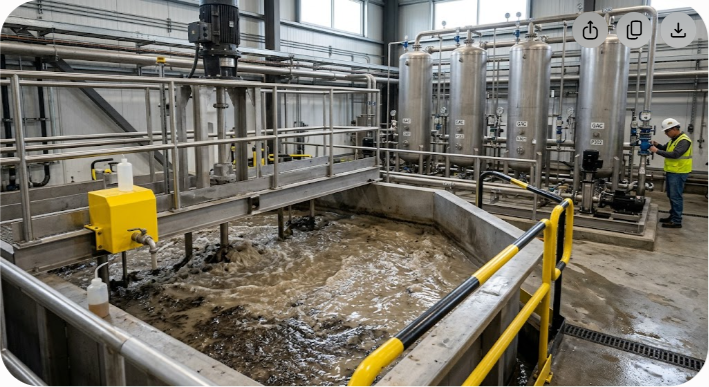
Bentonite and activated carbon are not interchangeable water-treatment media. The better choice depends on what is in the water and what the treatment system must remove. Activated carbon is generally the stronger option for many dissolved organic contaminants, taste and odor compounds, and certain trace chemicals. Bentonite is more useful when the treatment challenge involves suspended solids, colloids, some dissolved metal cations, or clarification. In difficult industrial wastewater, using the two in separate treatment stages can make more sense than choosing one over the other.
The distinction matters because the materials work in different ways. Activated carbon provides a highly porous surface that adsorbs dissolved compounds. Bentonite, particularly montmorillonite-rich clay, provides negatively charged mineral surfaces and expandable interlayers that support cation exchange, adsorption, and particle aggregation. Its usefulness in wastewater treatment depends strongly on mineral composition, dosage, pH, contaminant chemistry, and whether the clay is being used as a conventional bentonite, a modified clay, or as part of a formulated treatment process.
For that reason, there is no universal rule that bentonite is better for industrial water or that activated carbon is better for every dissolved contaminant. The right comparison starts with the water matrix, not the media price. This guide explains the chemistry, operating differences, contaminant-specific performance, treatment configurations, economics, and practical selection criteria engineers should consider before choosing either material.
Before comparing performance, it helps to separate three terms that are often used interchangeably but describe different processes.
Adsorption occurs when a contaminant accumulates on the surface of a solid. Activated carbon is a classic adsorbent, with contaminants occupying sites throughout its extensive pore network.
Absorption occurs when a substance enters the bulk of another material. In water treatment, the term is sometimes used loosely when describing contaminant uptake into a porous or swollen material. For bentonite, however, it is more accurate to discuss adsorption, ion exchange, interlayer hydration, and flocculation rather than treating all uptake as simple absorption.
Cation exchange occurs when positively charged ions held by a clay mineral are exchanged with other cations in the surrounding solution. Montmorillonite-rich bentonite has a substantial cation exchange capacity, although the actual value varies with mineral composition and testing method.
These distinctions are important because they determine which contaminants each material can handle effectively.
Activated carbon is produced from carbonaceous feedstocks such as coconut shells, wood, or coal and then activated to create a highly developed pore structure. Depending on the manufacturing process and feedstock, the resulting material can contain micropores, mesopores, and macropores.
Water treatment relies primarily on adsorption. Dissolved molecules move through the carbon structure and interact with the internal pore surfaces. Several forces can contribute, including dispersion interactions, hydrophobic interactions, pore-filling effects, and, depending on the carbon and contaminant, specific chemical interactions with surface functional groups.
The enormous internal surface area often associated with activated carbon is useful, but surface area alone does not determine treatment performance. Pore-size distribution, surface chemistry, contaminant concentration, pH, temperature, dissolved organic matter, contact time, and competing compounds all influence adsorption capacity.
This is why two activated carbons with similar headline surface-area values can perform quite differently in the same wastewater.
Bentonite is a clay material dominated by smectite minerals, particularly montmorillonite. Montmorillonite has a 2:1 layered structure in which an alumina- or magnesia-rich octahedral sheet sits between two silica-rich tetrahedral sheets.
Substitution of ions within the mineral lattice creates a net negative layer charge. Exchangeable cations such as sodium, calcium, magnesium, and potassium balance that charge in the spaces between the layers. When the clay contacts water, these interlayer cations and the clay structure interact strongly with water, producing hydration and, depending on the clay's chemistry, substantial swelling.
That structure gives bentonite several useful treatment functions:
One important correction to a common claim is that bentonite should not automatically be described as a universal coagulant or as a material that simply neutralizes every colloidal charge. Treatment performance depends on the wastewater chemistry and process design. Jar testing is usually the appropriate way to establish the required dose and settling behavior.
| Parameter | Bentonite Clay | Activated Carbon |
|---|---|---|
| Primary treatment mechanisms | Cation exchange, surface interactions, particle capture, swelling | Adsorption within a developed pore structure |
| Strongest applications | Clarification, selected metal-ion removal, particle capture, some oil and color treatment with suitable clay grades | Dissolved organic contaminants, taste and odor, chlorine, many VOCs and pesticides |
| Typical physical forms | Powder, granules, slurry | GAC, PAC, pellets or specialty forms |
| Surface area | Much lower than activated carbon in conventional dry-material comparisons | Often hundreds to more than 1,000 m2/g, depending on grade and test method |
| Cation exchange capacity | Significant for montmorillonite-rich bentonite; varies by grade | Generally low compared with swelling clays |
| High-turbidity feed | Can be incorporated into clarification systems | Usually requires upstream solids removal to protect the carbon bed |
| Dissolved organic micropollutants | Usually limited for untreated natural bentonite | Often highly effective when carbon and contaminant are well matched |
| Dissolved metal ions | Can provide ion exchange and surface uptake; performance varies | Generally limited for unmodified carbon; specialty carbons can improve metal uptake |
| Regeneration | Generally not regenerated like activated carbon | GAC can often be thermally reactivated, depending on the application |
| Sludge generation | Powdered bentonite treatment can create additional solids | Usually lower solids generation when GAC is used as a fixed bed |
| Best selection method | Jar tests and contaminant-specific trials | Isotherm, pilot, or column testing where appropriate |
Activated carbon is most useful when the treatment objective involves dissolved contaminants that can diffuse into and bind to its pore network. It is particularly common as a polishing step after upstream clarification and filtration.
Activated carbon contains a distribution of pore sizes rather than one uniform pore network.
The most suitable pore structure depends on the contaminant. A carbon selected for a small organic molecule may not be the best choice for a large dissolved organic compound. Surface chemistry matters too, particularly when the contaminant is polar or when the water contains a high concentration of competing organic matter.
Activated carbon is commonly used in two forms.
Granular activated carbon (GAC) is placed in fixed beds, contactors, or filter vessels. Water flows through the carbon, allowing dissolved contaminants to adsorb onto the media. GAC is well suited to continuous treatment and can sometimes be removed and regenerated or replaced when exhausted.
Powdered activated carbon (PAC) is dosed directly into a process stream or treatment tank. After contact, the carbon must normally be separated from the treated water, often together with coagulated solids. PAC is useful when treatment demand changes over time or when operators need flexibility without installing a permanent carbon bed.
Activated carbon performs best when the target contaminants can reach its adsorption sites. Several factors can interfere with that process.
Suspended solids and oil: High solids and free oil can foul GAC beds, increase pressure drop, and interfere with contaminant transport. Pretreatment is therefore important for dirty industrial wastewater.
Competing organic matter: Natural organic matter and other dissolved compounds compete for adsorption sites. A carbon bed treating a complex wastewater may reach breakthrough sooner than laboratory tests with a single contaminant would suggest.
pH and water chemistry: Adsorption can change significantly with pH and contaminant speciation. Ionizable compounds may behave very differently at different pH values.
Breakthrough: A carbon bed does not remove a contaminant indefinitely. Once adsorption sites become occupied, the contaminant concentration in the effluent begins to rise. Monitoring and breakthrough testing are essential for determining replacement or regeneration intervals.
Bentonite is most useful when its mineral properties match the treatment objective. It should not be treated as a direct substitute for activated carbon in every application.
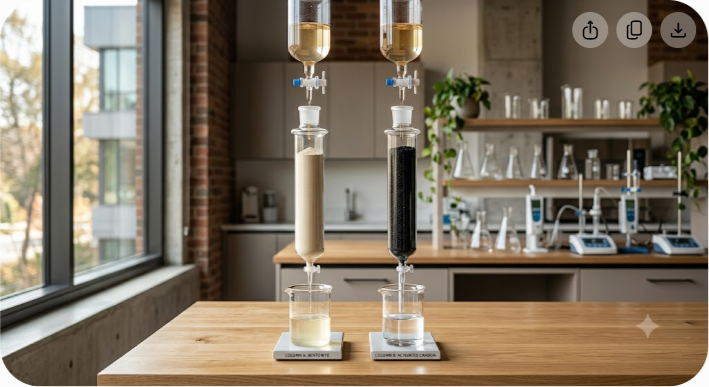
The dominant exchangeable cation influences the hydration and swelling behavior of bentonite.
Sodium bentonite generally has greater swelling capacity than calcium bentonite. In suitable water chemistry, hydration separates clay layers and produces a viscous suspension. This property makes sodium bentonite useful in applications where swelling, suspension stability, or mineral surface area is important.
Calcium bentonite generally swells less because divalent calcium ions interact differently with the clay layers. Its lower swelling behavior can be advantageous in some applications, while acid-activated calcium-rich clays are widely used in bleaching-earth applications.
The exact performance of either material depends on mineralogy and processing. It is therefore better to compare products using measured parameters such as montmorillonite content, cation exchange capacity, moisture, particle-size distribution, swelling index, and application-specific test results rather than relying only on the label sodium or calcium bentonite.
Montmorillonite's negative layer charge allows exchangeable cations to move between the clay and surrounding water. Dissolved metal ions can therefore interact with the clay through ion exchange and surface processes.
A simplified representation for a divalent metal such as lead is:
This equation is useful for illustrating the exchange process, but real wastewater treatment is more complicated. Metal removal may also involve precipitation, surface complexation, adsorption, and incorporation into treatment sludge. The final removal percentage depends on pH, alkalinity, competing ions, initial concentration, clay dose, mixing, and contact time.
For that reason, it is not accurate to promise that bentonite will reduce every metal to a particular parts-per-billion concentration or that the resulting metal-bearing sludge will always pass a leaching test. Those outcomes must be verified experimentally and against the applicable disposal requirements.
Fine clay minerals can participate in clarification and flocculation processes, but bentonite itself is also a fine suspended solid. Depending on the water chemistry, adding too much clay can increase residual turbidity rather than reduce it.
In industrial treatment, bentonite may be used alongside coagulants or polymers to improve particle capture, settling, or filtration. The optimum dose is highly wastewater-specific. A simple jar test can compare different bentonite grades and dosages before full-scale implementation.
Conventional bentonite is hydrophilic and is not automatically an efficient sorbent for non-polar oil. For hydrocarbon-rich wastewater, organoclays are often more relevant. These are clays modified with organic cations so that their surfaces become more compatible with hydrophobic compounds.
Organoclays can be used for oil and hydrocarbon treatment, but their capacity and suitability depend on the product, hydrocarbon type, competing contaminants, and process configuration. Claims such as a fixed percentage oil-uptake capacity should therefore be supported by product-specific testing rather than treated as a universal property of bentonite.
The most useful comparison is not simply which material is cheaper. It is which material has a credible removal mechanism for the contaminant that matters.
Bentonite: Bentonite can remove or reduce concentrations of cationic metals through ion exchange and surface interactions. It can be particularly useful as part of a broader precipitation and clarification process. Performance varies considerably with pH and competing ions.
Activated carbon: Conventional activated carbon is not normally the first choice for dissolved heavy-metal removal. Specialty or chemically modified carbons can be designed for particular metals, but they should be evaluated separately from standard GAC or PAC.
Practical choice: For metal-bearing industrial wastewater, test bentonite alongside chemical precipitation, hydroxide or sulfide precipitation, ion exchange, or other appropriate technologies rather than assuming bentonite alone will meet the discharge limit.
Activated carbon: Activated carbon is generally the stronger option for many dissolved organic compounds, including numerous VOCs, pesticides, solvents, taste-and-odor compounds, and other micropollutants. Performance depends on the carbon grade and contaminant properties.
Bentonite: Natural bentonite usually has limited affinity for many non-polar dissolved organics. Modified clays can provide stronger interactions with hydrophobic compounds, but they should not be assumed to perform like activated carbon.
Practical choice: Use activated carbon when trace dissolved organic removal is the primary treatment objective and testing confirms suitable adsorption capacity.
Bentonite: Conventional bentonite may contribute to clarification or emulsion treatment under suitable conditions, while organoclay is specifically engineered for hydrophobic contaminants.
Activated carbon: Free oil can foul carbon surfaces and reduce effective bed capacity. Removing free and emulsified oil upstream is generally preferable to sending an oil-rich stream directly to GAC.
Practical choice: Use oil separation, dissolved-air flotation, coagulation, organoclay, or other suitable pretreatment before activated carbon where necessary.
Bentonite: Bentonite can be incorporated into coagulation and clarification systems to help capture fine particles. Its success depends on the chemistry and dose.
Activated carbon: GAC is not a primary solids-removal medium. High suspended-solids loading can cause rapid fouling and pressure loss in fixed beds.
Practical choice: Clarify and filter high-solids water before GAC contactors.
Activated carbon: Activated carbon is widely used to reduce taste- and odor-causing organic compounds and to remove free chlorine. Specific compounds and water conditions determine the required carbon type and contact time.
Bentonite: Natural bentonite is not a substitute for activated carbon when the primary target is dissolved taste-and-odor compounds or chlorine.
Practical choice: Activated carbon is usually the more appropriate medium for these objectives.
Activated carbon can remove some PFAS compounds, but performance depends on chain length, functional group, carbon type, background organic matter, and operating conditions. Short-chain compounds can be more difficult to adsorb than long-chain compounds.
Bentonite should not be presented as a universal PFAS treatment medium. Where PFAS removal is required, treatment should be based on contaminant-specific testing and applicable regulatory requirements.
Different industrial streams call for different treatment trains. The examples below illustrate how the two media can fit into broader systems.
Mining wastewater may contain suspended minerals, dissolved metals, acidity, salts, and process chemicals. A single media rarely addresses all of these contaminants.
A practical treatment train may combine pH adjustment, chemical precipitation, coagulation and flocculation, clarification, filtration, and, where appropriate, bentonite or other sorbents. Activated carbon can be added later if dissolved organic contaminants remain.
Best approach: Treat the metal and solids load first. Use bentonite where testing shows it improves metal capture or clarification, rather than relying on it as the sole treatment step.
Electroplating rinse water can contain nickel, copper, zinc, chromium, and other contaminants. Some metals are present as dissolved ions, while others may be associated with particles or complexing agents.
Chemical precipitation and pH control are often central to treatment. Bentonite may assist solids capture or provide additional ion-exchange capacity, but it should be validated against the specific wastewater. Complexed metals may require additional treatment because simple clay exchange may not provide sufficient removal.
Best approach: Use bentonite as a complementary treatment where jar or bench testing demonstrates a benefit; do not assume it replaces established precipitation or ion-exchange processes.
Textile wastewater can contain dyes, surfactants, suspended solids, salts, auxiliaries, and substantial organic loads. Bentonite and modified clays can interact with some dyes, particularly charged dye molecules, while activated carbon can provide additional dissolved-organic and color removal.
Best approach: A combined process can be useful when preliminary clarification or clay treatment reduces the bulk contaminant load before activated carbon polishing. Coagulation, biological treatment, oxidation, membrane processes, or other technologies may also be appropriate depending on the wastewater.
Oil-containing streams require careful pretreatment. Free oil and high solids can rapidly foul downstream adsorption beds.
Oil-water separation, flotation, filtration, organoclay, and other hydrocarbon-removal technologies can be placed upstream of activated carbon where dissolved hydrocarbons remain a concern. Organoclay can be useful for selected hydrocarbon streams, but its performance should be confirmed with actual produced water.

Best approach: Remove free and emulsified oil before considering GAC for dissolved organic polishing.
Activated carbon has a well-established role in drinking-water treatment for taste and odor compounds, natural organic matter, pesticides, and other adsorbable contaminants. PAC can be used for seasonal or variable contaminant loads, while GAC contactors provide continuous treatment.
Bentonite is not normally a direct replacement for activated carbon in this role. Clay minerals may appear elsewhere in drinking-water treatment processes, but the choice must comply with drinking-water regulations and approved treatment-material requirements.
Best approach: Use activated carbon when adsorption is the required treatment mechanism and verify the carbon against the target contaminants and source-water chemistry.
Media price is only one part of treatment economics. A lower-cost material can become expensive if it requires high dosages, generates difficult sludge, or fails to meet the required effluent specification.
Bentonite is generally less expensive per unit mass than activated carbon, but treatment cost depends on grade, processing, dosage, freight, solids handling, and disposal. Powdered treatment also creates additional solids that must be separated and managed.
For that reason, a meaningful cost comparison should use cost per volume of water treated to the required effluent quality, not simply cost per metric ton of media.
GAC generally has a higher purchase price, but it can provide substantial adsorption capacity for suitable dissolved contaminants. Depending on the application, spent GAC may be regenerated or replaced. Regeneration economics depend on transport, carbon type, contaminant loading, attrition, and the regeneration service.
PAC has different economics because it is normally consumed and removed with the treatment solids rather than recovered as a fixed-bed medium.
Bentonite-based treatment can generate mineral sludge. If the clay captures regulated metals or other hazardous constituents, the resulting waste must be characterized under the applicable local requirements before disposal or reuse.
It is not safe to assume that metal-loaded bentonite will automatically pass a leaching test or qualify for beneficial reuse. Waste classification should be based on actual analytical results and the regulations governing the facility.
Many industrial wastewater streams contain more than one contaminant class. A treatment system might have to handle suspended solids, oil, dissolved metals, color, and trace organic chemicals in the same flow.
In such cases, separating the treatment functions often works better than forcing one medium to do everything.
This arrangement protects the carbon bed from unnecessary fouling and reserves its adsorption capacity for contaminants it is designed to capture.
The advantage is process specialization. Bentonite or another mineral treatment step can address solids and selected ionic contaminants, while activated carbon handles dissolved compounds that are better suited to adsorption.
However, claims that a hybrid system automatically extends carbon life by a specific percentage should be avoided without pilot data. The improvement depends on influent quality, pretreatment efficiency, carbon type, hydraulic loading, contact time, and the contaminant mixture.
A reliable selection process begins with measurement rather than assumptions.
At minimum, establish the concentrations and variability of the contaminants that matter to the treatment objective. Depending on the application, this may include:
Do not choose a treatment medium solely from a general wastewater category such as textile, mining, or metal finishing. Two plants in the same industry can have very different wastewater chemistry.
The required outlet concentration is just as important as the inlet concentration. A process designed to reduce a contaminant by 50 percent is very different from one that must reliably achieve a trace-level discharge limit.
Review the applicable discharge permit, reuse specification, drinking-water standard, or internal process requirement before selecting media.
For bentonite-based treatment, jar tests can compare clay type, dosage, pH, mixing conditions, settling time, and sludge characteristics.
For activated carbon, batch adsorption testing can provide useful screening information, while column or pilot testing is often more representative for continuous GAC systems. The testing should use actual wastewater whenever possible because competing contaminants can substantially change adsorption behavior.
Include all major operating costs:
The lowest media price is not necessarily the lowest treatment cost.
Activated carbon can have a dramatically higher measured surface area than bentonite, but that does not mean it will remove every contaminant more effectively. Adsorption depends on molecular properties, pore structure, surface chemistry, and competition in the water.
Likewise, a high cation exchange capacity does not mean bentonite will remove every dissolved contaminant. Non-ionic and weakly interacting compounds may remain largely unaffected.
GAC should not be treated as a replacement for solids separation. High turbidity, free oil, and biological growth can reduce bed performance and increase pressure drop.
Proper pretreatment usually makes the carbon stage more predictable and economical.
Bentonite can contribute to metal removal, but industrial metal treatment often depends on precipitation chemistry, pH, complexation, competing ions, and sludge separation. A bench test should demonstrate that the proposed clay dose can meet the actual target.
Bentonite products differ in mineral composition, swelling behavior, particle size, exchange capacity, moisture, and processing. A drilling-grade bentonite is not automatically the correct product for wastewater treatment.
Ask for application-specific specifications and test the selected grade against the actual wastewater.
A cheap material can generate expensive sludge. A more expensive carbon can be economical if it lasts substantially longer and reliably removes the target contaminant. Compare the entire treatment train instead of the purchase price alone.
Laboratory results are useful for screening, but full-scale hydraulic behavior, contaminant competition, sludge properties, and carbon breakthrough can differ significantly. Pilot testing becomes particularly valuable when the treatment system is large, the discharge limit is stringent, or the wastewater composition changes substantially over time.
For clay-based treatment, consistent raw-material quality matters. Important specifications can include montmorillonite content, cation exchange capacity, swelling index, moisture, particle-size distribution, pH, and chemical composition.
A supplier should also be able to provide a current technical data sheet and, where appropriate, batch-specific quality information. Application testing is still necessary because a material that performs well in one wastewater may behave differently in another.
Industrial mineral suppliers such as Axewelledge can be evaluated on the same basis: consistency of mineral quality, processing controls, technical documentation, supply capacity, and the ability to provide a grade suited to the intended application. Claims about reserves, treatment performance, or guaranteed removal should be supported by current documentation and application-specific test data rather than treated as universal properties.
The choice between bentonite and activated carbon becomes much clearer once the treatment objective is defined.
The key question is not whether bentonite or activated carbon is the better material in general. It is which treatment mechanism matches the contaminants in your water, the required effluent quality, and the operating conditions of the plant. In many industrial systems, the best answer is a properly tested combination of pretreatment, targeted contaminant removal, clarification, and activated-carbon polishing.













Have questions about our products? We're here to help!