Axewelledge, a leading exporter from India, specializes in high-quality Bentonite. With a commitment to excellence, we supply premium Bentonite to the Middle East and Southeast Asia markets.


North Angle Complex, 304,
150 Feet Ring Rd, Opposite Ambedkar Nagar BRTS Stop,
Madhav Park, Punit Nagar,
Mavdi, Rajkot, Gujarat 360004
© Axewelledge 2026, All Rights Reserved.
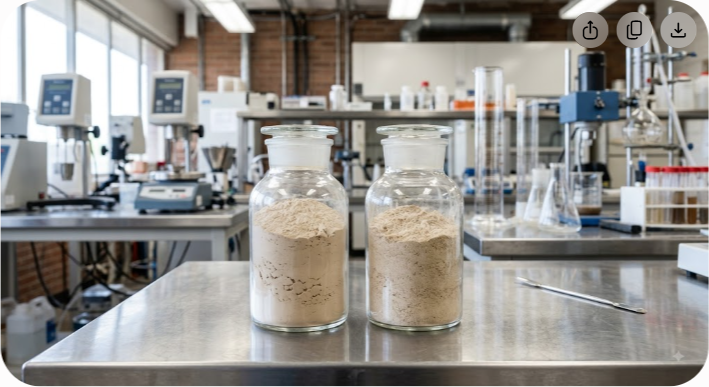
Bentonite is generally the better choice for freshwater drilling when you need strong viscosity, suspension, and filtration control. Attapulgite becomes the more practical choice when the drilling fluid contains seawater, concentrated brine, or other high-salinity fluids that can severely reduce the performance of ordinary sodium bentonite.
That distinction is the starting point for any useful Bentonite vs Attapulgite comparison. Neither clay is universally better. They build rheology in different ways, respond differently to dissolved salts and hardness, and solve different drilling-fluid problems.
For most freshwater water-well, horizontal directional drilling (HDD), and conventional water-based mud applications, sodium bentonite offers the combination of hydration, gel strength, suspension, and filter-cake formation that operators want. In saline systems, attapulgite can provide viscosity and suspension where a hydration-dependent bentonite system would need substantial chemical treatment or a different fluid design.
The right selection therefore depends on the water chemistry, formation conditions, required rheology, temperature, filtration target, and the rest of the mud formulation.
| Property | Sodium Bentonite | Attapulgite (Salt Gel) |
|---|---|---|
| Mineral group | Smectite, mainly montmorillonite | Palygorskite, also called attapulgite |
| Particle morphology | Thin, platy particles | Fibrous, elongated particles |
| Main viscosity mechanism | Hydration and platelet dispersion | Mechanical dispersion and fiber entanglement |
| Freshwater performance | Excellent | Useful, but usually not the first choice |
| Saltwater performance | Limited without treatment | Strong |
| Response to calcium and magnesium | Sensitive | More tolerant |
| Filtration control | Strong when properly dispersed | Limited by the clay itself |
| Filter-cake formation | Good | Poor compared with bentonite |
| Suspension | Strong | Strong, particularly in saline systems |
| Typical role | Primary viscosifier and filtration-control clay | Saltwater viscosifier and suspension aid |
| Common applications | Water wells, HDD, freshwater drilling, civil drilling | Seawater and brine systems, salt formations, selected high-temperature applications |
The important point is that these properties are not simply two versions of the same clay. Their mineral structures produce different behavior in a drilling fluid.
Sodium bentonite is a smectite clay dominated by montmorillonite. Its particles are made up of very thin layers with a large surface area relative to their mass. When sodium bentonite is properly dispersed in fresh water, water enters the spaces associated with the clay layers and causes the particles to hydrate and separate.
That hydration creates a dispersed suspension with useful rheological properties. The clay can increase low-shear viscosity, develop gel strength when circulation stops, and contribute to a relatively low-permeability filter cake on a permeable formation.
This combination explains why sodium bentonite remains one of the most widely used clays in water-based drilling fluids.
The performance of bentonite starts with hydration and dispersion. A simplified sequence looks like this:
The result is a drilling fluid that can transport cuttings through the annulus while keeping suspended solids from settling rapidly when circulation is interrupted.
The actual performance depends on much more than the name on the bag. Bentonite source, particle-size distribution, solids concentration, hydration time, mixing energy, water chemistry, temperature, and contaminants all affect the final mud properties.
One of bentonite's biggest advantages is filtration control. In a permeable formation, pressure can force liquid from the drilling fluid into the formation. Properly dispersed bentonite particles can accumulate against the formation face and form a relatively thin, low-permeability filter cake.
That cake helps limit filtrate invasion and can support borehole stability. It is especially valuable in applications such as HDD and water-well drilling, where maintaining the integrity of the borehole and controlling fluid loss are important.
Attapulgite does not provide the same filtration-control mechanism. This is one of the clearest practical differences between the two clays.
A properly formulated bentonite mud can show thixotropic behavior: its apparent structure changes with shear and time. During circulation, shear reduces the resistance to flow. When circulation stops, the mud can rebuild gel strength and help suspend cuttings and weighting material.
That behavior is useful, but it needs to be controlled. Excessive gel strength can make starting circulation difficult, increase equivalent circulating density, and complicate solids control. Good mud design is therefore about achieving the required rheology, not simply maximizing viscosity.
The main weakness of ordinary sodium bentonite is its sensitivity to water chemistry.
Freshwater allows sodium bentonite to hydrate and disperse effectively. Increasing concentrations of dissolved electrolytes compress the electrical double layer around clay particles and reduce the repulsive forces that help keep the particles separated. Divalent ions such as calcium and magnesium can be particularly disruptive.
The result can be flocculation, changes in rheology, increased filtration, and poorer filter-cake quality.
This does not mean that bentonite can never be used in saline water. It means the mud designer has to account for the salinity and hardness rather than assuming that freshwater performance will carry over unchanged. Chemical treatment, dilution, specialized products, polymers, or a different clay system may all be considered depending on the application.
The commonly repeated claim that bentonite simply "stops working" at one fixed salt concentration is too absolute. Performance changes progressively with water chemistry, clay quality, concentration, treatment, and test conditions. There is no single universal cutoff at which every bentonite mud suddenly becomes unusable.
Attapulgite, commonly associated with the mineral name palygorskite, has a fibrous crystal morphology rather than the platy morphology of smectite. Its elongated particles can disperse under shear and form a network within the liquid.
This structure gives attapulgite a useful role in saltwater and brine-based drilling fluids. Unlike sodium bentonite, it does not depend on the same degree of osmotic swelling and platelet dispersion to generate viscosity.
For that reason, attapulgite can maintain useful rheological behavior in water containing high concentrations of dissolved salts.
Attapulgite is often described as a mechanical or fiber-network viscosifier. During mixing and shear, bundles of the mineral can become more dispersed. The elongated particles then interact to create a three-dimensional structure throughout the fluid.
The basic process can be described as follows:
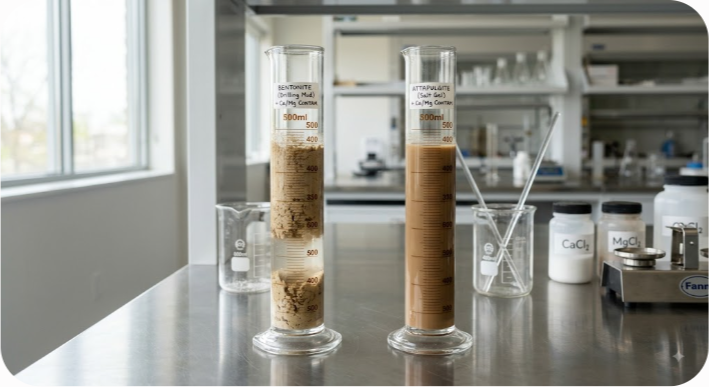
The mechanism is different from the hydration-driven swelling of bentonite. That difference is precisely why attapulgite is useful when high salinity makes conventional bentonite difficult to manage.
Dissolved salts still affect any drilling fluid, but attapulgite's viscosity mechanism is less dependent on the electrical repulsion and osmotic swelling that make smectite so sensitive to electrolyte concentration.
As a result, attapulgite is widely associated with saltwater drilling fluids and salt-gel systems. It can be used in seawater and other saline systems where the objective is to build viscosity and suspension without relying on conventional bentonite hydration.
That does not make attapulgite chemically immune to every contaminant. The complete mud system still has to be designed for the brine composition, solids loading, temperature, polymers, weighting materials, and other additives.
This is one of the most important distinctions in a drilling clay comparison.
Attapulgite can provide viscosity and suspension, but it should not be treated as a direct substitute for bentonite's filtration-control function. Its fibrous network does not normally create the same dense, low-permeability filter cake produced by well-dispersed bentonite.
If fluid-loss control is required in a saltwater system, the formulation may need additional additives such as starch, CMC, PAC, or other fluid-loss-control materials selected for the specific mud chemistry and temperature.
The exact additive package should be based on laboratory testing rather than a fixed recipe. A polymer that works well in one brine can perform very differently in another because salt concentration, hardness, temperature, pH, and solids content all influence polymer behavior.
For freshwater drilling, bentonite usually has the advantage. Its hydration and dispersion characteristics make it effective at building viscosity and gel strength while also contributing to filtration control.
This is why sodium bentonite is common in water-well drilling, HDD, and other applications where the mixing water has relatively low salinity and hardness.
Attapulgite can be dispersed in freshwater, but its main commercial advantage is not freshwater filtration control. Using it where bentonite already performs well may add complexity without solving a real problem.
For saline drilling fluids, attapulgite generally has the advantage.
Seawater, brackish water, and concentrated brines contain dissolved ions that can interfere with bentonite hydration and dispersion. Attapulgite's fiber-network mechanism makes it better suited to these conditions.
This is particularly relevant when the water source cannot be replaced economically. Instead of trying to force a freshwater clay to behave like a saltwater clay, the mud designer can select a mineral whose rheological mechanism is better matched to the fluid chemistry.
Calcium and magnesium deserve special attention because divalent ions can strongly affect smectite-based muds. Cement contamination, formation water, hard makeup water, and other sources can increase calcium concentration.
Bentonite systems may require treatment when hardness rises. Attapulgite is generally more tolerant of these saline conditions, although the complete fluid still needs monitoring.
Do not judge the system from chloride concentration alone. Two fluids with similar salinity can behave differently if their calcium, magnesium, pH, and other chemical characteristics differ.
Both clays can contribute to cuttings suspension, but the required rheological profile depends on the well geometry and drilling conditions.
Bentonite can provide strong low-shear viscosity and gel strength in freshwater systems. This helps keep cuttings suspended during low-flow periods and supports transport through the annulus.
Attapulgite can provide useful yield behavior in saline systems, making it valuable where a brine mud still needs to suspend drilled solids or weighting material.
The best hole-cleaning fluid is not necessarily the one with the highest viscosity. Excessive viscosity can increase pump pressure, reduce hydraulic efficiency, and complicate solids control. Operators should target the rheology required for the well rather than treating maximum viscosity as the goal.
Bentonite has a clear advantage when filtration control is a primary requirement. Its dispersed platelets can form a compact filter cake that limits filtrate loss into permeable formations.
Attapulgite alone is not a comparable filtration-control material. In saltwater systems, fluid-loss additives are often used alongside the clay to provide the required filtration performance.
This difference is especially important in formations where excessive filtrate invasion could destabilize the wellbore or interfere with the drilling objective.
Temperature can change the behavior of every water-based drilling fluid. Bentonite performance can deteriorate as temperature increases, particularly when exposure is prolonged and the system is also affected by salinity, contamination, or other chemical stresses.
Attapulgite is often selected for higher-temperature applications because its fibrous mineral structure remains useful under conditions where conventional bentonite systems become increasingly difficult to manage.
However, it is misleading to assign a single temperature limit to either mineral. Actual high-temperature performance depends on the complete mud formulation and exposure history. Laboratory aging tests at the expected bottomhole temperature provide a much better basis for selection than a generic temperature number printed in a comparison chart.
For geothermal drilling, in particular, the complete fluid system should be evaluated for rheology, filtration, thermal aging, corrosion, solids control, and compatibility with formation conditions.
Water-well drilling commonly benefits from bentonite because the mud may need to transport cuttings, stabilize the borehole, and limit fluid loss. Where the makeup water has suitable chemistry, bentonite can provide these functions in one mineral-based system.
The operator should still test the actual water before mixing large volumes. Hard or contaminated water can change bentonite performance significantly.
HDD often places a strong emphasis on borehole stability, cuttings transport, lubrication, and fluid-loss control. A properly hydrated bentonite drilling fluid can address several of these needs at the same time.
The formulation should be adjusted for formation type. A sandy formation, for example, can create very different fluid-loss demands from a cohesive clay formation. Excessive viscosity can also make pumping and returns management harder, so the mud should be designed around the drilling conditions rather than a fixed bentonite concentration.
Seawater contains substantial dissolved salts, so a conventional freshwater bentonite system cannot simply be mixed into seawater and expected to deliver the same rheology.
Attapulgite is well suited to saltwater viscosification because its performance does not depend on the same hydration mechanism. Fluid-loss control, however, normally requires separate consideration and may involve polymers or other additives.
Drilling through evaporite or salt-bearing formations can expose the mud system to substantial salinity. In these conditions, attapulgite can provide a useful viscosity base for saline fluids.
The final mud design still needs to address shale stability, filtration, solids loading, density, and any interaction between the drilling fluid and formation fluids. Clay selection is only one part of the system.
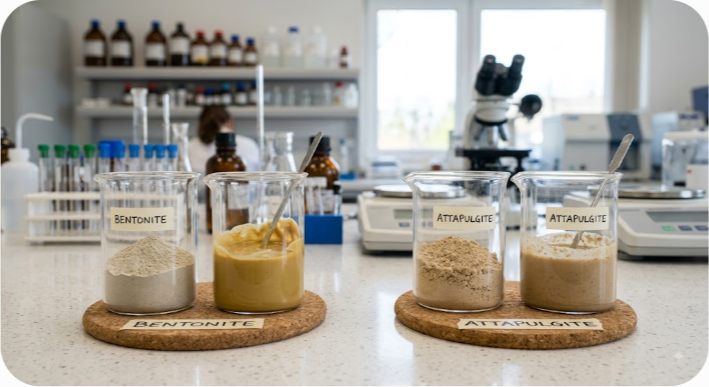
High-temperature geothermal drilling puts considerable stress on water-based mud systems. Attapulgite can be useful when the formulation requires a mineral viscosifier that tolerates saline and elevated-temperature conditions.
It should not be selected solely because a product brochure lists a high temperature. The finished mud should be hot-rolled or otherwise aged under representative conditions and then tested for rheology and filtration before field use.
API Specification 13A is an important reference when purchasing drilling-fluid materials for oil and gas applications. It covers several drilling-fluid materials, including bentonite and attapulgite, with defined testing and quality requirements.
When evaluating an API-grade product, check the current edition of the specification and the applicable product section rather than relying on an old data sheet or historical section number. API has issued revisions, addenda, and errata over time, so specifications should always be verified against the current published standard.
For bentonite, relevant API requirements include performance characteristics such as rheology, filtration, moisture, and residue, depending on the product classification. For attapulgite, the specification evaluates performance under saline test conditions appropriate to its intended use.
A supplier's claim that a material is "API compliant" should also be supported by current technical documentation, a certificate of analysis, and traceable quality-control testing. Buyers should distinguish between a product that was tested against an API specification and a manufacturer that is currently licensed to use the API Monogram.
Before purchasing sodium bentonite for a drilling project, ask for:
For large-volume projects, it is also sensible to test a representative sample with the actual makeup water before committing to a full shipment.
For attapulgite or salt-gel products, ask for:
These checks matter because two products sold under the same broad mineral name can have noticeably different performance depending on mineral purity, particle-size distribution, processing, and manufacturing controls.
The water is part of the drilling-fluid formulation. Testing clay without testing the makeup water can produce misleading results.
Measure salinity, hardness, pH, and other relevant properties before selecting the primary viscosifier. A bentonite that performs well in clean freshwater may behave very differently in hard groundwater.
Seawater is not simply freshwater with a little extra salt. Its ionic composition can materially change clay hydration, polymer performance, filtration, and rheology.
If seawater is the intended base fluid, test the actual water or a representative synthetic brine rather than assuming freshwater laboratory results will apply.
Attapulgite can provide valuable viscosity in saline fluids, but it does not automatically provide the compact filter cake associated with a well-dispersed bentonite system.
If fluid loss is a concern, select and test a compatible fluid-loss-control package as part of the complete formulation.
More viscosity is not always better. A mud that is unnecessarily viscous can require more pump pressure and make solids removal more difficult.
Focus on the rheological properties needed for cuttings transport, suspension, pressure management, and wellbore stability. The target should be fit-for-purpose rheology, not the highest possible number on a viscometer.
A mineral's stated temperature tolerance does not automatically represent the temperature limit of the complete drilling fluid.
High-temperature testing should include the finished formulation. Salts, polymers, weighting agents, contaminants, and exposure time can all change the result.
The lowest purchase price does not necessarily produce the lowest drilling-fluid cost.
A lower-cost clay may require a higher concentration, additional polymers, more treatment, or more frequent correction of mud properties. Compare cost per unit of required performance rather than cost per bag alone.
A straightforward selection process can prevent most clay-related formulation problems.
This approach is more reliable than selecting a clay from a single specification number.
They can be used in the same overall drilling-fluid strategy, but combining them is not automatically better than choosing one primary clay.
Bentonite can contribute filtration control and freshwater rheology, while attapulgite can help maintain viscosity when salinity increases. In a changing drilling environment, a formulation may use different materials as conditions change.
However, blending clays changes the rheology and solids characteristics of the fluid. The mixture should therefore be evaluated in the actual water chemistry rather than assumed to deliver the sum of the two materials' individual benefits.
If the system moves from freshwater into saline conditions, it may be more practical to redesign the fluid than simply add increasing quantities of both clays. Polymer treatment and filtration-control requirements also need to be considered.
The economics of drilling clay depend on more than the price per metric ton.
For freshwater drilling, bentonite can be economical because a properly hydrated product can provide viscosity, suspension, and filtration control with relatively few additional materials.
In a saline system, trying to force a conventional bentonite formulation to perform outside its preferred water chemistry can increase treatment requirements. Attapulgite may offer a more suitable base for viscosity in those conditions, although separate filtration-control additives can increase the total formulation cost.
The best comparison is therefore cost per unit of required mud performance. Include clay concentration, chemical treatment, fluid-loss additives, dilution water, waste handling, and the operational consequences of poor rheology when comparing formulations.
The answer to Bentonite vs Attapulgite depends primarily on water chemistry and the job the mud needs to perform.
Choose sodium bentonite when:
Consider attapulgite when:
The key is not to ask which clay is stronger in the abstract. Ask which clay's mineral structure matches the fluid chemistry and drilling conditions in front of you.
For procurement, compare technical data, applicable API requirements, batch consistency, laboratory performance, and delivered cost. A reliable supplier should be able to provide current product specifications, certificates of analysis, and application guidance rather than asking you to choose solely on a price-per-ton basis.
A good drilling clay is one that works with the rest of the fluid system. Match the mineral to the water, formation, temperature, and performance target, then verify the formulation with laboratory testing before taking it into the field.













Have questions about our products? We're here to help!