Axewelledge, a leading exporter from India, specializes in high-quality Bentonite. With a commitment to excellence, we supply premium Bentonite to the Middle East and Southeast Asia markets.


North Angle Complex, 304,
150 Feet Ring Rd, Opposite Ambedkar Nagar BRTS Stop,
Madhav Park, Punit Nagar,
Mavdi, Rajkot, Gujarat 360004
© Axewelledge 2026, All Rights Reserved.
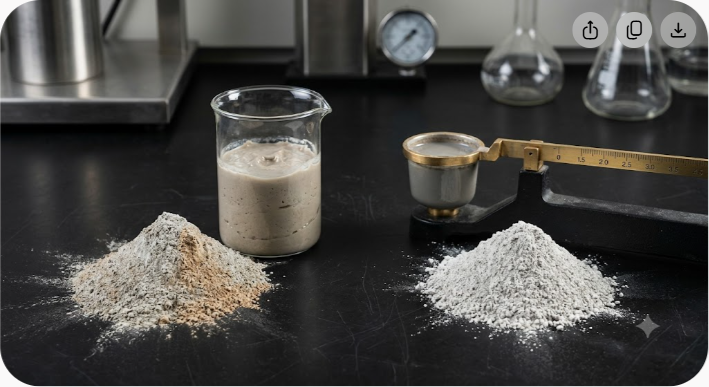
Bentonite and barite do different jobs in a drilling fluid. Bentonite builds rheology and helps control filtration; barite increases mud density and therefore hydrostatic pressure. The practical question isn't which mineral is better. It is how much of each the fluid system needs, and whether the resulting rheology, solids content, density, and filtration properties remain within the operating window.
That distinction matters because adding more bentonite isn't a substitute for a weighting agent, while adding more barite doesn't create the low-permeability filter cake or low-shear carrying capacity that a well-designed mud needs. A drilling fluid can have the correct mud weight and still have poor hole cleaning. It can also have strong gels and acceptable viscosity while failing to provide enough hydrostatic pressure for the formation.
The best formulation balances several properties at once: density, plastic viscosity, yield point, low-shear rheology, gel strength, fluid loss, filter-cake quality, solids concentration, lubricity, and chemical stability. The right balance depends on the well section, formation pressure, temperature, inclination, hole size, drilling rate, and whether the system is water-based or non-aqueous.
The simplest way to distinguish them is by their primary function.
Bentonite is mainly a rheology and filtration-control material. High-quality sodium bentonite hydrates in fresh water and forms a colloidal dispersion. That dispersion contributes to viscosity, yield point, gel strength, suspension, and filter-cake development.
Barite is mainly a weighting material. It is barium sulfate, a high-density mineral that increases drilling-fluid density without requiring the large volume of reactive solids that would be needed to raise density with clay alone.
The two materials can work together, but they should not be treated as interchangeable additives.
| Property | Sodium Bentonite | Barite |
|---|---|---|
| Primary function | Rheology and filtration control | Mud-weight increase |
| Main mechanism | Hydration and colloidal structure | High mineral density |
| Typical specific gravity | About 2.4 to 2.6 | About 4.1 to 4.2 or higher depending on grade and specification |
| Hydrates in fresh water | Yes | No |
| Builds gel strength | Yes | Not directly |
| Helps form filter cake | Yes | Mainly contributes as a larger solid fraction |
| Raises mud density efficiently | No | Yes |
| Main operational concern | Flocculation, contamination, excessive rheology | Sag, excessive solids and increased plastic viscosity |
This difference provides the starting point for nearly every drilling-fluid formulation decision involving the two minerals.
Bentonite is a clay dominated by the smectite mineral montmorillonite. Sodium bentonite is particularly useful in water-based drilling fluids because its plate-like particles interact with water and disperse into a fine colloidal system.
Once hydrated, the clay contributes to a structured fluid that behaves differently at low and high shear rates. Near the bit and through the drillstring, the fluid experiences high shear and should flow without excessive pressure loss. In the annulus, lower shear conditions require enough carrying capacity to transport drilled cuttings toward the surface.
That combination is one reason bentonite remains important in conventional water-based mud systems.
Hydrated bentonite increases the fluid's resistance to flow. More importantly, it contributes to non-Newtonian behavior, so the apparent viscosity changes with shear rate.
A properly formulated system can therefore be relatively easy to circulate through high-shear areas while maintaining useful low-shear carrying capacity in the annulus. The target isn't maximum viscosity. Excessive viscosity can increase pump pressure, raise equivalent circulating density, reduce drilling efficiency, and make solids control more difficult.
For that reason, mud engineers generally adjust bentonite concentration alongside polymer additives, drilled-solids loading, salinity, temperature, and the required rheological profile rather than treating clay concentration as an isolated number.
Yield point is a measure used in common drilling-fluid rheological models to describe the stress required to initiate flow after accounting for plastic viscosity. In practical terms, it provides useful information about the fluid's ability to carry solids under low-to-moderate shear conditions.
Sodium bentonite can contribute significantly to yield point because its hydrated particles form a structured network. The actual response depends on clay quality, concentration, water chemistry, hydration time, temperature, and contamination.
A high yield point isn't automatically desirable. The objective is sufficient low-shear carrying capacity without creating excessive circulating pressure or an unnecessarily thick mud.
When circulation stops, hydrated bentonite particles can form a weak structure that gives the fluid gel strength. That structure helps keep drilled solids suspended during connections and other periods of low circulation.
Gel strength must be controlled carefully. Weak gels can allow solids to settle. Excessively strong or rapidly building gels can make it difficult to restart circulation and may create undesirable pressure surges.
A useful drilling fluid therefore needs a gel profile that provides suspension without behaving like a rigid solid when the pumps are restarted.
Bentonite also contributes to the formation of a filter cake on permeable formations. Under differential pressure, part of the liquid phase can move into the formation while suspended solids remain on the wellbore wall.
Fine, hydrated bentonite particles can pack into a relatively thin, low-permeability cake. A good filter cake reduces filtrate invasion and can help reduce the risk of differential sticking. Filter-cake quality also depends on particle-size distribution, polymers, formation characteristics, solids concentration, and the overall chemistry of the mud system.
It is therefore misleading to think of bentonite as simply a viscosity additive. In a water-based drilling fluid, its contribution can extend across rheology, suspension, filtration control, and wellbore condition.
Barite is a naturally occurring mineral composed primarily of barium sulfate, BaSO4. Its most important drilling-fluid property is its high specific gravity.
A barite particle is much denser than a typical water-based drilling-fluid phase. Adding sufficient barite therefore increases the density of the entire mud system without requiring a comparable volume of clay or other low-density solids.
That makes barite the conventional weighting agent for many drilling-fluid systems.
Hydrostatic pressure from the drilling-fluid column provides an important part of well control. For a simple field calculation in oilfield units:
The mud column generally needs to provide sufficient pressure to control formation fluids while remaining below the pressure at which the exposed formation is likely to fracture. The allowable operating window can become narrow in depleted, weak, deepwater, or otherwise challenging formations.
Barite gives the mud engineer a practical way to increase density within that window.
For metric calculations:
If pressure is required in bar, the corresponding result in kPa must be divided by 100.
Bentonite has a much lower specific gravity than barite. More importantly, hydrated bentonite produces substantial rheological effects as its concentration increases.
Trying to raise mud weight substantially by continuously adding bentonite quickly increases viscosity and solids loading. Long before the fluid reaches the density required for many overbalanced drilling applications, it may become difficult to mix, pump, process, and control.
Barite solves the density problem much more efficiently because a relatively large amount of mass can be added without creating the same level of colloidal structure as additional hydrated clay.
There is still a limit. Excessive barite loading increases total solids and can raise plastic viscosity, pressure losses, and the risk of settling. Weighting a mud is therefore a rheology problem as well as a density problem.
Mineralogy explains why bentonite and barite behave so differently in a mud system.
| Physical property | Sodium Bentonite | Barite |
|---|---|---|
| Main mineral | Montmorillonite-rich smectite clay | Barium sulfate |
| Approximate specific gravity | 2.4 to 2.6 | Typically around 4.1 to 4.2 for drilling grades |
| Water behavior | Hydrates and disperses | Does not hydrate |
| Particle character | Very fine, plate-like particles after dispersion | Dense crystalline mineral particles |
| Primary fluid effect | Rheology, suspension and filtration control | Density increase |
| Solubility | Insoluble as a mineral; forms a colloidal dispersion | Very low solubility |
| Sensitivity to water chemistry | Significant | Relatively low chemically, although dispersion and wetting remain important |
| Main solids-control concern | Reactive and colloidal solids can build rapidly | Loss or accumulation of high-gravity solids |
| Typical failure concern | Flocculation or excessive viscosity | Sag or excessive plastic viscosity |

The values above are general engineering ranges, not substitutes for the specification of a particular commercial product. Actual performance depends on mineral purity, beneficiation, particle-size distribution, testing method, and the drilling-fluid formulation.
Sodium bentonite owes much of its usefulness to the interaction between montmorillonite platelets and water.
The clay layers carry electrical charges that allow water and exchangeable ions to influence the spacing and interaction between particles. In fresh water, sodium-dominated bentonite can hydrate and disperse extensively. The resulting high surface area and particle interactions produce the colloidal behavior required for useful drilling-fluid rheology.
Calcium-rich bentonite generally has lower swelling and hydration behavior in fresh water because divalent calcium ions promote stronger particle association than monovalent sodium under comparable conditions. Calcium contamination can therefore reduce the performance of a sodium-bentonite mud.
Soda ash is commonly used in water-based mud treatment when hardness from calcium is a concern, but treatment should be based on measured water and mud chemistry rather than on a fixed addition rate.
Fresh water provides the most favorable environment for conventional sodium bentonite hydration. Increasing salinity compresses the electrical double layer around clay particles and can reduce the degree of dispersion and swelling.
Divalent ions such as calcium and magnesium can have an even stronger effect on clay behavior. The result can be lower apparent viscosity, changes in gel strength, increased filtration, or a flocculated system, depending on the concentration and the rest of the formulation.
When drilling in saline or chemically aggressive environments, mud designers often rely more heavily on polymers and specialized viscosifiers rather than expecting untreated bentonite to provide the complete rheological package.
Barite is chemically stable under many drilling-fluid conditions, but calling it completely inert can be misleading from an operational perspective. Its physical behavior matters enormously.
Barite is a suspended solid. The larger and denser the particles are, the greater the tendency for them to settle when the fluid does not provide enough carrying capacity.
Particle-size distribution is therefore an important part of barite performance. A suitable distribution can support efficient packing and manageable rheology. Excessive coarse material can increase settling and abrasion, while an excessive fraction of very fine particles can contribute to higher plastic viscosity and make solids control more difficult.
Barite quality should consequently be evaluated using the applicable specification and the requirements of the particular mud system rather than by specific gravity alone.
The difference between bentonite and barite becomes especially clear when looking at hole cleaning.
A drilling fluid must transport cuttings through the annulus while also remaining pumpable. The relevant behavior changes with annular velocity, well inclination, cuttings concentration, pipe rotation, fluid density, temperature, and rheology.
Bentonite contributes to the low-shear structure that helps keep cuttings moving, particularly when annular velocities are limited. It can also provide useful suspension during temporary reductions in circulation.
But simply increasing bentonite concentration isn't a reliable hole-cleaning strategy. If viscosity becomes too high, pressure losses and equivalent circulating density can increase. The resulting mud may be harder to process and can make drilling problems worse rather than better.
Good hole cleaning comes from the combination of appropriate rheology, sufficient annular velocity, suitable density, mechanical pipe movement where applicable, and effective solids control.
Barite's principal contribution is density rather than carrying capacity. By increasing mud weight, it increases hydrostatic pressure and allows the drilling-fluid system to address higher formation pressures.
That doesn't mean barite has no effect on rheology. As high-gravity solids concentration rises, particle interactions increase plastic viscosity and can affect the overall flow profile. The more barite a system contains, the more carefully the mud engineer needs to monitor solids concentration and rheology.
A drilling fluid that loses excessive filtrate can create formation-damage and wellbore-stability problems. The objective is to control filtrate invasion while maintaining a filter cake that is thin, tough, and removable when required.
Bentonite is well suited to this role because its fine, plate-like particles can pack closely on a permeable surface. Polymers may be added to further reduce permeability and improve filter-cake properties.
Barite alone isn't an effective substitute for a properly formulated filtration-control package. Its particles are substantially larger than hydrated clay platelets, so a barite-rich cake without suitable fine solids and polymers can be relatively coarse and permeable.
In a well-designed weighted mud, however, the particle-size distribution of the complete solids system matters. Barite can contribute to the solid framework while fine particles and polymers fill smaller voids.
Water-based mud is where conventional sodium bentonite has its clearest role.
Fresh-water systems can take advantage of bentonite's hydration, while barite provides density when formation pressure requires a heavier fluid. The two materials are often used together, supported by polymers, alkalinity control, filtration-control agents, lubricants, dispersants, and other additives as needed.
Several problems can reduce bentonite performance:
The correct treatment depends on laboratory and rig-site measurements rather than on bentonite concentration alone.
Weighted water-based muds face a different set of challenges. Excessive high-gravity solids can raise plastic viscosity and increase pressure losses. Poor dispersion can create local concentration differences, while inadequate low-shear rheology can increase the risk of barite settling.
The solution may involve dilution, solids-control adjustments, chemical treatment, rheology modification, or changes in the barite addition strategy. Simply adding more dispersant isn't always the answer.
The comparison changes significantly in non-aqueous drilling fluids.
Untreated sodium bentonite does not hydrate in an oil-continuous phase in the same way it does in fresh water. Oil-based and synthetic-based muds therefore use organophilic clays, often called organobentonite or organoclay, to build structure in the continuous non-aqueous phase.
Barite remains a common weighting agent in these systems. The mineral itself doesn't need to hydrate, but its surface must be properly wetted and dispersed in the selected base fluid.
Organophilic clay is chemically modified so that it interacts with non-aqueous liquids. It can provide viscosity and suspension properties in oil- or synthetic-based systems where ordinary sodium bentonite would not provide the desired response.
This distinction is important when purchasing drilling-grade clay. A product described simply as bentonite isn't automatically suitable for an oil-based mud. The intended fluid system should be stated clearly in the product specification and technical data.
Barite is widely used in oil-based and synthetic-based muds because its density allows the system to reach the required mud weight. Wetting agents and emulsifiers help maintain the desired interaction between the mineral surfaces and the continuous phase.
As with water-based systems, the challenge is maintaining enough low-shear suspension to prevent settling without pushing plastic viscosity and equivalent circulating density too high.
Barite sag occurs when weighting-agent particles settle through the drilling fluid. The risk becomes particularly important in deviated and horizontal wells, where gravity can drive solids toward the low side of the annulus.
Sag can occur during static periods, during low-shear circulation, or under conditions where the fluid's suspension properties aren't sufficient for the density and particle-size distribution of the weighted system.
The most serious problem is that the mud column may no longer have a uniform density.
A section containing settled barite can become substantially heavier than the fluid above it, while the upper portion of the well may become lighter. This density variation can create well-control complications and make pressure management more difficult.
Restarting circulation after a static period can also produce pressure changes as settled material is disturbed and transported.
Practical measures include:
Sag prevention should be treated as a complete fluid-design issue, not simply a request for stronger gels.
Bentonite flocculation occurs when attractive particle interactions become strong enough to produce a less dispersed clay structure. The mud can develop unexpectedly high yield point, gel strength, and filtration values.
Common causes include calcium contamination, high electrolyte concentration, cement contamination, and excessive reactive drilled solids.
The first step is to identify the contaminant rather than treating the symptom blindly. Useful checks may include calcium concentration, chloride concentration, alkalinity, rheology, filtration, solids analysis, and the condition of the active clay system.
If calcium is elevated, soda ash may be used to precipitate soluble calcium under suitable conditions. The required treatment should be calculated from the measured concentration and verified with testing.
Where excessive drilled solids are responsible, dilution and improved solids control may be more effective than adding more chemical deflocculant. A mud that contains too many fine formation solids cannot always be repaired economically through chemical treatment alone.
HPHT drilling makes the distinction between rheology and density even more important.
Higher temperatures can alter polymer performance, clay behavior, fluid-loss characteristics, and the measured rheology of the system. The mud must also maintain sufficient density without creating excessive equivalent circulating density.
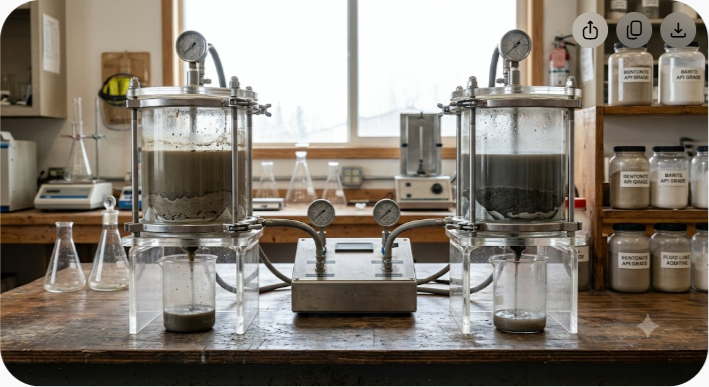
Bentonite may not be the only or even the primary rheology material in a demanding HPHT system. Specialized polymers and other additives may be selected to provide more stable performance under the expected downhole conditions.
Barite can still provide the required density, but the higher solids loading associated with heavy muds must be managed carefully. Fine-particle weighting materials may be considered in narrow pressure windows because particle-size distribution can influence sag and rheology.
The key point is that a product that performs well in a simple shallow water-based mud isn't automatically suitable for an HPHT application. Downhole testing and compatibility evaluation are essential.
When purchasing bentonite or barite for drilling fluids, product quality should be evaluated against the applicable API Specification 13A requirements and the mud program's own performance targets.
API specifications establish standardized requirements and test methods for drilling-fluid materials. They are useful for comparing products, but compliance with a specification doesn't guarantee identical performance in every mud system.
A bentonite purchasing specification should typically address:
A buyer should also ask how the material performs in the actual base water and formulation rather than selecting solely on the basis of a nominal grade.
For barite, important quality checks include:
The exact acceptance criteria should always be taken from the current applicable specification and the operator's procurement standard. Standards can be revised, and commercial products can be supplied to different specifications.
Mineral-based drilling-fluid materials still require responsible handling. Natural origin does not mean that every formulation or discharge scenario is automatically environmentally acceptable.
Offshore and onshore disposal requirements vary by jurisdiction and by drilling operation. Operators should follow the applicable environmental permit, waste-management plan, and material-discharge requirements.
Dry bentonite and barite also create dust during bag handling and bulk transfer. Appropriate engineering controls, ventilation, respiratory protection where required, and supplier safety documentation should be part of the material-handling program.
Barite should also be sourced with appropriate quality controls because naturally occurring deposits can contain trace impurities. Buyers should review the supplier's analytical data against the environmental and contractual requirements of the project.
Supply reliability matters as well. A drilling campaign that depends on consistent mud properties needs consistent raw-material quality, batch traceability, packaging, storage, and delivery. A low-cost material that varies substantially from one shipment to the next can create more expense at the rig through treatment and troubleshooting.
The following decision framework helps separate the two materials' roles during mud design.
Start by checking the measured density and confirming that the mud balance is properly calibrated. If the formulation requires a higher density, barite or another suitable weighting material is the normal solution.
Do not add large quantities of bentonite simply to increase density. The resulting rheology and solids loading can become unacceptable long before the desired mud weight is reached.
Check annular velocity, well inclination, pipe movement, cuttings loading, low-shear rheology, yield point, plastic viscosity, and solids control. Bentonite may be part of the solution in a suitable water-based system, but increasing clay concentration isn't automatically the correct treatment.
Review the bentonite quality and hydration state, filter-cake properties, polymer concentration, solids distribution, permeability of the exposed formation, and overall mud chemistry.
Barite alone won't solve a filtration-control problem. A properly designed filtration package is required.
Check total solids first. High barite concentration, drilled solids, reactive clay, and chemical flocculation can all contribute to excessive viscosity.
Dilution and improved solids control may be necessary before further chemical treatment. In some systems, changing the weighting material or particle-size distribution can also improve the rheological profile.
Don't rely on surface mud weight alone. Investigate density variation, well inclination, static periods, low-shear rheology, particle-size distribution, and the conditioning of the fluid.
A sag problem may require changes to the fluid formulation and drilling procedure rather than simply increasing gel strength.
Several formulation mistakes appear repeatedly because they focus on one property while ignoring the rest of the system.
Bentonite is primarily a rheology and filtration-control material. Its lower density and strong hydration behavior make it inefficient for substantial mud-weight increases.
Barite is relatively stable chemically, but large concentrations change the physical properties of the mud. Total solids, particle-size distribution, wetting, dispersion, and settling still matter.
Higher viscosity doesn't automatically mean better cuttings transport. Excessive rheology can increase pressure losses and ECD. The target should be a suitable rheological profile for the well, not the highest possible funnel viscosity or yield point.
A high-quality sodium bentonite can perform poorly in unsuitable water. Calcium, magnesium, salinity, pH, and other contaminants can change hydration and dispersion behavior.
Mud weight alone doesn't describe drilling-fluid performance. A useful field assessment considers density, rheology, filtration, solids, chemistry, temperature, and the condition of the wellbore.
Two products labeled as sodium bentonite can produce different yields and rheological responses because of mineral composition, beneficiation, moisture, particle-size distribution, and processing. Supplier documentation and laboratory testing matter.
Specific gravity is essential, but it isn't the whole specification. Particle-size distribution, residue, soluble components, impurities, moisture, and consistency between batches can all affect field performance.
Good materials can still produce poor drilling fluid if they are mixed or maintained incorrectly.
For conventional freshwater bentonite systems, hydrate the clay in suitable water before exposing it to high concentrations of salts or other chemicals that may limit dispersion.
Adequate shear and hydration time are important. The exact time depends on the clay product, equipment, water chemistry, temperature, and formulation, so a supplier's recommended procedure and laboratory testing should guide the program rather than a universal fixed number of hours.
Barite should be introduced through a properly functioning high-shear mixing system that can disperse the material efficiently. Avoid dumping large quantities into poorly circulated pits or allowing heavy solids to accumulate in dead zones.
The mud should be circulated and conditioned after additions so that the density is uniform before the next major formulation decision is made.
Shale shakers, hydrocyclones, centrifuges, and other solids-control equipment should be selected and operated according to the mud system and drilling conditions.
The objective isn't simply to remove as many solids as possible. The system must remove unwanted drilled solids while retaining the valuable components of the active mud and avoiding unnecessary losses of weighting material.
Routine measurements commonly include:
Testing frequency should increase when drilling through unstable formations, entering a high-pressure interval, changing the mud formulation, or investigating an abnormal trend.
Consider a water-based mud drilling a section where formation pressure requires a higher hydrostatic head. The measured mud weight is below the programmed value, while the rheology is already adequate for hole cleaning.
Adding more bentonite would address the wrong problem. It would increase solids and rheology without providing an efficient density increase.
Barite is the appropriate weighting material, assuming the mud system can accommodate the additional high-gravity solids. After the addition, the mud should be checked again for density, plastic viscosity, yield point, gels, filtration, and solids concentration.
Now consider the opposite situation. The mud has adequate density but poor low-shear carrying capacity and an underdeveloped filter cake. Adding more barite would not directly solve either problem. A review of bentonite hydration, polymer treatment, solids loading, water chemistry, and the filtration-control package would be more appropriate.
The lesson is straightforward: diagnose the missing property before selecting the mineral.
For most drilling-fluid decisions, the answer is not bentonite or barite. A properly designed system may need both, with each material assigned a specific job.
Use sodium bentonite when the water-based mud needs suitable colloidal structure, rheology, suspension, and filter-cake development. Use barite when the mud needs a substantial increase in density to provide the required hydrostatic pressure.
Use caution when conditions move outside conventional freshwater WBM operation. High salinity, high calcium concentration, high temperature, heavy solids loading, long static periods, and narrow pressure windows may require polymers, organophilic clays, specialized weighting materials, or other formulation changes.
The final selection should be based on the complete mud program rather than the performance of one ingredient in isolation.
The most reliable drilling-fluid design starts by identifying the required property and then choosing the material that controls it efficiently. Bentonite builds the structure; barite supplies the density. Managing both within the limits of the mud system is what turns those individual materials into a dependable drilling fluid.













Have questions about our products? We're here to help!