Axewelledge, a leading exporter from India, specializes in high-quality Bentonite. With a commitment to excellence, we supply premium Bentonite to the Middle East and Southeast Asia markets.


North Angle Complex, 304,
150 Feet Ring Rd, Opposite Ambedkar Nagar BRTS Stop,
Madhav Park, Punit Nagar,
Mavdi, Rajkot, Gujarat 360004
© Axewelledge 2026, All Rights Reserved.
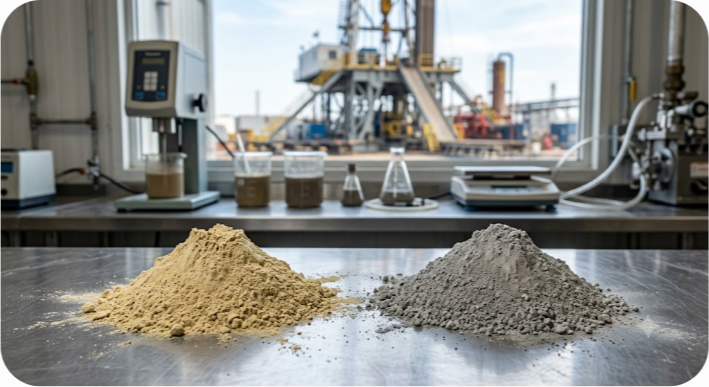
Bentonite and barite are both important drilling mud materials, but they solve different problems. Bentonite is mainly used to build viscosity, gel strength, suspension, and filtration control. Barite is mainly used to increase mud density and provide the hydrostatic pressure needed to balance formation pressure.
So, which is better for drilling mud? Neither mineral is a direct substitute for the other. In a conventional water-based drilling fluid, bentonite and barite are often used together, with each performing a specific job in the overall mud system.
The right choice depends on what the well requires. If the main problem is poor carrying capacity, weak gel strength, or excessive fluid loss, the mud formulation may need more effective clay or other rheology and filtration-control additives. If the mud needs more density to control formation pressure, a weighting material such as barite is the relevant solution.
This distinction matters because adding the wrong material can create new problems. Trying to increase mud weight with bentonite can produce excessive solids and viscosity without providing an efficient density increase. Adding barite to a poorly conditioned mud can raise solids loading and plastic viscosity while increasing the risk of settling or barite sag.
This guide compares bentonite vs barite across their physical properties, drilling-fluid functions, mixing practices, rheology, filtration control, density management, common mistakes, and field applications. It also explains why experienced mud engineers normally treat them as complementary materials rather than competing choices.
A drilling fluid has to perform several jobs at the same time. It must carry drilled cuttings to the surface, help cool and lubricate the bit and drillstring, provide hydrostatic pressure, reduce unwanted fluid invasion into permeable formations, and maintain suitable rheological properties as drilling conditions change.
No single mineral provides all of those functions. Drilling fluids are formulated from a combination of base fluids, clays, weighting materials, polymers, salts, lubricants, filtration-control products, and other additives selected for the well conditions.
Bentonite and barite sit in two very different parts of that formulation.
Bentonite is a clay material containing a high proportion of smectite minerals, principally montmorillonite. Sodium bentonite is widely used in fresh-water-based drilling fluids because its particles hydrate and disperse in water, producing viscosity and a structure that helps keep solids suspended.
The familiar swelling behavior of sodium bentonite comes from the ability of water to enter between the clay layers. The exact degree of hydration depends on mineral quality, water chemistry, mixing conditions, concentration, and the presence of other dissolved ions. For that reason, a simple statement that bentonite always swells by a fixed multiple can be misleading.
In a properly formulated water-based mud, hydrated bentonite contributes to several useful properties:
Bentonite is therefore best thought of as a rheology and filtration-control component, not as a high-density material.
Barite is the naturally occurring mineral barium sulfate, with the chemical formula BaSO4. Its most important property in drilling fluids is its high density. Commercial drilling-grade barite is selected and processed to meet specified physical and chemical requirements for use in drilling-fluid systems.
API Specification 13A covers drilling-fluid materials, including barite and several grades or types of bentonite. The current API specification framework should be checked against the edition and addenda specified by a particular project or procurement contract rather than relying on older section numbers from legacy documents. American Petroleum Institute +1
Barite is used primarily as a weighting agent. Because it is much denser than water and bentonite, relatively practical quantities can be added to increase mud weight. That increase in density raises the hydrostatic pressure exerted by the mud column.
Barite does not hydrate and swell in water in the way bentonite does. It therefore cannot replace the rheological and filtration functions of a properly hydrated clay system.
The easiest way to understand the difference is to compare what each material contributes to the drilling fluid.
| Property or Characteristic | Sodium Bentonite | Barite |
|---|---|---|
| Primary function | Viscosity, suspension, gel structure, and filtration control | Mud-weight increase and hydrostatic pressure control |
| Main mineral component | Smectite-rich clay, principally montmorillonite | Barium sulfate, BaSO4 |
| Typical mineral specific gravity | About 2.4 to 2.6 | Common drilling grades are typically around 4.1 to 4.2 or higher depending on grade and specification |
| Swelling behavior | Hydrates and can swell substantially in suitable water | Does not swell like bentonite |
| Effect on mud density | Relatively small compared with barite | Strong increase in mud density |
| Effect on rheology | Major contributor in many fresh-water mud systems | Can increase solids loading and plastic viscosity at high concentrations |
| Fluid-loss contribution | Important in many unweighted water-based muds | Mainly contributes solid material to the filter cake rather than acting as the primary filtration-control agent |
| Suspension function | Helps build the structure that suspends solids | Relies on the fluid's rheology for suspension |
| Primary well-control contribution | Indirect, through fluid properties | Direct, through increased hydrostatic pressure |
| Main operational concern | Hydration, water chemistry, excess rheology, and thermal or chemical degradation | Solids loading, density control, sag, and rheological effects |
| Common use | Water-based drilling-fluid formulation | Weighted drilling fluids, including water-based and nonaqueous systems |
| API relevance | Covered by API Specification 13A | Covered by API Specification 13A |
The key point is simple: bentonite builds the fluid's structure, while barite adds weight to the fluid.
That doesn't mean bentonite has no effect on density or barite has no effect on rheology. Every solid added to a drilling fluid changes the overall solids concentration and therefore can influence density and flow behavior. The difference is the primary purpose for which each material is selected.
Rheology describes how a drilling fluid flows and responds to applied stress. Mud engineers monitor properties such as plastic viscosity, yield point, and gel strengths because these values help indicate whether the fluid can circulate efficiently and transport cuttings under the current well conditions.
Hydrated bentonite contributes to the dispersed particle network in a water-based mud. That network increases resistance to flow and helps provide carrying capacity, especially at lower shear rates.
The objective isn't simply to maximize viscosity. Excessive viscosity can increase circulating pressure, reduce hydraulic efficiency, increase equivalent circulating density, and make solids removal more difficult. A good mud system is designed around the required rheological window rather than the highest possible viscosity.
Drilled cuttings have to move from the bottom of the hole to the surface. The ability of a drilling fluid to transport those cuttings depends on several variables, including annular velocity, fluid density, rheology, hole angle, cuttings size and shape, and the condition of the wellbore.
Bentonite helps by giving the fluid enough structure to carry suspended solids. Its contribution becomes particularly important when circulation slows or stops temporarily during connections, surveys, trips, and other operations.
A fluid with inadequate suspension properties may allow cuttings to settle. In a deviated or horizontal well, that can contribute to cuttings beds and increase the risk of torque, drag, pack-off, and other hole-cleaning problems.
When a water-based drilling fluid contacts a permeable formation, some liquid phase can move into the formation while suspended solids accumulate at the wellbore wall. This deposited layer is called the filter cake.
Well-dispersed bentonite can produce a relatively thin, low-permeability filter cake. The quality of that cake matters because excessive filtrate invasion can affect formation evaluation, contribute to wellbore instability in sensitive formations, and increase fluid losses.
Bentonite is not the only filtration-control material used in modern drilling fluids. Polymers such as PAC and CMC, along with other specialized additives, may be selected when tighter filtration control is required or when the water chemistry and temperature make conventional bentonite performance less suitable.
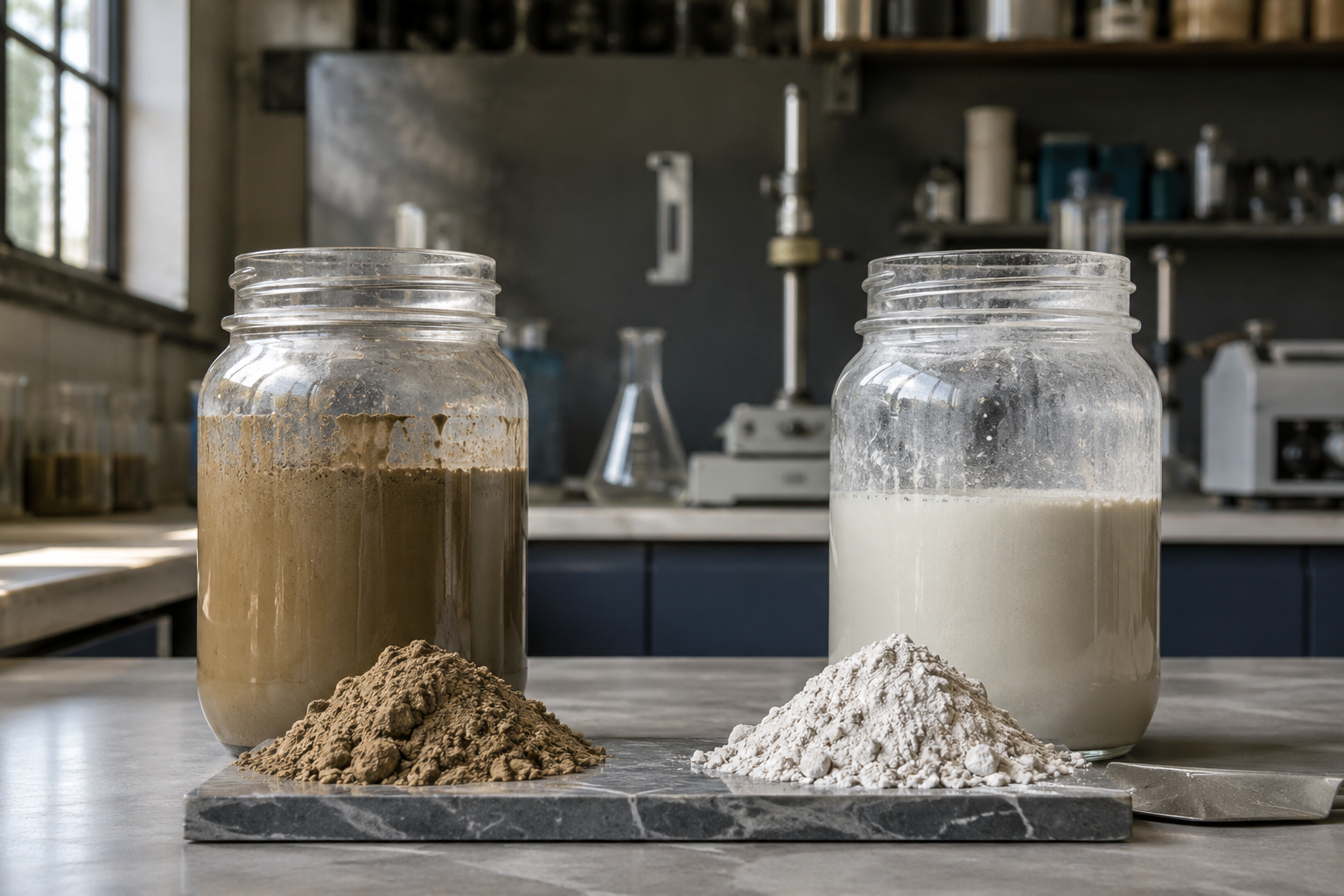
The primary reason for adding barite is to increase drilling-fluid density.
Mud weight determines the hydrostatic pressure exerted by the fluid column. In simplified terms, hydrostatic pressure increases as fluid density and true vertical depth increase. The actual well-control window is more complicated because formation pressure, fracture pressure, temperature, annular friction, well geometry, and equivalent circulating density all have to be considered.
Barite provides a practical way to raise mud density without relying on an impractical quantity of lower-density clay.
For example, a water-based mud that starts near 9 ppg may require substantially higher density as the well enters a formation with greater pore pressure. The mud engineer can calculate the required barite addition from the existing mud weight, target mud weight, system volume, and density of the weighting material.
The calculation should be based on actual field measurements and the selected barite grade. It shouldn't be treated as a universal fixed addition rate because the required amount changes with starting density, target density, volume, and material properties.
The connection between barite and well control is one of the most important concepts in drilling-fluid design.
If mud density is too low for the formation pressure, formation fluids can enter the wellbore. This influx is known as a kick and can develop into a serious well-control event if it isn't detected and managed correctly.
Increasing mud density with barite raises hydrostatic pressure. However, adding weight isn't simply a matter of making the mud as heavy as possible. If the mud system exceeds the formation's fracture or loss threshold, the operation can experience lost circulation.
The drilling window therefore lies between pressures that must be controlled and pressures that must not be exceeded. Mud weight is selected within that operational window, not in isolation.
Barite is not a viscosifier in the same way as hydrated bentonite. However, it can still have a significant effect on rheology because it increases the concentration of suspended solids.
As barite concentration rises, plastic viscosity can increase because the particles interact and create additional resistance to flow. Poor particle-size distribution, excessive low-gravity solids, or inadequate chemical conditioning can make this effect more pronounced.
That is why a high-density mud system requires more than simply adding sacks of barite. The complete fluid system must be monitored for density, plastic viscosity, yield point, gels, filtration, solids content, and other properties relevant to the well plan.
Bentonite has a much more direct role in filtration control than barite.
A properly hydrated clay system can help build a filter cake that limits fluid movement into permeable formations. The effectiveness of the cake depends on particle size distribution, clay concentration, water chemistry, differential pressure, and the presence of filtration-control polymers.
Barite contributes solid particles to the overall filter-cake structure, but it should not be treated as a substitute for a dedicated filtration-control program. In a weighted mud, the final cake contains a mixture of solids from the fluid system, and its performance depends on the formulation as a whole.
A common mistake is to assume that adding more bentonite will automatically solve every fluid-loss problem. That's not always true. Excessive clay can increase viscosity and solids loading without delivering the desired filtration performance. Depending on the formation and fluid system, a polymeric filtration-control additive may be a more effective solution.
The right question is not simply, "How much bentonite should be added?" It is, "What filtration and rheological properties does the mud need, and which combination of materials can achieve them within the operating limits?"
Barite is the clear choice when the primary requirement is to increase mud density.
Bentonite has a much lower mineral density than barite. Attempting to achieve a major increase in mud weight with bentonite would require adding large amounts of solid material. The result could be an excessively viscous and difficult-to-process fluid long before the desired hydrostatic pressure is reached.
Barite is specifically suited to this job because its high density means less material is required to produce a given increase in mud weight.
For field planning, mud engineers normally consider:
The final addition rate should come from the mud program and field calculations rather than a generic internet table.
Water chemistry is especially important when working with bentonite.
Fresh-water sodium bentonite generally performs best when the clay has adequate opportunity to hydrate and when the water does not contain excessive concentrations of ions that interfere with dispersion. Calcium and magnesium can reduce the effectiveness of conventional sodium bentonite by promoting flocculation and changing the clay's hydration behavior.
Salinity also matters. A bentonite formulation that performs well in low-salinity fresh water may behave very differently in seawater or a high-salinity system. Salt can suppress clay hydration and alter rheology, so specialized clays, polymers, or treated systems may be preferred depending on the application.
Barite is much less sensitive to water chemistry in terms of its basic role as a weighting material. It doesn't need to hydrate to provide density. Nevertheless, the overall mud chemistry still matters because dispersants, polymers, salts, contaminants, and other additives influence how barite behaves within the complete fluid system.
This is one reason material selection should always consider the finished mud rather than evaluating each mineral in isolation.
High-pressure, high-temperature wells place greater demands on drilling fluids. Temperature can change viscosity, chemical stability, filtration behavior, and the performance of polymers and other additives.
Bentonite can experience changes in rheology as temperature increases, and conventional freshwater clay systems may not provide the same performance at elevated temperatures as they do under surface conditions. The mud formulation may therefore rely more heavily on polymers and other specialized additives in HPHT applications.
Barite itself is a mineral weighting material and remains physically stable under the temperatures encountered in many drilling operations. The more complicated issue is the behavior of the complete weighted mud system at temperature and pressure, including sag tendency, rheological changes, chemical stability, and solids distribution.
HPHT mud design should therefore be based on laboratory testing at representative conditions. Surface measurements alone can give an incomplete picture of downhole behavior.
The exact mixing program depends on the mud formulation, equipment, water chemistry, and well plan, but the basic logic is straightforward.
Start with the specified base water or other continuous phase. Check water quality before adding large quantities of bentonite. Hardness, salinity, pH, and contaminants can affect hydration and dispersion.
If the formulation calls for chemical treatment before clay addition, complete that step first. The purpose is to give the bentonite a more suitable environment for hydration and dispersion.
Add bentonite through suitable mixing equipment so the dry material disperses rather than forming lumps. Allow adequate hydration time according to the mud program and material characteristics.
Good hydration is particularly important when the bentonite is expected to contribute substantially to viscosity and filtration control.
Measure density, viscosity, rheological properties, gel strengths, and filtration as required by the field testing program. If the mud does not meet the planned range, correct the formulation before adding large quantities of weighting material.
Barite should be added using equipment capable of handling the required solids rate. The addition rate should match the capacity of the mixing system and solids-control equipment.
Adding barite too quickly can overload the system, increase viscosity unexpectedly, or produce poor dispersion.
After weighting, measure the actual mud density rather than assuming the calculated value was achieved. Recheck rheology and other required properties because barite changes the solids concentration and can alter flow behavior.
Mud properties can change as the well is drilled. Formation solids, dilution, chemical treatments, temperature, and solids-control efficiency all affect the fluid. A good mud program is continuously adjusted to the well rather than treated as a one-time recipe.
They have different primary functions. Bentonite is mainly used for rheology, suspension, and filtration control, while barite is primarily used for density control.
Choosing between them as though they were two versions of the same additive leads to poor formulation decisions.
Bentonite can raise density slightly because it is a solid, but that is not its purpose. Large additions can produce excessive viscosity and solids concentration without delivering an efficient increase in hydrostatic pressure.
Use a suitable weighting material when the mud needs substantially more density.
A weighted mud needs enough carrying capacity to keep dense particles distributed throughout the system. If the base fluid is poorly conditioned, barite can settle under unfavorable conditions.
The solution isn't simply to add more clay. The entire rheology program should be evaluated, including low-shear-rate viscosity, gels, polymers, solids content, and agitation.
Poor-quality water can prevent bentonite from developing the expected properties. Hardness and salinity are especially important considerations for conventional sodium bentonite systems.
Testing the water before large-scale mixing is usually far cheaper than correcting a badly conditioned mud later.
A mud weight that looks correct on the surface can still be unsuitable if rheology, filtration, solids loading, or equivalent circulating density is outside the planned operating range.
Density is one measurement, not the entire mud program.
API Specification 13A has been revised over time, and API currently lists the 19th edition along with subsequent addenda and errata. Procurement documents should identify the applicable edition and requirements instead of copying old section numbers from previous projects. American Petroleum Institute +1
This is particularly important when purchasing material described as API compliant. The buyer should specify the applicable standard and request the appropriate quality documentation from the supplier.
Not all bentonite performs identically. Two materials can have similar appearance while producing noticeably different mud properties.
When evaluating drilling-grade bentonite, consider:
The phrase "high swelling" alone isn't enough to establish suitability. The material should be evaluated against the actual specification and drilling-fluid application.
API Specification 13A covers physical properties and test procedures for several drilling-fluid materials, including barite and bentonite. It is intended for manufacturers, distributors, and end users of the listed products. studylib.net +1
For procurement, a certificate of analysis for the supplied lot is more useful than a generic product description. Buyers should also confirm that the testing method and acceptance limits match the project specification.
Barite quality is especially important in high-density mud systems because relatively large quantities may be added to the active fluid system.
Important considerations include:
A higher specific gravity generally means more efficient weighting, but density alone does not define good drilling-grade barite. Particle-size distribution and chemical characteristics also matter because they influence solids loading, rheology, sag behavior, and the performance of the complete mud system.
API's current standards catalog identifies Specification 13A as the specification for drilling-fluid materials and separately lists API RP 13K for chemical analysis of barite. American Petroleum Institute +1
A simple price-per-ton comparison can give the wrong answer when evaluating drilling-mud materials.
Bentonite and barite serve different purposes, so their value should be assessed against the drilling problem they solve. A lower-cost material isn't necessarily the better choice if it forces additional treatment, increases solids loading, creates excessive viscosity, or fails to deliver the required fluid properties.
For bentonite, buyers should consider yield, hydration performance, filtration behavior, transport cost, and consistency. A bentonite that produces the required mud properties with less material may have a different total cost profile from a cheaper material with lower performance.
For barite, specific gravity, particle-size distribution, delivered cost, handling, and the amount required to reach the target mud weight all matter. Logistics can also become significant because weighted mud systems may consume large quantities of barite.
A useful purchasing comparison should therefore look at cost per unit of required drilling-fluid performance, not simply cost per metric ton.
In shallow sections with relatively modest formation pressures, a low-density water-based mud may rely heavily on bentonite and other low-cost additives for viscosity, suspension, and filtration control. Barite may not be required until the planned mud weight exceeds what the unweighted system can reasonably provide.
As true vertical depth and formation pressure increase, barite often becomes a major component of the drilling-fluid system. Bentonite or polymeric rheology modifiers continue to provide suspension and flow control while barite supplies the additional density.
Hole cleaning becomes especially important in high-angle sections. The fluid needs appropriate low-shear-rate carrying capacity without creating excessive pressure losses. Bentonite can contribute to the required structure, but polymers and other rheology modifiers may also be used depending on the mud system.
Barite may be required when formation pressure demands higher density. In that case, controlling solids and monitoring sag become increasingly important.
High-temperature and high-pressure wells generally require more carefully engineered mud systems. Conventional bentonite alone may not provide the required stability, while high-density barite systems require careful control of rheology, filtration, solids, and sag behavior.
Laboratory testing and field measurements should guide the final formulation.
If you're trying to decide whether bentonite or barite is the appropriate material for a particular mud requirement, start with the problem rather than the product name.
| Drilling requirement | Primary material to consider | Why |
|---|---|---|
| Increase mud viscosity | Bentonite or suitable rheology modifier | Builds the fluid's flow structure |
| Improve suspension | Bentonite or rheology polymer | Helps maintain solids suspension |
| Reduce fluid loss in a suitable WBM | Bentonite plus filtration-control additives as required | Helps build a low-permeability filter cake |
| Increase mud density | Barite | Provides efficient density increase |
| Balance formation pressure | Barite within the approved mud-weight window | Raises hydrostatic pressure |
| Maintain high-density mud | Barite plus a properly engineered rheology system | Controls density while maintaining suspension and hydraulics |
| Reduce excessive viscosity | Review clay, low-gravity solids, polymers, and chemical treatment | Adding more weighting material can worsen solids loading |
| Control barite sag | Review low-shear rheology, particle size, agitation, and overall formulation | Sag is a system problem, not simply a barite problem |
The table is a starting point, not a substitute for a well-specific mud program.
The strongest answer to the bentonite vs barite question is often that the two materials are complementary.
Imagine a water-based mud that needs to be increased from a relatively low starting density to a much higher target. Barite can provide the required weight, but the mud still needs enough rheological structure to transport cuttings and keep the weighting material properly distributed during circulation and static periods.
Bentonite may provide part of that structure in a suitable water-based formulation. Depending on the well and mud design, polymers and other additives may perform some or all of the required rheological and filtration functions instead.
This is why a drilling-fluid system should be evaluated as a whole. The question isn't whether bentonite is better than barite. The useful question is which combination of materials provides the required density, rheology, filtration, suspension, and hydraulic performance within the well's pressure limits.
Bentonite and barite are both important drilling-fluid materials, but their jobs are fundamentally different.
American Petroleum Institute +1
For drilling-fluid buyers, consistency is just as important as nominal specifications. A reliable supplier should be able to provide clear product specifications, quality documentation, appropriate packaging, and consistent lot performance. For sodium bentonite used in demanding drilling applications, Axewelledge supplies drilling-grade bentonite for international industrial markets and can support buyers evaluating material requirements for specific applications.













Have questions about our products? We're here to help!