Axewelledge, a leading exporter from India, specializes in high-quality Bentonite. With a commitment to excellence, we supply premium Bentonite to the Middle East and Southeast Asia markets.


North Angle Complex, 304,
150 Feet Ring Rd, Opposite Ambedkar Nagar BRTS Stop,
Madhav Park, Punit Nagar,
Mavdi, Rajkot, Gujarat 360004
© Axewelledge 2026, All Rights Reserved.
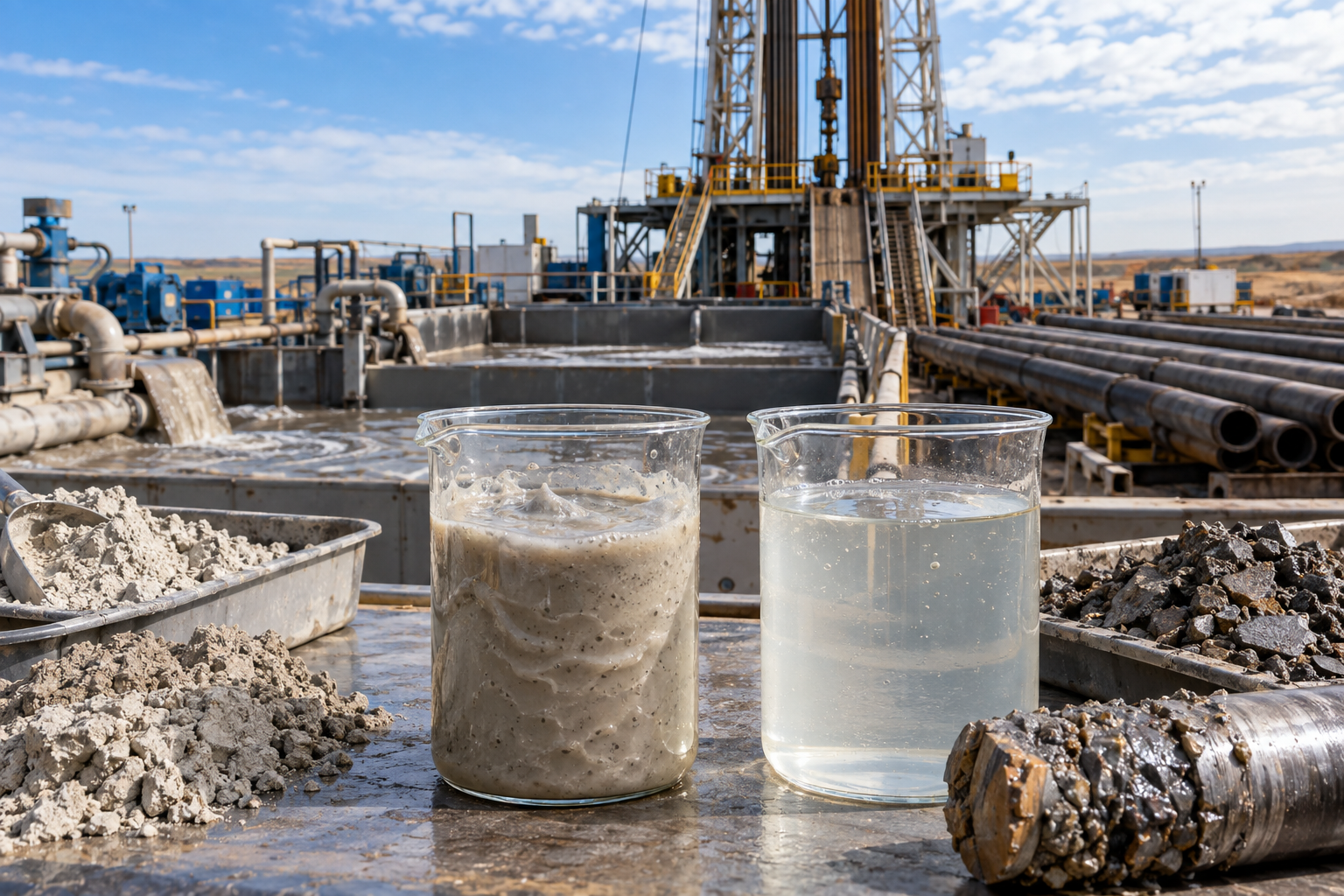
The main difference between bentonite and bentonite-free drilling fluids is how they create and control the properties a drilling fluid needs. Bentonite systems rely on hydrated clay, particularly montmorillonite-rich bentonite, to provide much of their viscosity, suspension capacity, and filter-cake structure. Bentonite-free systems use polymers and other additives to perform those functions without relying on bentonite as the primary clay component.
Neither approach is automatically the right choice for every well or borehole. The practical decision depends on the formation, make-up water, drilling method, required rheology, filtration target, solids loading, temperature, environmental requirements, and total operating cost.
Bentonite is widely used because it hydrates and swells in water, forming a structured suspension. That structure can help carry drilled cuttings and control filtration. Polymer-based systems work differently: selected polymers can provide viscosity, filtration control, inhibition, encapsulation, or other properties with less dependence on colloidal clay solids.
That difference becomes important once drilling conditions become demanding. A fluid that performs well in clean laboratory water may behave differently after it encounters hardness, salts, drilled solids, temperature changes, or repeated mechanical shear. For that reason, the useful comparison isn't simply "bentonite versus polymer." It is a comparison between complete fluid systems under the conditions in which they will actually operate.
A bentonite drilling fluid is usually a water-based drilling mud in which bentonite provides a significant part of the fluid's structure and rheological behavior.
When suitable bentonite is dispersed in water and allowed to hydrate, its fine clay particles interact to form a suspension. This increases viscosity and helps keep solids suspended when circulation slows or stops. The hydrated clay also contributes to the formation of a filter cake on permeable formations, which can help limit fluid loss into the formation.
Bentonite therefore does more than simply make water thicker. In a properly designed mud system, it can contribute to several functions at the same time:
Bentonite quality matters. Commercial bentonite deposits differ in mineral composition, montmorillonite content, swelling capacity, particle characteristics, and drilling-fluid performance. Sodium-rich bentonite is commonly valued for its strong hydration and swelling behavior, although the appropriate material depends on the application and the required specification.
Adding more bentonite isn't automatically a solution to poor mud performance. Too much clay can increase viscosity and solids loading, raise circulating pressure, interfere with hydraulics, and make solids control more difficult. The objective is to formulate the mud around the drilling requirements, not to maximize the amount of clay in the system.
A bentonite-free drilling fluid is formulated to provide the required drilling performance without using bentonite as the primary clay viscosifier.
Polymers and other specialty additives take on some or all of the jobs that hydrated bentonite would normally perform. Depending on the application, a bentonite-free system can contain polymer viscosifiers, filtration-control additives, shale inhibitors, salts, lubricants, encapsulating agents, deflocculants, or other chemicals selected for the formation and drilling method.
So, bentonite-free doesn't mean the fluid is simply water with a polymer added. A properly engineered system is still a complete drilling fluid with specific targets for rheology, filtration, inhibition, solids tolerance, and stability.
Polymer systems can also be designed to produce useful rheology with relatively low concentrations of colloidal solids. This can be attractive where the drilling program needs a low-solids system or where the operator wants more control over the fluid's rheological response.
The trade-off is that polymer performance is highly dependent on formulation and operating conditions. Water chemistry, salinity, hardness, pH, temperature, bacterial activity, shear, formation solids, and interactions with other additives can all influence performance. A bentonite-free label by itself says very little about how a particular product will behave in the field.
The broad differences can be summarized as follows:
| Feature | Bentonite drilling fluid | Bentonite-free drilling fluid |
|---|---|---|
| Primary structure | Hydrated clay particles | Primarily polymers and specialty additives |
| Main viscosifier | Bentonite | Polymer or alternative viscosifier |
| Filtration control | Bentonite filter cake, often supported by additives | Primarily polymers and filtration-control additives |
| Colloidal clay solids | Relatively significant | Can be very low |
| Rheology | Strong clay-based contribution | Often highly engineered polymer rheology |
| Water sensitivity | Strongly affected by water chemistry and clay quality | Strongly affected by polymer chemistry and water conditions |
| Formation interaction | Clay can interact with reactive formations | Can be designed to reduce clay-related interactions |
| Solids management | Clay and drilled solids require control | Drilled solids still require control, often with less added clay |
| Typical strength | Familiar, versatile and well established | Low-solids, application-specific formulation options |
| Main challenge | Excess solids and unsuitable clay hydration | Polymer compatibility, treatment requirements and cost |
| Selection approach | Match bentonite grade and mud properties to the formation | Match the polymer and additive package to the formation and water |
This table describes general tendencies rather than fixed rules. A carefully formulated bentonite mud can outperform a poorly designed polymer system, just as a well-designed bentonite-free system can solve a problem that conventional clay-based mud cannot handle efficiently.
Bentonite is useful because a single material can contribute to several important mud properties.
Hydrated bentonite creates a structured suspension that increases the fluid's resistance to flow. This helps the mud carry drilled cuttings through the annulus and back to the surface.
The goal, however, isn't maximum viscosity. Excessive viscosity can increase pressure losses, require more pumping energy, reduce hydraulic efficiency, and make the fluid harder to process. Good mud design aims for the rheological profile required by the hole, flow rate, cuttings load, and drilling method.
Cuttings shouldn't immediately settle whenever circulation slows. Bentonite contributes to suspension through its clay structure and gel behavior.
This becomes particularly important when pumps are stopped. If solids settle rapidly, restarting circulation can require additional effort and may contribute to poor hole cleaning or an overloaded annulus.
When drilling through a permeable formation, some liquid from the drilling fluid can move into the formation. Bentonite particles can form a relatively low-permeability filter cake at the formation face, reducing the rate of fluid loss.
Filtration control is not simply about achieving the lowest possible fluid-loss number. The filter cake also needs to be appropriate for the formation and the wider drilling program. An unnecessarily thick or difficult-to-remove cake can create problems later in the operation.
A properly formulated drilling fluid can help maintain borehole conditions by providing suitable hydraulic and filtration behavior and by limiting excessive fluid invasion into permeable formations.
That doesn't mean bentonite automatically stabilizes every formation. Reactive shale, unconsolidated sand, salt formations, and chemically sensitive formations may require additional inhibition or a different fluid strategy altogether.
Bentonite-free systems move much of the responsibility for rheology and filtration control from clay to polymers and other additives.
Polymers are long-chain molecules that can increase viscosity or modify the way a fluid responds to shear. Different polymer chemistries are selected for different purposes. One may primarily provide viscosity, another may improve filtration control, while another may help encapsulate drilled solids or inhibit reactive formations.
This gives engineers considerable flexibility. Instead of relying on one clay component to perform several jobs, the fluid can be built around a combination of additives, with each component selected for a defined function.
That approach can be useful when a drilling program needs low colloidal solids, specialized rheology, or a formulation tailored to a particular formation. It can also reduce the amount of clay introduced into the active fluid system.
There is a catch. The more chemistry-specific the system becomes, the more important compatibility testing becomes. A polymer that performs well in one water source may not perform the same way in another. Hardness, salinity, pH, temperature, mechanical shear, and other additives can all change the result.
No. The terms overlap, but they don't mean exactly the same thing.
A polymer drilling fluid can contain bentonite, while a bentonite-free drilling fluid can be polymer-based. "Polymer mud" describes the use of polymers as an important part of the formulation. "Bentonite-free" describes the absence of bentonite as a component or, in some technical contexts, its absence as the primary clay component.
For example, a water-based mud may contain bentonite plus a polymer for filtration control or rheology modification. Another system may contain polymers and no bentonite at all. Both can be described as polymer-containing systems, but their solids structure and fluid behavior may be quite different.
This distinction matters when comparing products. Before making a purchasing decision, check the actual formulation and technical data instead of assuming that every polymer mud is bentonite-free.
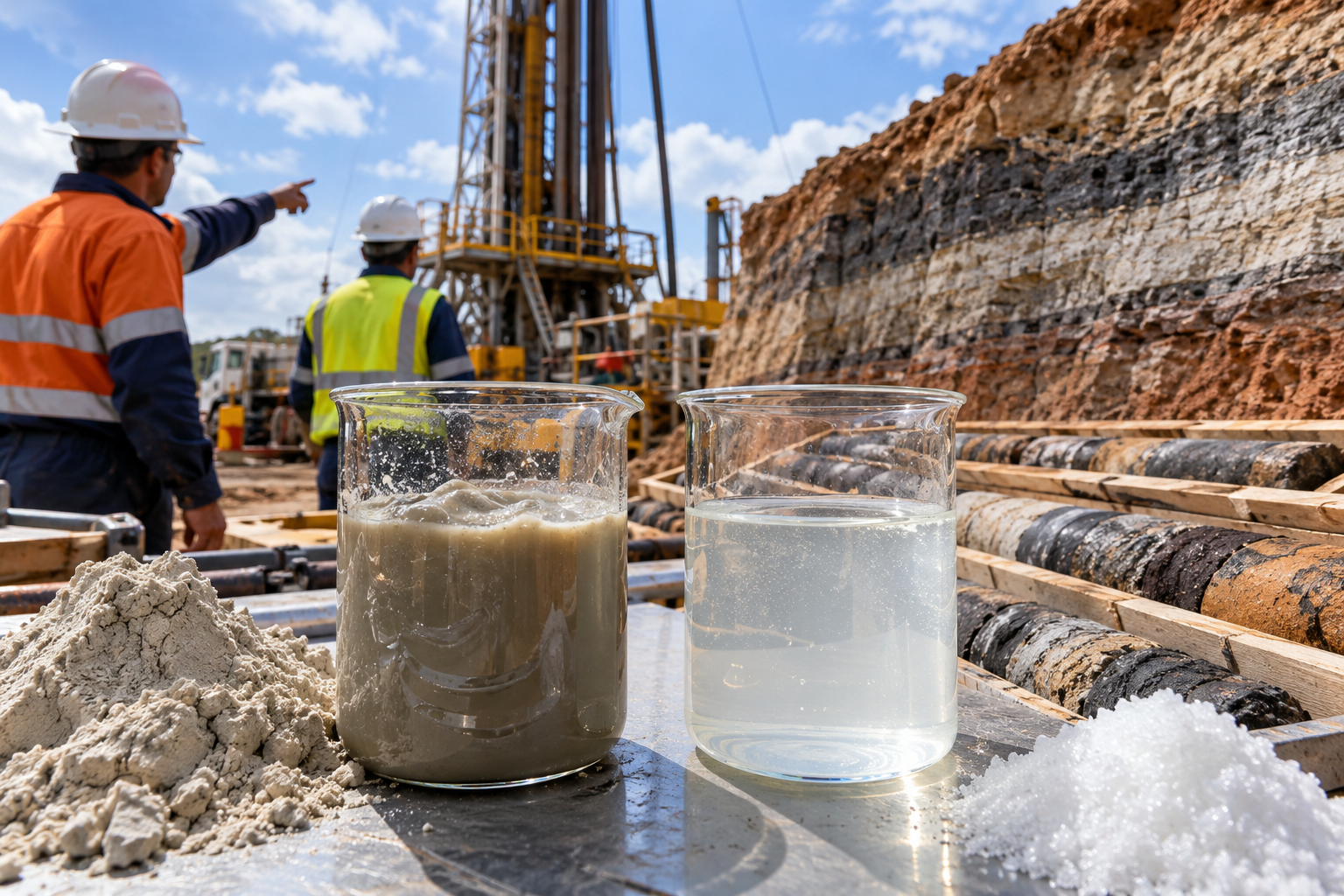
Rheology is one of the most important areas when comparing these two fluid approaches.
Drilling-fluid rheology affects pressure losses, pumping requirements, hole cleaning, cuttings transport, suspension, and equivalent circulating density. The desired rheological profile changes with hole geometry, depth, flow rate, cuttings characteristics, and drilling method.
Bentonite develops much of its rheology through interactions among hydrated clay particles. Polymer systems rely more heavily on the structure and concentration of dissolved or dispersed polymer molecules.
A drilling fluid may need to behave differently at different shear rates. For example, it can be useful to have manageable viscosity under high shear while retaining sufficient low-shear viscosity to help carry cuttings through the annulus. This is one reason low-solids polymer systems are used in applications where their rheological profile fits the hydraulic requirements.
Looking at one viscosity measurement in isolation can be misleading. The complete rheological profile, gel behavior, density, solids concentration, filtration, and operating conditions all matter.
Filtration control is often as important as viscosity.
When drilling through permeable formations, excessive fluid loss can alter formation conditions and increase fluid consumption. The drilling fluid should therefore provide an appropriate balance between filtration control, filter-cake quality, hole stability, and downstream operational requirements.
Bentonite naturally contributes to filter-cake formation. Additional fluid-loss-control materials can be used when tighter control is needed.
Bentonite-free systems generally depend more heavily on polymers and specialty filtration-control additives. This can provide precise control, but the performance is closely tied to chemical compatibility.
Water hardness, salinity, pH, temperature, and contamination can all influence polymer behavior. A formulation that gives good filtration results in laboratory water may need adjustment when mixed with a different field water source.
For that reason, filtration should be measured as part of a complete fluid evaluation rather than inferred from the name or advertised properties of an additive.
One of the most common mistakes in drilling-fluid selection is evaluating the dry product without considering the water in which it will be mixed.
Bentonite and polymers can respond very differently depending on water chemistry. Hardness ions can interfere with clay hydration and polymer performance. High salinity can change swelling and viscosity behavior. Temperature can affect polymer stability and the rate of chemical reactions. Other additives and formation contaminants can introduce additional interactions.
The practical solution is straightforward: test the actual make-up water whenever possible.
Before committing to a large field treatment, evaluate the proposed fluid using representative water and, where practical, representative formation solids. A small compatibility test can identify problems before they become expensive field treatments.
Water chemistry also explains why two drilling operations using the same nominal bentonite grade can report different results. The material may be similar, but the surrounding system isn't.
There is no universal winner.
A properly selected bentonite system can be a practical choice when the formation and water chemistry are compatible with clay-based mud. It can provide useful viscosity, suspension, filtration control, and gel strength through a relatively familiar formulation.
A bentonite-free system may be worth evaluating when the operation needs very low colloidal clay solids, specialized polymer rheology, or a formulation designed around particular water and formation conditions.
The useful question is not whether bentonite is inherently better than polymer. Instead, ask which complete fluid system can meet the required rheology, filtration, stability, solids-control, and environmental requirements with manageable treatment and operating costs.
Bentonite is often considered when the drilling program needs a proven clay-based water system and the formation and make-up water are compatible with the selected grade.
Typical applications and considerations include:
The exact bentonite grade matters. A material should be evaluated against the technical requirements of the project rather than selected solely by price or by a generic description such as "high swelling."
For projects that follow recognized drilling-fluid specifications, buyers should review the applicable requirements for bentonite quality and testing. The relevant specification depends on the drilling application and the procurement requirements of the project.
A bentonite-free system may be worth evaluating when the drilling program has a specific reason to minimize or eliminate clay-based solids.
Potential reasons include:
Bentonite-free systems can be particularly useful when the fluid needs to be engineered around a narrow set of performance targets. But the label itself isn't a guarantee of performance. The formulation still needs to be tested against the actual drilling conditions.
Choosing between bentonite and bentonite-free drilling fluid is easier when the decision is based on measurable requirements rather than product labels.
Start with the geology.
Determine whether you're drilling through unconsolidated sand, reactive shale, stable rock, highly permeable material, fractured formations, or a mixed sequence. Each formation creates different demands on filtration, inhibition, suspension, and borehole stability.
The formation should determine what the fluid needs to accomplish.
Measure or obtain reliable information about the water's hardness, salinity, pH, and other relevant chemical properties.
This is particularly important for polymer systems because polymer performance can depend strongly on the chemistry of the make-up water.
Avoid vague targets such as "high viscosity." Establish the actual operating requirements for viscosity, yield behavior, gel strength, and cuttings transport.
The required values depend on factors such as hole diameter, depth, pump rate, annular velocity, cuttings size, drilling method, and available hydraulic capacity.
Determine the acceptable fluid-loss range and the filter-cake characteristics needed for the formation and drilling program.
A drilling fluid should be evaluated as a complete system. Good viscosity alone doesn't guarantee effective filtration control.
Consider both the solids deliberately added to the system and the formation solids entering it during drilling.
This is important for both bentonite and bentonite-free systems. A low-solids formulation can still become a high-solids mud if drilled solids aren't removed efficiently.
Prepare representative samples and compare them under controlled conditions.
Useful measurements may include:
The purpose of testing is not to produce a collection of numbers. It is to determine whether the complete fluid can meet the requirements of the drilling operation.
Fresh-mud performance isn't enough.
If the fluid will encounter formation solids, salt, hardness, temperature, or other contaminants, reproduce those conditions as closely as practical in the laboratory.
A formulation that looks excellent when freshly mixed can change after hours of circulation. Testing after representative exposure provides a more realistic picture of field behavior.
The cheapest bag isn't necessarily the cheapest drilling solution.
A proper cost comparison should include treatment concentration, water consumption, mixing requirements, fluid losses, solids control, additional additives, waste handling, and downtime.
A more expensive product used at a lower concentration may have a different total cost than a cheaper product that requires substantially more material.
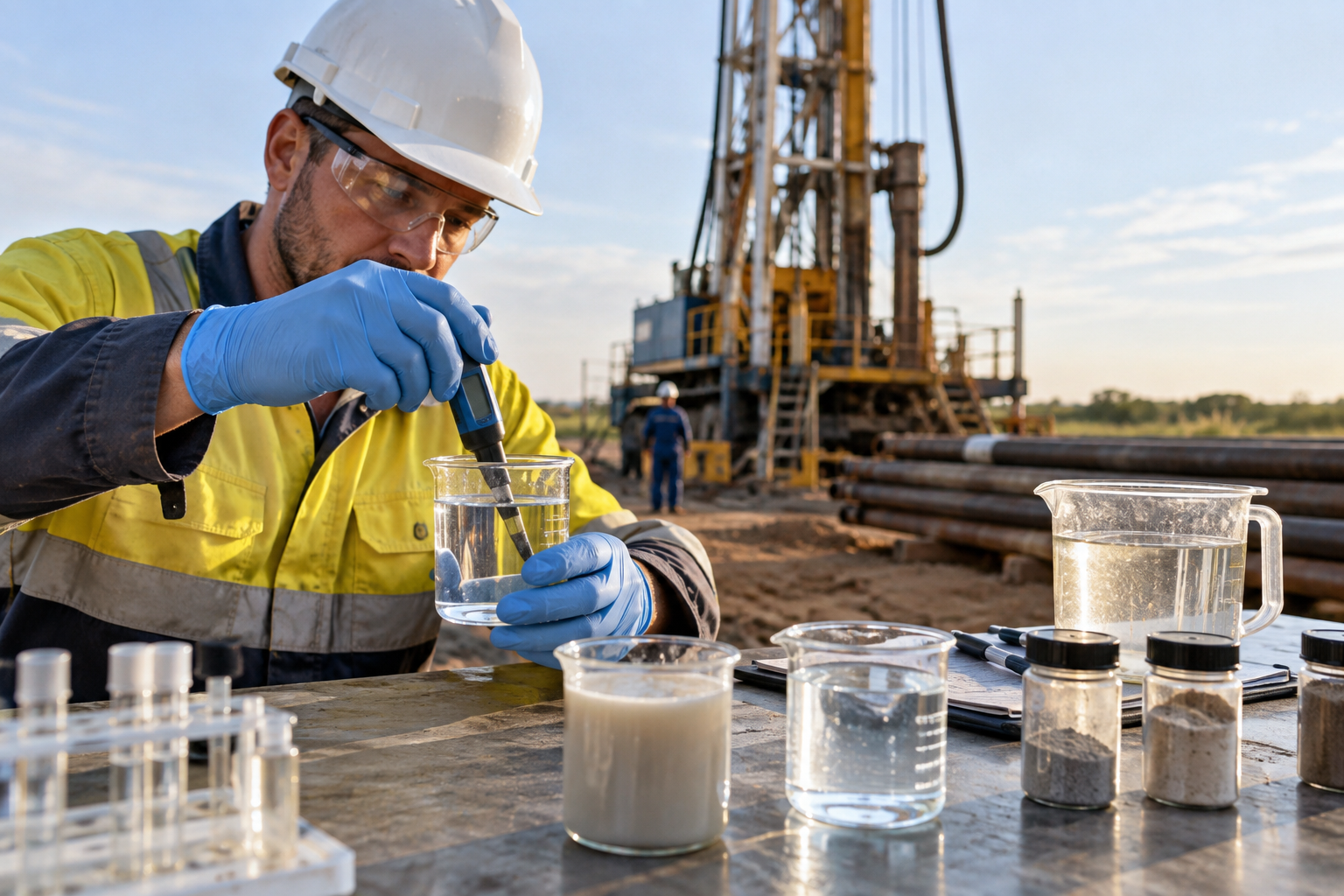
More viscosity isn't automatically better.
Excessive viscosity can increase pressure losses and pumping requirements. It can also affect hydraulic efficiency and solids processing. The goal is the right rheological profile for the job, not the largest possible viscosity value.
A formulation selected without testing the actual make-up water can behave unpredictably in the field.
Hardness, salinity, pH, and other ions can affect both clay and polymer systems. Water testing is a relatively simple step that can prevent unnecessary treatment problems later.
Bentonite-free systems have useful applications, but removing bentonite doesn't remove the need for fluid engineering.
Polymers can be sensitive to temperature, salinity, hardness, shear, biological activity, and incompatible additives. The chemistry has to match the application.
The fluid changes during drilling.
Formation solids enter the system, chemicals are consumed or diluted, water chemistry can shift, and repeated mechanical shear can affect additives. A fresh sample provides a baseline, not the whole field picture.
High swelling is useful, but swelling alone doesn't describe a drilling-grade bentonite's complete performance.
Rheology, filtration, particle characteristics, water compatibility, consistency, and the requirements of the drilling system should also be considered. A material that looks strong on one specification may not be the best fit for the complete formulation.
Consider a drilling contractor working in a formation where cuttings transport and filtration control are important. The available water is reasonably compatible with a selected sodium bentonite, and the project doesn't require exceptionally low colloidal solids.
A conventional bentonite mud could be a practical option because the clay contributes viscosity, suspension, and filter-cake formation within a familiar water-based system.
Now consider a different project where the operator wants very low colloidal clay solids and a rheological profile controlled primarily through polymers. A bentonite-free polymer system may deserve evaluation because the formulation can be built around specialty viscosifiers and filtration-control additives.
The lesson isn't that one project should always use bentonite and another should always avoid it. The drilling conditions determine the requirements, and testing determines whether the proposed formulation can meet them.
This is also why experienced drilling-fluid teams look beyond a single laboratory value. A mud has to perform as a system while circulating, carrying cuttings, interacting with formation solids, and responding to changing water and temperature conditions.
There is no single bentonite concentration that works for every drilling operation.
The required concentration depends on the bentonite grade, water chemistry, formation, desired rheology, drilling method, hole size, circulation rate, solids loading, and filtration requirements.
Laboratory test procedures sometimes specify a particular bentonite concentration to create a standardized test suspension. That concentration should not be mistaken for a universal field recipe.
For example, a standardized laboratory procedure may use a fixed mass of bentonite and a defined volume of water so that different materials can be compared under controlled conditions. The purpose is reproducibility. Field mud design has a different purpose: meeting the performance requirements of a specific drilling operation.
Field concentrations should therefore be established through the drilling program's technical requirements and representative testing rather than copied directly from a laboratory test method.
Yes. Bentonite and polymers can be combined when the formulation is designed for compatibility.
In many water-based drilling-fluid systems, bentonite provides part of the clay structure while polymers are added to modify rheology, improve filtration control, encapsulate drilled solids, or provide other functions.
This is why the categories aren't always completely separate. A mud can be bentonite-based and still contain a substantial polymer package. Conversely, a polymer-based system can be designed without bentonite.
Compatibility remains the key consideration. Some polymers interact with clay surfaces and change the rheology of the system. Others can be affected by hardness, salinity, temperature, shear, or other additives.
Before combining products, test the complete formulation in representative water. Don't assume that two products will perform as expected simply because each performs well on its own.
A drilling-fluid program should monitor the properties that affect the operation rather than relying on the mud's appearance.
For water-based drilling fluids, relevant measurements commonly include density, viscosity, gel strength, filtration, solids, sand content, pH, and other chemistry parameters appropriate to the system.
A practical monitoring routine can include these steps:
This is more reliable than adding more bentonite or polymer whenever the mud appears thin. A change in viscosity may be caused by dilution, contamination, solids loading, water chemistry, temperature, or additive interactions. The cause should be identified before treatment is selected.
There isn't a reliable answer based on the fluid category alone.
Environmental performance depends on the complete drilling-fluid system, including raw materials, additive concentrations, formation cuttings, water use, recycling practices, waste handling, and applicable regulations.
Bentonite is a naturally occurring clay mineral, but a bentonite drilling mud can also contain polymers and other additives. A bentonite-free system may contain synthetic or naturally derived polymers with their own environmental considerations.
For projects in the United States or other regulated markets, evaluate the complete formulation against the requirements that apply to the site. Product labels such as "natural" or "free" don't provide enough information to determine the environmental profile of the complete drilling-fluid system.
Waste handling is also part of the assessment. The composition of the cuttings and used fluid, available recycling options, treatment requirements, and disposal route can all affect the practical environmental impact of a drilling program.
Cost comparisons need to go beyond the purchase price of the dry additive.
A useful cost model considers:
A bentonite system may be economical because one material contributes to several mud properties. A bentonite-free system may justify a higher additive cost when its performance reduces another operating expense or solves a specific drilling problem.
The useful comparison is therefore the total cost of achieving the required drilling performance, not simply the price per kilogram, tonne, sack, or barrel of additive.
When bentonite is part of a drilling-fluid program, material consistency matters. Changes in clay quality or performance can affect the behavior of the finished mud, particularly when the formulation is designed around a specific grade.
Axewelledge supplies bentonite for industrial applications and supports international supply requirements. For drilling-related applications, buyers should define the required grade, relevant technical specifications, packaging, quantity, water conditions, and intended use before selecting a material.
If you're comparing bentonite grades for drilling, don't ask only for the "strongest" material. Ask for the technical data that matters to your formulation. Depending on the application, that can include swelling behavior, rheological performance, filtration characteristics, particle-size distribution, moisture, residue, and consistency between batches.
The right product is the one whose measured properties fit the drilling-fluid system and project requirements.
Before selecting a bentonite or bentonite-free drilling fluid, answer these questions:
If these questions are answered before procurement, the selection becomes much less dependent on marketing claims and much more grounded in measurable drilling requirements.
Bentonite and bentonite-free drilling fluids address the same broad drilling needs through different chemistry.
Bentonite-based fluids use hydrated clay to contribute viscosity, suspension, gel strength, and filtration control. Bentonite-free systems shift more of those functions to polymers and other specialty additives.
Bentonite can be a practical choice when its swelling, rheological, and filtration characteristics fit the formation and water chemistry. Bentonite-free systems can be useful when the drilling program needs low colloidal solids, specialized rheology, or a formulation built around specific polymer chemistry.
The decision should come from the complete fluid system, not from a product label, a single viscosity measurement, or the lowest price per bag. Test the proposed formulation using representative water and operating conditions, then compare performance and total treatment cost.
For drilling-grade bentonite sourcing, Axewelledge can provide material information and technical specifications to help buyers evaluate whether a particular grade fits their intended application.













Have questions about our products? We're here to help!