Axewelledge, a leading exporter from India, specializes in high-quality Bentonite. With a commitment to excellence, we supply premium Bentonite to the Middle East and Southeast Asia markets.


North Angle Complex, 304,
150 Feet Ring Rd, Opposite Ambedkar Nagar BRTS Stop,
Madhav Park, Punit Nagar,
Mavdi, Rajkot, Gujarat 360004
© Axewelledge 2026, All Rights Reserved.
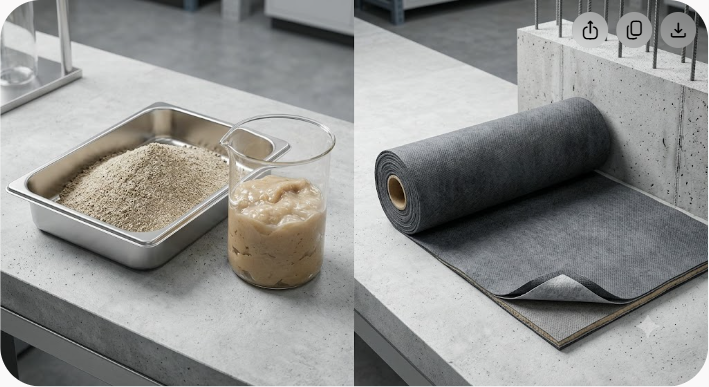
Bentonite and bentonite membranes are closely related, but they aren't the same waterproofing product. Bentonite is the water-reactive clay that provides the sealing action; a bentonite membrane is an engineered waterproofing system that contains and controls that clay.
That distinction matters. Loose sodium bentonite can be useful for sealing soil, filling selected voids, or forming low-permeability barriers, but it isn't automatically a substitute for a manufactured bentonite membrane. A membrane, often produced as a geosynthetic clay liner or a composite waterproofing sheet, gives the clay a controlled thickness, carrier layers, confinement, and a defined installation method.
For construction projects, the practical choice usually comes down to the site and the application. If you're trying to waterproof a foundation wall, below-grade concrete structure, tunnel, or similar structure, an engineered bentonite membrane is often easier to specify and install consistently. If you're formulating a sealing material, treating soil, filling a designed barrier system, or working with a project that specifically calls for granular or powdered sodium bentonite, the raw clay may be the appropriate material.
The key is not simply asking which material is stronger. Ask where the bentonite will be placed, how it will be confined, how much water it will encounter, and what happens if the surrounding material moves.
Bentonite is a natural clay containing a high proportion of smectite minerals, particularly montmorillonite. Sodium bentonite is widely used for waterproofing because it can absorb water and swell substantially. Once hydrated and properly confined, the swollen clay can form a dense, low-permeability barrier.
This is the basic mechanism behind bentonite waterproofing:
The last point is easy to overlook. Bentonite does not become an effective waterproofing barrier simply because it swells. The clay needs suitable confinement and enough material to create a continuous seal.
This is why sodium bentonite performs differently in a properly designed waterproofing assembly than loose clay placed beside a foundation without a defined installation system.
Waterproofing performance also depends on bentonite quality. Swelling capacity, fluid loss, particle size, moisture content, mineral composition, and the presence of soluble salts can all affect behavior.
For industrial applications, buyers should therefore avoid choosing bentonite solely by its name. A material described simply as 'bentonite' can vary considerably in mineralogy and performance.
A bentonite membrane is a manufactured waterproofing product in which bentonite is incorporated into a controlled composite structure.
One common form is a geosynthetic clay liner, or GCL. A GCL typically contains a layer of bentonite supported or encapsulated between geotextile layers. Depending on the product design, the bentonite may be mechanically bonded, stitched, needle-punched, or otherwise held between carrier materials.
Other bentonite waterproofing membranes are manufactured specifically for use against concrete structures. These products may combine bentonite with geotextiles, polymer layers, coatings, or other components intended to improve handling, durability, and installation.
The membrane performs two jobs at once:
That second function is important because loose bentonite has no built-in resistance to being displaced by construction activity, flowing water, or changes in soil conditions.
A membrane also makes the installation process more repeatable. Instead of spreading an unknown amount of loose clay and hoping it develops a continuous barrier, the installer works with a manufactured product with defined dimensions and application requirements.
The simplest distinction is this: bentonite is the active mineral material, while a bentonite membrane is an engineered waterproofing product that uses bentonite as its sealing component.
| Feature | Loose bentonite | Bentonite membrane or GCL |
|---|---|---|
| Basic form | Powder, granules, pellets, or lumps | Manufactured sheet or composite liner |
| Main waterproofing mechanism | Swelling and sealing after hydration | Swelling and sealing of contained bentonite |
| Confinement | Must be provided by the application | Built into or supported by the system |
| Installation control | Depends heavily on placement and dosage | More controlled sheet installation |
| Typical construction use | Soil sealing, designed barriers, selected void filling | Foundations, below-grade walls, slabs, containment and civil works |
| Thickness control | Application-dependent | Controlled during manufacturing |
| Handling | Bulk material requires careful placement | Supplied as rolls or defined panels |
| Risk of displacement | Higher if not confined | Lower when properly installed and confined |
| Quality depends on | Mineralogy, swelling, fluid loss, particle size and chemistry | Bentonite properties plus membrane construction and installation |
| Best suited to | Applications designed around raw bentonite | Applications requiring an engineered waterproofing assembly |
Neither option is universally better. The right choice depends on the waterproofing design.
Bentonite waterproofing works because of the interaction between clay particles and water.
Montmorillonite has a layered structure that allows water and certain ions to interact with the clay surfaces. Sodium-dominant bentonite generally develops strong swelling behavior when hydrated. As water enters the clay, the particles expand and the pore spaces become progressively restricted.
A sufficiently dense, hydrated bentonite layer can therefore have very low hydraulic conductivity.
But swelling alone doesn't explain the full performance of a waterproofing system. Confinement is critical.
If a large quantity of unconfined bentonite is allowed to hydrate freely, it may swell into the surrounding space instead of forming a thin, dense barrier. In a properly designed membrane or GCL, the carrier layers and surrounding construction provide the conditions needed to keep the clay concentrated.
This is also why the installation environment matters. The clay needs access to water to activate, but uncontrolled water movement can create problems if the system is not properly detailed.
Not every bentonite grade behaves the same way in water.
Sodium bentonite is commonly selected for sealing applications because of its high swelling capacity and ability to form a low-permeability hydrated mass. Calcium bentonite generally has lower free swelling and behaves differently under hydration.
That doesn't mean calcium bentonite has no useful applications. It is used in foundry work, absorbents, drilling-related applications, construction materials, and other industries. However, a waterproofing specification requiring strong swelling and sealing should be matched to a bentonite grade designed and tested for that purpose.
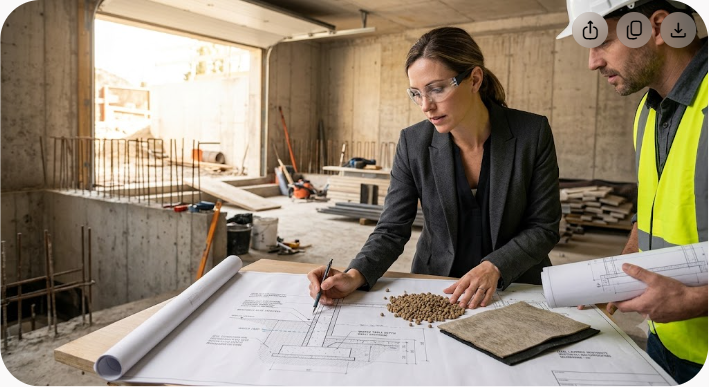
When purchasing sodium bentonite for a waterproofing-related application, useful technical properties to review include:
The exact test method should be agreed upon before comparing supplier data. Two suppliers can report apparently similar numbers using different test procedures, making a direct comparison misleading.
Loose bentonite can make sense when the project is specifically designed around the properties of the raw clay.
For example, sodium bentonite may be used in engineered soil barriers, sealing mixes, selected borehole or excavation applications, or systems where the clay is mixed with another material to achieve a specified permeability.
It can also be supplied in different physical forms depending on the application. Fine powder hydrates quickly and is useful for controlled mixing, while granular products and pellets can be easier to place in selected sealing applications.
The important question is whether the application provides adequate confinement and uniform coverage.
Loose bentonite becomes a poor choice when someone treats it as a universal waterproofing powder. Sprinkling clay around a leaking foundation, for example, doesn't reproduce the performance of a properly installed bentonite membrane. Water movement can carry particles away, uneven placement can create weak points, and the material may not remain where it was originally installed.
If a project specification calls for a GCL or a proprietary bentonite waterproofing membrane, replacing it with loose bentonite should not be treated as an equivalent substitution without engineering approval.
A bentonite membrane becomes attractive when you need a controlled waterproofing layer that can be installed over a defined surface.
Typical applications include:
The exact suitability depends on the membrane product, substrate, water conditions, structural design, and installation requirements.
For building waterproofing, the membrane's carrier layer can make a major practical difference. It allows the installer to handle the bentonite without trying to spread a precise loose-clay layer over a vertical or irregular surface.
This doesn't eliminate installation risk. Seams, penetrations, corners, terminations, construction joints, damaged sections, and transitions between materials still require careful detailing.
Start with the application rather than the product name.
Are you trying to stop groundwater from reaching a concrete wall? Seal a soil layer? Reduce seepage through a containment structure? Protect an underground structure?
Different objectives require different systems.
Horizontal applications are usually easier to control than vertical applications. A loose material can be distributed over a prepared horizontal surface, but maintaining uniform coverage on a vertical wall is much more difficult.
For vertical construction waterproofing, an engineered membrane can provide much better control over material placement.
Consider whether the material will see intermittent moisture, continuous groundwater, hydrostatic pressure, saline water, contaminated water, or water containing chemicals.
Bentonite performance can change in the presence of dissolved salts and certain chemicals. A product that performs well with fresh water should not automatically be assumed to behave identically in a high-salinity environment.
Ask what will physically hold the hydrated bentonite in place.
Soil pressure, concrete, geotextiles, cover materials, or other structural components may provide confinement depending on the system. If you cannot clearly explain how the bentonite will remain concentrated in the waterproofing zone, the design needs another look.
Consider settlement, joint movement, substrate irregularities, penetrations, construction sequencing, and potential damage from other trades.
A waterproofing system doesn't exist in isolation. It has to survive the actual construction process.
For a raw bentonite purchase, establish the required physical and performance properties before selecting a supplier.
For a membrane, review the manufacturer's installation instructions and project-specific performance requirements.
A good membrane can still fail if it is installed incorrectly.
The details vary by product, but the following principles are broadly important.
The supporting surface should be reasonably smooth, stable, and free of conditions that could damage the membrane. Sharp projections, loose debris, uncontrolled voids, and unsuitable surfaces can compromise continuity.
Bentonite membranes are installed in panels or rolls, so joints become part of the waterproofing system. Overlaps must follow the manufacturer's requirements, including any specified minimum overlap or supplementary bentonite detailing.
Do not assume that simply touching two sheets together creates a reliable waterproof joint.
Pipes, piles, tie rods, drains, construction joints, corners, and changes in geometry are common weak points in waterproofing work. These areas may require additional bentonite products or compatible detailing materials.
A membrane that is punctured after installation isn't performing as designed. Construction traffic, reinforcement placement, backfilling, formwork, and subsequent trades can all create damage.
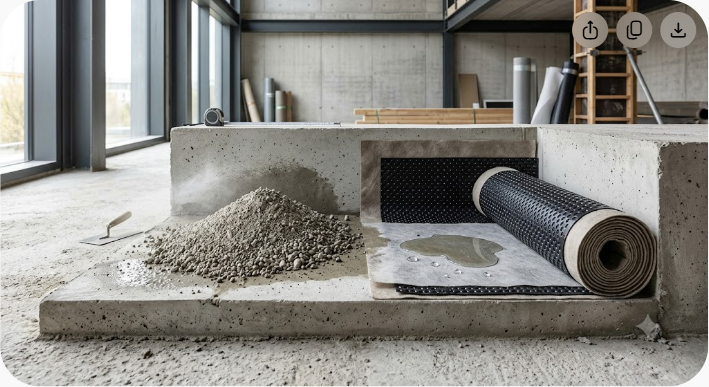
Protection requirements depend on the system. Follow the product-specific instructions rather than relying on a generic assumption that soil or concrete will automatically protect the membrane.
Many bentonite waterproofing systems depend on confinement to achieve their intended sealing performance. The final assembly therefore matters as much as the membrane itself.
Loose bentonite can contribute to a foundation waterproofing design, but simply placing raw bentonite around a concrete foundation isn't equivalent to installing a dedicated bentonite membrane.
A foundation system has to account for groundwater pressure, concrete joints, penetrations, construction tolerances, soil movement, drainage conditions, and the way the bentonite will remain confined.
For a new below-grade structure, a purpose-designed bentonite membrane may provide a more predictable installation method. The membrane places a defined bentonite layer at the waterproofing interface and is designed around the surrounding construction.
If you're dealing with an existing foundation leak, loose bentonite is also rarely a straightforward repair material. Finding the actual leakage path is usually more important than adding clay somewhere near the affected area.
Bentonite is not a single standardized material. Sodium and calcium bentonite can behave very differently, and even sodium bentonites can vary significantly in swelling, fluid loss, mineral composition, and performance.
This is one of the most important errors.
A highly swelling clay still needs the right physical conditions to form an effective barrier. If it can freely expand into a large void, its density at the sealing interface may become inadequate.
Powder, granules, pellets, and manufactured membranes aren't interchangeable simply because they contain the same mineral.
Product form affects placement, hydration, mixing, dust control, handling, and sealing behavior.
Free swell is useful, but it doesn't tell the entire story.
Fluid loss, hydraulic conductivity, particle size, mineralogy, and chemical compatibility may all matter depending on the application. A waterproofing specification should use the properties that actually control performance in service.
Fresh groundwater and saline or chemically affected water can produce different bentonite behavior. High concentrations of dissolved ions may reduce swelling compared with the same clay hydrated in low-salinity water.
If the application involves seawater, brine, industrial wastewater, or another unusual liquid, test compatibility rather than assuming freshwater performance.
A membrane doesn't solve poor detailing by itself. Seams, penetrations, joints, corners, transitions, and damage protection are all part of the final system.
The raw clay may contain the same active mineral, but the engineered product provides additional functions such as controlled distribution and physical containment. Those functions are part of its design value.
Bentonite isn't the only approach to below-grade waterproofing. Depending on the structure, designers may also consider sheet membranes, liquid-applied membranes, cementitious waterproofing, PVC or other synthetic liners, drainage systems, or combinations of several methods.
Bentonite has a distinctive advantage: the clay can swell and seal localized imperfections when it is properly confined and the system is designed to accommodate that behavior.
At the same time, bentonite is not a universal answer. Some environments demand a membrane with different chemical resistance, higher movement tolerance, or a particular performance history.
The best comparison is therefore not 'bentonite versus every other waterproofing material.' It is whether the bentonite system fits the project's water conditions, structure, installation sequence, and service requirements.
Whether you're purchasing raw sodium bentonite for a formulation or sourcing material for a construction product, ask questions that reveal actual performance.
A useful supplier discussion should cover:
These questions are especially important when a buyer is sourcing internationally. A reliable supply isn't just about having enough mineral in the ground. Consistent processing, quality control, packaging, documentation, and logistics all affect the finished application.
For projects that depend on sodium bentonite performance, the starting material deserves careful attention. Axewelledge supplies bentonite for construction and other industrial applications, with processing and quality-control capabilities intended to support consistent mineral supply.
If you're developing a waterproofing product, GCL, sealing compound, or another bentonite-based system, the useful conversation is not simply about buying a high-swelling clay. Share the intended application, required particle size, performance targets, packaging requirements, and destination market so the material can be matched to the process.
For international buyers, that approach also makes it easier to align technical specifications with shipping and production requirements before an order is placed.
If you're still deciding between loose bentonite and a bentonite membrane, use these questions:
A common purchasing mistake is to compare two bentonite products using one headline number. For example, a buyer may see a high free-swell value and assume that product will automatically deliver better waterproofing.
Real systems are more complicated.
The bentonite's mineralogy affects hydration. Particle size affects distribution and handling. Water chemistry affects swelling. Confinement affects the density of the hydrated clay. The membrane construction affects how the clay is held in place. Installation affects continuity. Structural movement affects long-term integrity.
That's why good waterproofing design connects material properties with system design.
A raw bentonite supplier should be able to describe the material clearly. A membrane manufacturer or waterproofing specialist should be able to explain how that material is incorporated into the complete system.
Bentonite and bentonite membranes shouldn't be treated as competing versions of the same product. Bentonite is the reactive sealing clay; a bentonite membrane is an engineered waterproofing assembly built around that clay.
Use raw sodium bentonite when the project is specifically designed to control its placement, hydration, and confinement. Choose a bentonite membrane or GCL when you need a manufactured waterproofing layer with controlled bentonite distribution and a defined installation system.
Before buying, look beyond the product name. Check swelling, fluid loss, particle size, mineral composition, water chemistry, confinement, installation conditions, and the requirements of the finished structure.
For manufacturers and contractors sourcing sodium bentonite for waterproofing-related applications, Axewelledge can help evaluate the material requirements and supply format against the intended use. A clear technical specification at the start usually saves far more time than trying to correct a poor material match later.













Have questions about our products? We're here to help!