Axewelledge, a leading exporter from India, specializes in high-quality Bentonite. With a commitment to excellence, we supply premium Bentonite to the Middle East and Southeast Asia markets.


North Angle Complex, 304,
150 Feet Ring Rd, Opposite Ambedkar Nagar BRTS Stop,
Madhav Park, Punit Nagar,
Mavdi, Rajkot, Gujarat 360004
© Axewelledge 2026, All Rights Reserved.
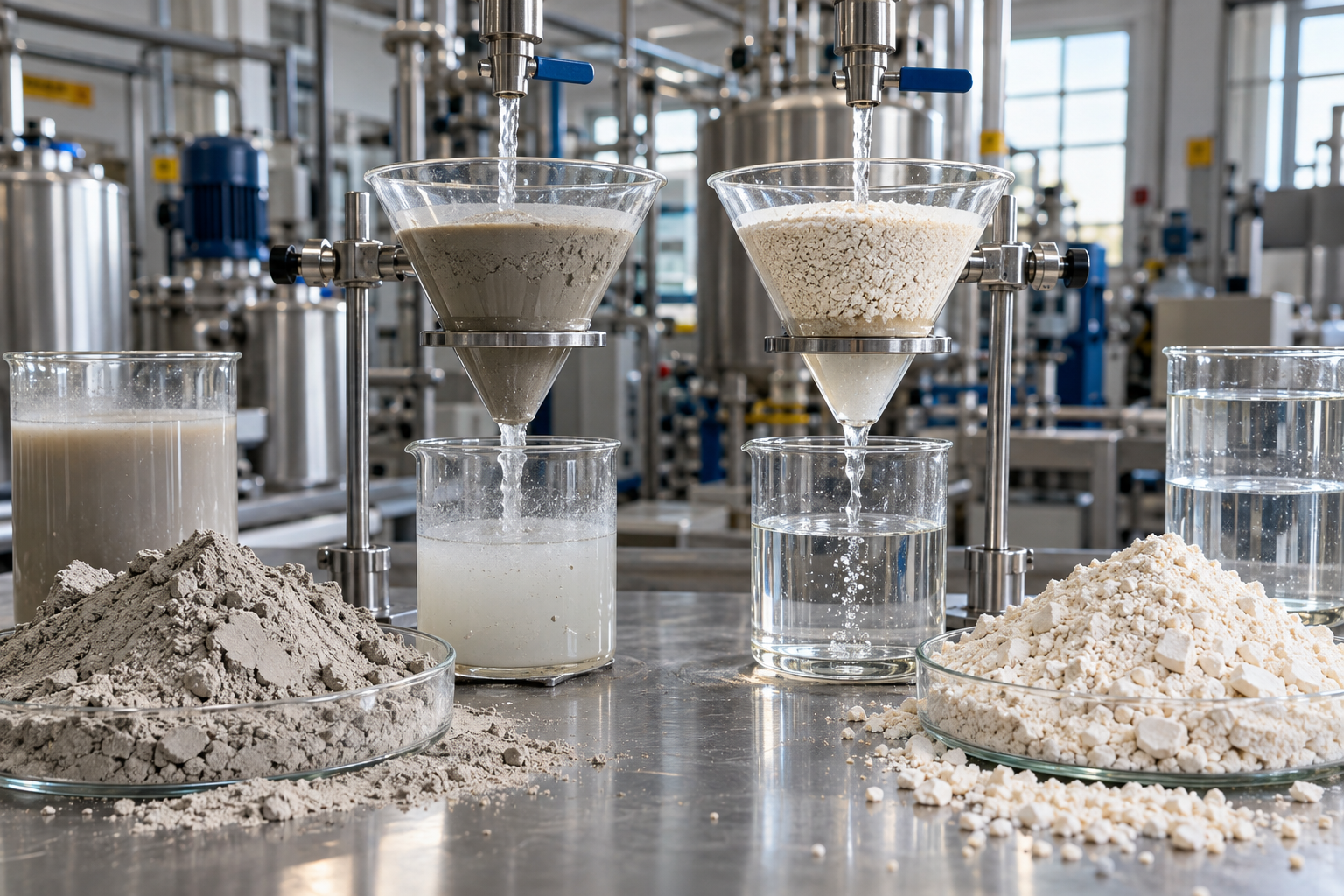
Bentonite and diatomaceous earth are both natural mineral materials, but they solve filtration problems in very different ways. Diatomaceous earth is generally the more suitable choice when you need a porous filter aid that forms a permeable cake and captures fine suspended solids. Bentonite is more useful when adsorption, swelling, binding, clarification, or particle conditioning is part of the treatment objective.
That difference matters in practice. Choosing a mineral simply because both materials arrive as fine powders can result in slow flow, poor clarification, higher media consumption, or a filter cake that's difficult to remove and dispose of.
If you're comparing bentonite vs diatomaceous earth for filtration, begin with the job the material needs to perform. Are you trying to physically retain suspended particles? Or do you need a mineral that interacts with contaminants through adsorption and surface chemistry? Once that question is clear, the choice becomes much easier to evaluate.
Bentonite is a clay-rich mineral, commonly dominated by smectite minerals such as montmorillonite. Its practical properties include water absorption, swelling, high surface area, colloidal behavior, and adsorption capacity. Depending on its mineralogy and processing, bentonite can be used in clarification, binding, sealing, drilling fluids, wastewater treatment, and other industrial processes.
Diatomaceous earth, often abbreviated as DE, is a siliceous material formed largely from the fossilized remains of microscopic aquatic organisms called diatoms. Its filtration value comes from its porous particle structure. When used as a filter aid, DE can create an open filter cake with numerous pathways for liquid to pass through while suspended particles are retained.
So while both materials can interact with contaminants, they aren't interchangeable filter media.
A useful way to frame the difference is:
There are specialized applications and exceptions, but this distinction is a useful starting point for material selection.
Bentonite is a naturally occurring clay material used across many industries because of the way its mineral surfaces interact with water and other substances. Sodium bentonite is particularly known for strong hydration and swelling, while calcium bentonite generally shows different hydration and swelling characteristics.
In filtration and water treatment, bentonite isn't normally used in the same way as a conventional porous filter aid. Its value may instead come from adsorption, particle binding, modification of particle behavior, or support for clarification and flocculation processes.
Once hydrated, bentonite particles can become extremely fine and remain dispersed in water. That behavior can be useful when the process is designed around it, but it can create problems when it isn't. If bentonite is added without considering dosage, mixing, settling, and downstream separation, it can increase the fine-solids load rather than make filtration easier.
This is one of the most important points about bentonite filtration: adding bentonite doesn't automatically make water filter faster or become clearer.
The treatment system must also provide an effective way to remove the bentonite and whatever material it has captured.
Bentonite can interact with suspended particles and other substances through charged mineral surfaces and high surface area. Depending on the liquid chemistry and target contaminant, it may contribute to adsorption or help form larger agglomerates when used with an appropriate coagulation or flocculation system.
The result depends on several variables, including pH, mineral composition, particle size, dosage, mixing energy, ionic conditions, and the nature of the contaminants.
For that reason, industrial users generally evaluate bentonite through jar tests or process trials rather than assuming that one fixed dosage will work across different liquids.
Sodium bentonite is often selected when strong hydration and swelling are desirable. Those properties are valuable in sealing, drilling, and selected treatment applications, but they don't make sodium bentonite a direct replacement for a porous DE filter aid.
In a filtration process, strongly swelling bentonite can form a dense layer and increase resistance to liquid flow. If the process depends on high permeability, that behavior may work against the desired result.
Diatomaceous earth is widely used as a filtration aid because its particles have a naturally porous structure. At microscopic scale, the silica-rich remains of diatoms create a complex network of small spaces.
In a typical DE filtration process, the material may be applied as a precoat on the filter surface or added during filtration as body feed. The resulting filter cake provides many tortuous pathways through which liquid can move.
Suspended particles are retained within or on that porous structure while clarified liquid passes through.
DE grade matters considerably. Finer grades can provide tighter particle retention, but they can also create greater resistance to flow. Coarser grades generally offer greater permeability, although they may allow some smaller particles to pass.
That's why industrial DE filtration isn't simply a question of whether DE is good or bad. The useful question is whether the grade, permeability, cake thickness, pressure conditions, and target particle size fit the process.
| Feature | Bentonite | Diatomaceous Earth |
|---|---|---|
| Primary mineral character | Clay-rich mineral | Porous siliceous material |
| Main filtration role | Adsorption, binding, clarification, treatment support | Filter aid and mechanical particle retention |
| Water interaction | Strong hydration and, depending on type, swelling | Does not behave like a swelling clay |
| Filter cake behavior | Can form dense layers depending on conditions | Typically creates a porous, permeable cake |
| Adsorption potential | Often an important property | May adsorb some substances, but filtration is its primary role |
| Typical strength | Surface interaction and binding | Physical retention of suspended solids |
| Fine-particle filtration | Process dependent | Strong when an appropriate grade is selected |
| Flow resistance | Can become high if excessive or poorly conditioned | Depends strongly on grade and cake thickness |
| Common treatment role | Clarification, adsorption, binding, wastewater support | Liquid clarification and filter-aid applications |
| Key selection factor | Mineralogy, swelling, surface chemistry, dosage | Grade, permeability, particle retention, and cake formation |
There isn't one universal answer because the two materials are suited to different mechanisms.
If the main requirement is fine suspended-solid removal through a porous filter cake, diatomaceous earth is usually the more natural starting point.
If the process needs adsorption, binding, clarification, or modification of contaminant behavior, bentonite may have a role, either as a treatment material or as one part of a broader treatment sequence.
Consider a liquid containing suspended particles that must be removed continuously through a pressure filter. A properly selected DE grade may fit this application because the material is designed to form a permeable filtration layer.
Now consider a wastewater stream containing contaminants that interact with clay surfaces. Bentonite may contribute useful adsorption or binding behavior before the solids are removed through sedimentation, a filter press, or another downstream process.
The treatment objective changes the answer.
Bentonite deserves consideration when the treatment problem involves more than simple mechanical particle separation.
Bentonite has a high surface area and charged mineral surfaces that can interact with certain substances. Actual adsorption performance depends on the bentonite type and liquid chemistry, so application testing is important.
Bentonite can bind or interact with suspended material in selected treatment systems. In some processes, it can be combined with other treatment chemicals to improve particle agglomeration and subsequent separation.
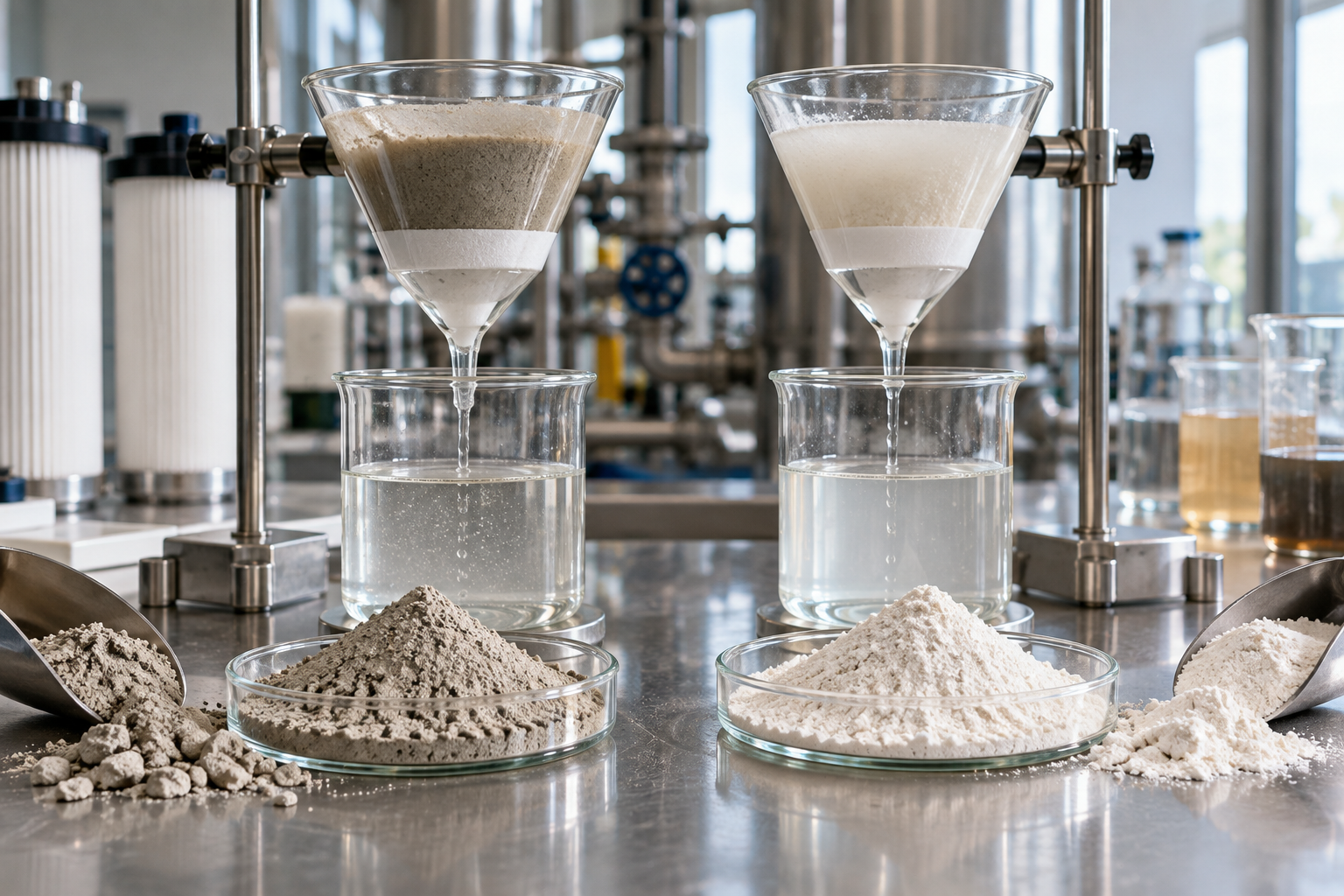
Bentonite becomes more practical when the treatment system has an effective way to remove the resulting solids. Depending on the application, that could involve settling, dissolved air flotation, a filter press, centrifugation, or another separation method.
Not all bentonite behaves the same way. Sodium bentonite, calcium bentonite, and processed or modified grades can have significantly different hydration and performance characteristics.
For industrial procurement, the technical specification should therefore cover more than the word 'bentonite.' Ask about mineral composition, moisture, particle-size distribution, swelling behavior, viscosity where relevant, and other parameters tied to the intended application.
DE is often the better starting point when the process is fundamentally a solid-liquid filtration problem.
DE is specifically used to create a porous cake that supports liquid flow while retaining suspended solids.
Different DE grades are available for different filtration requirements. A finer material can help retain smaller particles, while a more permeable grade can support higher flow rates.
In properly designed filtration systems, DE can provide a controllable filtration layer. Operators can adjust grade, precoat quantity, body-feed rate, pressure, and other process variables to balance clarity and throughput.
If the equipment is designed for DE filtration, switching to bentonite isn't simply a matter of replacing one powder with another. Hydraulic behavior, cake permeability, pressure drop, dosing, and solids-disposal requirements may all change.
The mineral name is only one part of the equation. Filtration performance depends on the interaction between the material, liquid, contaminants, and equipment.
These are the variables worth checking before choosing either mineral.
Particle size affects both contaminant capture and pressure drop. A very fine material can provide tighter separation, but it may also reduce permeability.
With DE, this is one reason grades are selected according to the filtration target rather than simply choosing the finest available powder.
With bentonite, particle size also affects hydration, dispersion, settling behavior, and the characteristics of the resulting solids.
A filter cake needs enough structure to retain solids without becoming an impermeable barrier.
This is where DE has an important advantage in applications specifically designed around filter aids. Its porous particle structure can maintain pathways for liquid flow.
Bentonite can behave differently because hydrated clay particles may pack densely and create significant resistance to flow.
As a filtration cycle progresses, the cake normally accumulates solids and resistance increases. If pressure rises too quickly, the process may become inefficient even if the filtrate initially looks excellent.
Track pressure alongside flow rate and filtrate quality. A clear liquid produced at very low throughput isn't necessarily a successful filtration process.
pH, ionic strength, dissolved salts, temperature, organic content, and contaminant type can all influence mineral behavior.
This is particularly important for bentonite because its swelling and dispersion characteristics can change substantially with water chemistry.
More mineral doesn't automatically mean better filtration.
An excessive dose can increase solids generation, reduce throughput, raise disposal requirements, and increase operating costs. Start with controlled testing and measure the actual process response.
If you're choosing between the two for an industrial process, don't make the decision from a product brochure alone. Run a controlled comparison using representative material and realistic operating conditions.
A useful evaluation can follow these steps:
This is the most common conceptual mistake. Two mineral powders can look similar in a bag and behave very differently once they contact water.
DE is valued for its porous filtration structure. Bentonite is valued for clay-mineral behavior, including hydration, swelling, binding, and adsorption.
Fine isn't always better.
A finer filter aid can increase resistance and reduce throughput. Highly dispersed clay can also make downstream separation more difficult.
The right material is the one that delivers the required separation at an acceptable flow rate and total cost.
Every treatment decision creates a solids-management question.
If bentonite captures contaminants, the resulting solids still need to be separated and handled. If DE forms a filter cake, the spent DE and captured solids also require disposal or further processing.
A filtration system isn't finished when the liquid looks clear. You also need to know what happens to the solids afterward.
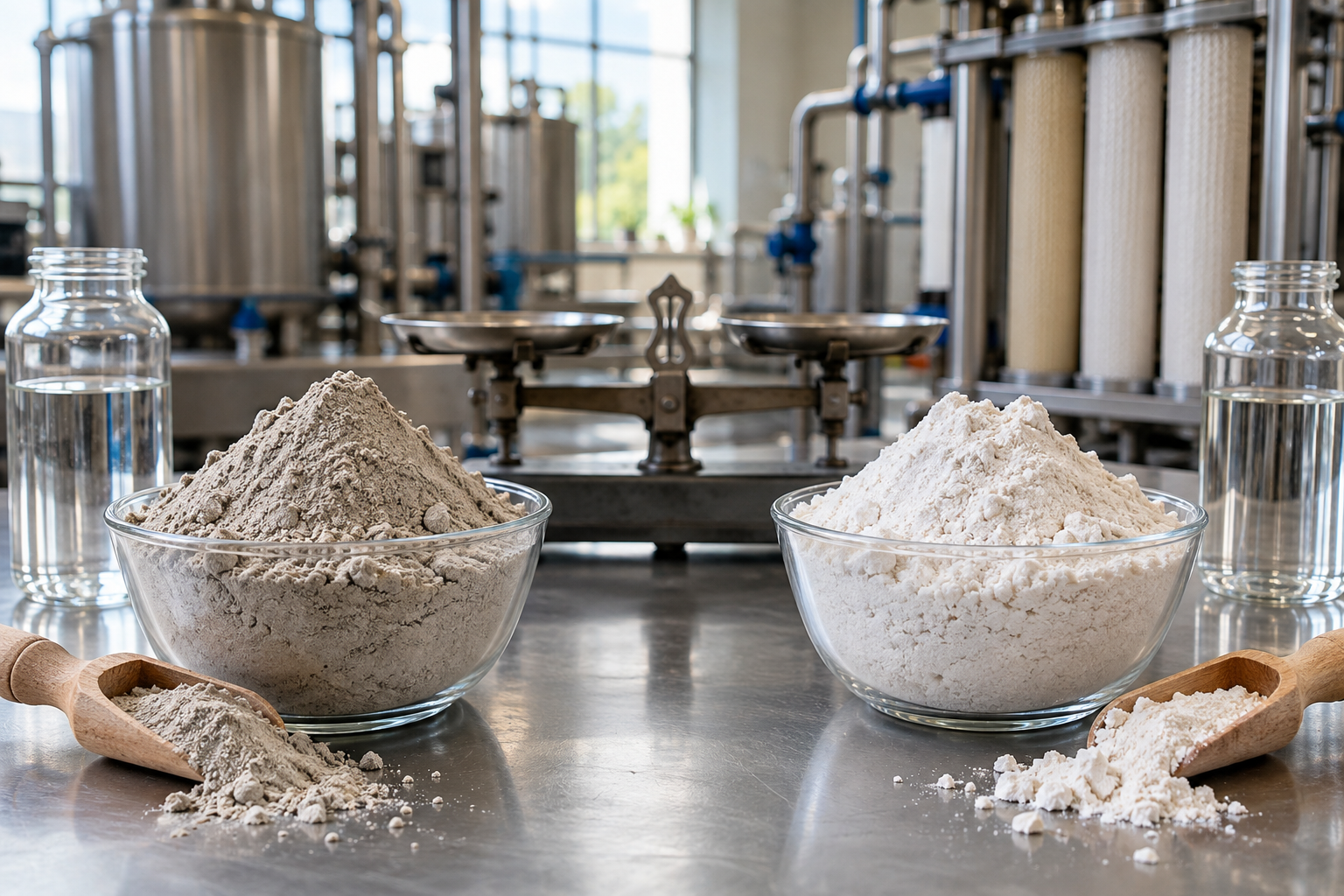
A lower purchase price doesn't necessarily mean a lower filtration cost.
A more useful calculation is the total mineral cost required to process a defined volume of liquid at the required quality. Add disposal and operating costs before comparing alternatives.
The term bentonite covers materials with different mineralogical and performance characteristics. A grade intended for drilling, foundry work, sealing, or another application may not automatically be suitable for filtration.
Always match the specification to the intended treatment.
In some treatment systems, different materials can be used at different stages, but combining bentonite and DE isn't automatically beneficial.
A process might use bentonite or another adsorbent during a conditioning stage and then separate the resulting solids with a downstream filtration step. In another process, DE might be used as the filter aid while a different treatment chemical addresses dissolved contaminants.
The key is to give each material a defined job.
If bentonite is added to capture or bind a target contaminant, the process needs an effective separation step afterward. If DE is used to improve mechanical filtration, its grade and dosing should be optimized for the resulting solids load.
Before combining materials, test whether the additional mineral improves the final process enough to justify its cost and additional solids generation.
Suppose the main problem is a stream containing fine suspended particles that need to be retained by a pressure filtration system.
Here, DE is a logical candidate because its primary role is to form a permeable filter cake. The operator can evaluate different grades based on clarity, flow, pressure rise, and cake capacity.
Bentonite wouldn't automatically be a substitute because hydrated clay can increase resistance and may itself become part of the solids load.
Now suppose the objective includes adsorption or binding in addition to suspended-solids removal.
Bentonite may be worth evaluating as a treatment component. The process could involve conditioning followed by a separate solid-liquid separation step.
In this situation, judging bentonite only by its ability to act as a porous filter aid would overlook the properties that may actually matter most.
If the process must move a large liquid volume continuously, pressure drop becomes critical.
A filtration aid with suitable permeability may be preferable to a material that forms a dense, resistant layer. This is one reason DE grade selection matters in high-throughput filtration systems.
The best material isn't necessarily the one that produces the lowest turbidity in a small beaker. It's the one that maintains the required liquid quality at a practical throughput.
If bentonite is part of your process, begin with the application rather than the product name.
Ask your supplier for technical data covering properties relevant to the process. Depending on the application, useful information may include:
For filtration-related applications, also ask whether the supplier has application data for liquids with similar chemistry and contaminant loads.
A supplier that understands the end use should be able to discuss more than price per ton.
DE selection also needs to be tied to the process rather than based on a generic product description.
Important questions include:
A coarse grade may support better permeability, while a finer grade may provide tighter particle retention. The right balance depends on the actual feed and equipment.
Water filtration covers many different processes, so the answer depends on what 'filtration' means in the application.
For relatively simple suspended-solids removal, a conventional filtration medium may be more appropriate than either bentonite or DE. DE can be useful in specialized liquid-clarification systems where a filter aid is required.
Bentonite may have a role in water treatment where adsorption, clarification, or contaminant binding is relevant, but it generally needs an appropriate solids-separation step if the treated water must be clear.
For drinking-water applications, material selection also has to account for applicable local regulations, treatment standards, and product certifications. Industrial and potable-water requirements should not be treated as identical.
Wastewater is particularly sensitive to process conditions because the contaminant mix can vary substantially from one facility to another.
Bentonite can be considered in selected wastewater-treatment systems because of its surface properties and ability to interact with suspended or dissolved substances. However, the resulting solids still need to be separated effectively.
DE can support filtration where a filter aid is needed to improve the capture of suspended particles. Its effectiveness depends on the filter configuration, grade, solids concentration, and operating conditions.
For either material, jar tests and pilot trials can be valuable because wastewater chemistry can make laboratory assumptions unreliable at production scale.
There is no meaningful universal answer based only on the price of the dry material.
Actual cost depends on dose, replacement frequency, filtration rate, solids generation, equipment requirements, disposal cost, and labor.
For example, a material that costs more per kilogram but requires less material per cubic meter and maintains higher throughput may have a lower total process cost. Conversely, a low-cost mineral can become expensive if it causes frequent filter cleaning or produces large quantities of difficult-to-handle waste.
For procurement teams, a useful comparison is cost per cubic meter of acceptable filtrate rather than cost per kilogram of mineral.
Both bentonite and DE are mineral powders, so good industrial housekeeping matters.
Avoid creating unnecessary airborne dust during unloading, transfer, and mixing. Use appropriate ventilation and personal protective equipment based on the material's safety data sheet and the workplace risk assessment.
DE requires particular attention to its silica content and the specific form of the product. Not all DE products have identical composition or hazard profiles, so users should review the current safety data sheet for the exact grade being handled.
Bentonite can also generate dust during dry handling. Once hydrated, it can create slippery surfaces and difficult-to-clean deposits if spills aren't managed promptly.
Good storage practices matter as well. Keep mineral products dry before use, protect bags from moisture, and follow supplier instructions for storage and handling.
If you're still deciding between bentonite and diatomaceous earth, work through these questions.
Do you mainly need to capture suspended particles through a filter cake? Start by evaluating DE.
Do you need adsorption, binding, swelling, or clarification as part of the treatment? Evaluate bentonite or another suitable treatment material alongside the required separation method.
Is high throughput important? Pay close attention to permeability, pressure drop, cake thickness, and media consumption.
Is the contaminant chemistry complex? Run laboratory testing rather than selecting a mineral from a generic application list.
Will the treatment generate a large amount of solids? Include solids handling and disposal in the process economics.
Are you treating potable water or another regulated liquid? Verify the applicable specifications and certifications for the exact product and application.
Bentonite and diatomaceous earth aren't two versions of the same filtration material. DE is primarily a porous filter aid for mechanical separation, while bentonite is a clay mineral whose value often comes from adsorption, binding, swelling, and clarification behavior.
If your process needs a permeable cake that captures suspended solids, investigate the appropriate DE grade first. If the challenge involves contaminant interaction, adsorption, or binding before solids separation, bentonite may deserve a place in the treatment process.
The practical choice should come from testing the material against your actual liquid, contaminant load, equipment, and throughput requirement. A controlled trial can reveal far more than a generic claim that one mineral is simply better than the other.
For industrial applications, Axewelledge can help buyers evaluate bentonite specifications around the intended use rather than treating every bentonite product as identical. Share your application, target contaminant, required throughput, and preferred specification so the appropriate grade can be assessed for your process.













Have questions about our products? We're here to help!