Axewelledge, a leading exporter from India, specializes in high-quality Bentonite. With a commitment to excellence, we supply premium Bentonite to the Middle East and Southeast Asia markets.


North Angle Complex, 304,
150 Feet Ring Rd, Opposite Ambedkar Nagar BRTS Stop,
Madhav Park, Punit Nagar,
Mavdi, Rajkot, Gujarat 360004
© Axewelledge 2026, All Rights Reserved.
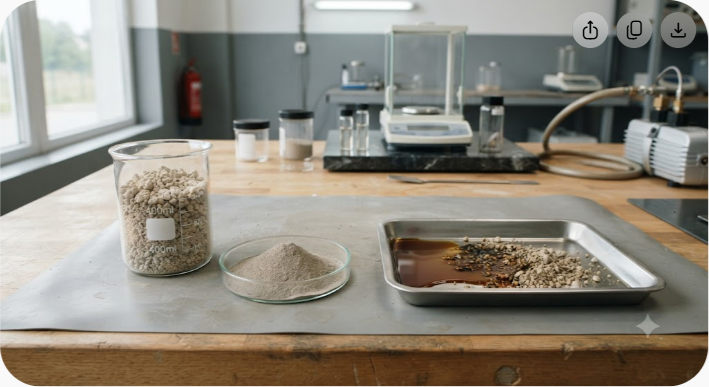
The short answer: for routine dry cleanup of oil and grease on a solid surface, Fuller's earth is often the more conventional starting point. Bentonite can also be used as an oil sorbent, but its performance depends much more on grade, processing, particle structure, and whether the application involves dry oil, an oil-water mixture, or a formulated product.
The important point is that neither name tells you enough by itself. Fuller's earth is a broad commercial term rather than one precisely defined mineral, while bentonite covers materials with different mineralogy, swelling behavior, particle sizes, and treatments. A granular clay used to clean hydraulic oil from a concrete floor is solving a different problem from a finely processed clay used in oil refining or an organoclay designed to interact with hydrocarbons in water.
So, which is better for oil absorption? It depends on the job. Fuller's earth often makes practical sense for dry oil and grease cleanup because absorbent grades have a long-established use in that area. Bentonite becomes more relevant when swelling, binding, formulation requirements, or modified surface chemistry are useful. The right comparison is not simply bentonite versus Fuller's earth. It is one specific grade versus another under the conditions where the material will actually be used.
At first glance, bentonite and Fuller's earth can look almost interchangeable. Both are naturally occurring mineral clays, both can interact with liquids, and both can be supplied as powders or granules. Their behavior can be quite different once they are processed for a particular application.
Bentonite is primarily associated with smectite minerals, especially montmorillonite. Sodium-rich bentonite is well known for hydration, swelling, dispersion, and gel formation. Those properties make it valuable in drilling fluids, geotechnical sealing, foundry applications, and other water-based systems.
Fuller's earth is a broader material category. Depending on the deposit, it may contain palygorskite, calcium-rich smectite, or other clay minerals. Some Fuller's earth materials have characteristics that overlap with bentonite, which is one reason the commercial names can sometimes create confusion.
For oil absorption, a useful practical distinction is:
That distinction matters because oil absorption is not one single use case. A maintenance team cleaning hydraulic oil from concrete needs a material with different properties from a processor treating an oily wastewater stream.
Fuller's earth is best understood as a functional group of clay materials rather than a single mineral species.
The name has a long history. Fullers traditionally used clay to remove greasy substances such as lanolin from wool. That historical use is closely tied to the material's reputation for handling oily and greasy substances. Modern Fuller's earth products can contain different clay minerals depending on their geological source and processing route.
Some deposits are rich in palygorskite, also known as attapulgite. Others contain substantial montmorillonite or related smectite minerals. As a result, two products marketed as Fuller's earth can have noticeably different pore structures, surface properties, particle sizes, and liquid uptake.
For industrial spill cleanup, Fuller's earth is often processed into granules. Granulation changes how the material behaves in the field. A useful absorbent needs more than mineral surface area. It must spread across a contaminated area, contact the oil, retain the liquid, resist excessive breakdown, and remain practical to collect afterward.
Fuller's earth also has applications outside spill response. Certain grades have been used for filtration and decolorization of oils and fats, as well as in cleaning compounds and other absorbent products. Those applications shouldn't be confused with floor cleanup, though. A clay selected for oil refining isn't automatically the best choice for absorbing a puddle of hydraulic oil.
The phrase Fuller's earth does not guarantee a fixed oil absorption value. Important variables include:
This is why industrial buyers should ask for a technical specification rather than relying on the material name alone.
Bentonite is a naturally occurring clay dominated by smectite, particularly montmorillonite. Its most familiar characteristic is swelling when suitable grades come into contact with water.
That behavior is extremely useful in applications where hydration and gel formation are desirable. Drilling fluids, geosynthetic clay liners, water well drilling, foundry sand, construction sealing, and other industrial processes all make use of different bentonite grades.
Oil absorption is a different challenge.
Oil is largely hydrophobic, so the properties that make a bentonite excellent for water retention do not automatically make it an excellent dry oil absorbent. A standard sodium bentonite selected primarily for swelling in water should not be assumed to have the same performance as a granular product specifically engineered for oil pickup.
Processing can change the practical behavior substantially. Bentonite may be dried, milled, screened, granulated, blended, activated, or chemically modified depending on the intended use. Organophilic or organoclay-treated bentonite is especially relevant when the target is a hydrophobic organic compound rather than water.
For ordinary spill cleanup, however, theoretical surface area isn't enough. The absorbent must also be easy to spread, capable of retaining oil, manageable during collection, and appropriate for the intended disposal route.
Yes, bentonite can sorb oil, but that doesn't mean every bentonite product is an effective oil-spill absorbent.
Performance depends on mineralogy, particle size, porosity, surface treatment, moisture, oil characteristics, and processing. Modified bentonite or organoclay can be particularly useful when the application involves hydrocarbons dispersed in water, while a suitable granular bentonite may be considered for dry surface cleanup.
The specification is what separates a useful application-grade product from a generic clay powder.
The word "absorb" can hide an important distinction. Clay-based oil cleanup may involve both absorption and adsorption.
Absorption occurs when liquid enters the internal structure or pore spaces of a material. Adsorption describes molecules accumulating on surfaces. In a porous mineral granule, both mechanisms may contribute to the total amount of oil retained.
Several physical and chemical properties influence the result.
Smaller particles generally expose more surface area per unit mass. That can increase contact with oil, but making a material extremely fine isn't automatically an advantage.
Fine powders can become dusty, difficult to spread evenly, and harder to collect. For an open industrial spill, a well-designed granule may be more practical even if a fine powder has greater nominal surface area.
Pore structure determines how liquid can enter and remain within the absorbent. A material with useful internal pore volume may retain oil more effectively than a dense particle with limited accessible space.
Porosity also affects drainage. An absorbent that initially takes up oil but releases a large portion when compressed or handled may perform poorly in actual cleanup operations.
Montmorillonite, palygorskite, and other clay minerals have different structures and surface characteristics. Mineralogy therefore affects how a product interacts with water, oil, and other liquids.
This is one reason the term "clay absorbent" is too broad for an industrial purchasing specification.
Water already present in the product can affect available pore space, bulk density, handling, and measured liquid uptake. Two products with similar mineral names can produce different results if their moisture contents differ significantly.
For meaningful comparisons, oil absorption should ideally be considered on a consistent dry-material basis.
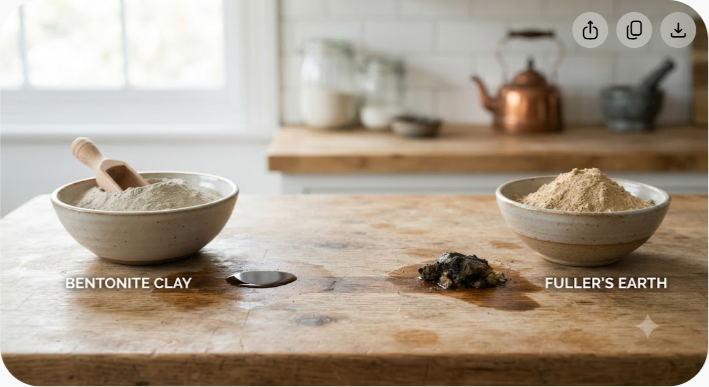
A coarse granule behaves differently from a fine powder. Granules are generally easier to distribute and recover during floor cleanup, while finer materials can be useful where mixing, filtration, or controlled processing is available.
Particle size also affects the speed of liquid contact. There is no universally correct mesh size for every oil-absorption application.
Light hydraulic oil, diesel, lubricating oil, vegetable oil, and heavy crude do not move through an absorbent at the same rate.
A material that performs well with a relatively mobile oil may take longer to load with a more viscous material. Temperature can matter as well because viscosity changes with temperature for many oils.
A short contact period can produce a different result from an extended soak. When comparing suppliers, make sure the test conditions are reasonably comparable.
A headline claim such as "absorbs twice its weight" has limited meaning unless you also know what oil was used, how long the contact lasted, what particle size was tested, and how excess oil was removed before weighing.
The following table is a practical starting point, not a universal performance ranking. Actual results should be confirmed for the specific product and application.
| Feature | Bentonite | Fuller's Earth |
|---|---|---|
| Main mineral association | Montmorillonite and other smectites | Often palygorskite or calcium-rich clay, depending on deposit |
| Best-known property | Swelling, binding, and rheology in suitable grades | Absorbent and adsorptive behavior in established applications |
| Oil and grease use | Possible, depending on grade and processing | Long-established commercial use |
| Water behavior | Sodium grades can swell strongly | Many grades are less swelling than sodium bentonite |
| Dry spill cleanup | Possible with suitable formulation and granulation | Common application for suitable granular grades |
| Fine-powder use | Common in industrial formulations | Common in filtration and absorbent applications |
| Granular absorbent use | Possible with suitable processing | Widely established |
| Oil refining | Selected grades may be used in related applications | Established use in certain filtration and decolorization processes |
| Oil in water | Specialty organoclay grades may be suitable | Depends on mineralogy and any surface treatment |
| Main purchasing considerations | Mineralogy, swelling, particle size, moisture, treatment | Mineralogy, porosity, particle size, moisture, absorbency |
The main takeaway is straightforward: the product specification matters more than the generic clay name.
For straightforward dry cleanup of oil or grease from a solid surface, Fuller's earth is often the more conventional starting point. Its established use as an oil and grease absorbent makes it relevant to workshops, manufacturing facilities, garages, maintenance areas, and similar environments.
That doesn't make Fuller's earth universally superior.
Consider an oily wastewater stream. The challenge is no longer simply picking up liquid from concrete. Oil droplets must be captured from a water-based system, and the sorbent has to interact with the hydrophobic material under those conditions. A properly selected organoclay may be more relevant than an untreated granular floor absorbent.
The same issue appears when physical handling becomes the main constraint. A facility may need a coarse, low-dust granule that spreads evenly and can be swept or vacuumed efficiently. In that case, granule structure, bulk density, dust generation, and oil retention may matter more than whether the underlying mineral is called bentonite or Fuller's earth.
A better question is: Which material provides the required oil uptake, retention, handling, and recovery performance under the actual operating conditions?
Bentonite becomes particularly interesting when oil absorption is only one part of the material's required function.
Untreated hydrophilic bentonite and engineered organoclay should not be treated as interchangeable materials.
For oil dispersed in water, organophilic modification can change the clay's interaction with hydrocarbons. This makes certain organoclays relevant to applications involving oily wastewater, cutting-fluid streams, produced water, and other hydrocarbon-contaminated liquids.
The exact formulation still matters. Water chemistry, salinity, oil composition, particle size, mixing conditions, and separation method can all influence performance.
Bentonite can be incorporated into a mineral absorbent formulation when swelling, binding, density, granule strength, or other properties are useful alongside liquid uptake.
In this type of application, oil absorption is only one design parameter. The manufacturer may also need to control dust, flowability, granule durability, moisture, and post-use handling.
Bentonite is already used across many industrial processes because different grades offer different combinations of swelling, binding, rheology, adsorption, and particle properties.
If an absorbent product must perform another function after or alongside oil pickup, bentonite may be worth evaluating rather than selecting a conventional floor absorbent by default.
Modified bentonite can provide a surface chemistry that is more compatible with hydrophobic organic compounds than untreated clay.
This is a specialty area, so performance should be established with the actual contaminant and water chemistry. It shouldn't be inferred simply from the fact that a product is labelled "organoclay."
Fuller's earth is particularly practical when the primary objective is to pick up oil, grease, or another liquid from a solid surface.
A properly processed granular product can be spread over a contaminated area, allowed to contact the liquid, and then collected. Its practical value comes from the combination of mineral surface characteristics, pore structure, particle size, granule strength, and handling behavior.
That last point is easy to underestimate. An absorbent is part of a cleanup process, not just a material sitting in a laboratory beaker. Workers need to spread it, allow contact, collect the spent material, and move it to the appropriate waste-handling stage.
For that reason, a product with slightly lower measured uptake can still be more practical if it generates less dust, spreads more evenly, holds oil securely, and is easier to recover.
Oil spill cleanup and oil refining can both involve clay, but they are not the same application.
A clay that picks up oil from a floor isn't automatically the right material for bleaching or refining an oil. Refining and bleaching earth applications can depend heavily on surface chemistry and adsorption of pigments, oxidation products, trace contaminants, and other unwanted compounds.
Certain Fuller's earth and activated clay products have established uses in the treatment of vegetable oils, mineral oils, fats, and greases. The process may involve controlled dosage, mixing, temperature, contact time, and filtration.
Spill cleanup has a different priority list. You may care most about:
A refining clay may be highly effective for one of those process requirements and unsuitable for another. Always match the grade to the job.
If you're purchasing bentonite or Fuller's earth for oil absorption, start with the application rather than the product name.
Write down exactly what you need to absorb.
Examples include hydraulic oil, lubricating oil, transformer oil, diesel, cutting fluid, vegetable oil, and crude oil. Their viscosity and composition can differ substantially.
If the oil comes from a known process, provide the supplier with the product name or technical description where appropriate. A generic term such as "industrial oil" isn't always enough to predict absorbent behavior.
This distinction eliminates many unsuitable products immediately.
For oil on concrete, asphalt, metal, or another solid surface, a conventional granular absorbent may be appropriate. For oil dispersed in water, you need to consider surface chemistry, water compatibility, buoyancy, salinity, mixing, separation, and the behavior of the loaded sorbent.
Don't use a dry-floor absorption specification as proof that a product will work in an oil-water system.
Decide whether you need powder, granules, pellets, or another engineered form.
For routine spill response, granules are generally easier to distribute and recover than very fine powders. Fine materials may be useful in controlled industrial processes where dust and recovery can be managed with suitable equipment.
Moisture affects handling, bulk density, pore availability, and measured absorption. When comparing products, ask whether reported absorption is based on the material as supplied or on a dry basis.
A product with higher moisture can appear different simply because part of its mass is water rather than mineral absorbent.
This question is frequently overlooked, yet it can change how an advertised number should be interpreted.
Ask for:
A capacity figure without its test conditions isn't enough to make a reliable purchasing comparison.
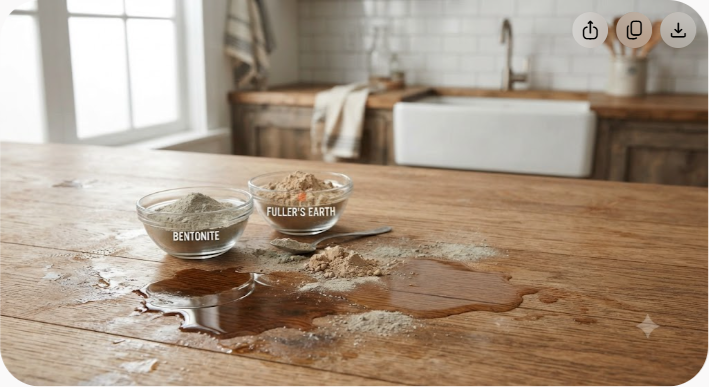
A controlled bench test is often more informative than a catalogue comparison.
Start by weighing a dry sample of each candidate material. Add a known amount of the actual oil. Allow a defined contact period under controlled conditions. Remove or drain free oil using the same procedure you expect to use in the real application. Weigh the loaded material and calculate the retained oil relative to the dry absorbent mass.
Repeat the test with each candidate under the same conditions.
For a serious industrial application, repeat testing across more than one batch. A single successful sample doesn't tell you much about long-term consistency.
Capacity isn't the whole story.
Check whether the loaded granules remain intact, whether oil drains out during handling, whether the absorbent leaves a residue, how much dust it creates, and how easily workers can sweep, vacuum, or otherwise collect it.
The product that wins on a laboratory capacity number isn't necessarily the product that produces the cleanest and fastest field cleanup.
Particle size affects both material behavior and practical handling.
A fine clay has a large surface area relative to its mass. This can increase contact with oil, but fine powder also presents more opportunities for dust generation and handling losses.
Coarser granules expose less surface area immediately, yet they can provide internal pore space for liquid retention while remaining much easier to distribute across a floor.
There is no universally correct particle size.
For a floor absorbent, you may prioritize a particle distribution that spreads evenly without becoming airborne and remains easy to collect. For a controlled mixing or treatment process, a much finer material may be acceptable or even preferable because the process equipment can manage dispersion and recovery.
This is why comparing a fine Fuller's earth powder with a coarse bentonite granule and then declaring one mineral superior isn't a meaningful test. You're comparing mineral chemistry and physical engineering at the same time.
For maintenance operations, particle size can influence:
The ideal balance depends on the equipment, workforce, spill size, oil type, and surface being cleaned.
It isn't. The term can describe different clay materials, including palygorskite-rich and montmorillonite-rich products. Their behavior can differ substantially.
A purchasing specification should therefore identify the relevant material characteristics rather than relying on the commercial name alone.
Bentonite grades differ in mineralogy, swelling behavior, particle size, processing, moisture, and surface treatment.
A sodium bentonite developed for water-based drilling fluid or sealing work isn't automatically equivalent to a bentonite product formulated as a dry oil absorbent.
A capacity figure without a test method can be difficult to interpret.
Different oils, temperatures, particle sizes, contact periods, and drainage procedures can produce very different results. Always ask what the number actually measures.
An absorbent used on a dry workshop floor has a different job from a sorbent intended to remove oil from water.
The presence of water can change wetting, dispersion, buoyancy, sorbent behavior, and separation requirements. Treat these as separate applications when evaluating products.
Fine powder can perform well in a controlled industrial process but create dust and recovery problems during open-area spill cleanup.
Choose the physical form for the way the product will actually be deployed.
Initial uptake is only part of performance. An absorbent that picks up oil but releases a significant amount during sweeping, transport, or compression may create secondary contamination.
Retention should be part of the application test.
Two suppliers can use the same commercial product name while supplying materials with different mineralogy, particle size, moisture, or processing.
Request a technical data sheet and representative sample. For important applications, verify the material with your own oil and operating conditions before committing to large-volume purchasing.
Consider a maintenance team dealing with a hydraulic-oil leak on a concrete factory floor.
The oil isn't mixed with water. The team needs a material that spreads quickly, picks up the liquid, remains manageable during sweeping, and can be collected for appropriate disposal.
A suitable coarse Fuller's earth-based absorbent is a logical candidate because this is a conventional oil-and-grease absorbent application. A suitable granular bentonite product could also work, but the team should verify its actual oil uptake, granule strength, dust behavior, and retention instead of assuming that the word "bentonite" guarantees performance.
Now change the problem.
The same facility has an oily wastewater stream. The objective is no longer to absorb a puddle from a solid floor. Oil is dispersed in water, so the material must interact with the hydrocarbon under aqueous conditions and then fit into the facility's separation and waste-management process.
A specialty organoclay may now deserve evaluation. Conventional floor-absorbent granules shouldn't be selected simply because they work well on concrete.
Same broad contaminant. Different engineering problem.
For industrial purchasing, ask for enough information to connect the material specification to the process.
A useful technical data sheet should identify, where relevant:
For larger procurement programs, request representative samples and information about batch consistency. A successful first sample is useful, but repeatable performance across shipments is what keeps an industrial process stable.
Before placing a large order, ask:
These questions move the discussion away from marketing terminology and toward measurable product performance.
Use the following framework as a starting point rather than as a substitute for application testing.
The final selection should come from verified application performance, not the material label alone.
Clay is a natural mineral, so deposit characteristics matter. Processing matters just as much when the final product is intended to meet a defined industrial specification.
Selective mining, drying, grinding, screening, blending, activation, and granulation can all affect the properties an end user sees. Moisture control and particle-size consistency can be particularly important when the product is supplied in large quantities.
For international buyers, consistency becomes even more important. Bulk bags, smaller bags, and other shipment formats need to suit the receiving plant's storage and handling equipment. Documentation should also match the material actually being shipped.
Axewelledge supplies processed bentonite for industrial applications and works with international customers that require consistent mineral products and export logistics. If bentonite is one of the candidates for your oil-absorption application, the most useful starting information is the oil type, intended use, particle-size requirement, and target performance. Those details provide a better basis for product selection than a generic request for "bentonite oil absorbent."
Bentonite and Fuller's earth can both interact with oil, but they shouldn't be treated as interchangeable materials.
For dry oil and grease cleanup on solid surfaces, a suitable Fuller's earth-based granular absorbent is often a practical starting point. Bentonite becomes more interesting when swelling, binding, formulation requirements, or engineered surface chemistry are part of the application. Even then, the exact bentonite grade matters.
Fuller's earth also needs product-level evaluation because the term covers more than one mineral composition. Two materials carrying the same commercial name can behave differently because of mineralogy, particle size, porosity, moisture, and processing.
When selecting an oil absorbent, compare the properties that determine real-world performance: mineralogy, particle size, moisture, porosity, oil type, absorption test method, retention, dust, spreadability, and ease of recovery.
Most importantly, test the actual product with the actual oil under realistic conditions. A controlled application test will tell you far more than a generic capacity claim.
For industrial buyers evaluating bentonite grades, Axewelledge can help move the discussion from a general mineral comparison toward a specification based on the application, particle requirements, and intended performance.













Have questions about our products? We're here to help!