Axewelledge, a leading exporter from India, specializes in high-quality Bentonite. With a commitment to excellence, we supply premium Bentonite to the Middle East and Southeast Asia markets.


North Angle Complex, 304,
150 Feet Ring Rd, Opposite Ambedkar Nagar BRTS Stop,
Madhav Park, Punit Nagar,
Mavdi, Rajkot, Gujarat 360004
© Axewelledge 2026, All Rights Reserved.
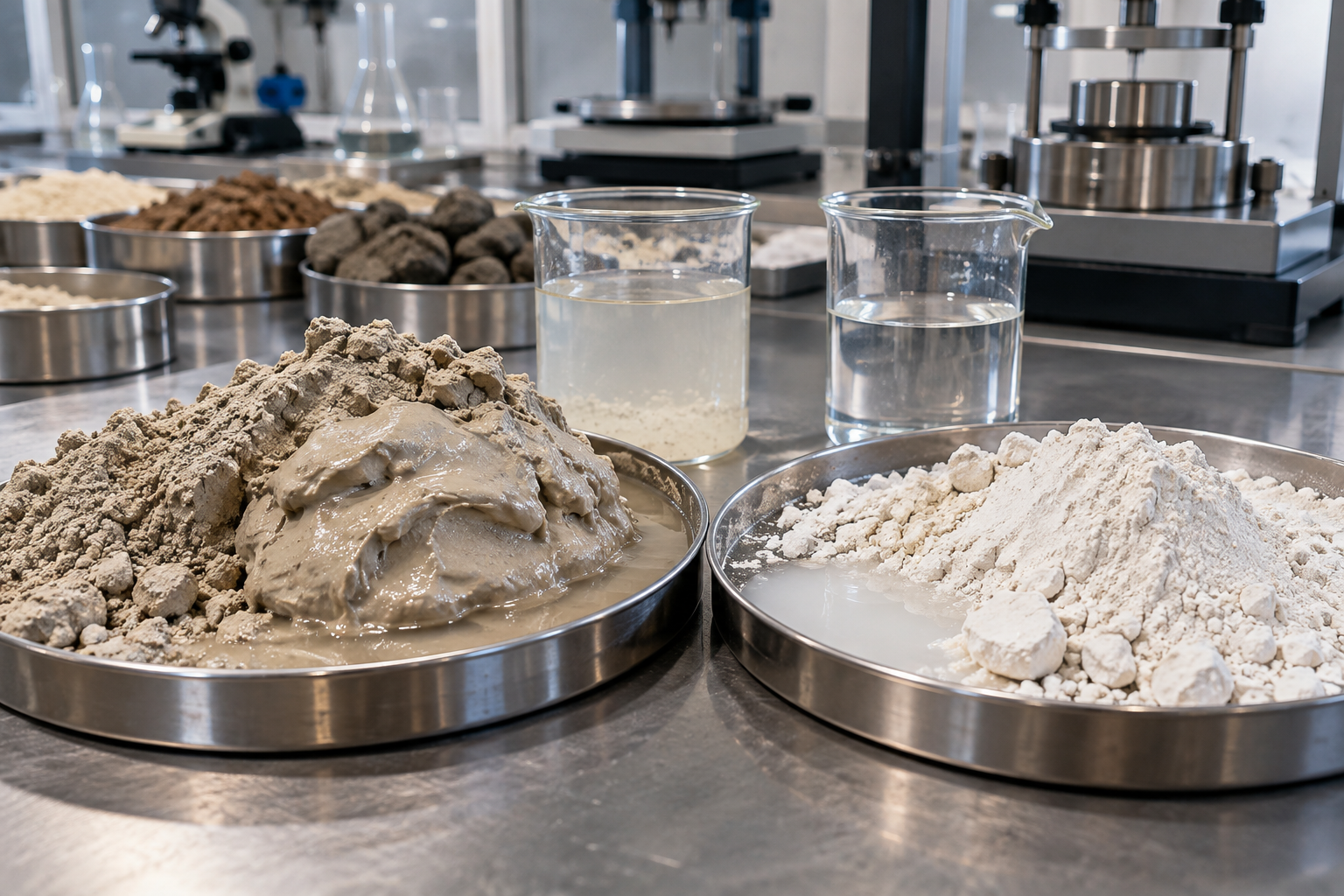
Bentonite and kaolin are both clay materials, but they behave very differently when they encounter water or humid air. If you need strong hydration, swelling, liquid binding, or sealing, bentonite is usually the first clay worth evaluating, particularly a high-swelling sodium bentonite. Kaolin also interacts with moisture, but kaolinite has a much lower swelling response.
The difference comes down to mineral structure rather than a simple label such as "absorbent." In a real industrial application, you need to know whether the material should take up liquid, adsorb water onto its surfaces, swell between mineral layers, bind moisture, or remain dimensionally stable after wetting.
That distinction can affect product performance, processing, storage, and cost. This guide explains how bentonite and kaolin respond to moisture, how their properties compare, which applications suit each material, and what to ask for when evaluating a commercial clay grade.
If strong moisture interaction is the main requirement, bentonite generally has the advantage over kaolin. Many bentonites contain smectite minerals, especially montmorillonite, whose layered structure can take up water and expand substantially. Sodium-rich bentonite is particularly well known for its hydration and swelling behavior.
Kaolin behaves differently. Its principal mineral, kaolinite, has a structure that does not permit the same degree of interlayer expansion. It can interact with water on its fine particle surfaces, but it generally remains much more dimensionally stable than strongly swelling bentonite.
The right choice still depends on the application.
Choose bentonite when you need:
Choose kaolin when you need:
Water absorption and swelling should not be treated as identical measurements. A clay can interact with water without showing the dramatic volume increase associated with sodium bentonite.
Bentonite is a clay material dominated by smectite-group minerals, commonly montmorillonite. Many commercial deposits formed from the alteration of volcanic ash, although the mineral composition of bentonite varies considerably between deposits.
That variation matters. Two products sold simply as "bentonite" can behave differently because their mineral composition, exchangeable ions, particle size, moisture content, and processing history are not necessarily the same.
For moisture-related applications, one of the most important distinctions is between sodium-rich and calcium-rich bentonite.
Sodium-rich bentonite is associated with strong hydration and high swelling. When water enters the spaces associated with smectite layers, the clay can expand substantially and form a hydrated mass.
Calcium bentonite generally shows lower swelling than sodium bentonite. That does not make calcium bentonite unsuitable for every absorbent or moisture-related application. It simply means that the expected water response is different.
The performance of an individual grade depends on more than whether the label says sodium or calcium. Mineral purity, exchangeable cations, particle-size distribution, processing, and test conditions can all influence the result.
When bentonite particles contact water, water molecules interact with charged mineral surfaces and can enter between layers. Hydration increases the spacing between those layers, which can produce substantial swelling. This property is central to many bentonite applications, including drilling fluids, containment liners, foundry bonding, sealing systems, and selected absorbent products.
Kaolin is a clay material in which kaolinite is the principal mineral. Kaolinite belongs to a different clay-mineral group from the smectites commonly found in swelling bentonite.
Its structure helps explain why kaolin and bentonite respond differently to water. Kaolinite has a one-to-one layered structure consisting of one tetrahedral sheet and one octahedral sheet. The layers are held together more strongly than the layers in highly expansive smectite minerals.
Kaolin still interacts with water. Its very fine particles provide mineral surfaces where water can interact with the material, and moisture can influence how kaolin behaves in a formulation. What it generally does not do is develop the dramatic interlayer swelling associated with sodium montmorillonite.
That lower swelling response is useful in applications where a clay needs to contribute mineral, filler, ceramic, paper, or refractory properties without creating substantial expansion.
Kaolin therefore shouldn't be viewed as a weaker form of bentonite. They are different clay materials with different structures and commercial roles.
The main reason is mineral structure.
Clay minerals have extremely fine particles and large effective surface areas, so water can interact with their surfaces. Some clay minerals also allow water to enter between mineral layers. The amount and type of interaction depend on the mineral's structure and chemistry.
Smectites such as montmorillonite have a layered structure that can accommodate changes in layer spacing. Sodium-rich montmorillonite is particularly responsive to hydration, which is why sodium bentonite can swell so strongly.
Kaolinite has a different structure and does not undergo comparable interlayer expansion. As a result, kaolin generally shows much less swelling when exposed to water.
A useful way to think about the difference is this: strongly swelling bentonite can change its volume and consistency dramatically as it hydrates, while kaolin generally retains a more stable physical structure.
That distinction is important when selecting a clay. Two materials can both be described as water-interacting minerals while behaving very differently in the actual process.
The terms absorption and adsorption are often mixed together in discussions about clay and moisture, but they describe different processes.
Absorption generally means that a substance enters the bulk of another material. Adsorption refers to molecules accumulating on a surface or at an interface.
Clay minerals can exhibit strong surface interactions with water, while smectite hydration can also involve water entering spaces associated with the mineral layers. The resulting swelling is one reason bentonite behaves differently from kaolin.
For this reason, the question "How much moisture does this clay absorb?" isn't specific enough for industrial purchasing.
A supplier or laboratory may report properties such as:
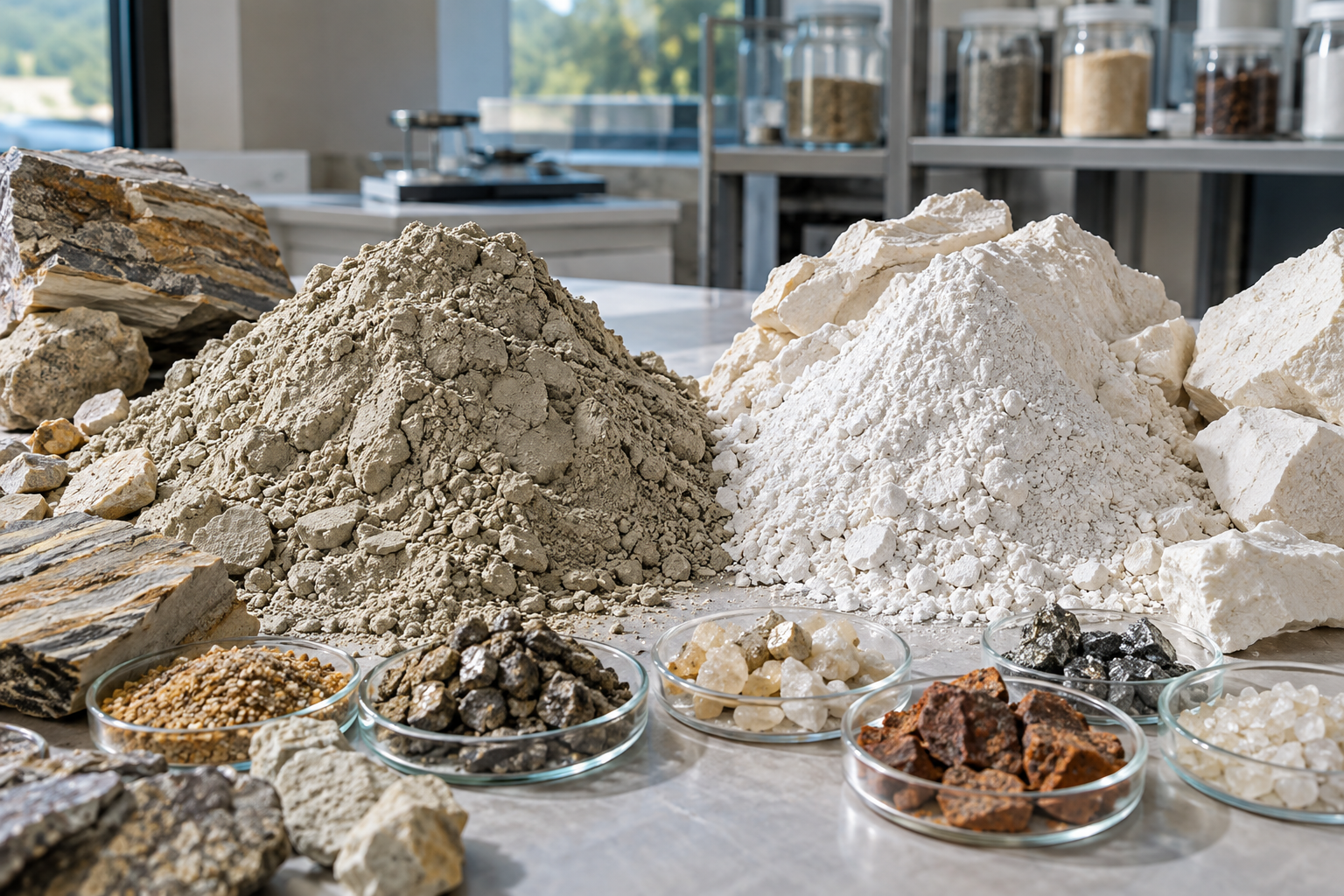
These measurements are not interchangeable. A high free-swell value, for example, tells you about expansion under a defined test, not necessarily how many kilograms of a particular liquid the material can retain in your finished product.
Before comparing two clay grades, identify the property that actually predicts success in your application.
| Property | Bentonite | Kaolin |
|---|---|---|
| Main mineral group | Commonly smectite, especially montmorillonite | Kaolinite group |
| Water interaction | Strong for suitable grades | Mainly surface interaction and moisture retention |
| Swelling in water | Can be very high, especially for sodium bentonite | Low to negligible |
| Moisture response | Strong for swelling grades | More limited swelling response |
| Dimensional change when wet | Can be substantial | Generally much lower |
| Gel formation | Common with suitable swelling grades | Not comparable with high-swelling bentonite |
| Absorbent applications | Suitable for many liquid-handling applications | More application-specific |
| Sealing applications | Strong fit for suitable grades | Generally not selected for swelling-based sealing |
| Ceramic applications | Used in selected formulations | Major established use |
| Drilling fluids | Major application | Not a primary substitute |
| Key strength | Hydration, swelling, binding, and sealing | Stability and kaolinite-specific physical properties |
This table is a general guide, not a product specification. Bentonite grades can differ substantially, and kaolin products also vary by mineral purity, particle size, processing, and intended application.
For procurement decisions, compare technical data from specific products rather than assuming that every bentonite or kaolin grade behaves like the average material in its category.
There is no single moisture-absorption figure that applies to all bentonite.
This is important because commercial bentonite products can differ in mineral composition and processing. A high-swelling sodium bentonite can behave very differently from a calcium bentonite, and neither should automatically be assigned a universal water-retention value.
Historical laboratory work has demonstrated substantial water uptake by some bentonite samples under defined test conditions. Such results illustrate the strong interaction between smectitic clay and water, but they should not be presented as a guaranteed specification for every commercial product.
For purchasing, the useful question is not simply "How many times its weight in water can bentonite absorb?" Instead, ask which test was used, what conditions were applied, and whether the result represents the behavior you need in production.
For an absorbent application, ask the supplier:
A technical data sheet and certificate of analysis are much more useful than a generic claim such as "high absorption."
Kaolin interacts with water, but it doesn't respond with the same dramatic expansion seen in sodium bentonite.
The fine particles of kaolin provide substantial surface area for interaction with water. Moisture can affect its handling, dispersion, rheology, and behavior within a formulation. However, kaolinite generally exhibits little or no swelling compared with highly expansive smectite.
That lower swelling response can be an advantage. If your process requires a mineral that remains comparatively stable after wetting, kaolin may be more appropriate than a strongly swelling bentonite.
Kaolin is often selected for properties other than maximum water uptake. Depending on grade and application, buyers may consider brightness, particle size, mineral purity, firing behavior, chemical characteristics, dispersion, and compatibility with other ingredients.
If the only requirement is to capture as much liquid as possible, kaolin may not be the first material to evaluate. If the requirement is to introduce a fine clay mineral while maintaining relatively stable dimensions, its properties may be much more relevant.
Generally, sodium bentonite shows stronger swelling and hydration than calcium bentonite. Sodium montmorillonite has a particularly strong response to water, while calcium- and magnesium-dominated montmorillonite generally show lower swelling.
This distinction matters when selecting a material for moisture-related applications. A buyer who specifies only "bentonite" may receive a product with a very different water response from the one originally expected.
For example, a sealing application may depend heavily on swelling and low permeability, while an absorbent product may place greater emphasis on liquid uptake, particle integrity, and handling after wetting. The word "bentonite" alone does not define those performance characteristics.
When comparing products, specify the required test result rather than relying solely on the mineral name.
Bentonite is particularly useful when moisture interaction needs to be combined with swelling, binding, or sealing.
Suitable bentonite grades can be incorporated into absorbent products because they interact strongly with liquids and can form hydrated structures. This can be useful where the material needs to capture or immobilize liquid rather than simply become damp.
The actual result depends on the grade, particle size, formulation, and liquid being handled. Oil, water, wastewater, and other fluids can behave differently, so an application-specific test remains important.
Some bentonite products are used in applications intended to manage moisture and odors. Their performance depends on how the clay is processed and formulated, as well as the type and amount of liquid present.
For these applications, don't evaluate the mineral in isolation. A finished product may contain binders, fillers, fragrances, or other ingredients that change moisture uptake and handling characteristics.
Swelling is especially valuable when bentonite is used as a water barrier.
A suitable sodium bentonite can hydrate and expand within a compacted layer, reducing the movement of water through the material. This behavior makes appropriate bentonite grades useful in certain liners, barriers, and containment systems.
Kaolin generally does not provide the same swelling mechanism. It therefore isn't normally chosen as a direct replacement when the design depends on strong water-induced expansion.
Bentonite is widely used in drilling fluids because hydrated clay can contribute to suspension, viscosity, and the transport of drilled solids.
The performance required in drilling is more specific than simple water absorption. Rheology, filtration behavior, solids control, and fluid chemistry all matter. Kaolin is therefore not a straightforward substitute simply because it is also a clay.
Maximum moisture uptake isn't always the objective.
Kaolin can be preferable when a formulation needs a relatively non-swelling clay with particular mineral, particle, optical, ceramic, or processing properties. Its established use in ceramics, paper, coatings, and refractory materials reflects this broader role.
For example, a ceramic manufacturer may care more about mineral purity, particle size, firing characteristics, and formulation behavior than about how much water the dry mineral can take up.
A highly swelling bentonite can even create problems when dimensional stability or controlled rheology is important. Introducing it into a formulation designed around kaolin may increase viscosity or swelling in ways the process was not designed to handle.
The practical lesson is simple: don't substitute one clay for another solely because both are described as clay minerals. Compare the property that matters to the process.
Humidity control is different from direct liquid absorption.
When a dry clay is exposed to humid air, water molecules can interact with its surfaces and the material can gain moisture. The amount of moisture taken up depends on relative humidity, temperature, mineral structure, particle size, initial moisture content, and exposure time.
A humidity test therefore cannot be compared directly with a liquid-water absorption test.
For a meaningful humidity-control evaluation, record at least:
The distinction is important in procurement. Two suppliers can both report "moisture absorption" while using different humidity levels, exposure times, sample sizes, or measurement methods. Their numbers may look comparable without actually describing the same property.
If humidity control is the goal, specify the environmental conditions before asking suppliers to compare products.
Start with the problem you need the clay to solve, not with the product name.
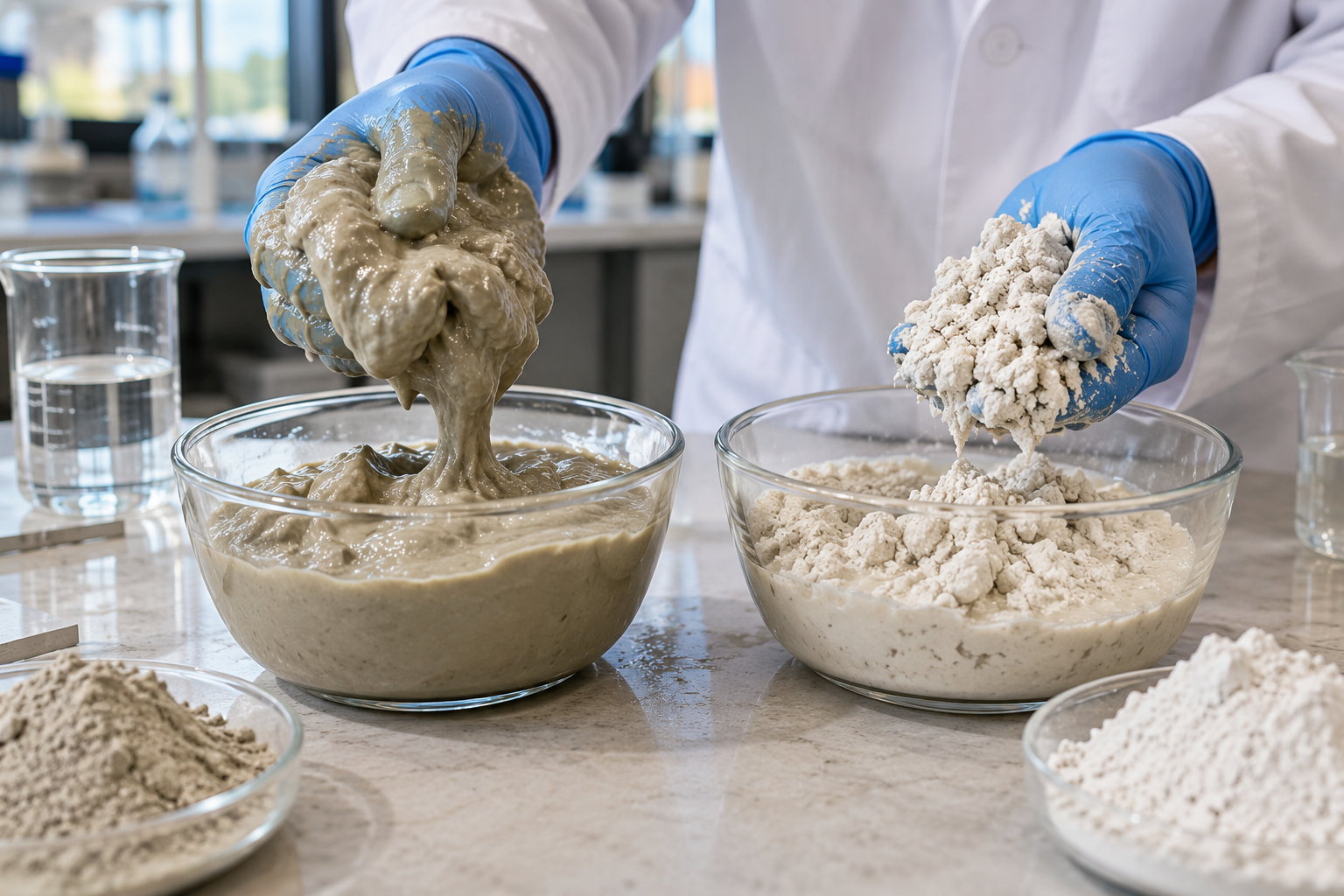
Identify what the material will encounter. Is it liquid water, high humidity, oil, wastewater, animal waste, or moisture inside a formulation?
Each situation can require a different performance test.
If swelling helps the material perform its job, a suitable bentonite deserves serious consideration. If swelling would interfere with the process, a lower-swelling clay such as kaolin may be more appropriate.
For bentonite, establish whether sodium-rich or calcium-rich material is appropriate and request information about mineral composition. For kaolin, define the grade and the physical and chemical properties that matter to the formulation.
Don't compare a bentonite water-absorption result with a kaolin humidity-adsorption result as if they measured the same property.
Ask each supplier for the test method, sample preparation, conditions, and reporting units behind the specification.
A bench test can expose problems that a data sheet won't show.
Measure a known quantity of dry material, expose it to the actual liquid or humidity conditions, and record mass change, volume change, texture, dispersion, and handling behavior. If the clay will be used in a formulation, test the complete formulation rather than relying only on the raw mineral.
The dry powder can look excellent on paper and still perform poorly after hydration.
Check whether it becomes excessively sticky, forms hard lumps, swells beyond the available space, settles too quickly, remains suspended when needed, blocks equipment, or becomes difficult to remove.
For industrial purchasing, consistent performance can matter as much as the headline absorption figure.
Ask about batch specifications, particle-size control, moisture at shipment, packaging, certificates of analysis, and technical support. A material that performs consistently is easier to qualify and manage in production.
It doesn't. Bentonite composition varies, and sodium-rich and calcium-rich materials can have noticeably different hydration and swelling behavior.
Always evaluate the specific commercial grade rather than assuming that a general bentonite specification applies to every product.
Swelling demonstrates hydration and structural expansion, but it isn't a universal measurement of liquid absorption capacity.
A buyer should request the property that actually defines success for the application. If liquid uptake matters, use a suitable liquid-absorption test. If sealing matters, swelling and permeability may be more relevant.
A water-absorption test, free-swell test, swelling-index test, and humidity-adsorption test measure different aspects of clay behavior.
Always compare results obtained under equivalent conditions.
Particle size affects surface area, dispersion, handling, and the rate at which water interacts with the material. Two grades with similar mineral composition can behave differently because their physical processing differs.
If particle size is important to the process, include it in the purchasing specification rather than treating it as a secondary detail.
A lower price per tonne doesn't automatically mean a lower operating cost. If the cheaper material requires more dosage, more frequent replacement, additional processing, or creates handling problems, its total cost can be higher.
Compare cost against the amount of material required to achieve the target performance.
Kaolin isn't an inferior version of bentonite. The two materials have different mineral structures and therefore different properties.
Kaolin may be exactly what a formulation needs when low swelling and specific mineral characteristics are important. Bentonite may be the better choice when hydration, swelling, binding, or sealing is central to the application.
Yes, depending on the formulation and performance target.
A blend can be useful when a product needs properties associated with more than one mineral. For example, a manufacturer may want some moisture interaction from bentonite while using another mineral to influence swelling, processing, particle characteristics, or formulation stability.
A blend shouldn't be assumed to produce a predictable middle ground. Adding kaolin to bentonite does not automatically create an intermediate absorption or swelling value. Mineral composition, particle size, moisture content, liquid chemistry, and blend ratio can all affect the result.
If the application is sensitive to swelling, viscosity, water retention, or settling, test several blend ratios under actual operating conditions before selecting a production formulation.
If you're sourcing bentonite for moisture absorption or another moisture-sensitive application, make the supplier discussion specific.
Ask for:
For a serious industrial application, a technical data sheet and certificate of analysis are more useful than a broad statement such as "excellent absorption."
Axewelledge supplies bentonite for industrial applications and can help buyers evaluate grades against a defined performance requirement. When moisture behavior matters, the most useful starting point is to provide the intended application, target liquid or humidity conditions, required performance, expected dosage, and approximate volume. That gives the supplier a basis for discussing material specifications rather than simply quoting a generic bentonite grade.
The decision becomes clearer when the required moisture response is defined first.
For strong hydration and swelling, a suitable high-swelling bentonite, particularly sodium bentonite, is generally the more relevant material to evaluate.
For moisture interaction without substantial swelling, kaolin may be worth evaluating when its other mineral and processing properties fit the formulation.
For sealing applications that depend on water-induced expansion, an appropriate bentonite grade is generally the more relevant starting material.
For ceramics and other applications where kaolinite-specific properties are important, kaolin has an established role and should not be replaced simply because bentonite can absorb and swell more strongly.
For absorbent products, test the actual commercial grade against the target liquid. Mineral type provides a useful starting point, but it doesn't determine final product performance by itself.
The more useful question isn't simply, "Which clay absorbs more moisture?" Ask instead, "Which moisture response does my process require?"
That change in question usually leads to a much better material specification.
Before placing an order, confirm these five points:
This approach avoids a common purchasing problem: selecting a material because its marketing literature quotes a large absorption number, only to discover that the reported test doesn't represent the behavior required by the process.
Bentonite and kaolin both interact with moisture, but their mineral structures produce very different responses. Bentonite containing swelling smectite, particularly sodium-rich material, can hydrate strongly and expand substantially. Kaolin, whose principal mineral is kaolinite, generally shows much less swelling and is often selected for other mineral and processing characteristics.
When water uptake, swelling, liquid binding, or swelling-based sealing is central to the application, bentonite is usually the more relevant clay to investigate. When low swelling, dimensional stability, or kaolinite-specific properties matter, kaolin may be the better fit.
The final decision should be based on comparable technical data and application testing rather than a generic absorption number. Define the liquid or humidity conditions, identify the property that matters, compare equivalent test methods, and test the actual commercial grade before scaling up.
If you're evaluating bentonite for an industrial moisture-control, absorbent, sealing, or processing application, Axewelledge can help you identify the relevant grade and specification. Share the application, target moisture or liquid, required performance, and expected volume so the material can be evaluated on performance rather than price alone.













Have questions about our products? We're here to help!