Axewelledge, a leading exporter from India, specializes in high-quality Bentonite. With a commitment to excellence, we supply premium Bentonite to the Middle East and Southeast Asia markets.


North Angle Complex, 304,
150 Feet Ring Rd, Opposite Ambedkar Nagar BRTS Stop,
Madhav Park, Punit Nagar,
Mavdi, Rajkot, Gujarat 360004
© Axewelledge 2026, All Rights Reserved.
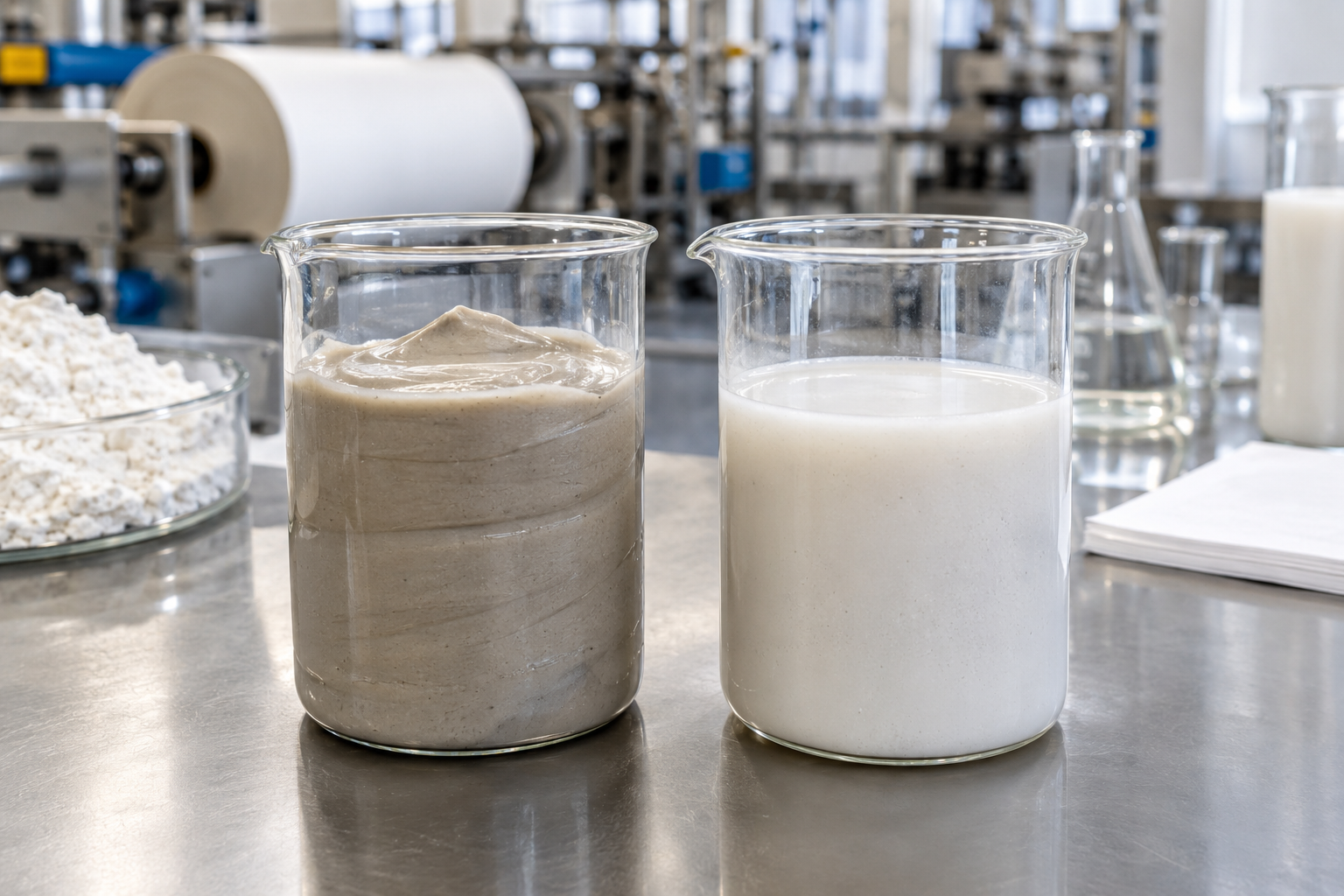
Bentonite and kaolin may both be clay minerals, but they don't perform the same job in a paper mill. Bentonite is primarily a functional microparticle used in retention and drainage programs, while kaolin is primarily a mineral filler used to modify the optical, surface, and printing properties of paper.
That distinction matters when a mill is trying to improve first-pass retention, filler retention, drainage, formation, or machine runnability. A paper machine can use both materials in the same furnish, but they should not be treated as interchangeable additives.
Bentonite is generally used at a relatively low dosage and is commonly paired with a cationic polymer in a microparticle retention program. Kaolin is normally added at a much higher loading because it becomes part of the finished sheet as a functional filler. Its retention therefore depends on the broader wet-end chemistry, including charge control, polymer selection, mixing, shear, and the characteristics of the fiber furnish.
The practical question isn't simply whether bentonite is better than kaolin. It is which material is doing which job, and how should the retention system be designed around that job?
The simplest way to separate the two is by function. Bentonite is an active component of certain retention systems; kaolin is usually the material that the retention system is trying to keep in the sheet.
Bentonite belongs to the smectite family and commonly contains a high proportion of montmorillonite. Sodium bentonite hydrates and expands in water, producing very fine platelets with a large effective surface area. Those platelets can interact strongly with cationic polymer structures and help create small, dense flocs after the furnish has experienced shear.
Kaolin is dominated by kaolinite, a 1:1 layered aluminosilicate. Unlike smectite, kaolinite does not undergo the same type of interlayer swelling. In papermaking, kaolin is valued mainly for its optical and surface characteristics, including opacity, brightness, smoothness, and printability, depending on grade and application.
This difference explains why comparing the two purely on retention performance can be misleading. A mill doesn't normally choose between bentonite and kaolin as two competing retention aids. It may choose kaolin as a filler and then select a retention program capable of retaining that filler efficiently.
| Operational Attribute | Sodium Bentonite in a Microparticle Program | Kaolin Clay as a Mineral Filler |
|---|---|---|
| Primary Function | Retention and drainage microparticle | Functional mineral filler |
| Main Mineral | Montmorillonite-rich smectite | Kaolinite |
| Crystal Structure | 2:1 layered structure with expandable interlayers | 1:1 layered aluminosilicate |
| Behavior in Water | Hydrates and swells, depending on grade and ionic environment | Essentially non-swelling |
| Typical Wet-End Role | Works with cationic polymer systems | Becomes part of the finished sheet |
| Relative Dosage | Low compared with filler loading | Often several percent of furnish dry solids |
| Charge Behavior | Strongly anionic surface after hydration | Generally negatively charged surface |
| Retention Mechanism | Microparticle interaction with polymer and furnish | Polymer-assisted retention, coagulation, and mechanical entrapment |
| Main Paper Benefit | Retention, drainage, and floc structure control | Opacity, brightness, smoothness, and print performance |
| Main Process Risk | Poor response if hydration, shear, charge, or addition point is wrong | Poor ash retention, deposit formation, and drainage problems if poorly controlled |
The exact performance of either material depends on grade, particle-size distribution, surface chemistry, furnish composition, process water, and the rest of the wet-end program. Published physical-property ranges should therefore be treated as indicative rather than universal specifications.
Bentonite is most effective when it is treated as part of a complete wet-end program rather than as a standalone substitute for a conventional retention polymer.
A common approach is a dual-component or microparticle system using a cationic polymer followed by an anionic microparticle such as bentonite. The polymer first interacts with negatively charged fibers, fines, and fillers. Mechanical shear then breaks the larger flocs into smaller polymer-rich structures. Bentonite added downstream can interact with those structures and help rebuild retention without simply recreating the large flocs produced by an aggressive single-polymer program.
A simplified operating sequence is:
The exact injection point isn't universal. Some machines require a different sequence because of stock consistency, equipment layout, polymer chemistry, mixing energy, and the position of the final shear point. A successful program is therefore established through mill trials and process measurements rather than by copying a dosing location from another machine.
The main advantage of a microparticle system is its ability to work with a furnish that has already experienced significant mechanical shear. Conventional polymer bridges can become less effective when large flocs are repeatedly broken apart. An appropriately selected microparticle can interact with residual polymer structures and produce smaller aggregates.
Those aggregates can retain fines and filler without creating the oversized flocs associated with excessive polymer dosing. That distinction is important because high retention by itself doesn't guarantee good paper. If the furnish is badly flocculated, the resulting sheet can show uneven formation, variable basis weight, poor optical uniformity, and inconsistent strength.
A good retention program therefore aims for controlled aggregation, not the largest possible floc.
Kaolin serves a different purpose. Papermakers add it primarily as a filler to modify the finished sheet rather than to accelerate drainage.
Depending on grade and paper type, kaolin can contribute to opacity, brightness, smoothness, printability, and surface characteristics. It can also replace part of the fiber furnish, which may make it economically attractive when the target paper properties allow higher filler loading.
The challenge is straightforward: every kilogram of kaolin added to the wet end has to be retained efficiently if the mill expects it to contribute to the finished sheet.
Fine kaolin particles can remain suspended in the white-water system when retention is inadequate. The result can be higher white-water turbidity, greater solids circulation, increased treatment load, and unstable machine chemistry. Poor filler retention can also reduce the amount of ash reaching the sheet, making it difficult to maintain the intended optical and cost profile.
Kaolin retention generally depends on some combination of charge control, coagulation, polymer bridging, microparticle technology, and physical entrapment within the forming web.
Kaolin has a negatively charged surface in typical papermaking systems. Cationic coagulants can reduce charge-related repulsion and encourage particles to associate. A higher-molecular-weight retention polymer can then bridge particles and fibers into larger aggregates.
The dosage must be controlled carefully. Too little treatment leaves fine filler circulating in the white-water loop. Too much polymer can create excessive flocculation, damaging formation and potentially reducing the very paper-quality attributes the filler was introduced to improve.
The best program depends on the furnish and operating conditions. Recycled fiber, dissolved and colloidal substances, calcium concentration, conductivity, pH, filler type, and process-water closure can all change the required treatment level.
Using both materials isn't unusual because their roles are complementary.
A mill may use kaolin to achieve a target ash level, opacity, smoothness, or print property while using bentonite as part of the retention program that keeps the filler and fines in the sheet. In this arrangement, kaolin is the functional filler and bentonite is one component of the chemistry used to retain it.
This is an important distinction when evaluating chemical consumption. If a mill reduces kaolin dosage, it may reduce filler demand but lose opacity or other target properties. If it reduces bentonite or another retention component, it may see lower filler retention and increased solids circulation. The two changes have different consequences and shouldn't be evaluated using the same metric.
First-pass retention (FPR) describes the fraction of furnish solids retained on the forming section during the first passage of the stock through the machine. First-pass ash retention (FPAR) focuses on mineral solids, including fillers such as kaolin and calcium carbonate.
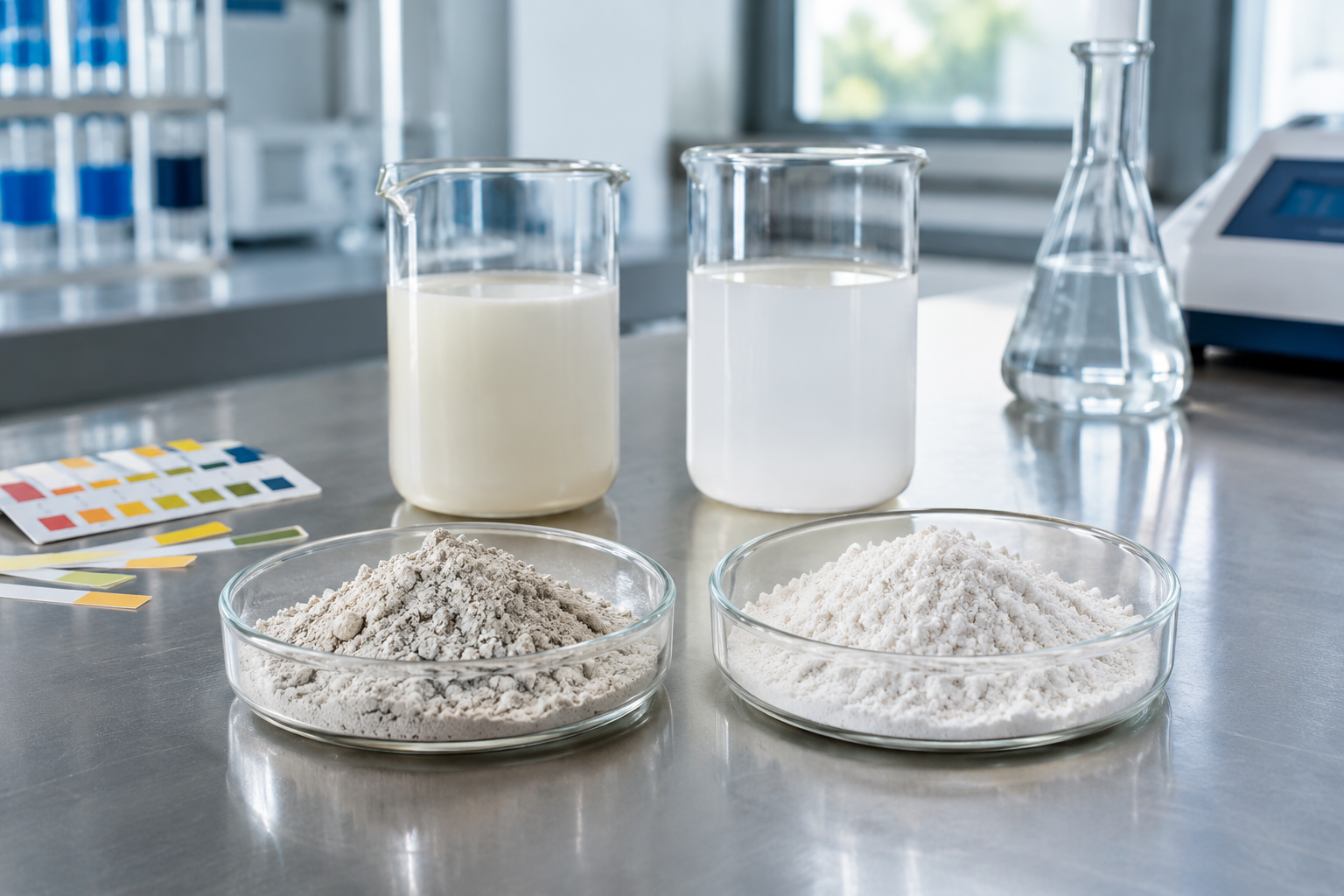
These measurements are useful because they separate overall solids retention from filler retention. A machine can have acceptable total retention while still losing a significant proportion of its mineral filler to the white-water system.
For example, if fiber retention remains stable while ash retention falls, the cause may be related to filler chemistry, particle size, charge balance, or polymer-filler interaction rather than a general failure of the retention system.
There is no single FPR or FPAR value that represents good performance for every paper machine. Grade, furnish, forming technology, filler loading, operating speed, white-water closure, and product specifications all matter. Claims that a particular bentonite program will automatically deliver a fixed retention percentage should therefore be treated cautiously.
Retention is only one part of the wet-end equation. A mill can increase retention while making the sheet worse if the treatment creates excessive flocculation.
Large flocs can produce uneven formation, local variations in basis weight, poor optical uniformity, and changes in strength development. They may also respond poorly to downstream shear. The practical goal is to retain the required solids while preserving a sufficiently uniform fiber network.
Microparticle programs are attractive partly because they can provide high retention with a finer floc structure than some conventional high-polymer programs. The result still depends on polymer type, charge demand, dosage, mixing energy, bentonite properties, and the timing of each addition.
Retention and drainage are closely connected, but they aren't identical.
A furnish that retains fines and filler efficiently can still drain poorly if the retained material blocks pores within the forming structure. Conversely, a program that drains extremely quickly may create poor retention or weak formation if too much fine material leaves with the white water.
Bentonite microparticle systems can improve drainage in some furnishes by modifying the structure of flocs and promoting the release of water during forming. The effect should be verified on the actual machine because drainage response depends strongly on furnish and process conditions.
Improved drainage can have practical consequences in the press and dryer sections. Higher solids content entering the press can reduce the amount of water that later has to be removed thermally. However, the magnitude of any energy saving depends on the press configuration, basis weight, machine speed, steam system, target moisture, and the actual change in press dryness.
For this reason, broad claims such as a fixed percentage reduction in steam demand for every percentage-point increase in press dryness should not be treated as universal rules. The correct approach is to measure the mill's baseline and quantify the actual energy response.
Kaolin can have the opposite effect when excessive fines accumulate or when the retention program creates a dense, poorly draining structure. The issue isn't that kaolin inherently prevents drainage. Rather, poor filler retention and unsuitable flocculation can increase the solids load circulating in white water and change the structure of the forming web.
Paper quality depends on more than how much material stays on the wire.
Formation describes how evenly fibers, fines, and fillers are distributed throughout the sheet. Poor formation can produce visible variations in light transmission and affect printing uniformity, appearance, and some mechanical properties.
An overly aggressive polymer program may produce large flocs and poor formation. A well-designed microparticle program can help maintain smaller aggregates while retaining fine material. That can make bentonite useful when a mill is trying to improve retention without accepting a major formation penalty.
Kaolin contributes differently. Its value comes from the properties it provides as a mineral filler. Depending on particle size, shape, brightness, treatment, and loading, kaolin can improve opacity and surface characteristics and can influence printing behavior.
Not all kaolin grades behave the same way. Hydrous kaolin and calcined kaolin have different structures and optical properties and are selected for different paper applications.
Calcined kaolin has undergone controlled thermal treatment that changes its structure and can increase its contribution to opacity and other optical properties. Hydrous kaolin remains a widely used filler where its particular combination of brightness, particle characteristics, and surface properties fits the paper grade.
The correct comparison therefore isn't simply "kaolin versus bentonite." A technically sound evaluation should specify the kaolin grade, bentonite grade, particle-size distribution, furnish, and target paper properties.
Neither bentonite nor kaolin works independently of the wet-end environment. The same product can behave very differently when the furnish, process water, or charge demand changes.
pH affects polymer charge, fiber surface chemistry, filler behavior, and the interactions between dissolved substances and retention chemicals. Bentonite can be used in a range of papermaking systems, but its response depends on the grade and the surrounding ionic environment.
Conductivity and dissolved ions also matter. Calcium and other multivalent ions can influence particle interactions and polymer conformation. Highly closed white-water systems may behave differently from systems with lower recirculation and lower dissolved-solids concentrations.
For this reason, changing only the retention chemical while ignoring process-water chemistry can lead to inconsistent results.
Dissolved and colloidal substances are a common source of instability. Material from wood extractives, recycled fibers, coating residues, and process additives can contribute to the anionic charge demand of the system.
If a cationic polymer is consumed by these contaminants before it reaches the fiber and filler surfaces, the intended retention mechanism can weaken. Operators may respond by increasing polymer dosage, but that can create another problem: excessive flocculation once the charge demand changes again.
Monitoring cationic demand, charge, turbidity, ash, and retention can help distinguish a genuine dosage problem from a changing furnish condition.
Chemical addition points deserve as much attention as chemical selection.
A typical microparticle program may use an early charge-control step, a primary cationic polymer addition, a defined shear point, and a downstream bentonite addition. The exact locations vary by machine.
The phrase "immediately after the pressure screen" should not be interpreted as a universal rule. Pipe length, mixing intensity, machine layout, consistency, and the location of other additives all influence the best injection point.
Kaolin filler may be added at a different location depending on the stock-preparation system and desired contact time with the retention chemistry. Some mills introduce filler into thick stock, while others use a more downstream addition strategy. The correct location is the one that gives adequate dispersion and allows the retention program to capture the filler before the forming section.
Bentonite performance starts before the slurry reaches the paper machine.
Sodium bentonite needs adequate contact with water to hydrate its smectite structure. Poor dispersion can leave agglomerates in the make-down tank and reduce the effective surface available for interaction with the retention program.
A practical make-down procedure should follow the supplier's recommended solids concentration, water quality, mixing conditions, and aging time. There isn't one universal slurry concentration or hydration period that applies to every bentonite product.
A general process is:
A mill should follow the technical data supplied for its specific bentonite rather than assuming that every sodium bentonite has identical swelling behavior.
The cost comparison between bentonite and kaolin becomes clearer when each material is evaluated according to its function.
Bentonite is normally consumed at a much lower dosage than a mineral filler. Its economic value therefore comes from the process response it produces rather than from replacing a large quantity of fiber directly.
Potential benefits include improved retention of fines and filler, better drainage, lower demand for some other retention chemicals, and improved machine stability. Whether those benefits outweigh the chemical cost depends on the individual machine.
A useful mill trial should measure more than chemical consumption. Track retention, ash retention, white-water turbidity, drainage indicators, press dryness, formation, basis-weight variation, breaks, and energy consumption where practical. A small change in chemical cost can be insignificant if it prevents a larger production or quality problem, while an apparently inexpensive treatment may be costly if it creates downstream instability.
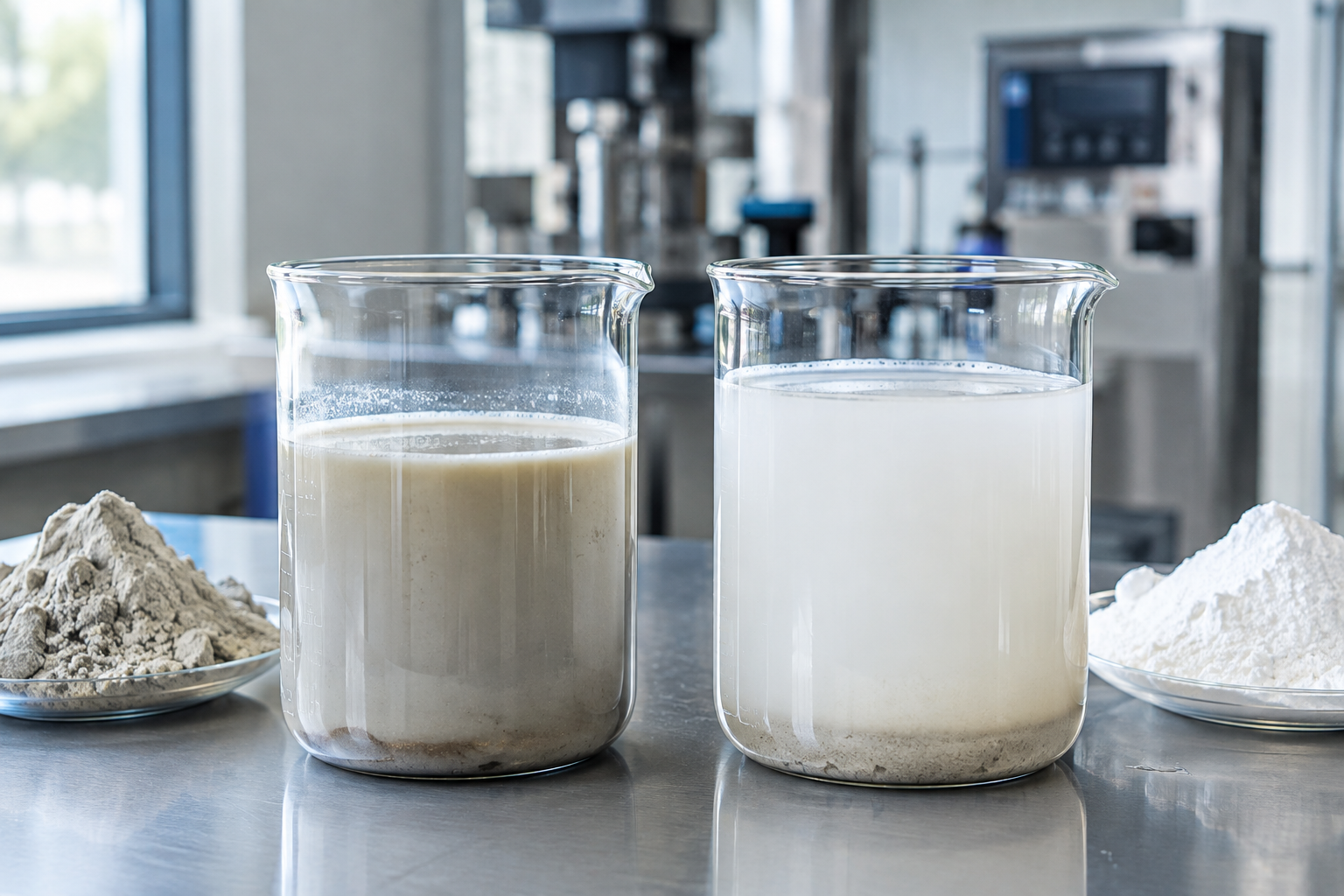
Kaolin can provide an economic advantage when it replaces part of the fiber furnish while maintaining the required paper properties. The value depends on the relative cost of filler and fiber as well as the filler loading that the grade can tolerate.
The calculation must also include the cost of retaining the filler. Poor ash retention means that a portion of the purchased mineral leaves the machine with white water rather than becoming useful product. Additional costs may appear through wastewater treatment, sludge handling, deposits, cleaning, or increased wear.
A realistic filler-cost calculation should therefore consider:
When retention or drainage changes suddenly, adding more chemical isn't always the right first response. Start by checking what changed in the process.
Likely cause: Excessive flocculation, poor mixing, or a change in charge demand.
Typical signs: Large visible flocs, uneven formation, unstable basis weight, or deterioration in optical uniformity.
What to check: Review polymer dosage, addition point, dilution, mixing energy, furnish consistency, and charge demand. A controlled reduction in polymer dosage may improve formation, but it should be tested alongside retention and ash measurements rather than made solely on appearance.
Likely cause: A change in filler chemistry, particle size, cationic demand, polymer performance, or white-water conditions.
Typical signs: Rising white-water ash and turbidity, lower sheet ash, or changes in opacity.
What to check: Measure white-water solids and ash, review filler addition rate, confirm polymer preparation, and check charge conditions. If anionic trash has increased, the retention program may need adjustment rather than simply increasing the bentonite dose.
Likely cause: Inadequate hydration, poor dispersion, unsuitable addition timing, excessive dilution problems, or a mismatch between bentonite and polymer chemistry.
Typical signs: Variable retention, inconsistent drainage, visible slurry agglomerates, or little response to changes in bentonite dosage.
What to check: Examine make-down quality, slurry age, concentration, pump performance, injection location, and the shear history between polymer and bentonite addition.
Likely cause: The furnish may be forming a dense or overly flocculated structure that holds water rather than releasing it efficiently.
Typical signs: High retention accompanied by elevated vacuum demand, slow drainage, poor press dryness, or wet sheet entering the press section.
What to check: Compare polymer dosage with formation and drainage measurements. Examine floc structure and test whether a microparticle program can maintain the required retention with a finer aggregate structure.
Likely cause: Poor filler retention, furnish changes, inadequate coagulation, unstable charge demand, or excessive process-water closure.
Typical signs: Higher turbidity, increased ash circulation, deposits, and greater load on wastewater treatment.
What to check: Measure white-water ash and total suspended solids, inspect the filler retention program, and review changes in recycled fiber, coating broke, process-water quality, and additive dosage.
The most reliable way to improve retention is to treat the wet end as a connected system rather than optimizing one chemical at a time.
Record current polymer, coagulant, and bentonite consumption along with furnish consistency, pH, conductivity, filler loading, FPR, FPAR, white-water turbidity, drainage indicators, press dryness, formation, and relevant machine-speed data.
Without a baseline, it is difficult to distinguish a genuine improvement from normal process variation.
Determine whether the main problem is poor fiber retention, poor filler retention, slow drainage, poor formation, excessive chemical consumption, or instability caused by charge demand.
The answer determines where to focus the trial.
If a microparticle program is being evaluated, test polymer type and dosage, shear exposure, bentonite grade, bentonite dosage, and injection location as a coordinated system. Changing several variables without a trial plan can make the result impossible to interpret.
A retention increase isn't automatically a process improvement. Track ash retention and total retention alongside formation and drainage. If retention rises while formation deteriorates, the treatment may be too aggressive.
Calculate chemical cost per tonne of paper, filler loss, fiber substitution, energy use, production rate, and quality effects. The strongest program is the one that improves the total manufacturing result, not necessarily the one that minimizes the price of a single chemical.
Different paper grades place different demands on the wet end, so there is no universal bentonite or kaolin recipe.
These grades may place strong emphasis on drainage, retention, machine speed, and economical furnish use. A microparticle system can be useful when conventional polymer treatment creates excessive flocculation or when fine-particle retention is difficult to maintain under high shear.
The actual program should still be matched to furnish type and target strength. Recycled fiber can introduce substantial variability in charge demand and fines content, making routine wet-end monitoring particularly important.
Kaolin can be selected when opacity, brightness, smoothness, or print performance is important. The retention system must then keep the filler in the sheet without compromising formation.
A bentonite-containing microparticle program may be appropriate where the mill needs to balance filler retention and formation, but the final choice should be based on machine trials and the properties of the selected kaolin grade.
Specialty grades often have narrow quality windows and may use unusual fillers, fibers, pigments, or functional additives. In these applications, generic dosage recommendations are especially unreliable. Laboratory screening followed by controlled machine trials is usually a better route than applying a standard retention recipe.
Several wet-end mistakes appear repeatedly when mills try to improve retention or reduce chemical costs.
Bentonite and kaolin should not be viewed as competing versions of the same papermaking additive. They solve different process problems.
Bentonite is primarily a wet-end process aid. In an appropriate microparticle retention system, it can help control floc structure, retain fines and filler, and improve drainage.
Kaolin is primarily a functional filler. It contributes to paper properties such as opacity, brightness, smoothness, and printability, but it must be retained efficiently to deliver those benefits economically.
For mills using both materials, the key is coordination. Kaolin loading, filler grade, polymer chemistry, bentonite properties, charge demand, shear history, addition points, and white-water conditions all interact.
The most effective optimization strategy is therefore to measure the whole system. Start with FPR and FPAR, then connect those measurements to formation, drainage, press dryness, white-water quality, chemical consumption, and finished-paper properties. That approach gives papermakers a much clearer basis for deciding whether a bentonite microparticle program, a different kaolin grade, a revised polymer package, or a broader wet-end adjustment will produce the best result.













Have questions about our products? We're here to help!