Axewelledge, a leading exporter from India, specializes in high-quality Bentonite. With a commitment to excellence, we supply premium Bentonite to the Middle East and Southeast Asia markets.


North Angle Complex, 304,
150 Feet Ring Rd, Opposite Ambedkar Nagar BRTS Stop,
Madhav Park, Punit Nagar,
Mavdi, Rajkot, Gujarat 360004
© Axewelledge 2026, All Rights Reserved.
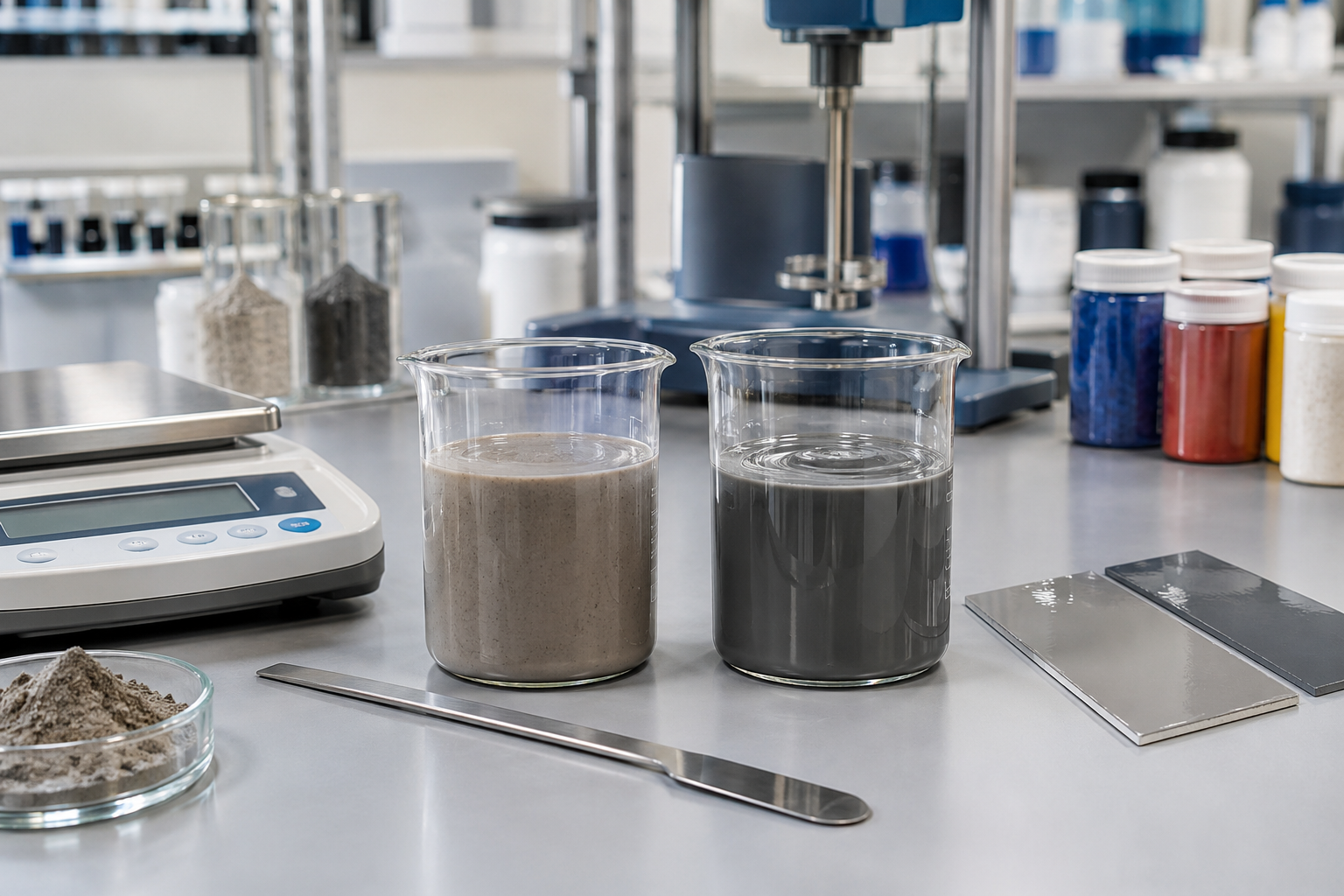
A coating can have the right resin, pigment and solvent and still fail in the can or on the substrate because its rheology is wrong. Bentonite and organoclay can both control viscosity, settling and sag, but they do so through different surface chemistry and aren't interchangeable by default.
The short answer is straightforward: conventional bentonite is generally better suited to compatible water-based and other polar systems, while organoclay is commonly selected for solventborne coatings and other organic media. The final choice depends on the continuous phase, resin, solvent polarity, pigment loading, application method and target rheology.
Bentonite is a naturally occurring smectite clay, usually rich in montmorillonite. Sodium bentonite is particularly useful in water because its platelets hydrate, swell and form a structured dispersion. Organoclay starts with a layered clay and modifies its surface with organic compounds so it can interact more effectively with many organic liquids and binders.
That difference affects everything from dispersion and activation to low-shear viscosity, sag resistance and storage stability. A clay that performs well in a waterborne acrylic isn't automatically suitable for a solventborne alkyd. The reverse is also true.
Bentonite is a naturally occurring clay whose main active mineral is usually montmorillonite, a member of the smectite group. Its layered structure gives it a large reactive surface area and allows it to interact strongly with water and other polar components. Sodium bentonite is particularly well known for swelling and developing viscosity in aqueous dispersions.
Organoclay starts with a layered clay such as bentonite and modifies its exchangeable inorganic cations with organic compounds, commonly quaternary ammonium compounds. This treatment changes the clay surface from strongly hydrophilic toward a more organophilic character. As a result, the modified clay can interact more effectively with selected organic solvents, resins and other formulation components.
The distinction matters because a coating isn't simply a liquid containing particles. Resin, solvent or water, pigment, filler and additives interact continuously as the coating moves from storage to mixing to application.
A clay that disperses readily in water may perform poorly in a solventborne alkyd coating. Likewise, an organoclay designed for an organic medium isn't automatically the right choice for a waterborne acrylic formulation.
| Feature | Bentonite | Organoclay |
|---|---|---|
| Basic material | Natural smectite clay, commonly montmorillonite-rich | Organically modified layered clay |
| Surface character | Generally hydrophilic | More organophilic than untreated clay |
| Strongest natural compatibility | Water and compatible polar systems | Many compatible organic solvent and resin systems |
| Main coating role | Suspension, viscosity control and thixotropy in compatible systems | Rheology modification, anti-settling and sag control in compatible organic systems |
| Waterborne use | Often suitable when properly selected and dispersed | Depends strongly on the specific organoclay chemistry |
| Solventborne use | Conventional bentonite is often poorly suited without modification | Commonly used in suitable solventborne systems |
| Dispersion requirements | Hydration, wetting and adequate shear are important | Wetting, dispersion and, for some grades, activation are critical |
| Typical formulation concern | Over-thickening, incomplete hydration or electrolyte sensitivity | Incomplete activation, incompatibility or excessive structure |
| Raw-material economics | Often attractive where natural clay is suitable | Usually carries additional processing and modification cost |
| Best selection method | Match clay grade to the aqueous formulation and target rheology | Match organoclay grade to solvent polarity, resin and processing method |
The important word in that table is compatible. Neither material should be selected from the clay name alone.
Bentonite's usefulness comes from its layered mineral structure and its interaction with the liquid phase. In water, suitable bentonite particles hydrate and disperse. The resulting platelets interact with one another and with the surrounding liquid, increasing resistance to flow and helping create a structured suspension.
In a coating, that structure can help keep pigments and fillers suspended during storage. It can also increase low-shear viscosity, which helps the wet film resist sag after application.
The effect isn't simply a case of adding more bentonite to get a better coating. A formulation must flow through pumps, pipes, filters and application equipment, then recover enough structure to resist sag and settling. Excessive clay can push viscosity too high and make application, atomisation or leveling difficult.
The useful question is therefore not how much viscosity the clay can create. It's whether the clay produces the right rheological profile for the finished coating.
Sodium bentonite has a strong affinity for water and can develop substantial swelling and viscosity. That makes it useful when a formulation needs a mineral-based structuring aid, provided the resin, salts, pH and other additives are compatible.
For an industrial formulator, the practical questions go beyond whether a material is labelled sodium bentonite. Check the following properties before qualifying a grade:
A consistent mineral feed and controlled processing can matter just as much as the nominal product name.
Organoclay is designed to address a different compatibility problem. Conventional bentonite is strongly associated with water because its surface is hydrophilic. Many solventborne coating systems contain hydrocarbons, esters, ketones, alcohols, glycol ethers or other organic components instead.
Organic modification changes how the clay interacts with those media. In a suitable solvent and resin system, organoclay platelets can form a three-dimensional structure that increases low-shear viscosity and yield stress. Under applied shear, that structure breaks down enough for the coating to flow. When the shear is removed, the structure can rebuild.
That reversible behaviour is the basis of the thixotropic response used in many industrial coatings.
There isn't one universal organoclay, either. The organic treatment, clay characteristics and intended solvent environment all affect performance. Commercial grades are developed for different solvent polarities and coating applications, so the technical data for the specific grade should always guide selection.
Bentonite is worth considering when the formulation is compatible with an untreated or appropriately processed smectite clay, particularly in water-based systems.
It can contribute to:
For example, consider a waterborne industrial primer containing dense mineral pigments that slowly settle during storage. Increasing a polymeric thickener may raise application viscosity without providing the desired low-shear suspension. A compatible bentonite-based rheology modifier can create a different type of structure and may improve storage stability without relying entirely on the polymer thickener.
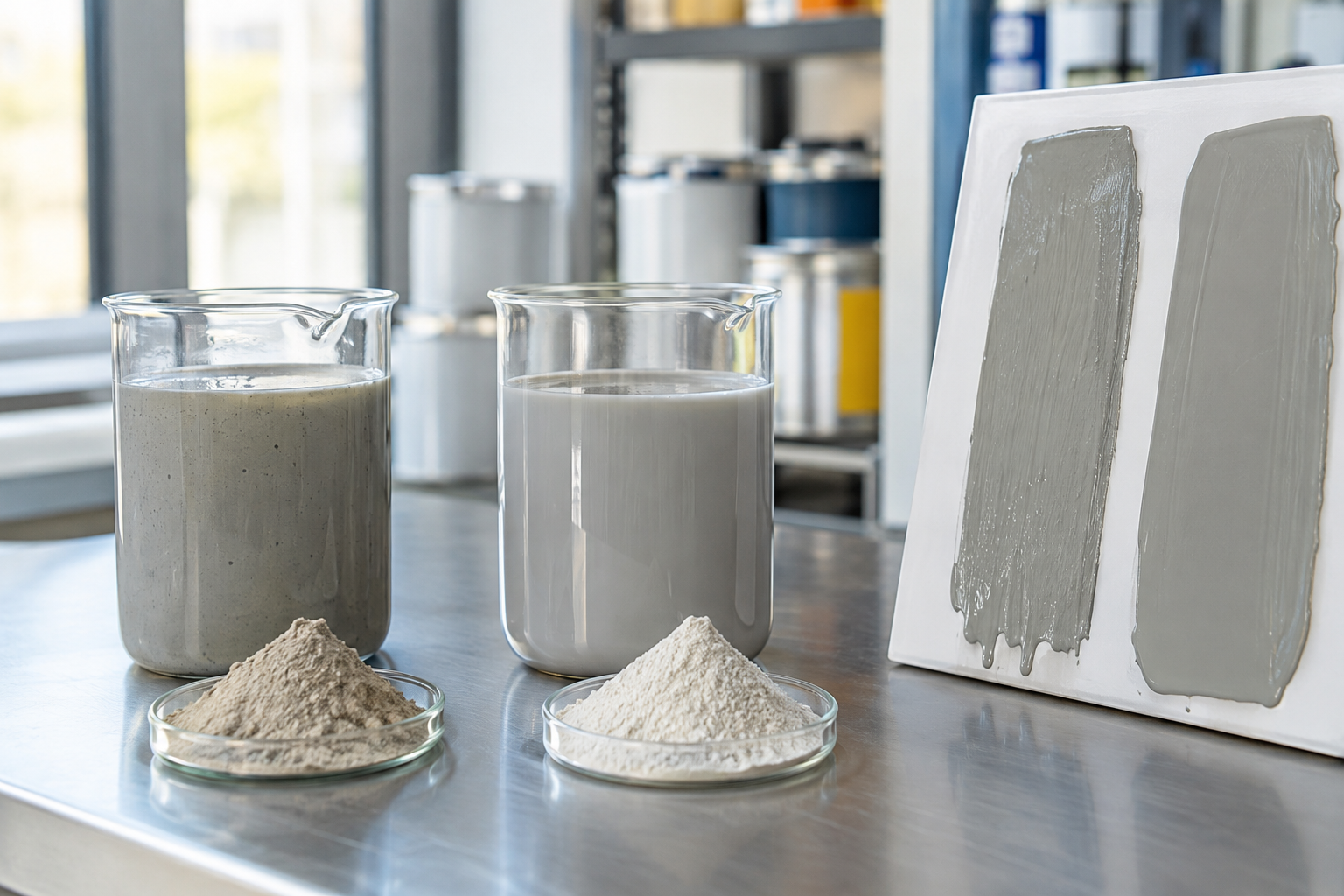
The complete formulation still needs to be tested. Water quality, dissolved salts, pH, surfactants, dispersants and polymer chemistry can all change clay behaviour.
Organoclay becomes particularly relevant when you're formulating a solventborne coating and need low-shear structure without relying entirely on the resin or conventional polymeric thickeners.
Typical objectives include:
Industrial maintenance and protective coatings are common examples. A heavily pigmented coating applied to a vertical steel surface needs enough body to resist sag, but it also needs to spread under brush, roller or spray conditions.
That's where shear-dependent viscosity becomes useful. A suitable organoclay can give the coating structure at rest while allowing it to become less viscous under application shear.
One of the most common formulation mistakes is choosing the rheology additive before looking carefully at the liquid phase.
Start with the continuous phase, not the mineral.
In waterborne coatings, conventional smectite clays can be useful because the clay naturally interacts with water. However, dispersion quality is critical. Poorly dispersed particles can create lumps, inconsistent viscosity and weak suspension performance.
The formulation also contains components that can compete with or interfere with clay hydration. Electrolytes, surfactants, pigments and polymer dispersions may alter the final structure.
Some organically modified clays are also designed for waterborne applications, so the word organoclay alone doesn't rule a material in or out. Always check the supplier's technical data for the specific system.
In solventborne coatings, the polarity of the liquid phase becomes especially important. Organoclay products are available for different organic media because compatibility isn't universal.
A coating based on mineral spirits isn't necessarily going to behave like one based on a more polar solvent blend. Even when two formulations have similar viscosity before adding the clay, their interactions with an organoclay can be very different.
The same principle applies to the resin. An organoclay that works well in one alkyd or epoxy system may not give the same result in another binder or solvent blend.
High-solids formulations introduce another challenge: there is less liquid available to wet and separate particles, while the target viscosity may already be high.
Here, dispersion efficiency and dosage become especially important. Adding more rheology modifier isn't a substitute for achieving good particle wetting and dispersion.
For development work, pay close attention to mixing energy, addition order and temperature as well as dosage. These process variables can change the final rheology significantly.
Sag occurs when a wet coating moves downward under gravity after application. The risk increases with wet film thickness, low viscosity and certain substrate geometries.
A suitable organoclay can increase low-shear viscosity and yield stress, helping the coating hold its position on a vertical surface. This can be particularly useful in protective and maintenance coatings where relatively high wet-film builds are required.
But sag resistance always involves a compromise. If the coating becomes too structured, you can create poor brushability, poor spray atomisation, weak flow and leveling, or an undesirable surface texture.
The target isn't maximum viscosity. It's the right viscosity at the right shear rate.
It can, provided the clay is compatible with the formulation and produces enough low-shear structure.
Pigments and fillers are constantly affected by gravity. If the liquid phase doesn't provide enough resistance, heavier particles settle during storage. A structured coating can slow that movement and make the settled material easier to redisperse.
This is one reason rheology should be evaluated at several shear conditions rather than with a single viscosity measurement. A coating can look acceptable at a high-shear viscosity while still suffering from settling because its low-shear structure is inadequate.
The same principle applies to organoclay. Its value isn't simply that it makes the coating thicker. A suitable grade can create a structure designed to control settling and sag while still allowing the material to flow during application.
A technically suitable clay can perform badly if it's added incorrectly.
This is particularly important for organoclay. Depending on the grade, the material may require specific wetting, high-shear dispersion or chemical activation to develop its intended structure. The supplier's recommended addition sequence should therefore be treated as part of the formulation specification, not as an optional suggestion.
A practical laboratory workflow is:
This sequence separates a genuine rheology improvement from a temporary increase in apparent viscosity.
Bentonite grades vary in mineral composition, montmorillonite content, particle size, moisture and processing history. Two materials sold under the same broad mineral name can behave differently in a coating.
If consistency matters, request a technical specification and test representative samples rather than assuming that one bentonite grade can replace another without formulation work.
Organoclay isn't just bentonite with a higher price tag. Organic modification changes surface chemistry and therefore changes how the clay behaves in a formulation.
The useful comparison isn't which clay is stronger. It's which clay creates the required rheology in this particular coating.
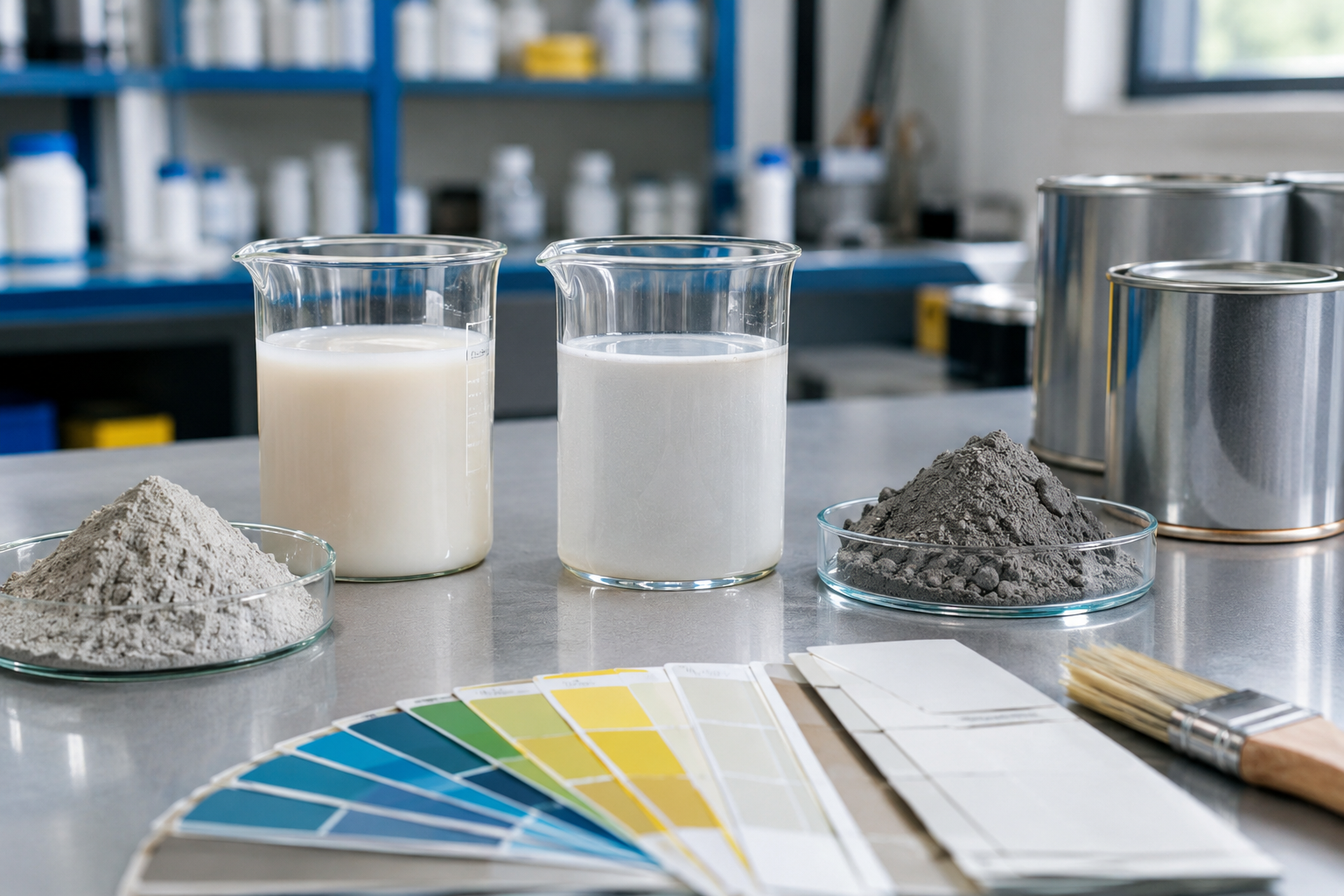
This can hide a dispersion problem. If the clay is poorly dispersed, increasing dosage may raise apparent viscosity without creating the desired stable structure.
It can also damage application properties. A coating may become difficult to spray, brush or level even though the viscosity number appears to be within an acceptable range.
A coating needs to survive storage, transport and application. Measure viscosity after storage, inspect settling and test redispersion. A formulation that looks perfect on day one may develop hard sediment later.
Storage testing should also consider temperature exposure where relevant to the product's actual distribution and use conditions.
This is particularly risky with organoclay. A grade developed for one solvent environment may not provide the same rheology in another.
Check the supplier's recommended polarity range and validate the grade in the actual solvent blend rather than relying on a generic statement that the material is suitable for solventborne coatings.
A coating that stays exactly where you put it but won't level isn't necessarily better. Check sprayability, brush drag, roller behaviour, flow, leveling, surface appearance and dry-film properties alongside sag.
The best formulation balances storage stability with application and final film performance.
There is no single universal dosage that works across industrial coatings.
The correct addition level depends on clay grade, resin, solvent or water phase, pigment volume concentration, target rheology and application method. Organoclay technical data commonly provide recommended starting ranges, but those values are starting points rather than guaranteed final dosages.
For development work, use a controlled ladder of additions rather than changing several ingredients at once. Prepare a series of otherwise identical laboratory batches with progressively higher rheology-modifier levels. Measure low-shear and higher-shear viscosity, settling, sag and application behaviour.
That gives you a response curve rather than a single pass-or-fail result.
It's also useful to record the exact mixing energy, mixing time, temperature and addition sequence. A change in processing can sometimes produce a larger rheological difference than a small change in dosage.
When moving from laboratory batches to production, repeat the evaluation because equipment geometry, shear history and batch size can change dispersion and final rheology.
Sometimes, yes, but combining them shouldn't be treated as automatically beneficial.
If a formulation contains both water and organic phases, or if different rheological functions are required at different shear conditions, more than one structuring mechanism may be useful. However, the two materials can interact with each other and with other additives, making the final rheology harder to predict.
If you test a combination, establish a control formulation first. Then change only one variable at a time. Measure viscosity, settling, sag, leveling and storage stability before deciding whether the combination provides a real advantage.
A blend is worthwhile only when it solves a defined formulation problem more effectively than a single rheology modifier or another additive package.
A simple decision process can make selection much faster.
The best coating formulation may use a combination of rheology technologies rather than relying on one additive.
Consider a solventborne protective coating containing a resin binder, corrosion-resistant pigments and mineral fillers. The coating will be applied to vertical steel surfaces, so settling and sag are both concerns.
Conventional untreated bentonite wouldn't automatically be the first choice because its natural hydrophilic character may not provide the desired interaction with the organic liquid phase.
A compatible organoclay is more directly aligned with this type of formulation. The formulator would still need to select the grade according to solvent polarity and resin chemistry, establish the correct dispersion method and optimise dosage.
The finished formulation should then be checked for several properties:
This is a better evaluation than simply comparing the viscosity of two additives in a beaker. The coating has to work as a complete system, not just produce an impressive laboratory number.
If you're sourcing bentonite for coatings, ask for information that lets your formulation team predict batch-to-batch behaviour.
Useful questions include:
For industrial production, consistency matters as much as a good result from one laboratory batch. A supplier that can provide controlled processing, clear specifications and repeatable material quality is easier to qualify for long-term use.
Axewelledge supplies processed bentonite for industrial applications and can discuss grade selection based on the intended use, processing requirements and supply volume. For coating formulators, the useful starting point is the formulation itself: the liquid phase, binder, performance target and processing conditions should determine the mineral specification.
Bentonite and organoclay address related rheology problems through different chemistry. Conventional bentonite is naturally suited to water-rich, compatible systems, while organoclay is modified to function more effectively in many organic media.
For industrial coatings, don't choose between them based on a generic claim that one is stronger, cheaper or more versatile. Match the clay to the continuous phase, resin chemistry and required shear behaviour.
Then test what actually matters: settling, redispersion, sag, application, leveling and storage stability.
That approach gives you a much more reliable basis for selecting a coating rheology modifier than simply chasing a target viscosity.













Have questions about our products? We're here to help!