Axewelledge, a leading exporter from India, specializes in high-quality Bentonite. With a commitment to excellence, we supply premium Bentonite to the Middle East and Southeast Asia markets.


North Angle Complex, 304,
150 Feet Ring Rd, Opposite Ambedkar Nagar BRTS Stop,
Madhav Park, Punit Nagar,
Mavdi, Rajkot, Gujarat 360004
© Axewelledge 2026, All Rights Reserved.
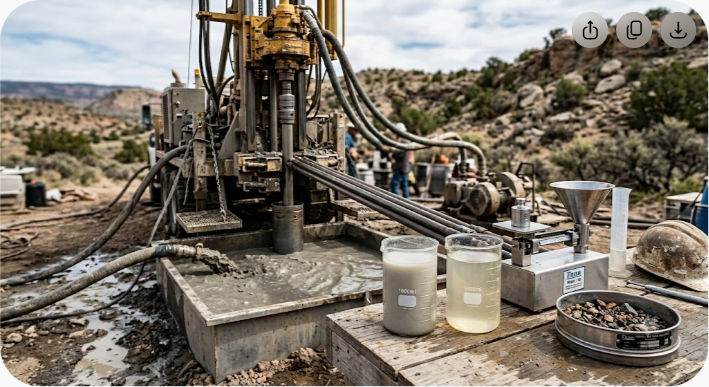
Bentonite and polymer mud can both stabilize a water-well borehole and transport drilled cuttings, but they do the job through different mechanisms. For many conventional rotary water wells, bentonite remains a practical choice because one properly prepared mineral-based fluid can provide viscosity, gel strength, cuttings suspension and filter-cake formation. Polymer mud can be useful when low solids, lubrication, specialised cuttings control or particular formation conditions matter more. In some jobs, a bentonite-polymer system makes sense because it combines properties from both fluid types.
There isn't a universal winner. The right choice depends on the formation, drilling method, mixing-water chemistry, borehole geometry, circulation equipment and how the completed well will be developed. Selecting a mud simply because it has a lower purchase price, or because another drilling crew uses it successfully, can create larger costs later through unstable walls, excessive fluid loss, difficult solids control or prolonged well development.
The most useful way to compare bentonite and polymer is therefore not to ask which material is better in general. Ask which fluid gives the borehole the required stability and cleaning performance while remaining compatible with the formation and the final well construction plan.
Bentonite mud is a water-based drilling fluid in which swelling clay, principally montmorillonite, provides much of the fluid's structure. When suitable bentonite hydrates and disperses in water, it develops viscosity and gel strength. It can also form a relatively low-permeability filter cake against a permeable borehole wall. Those properties help suspend cuttings, limit fluid loss and support the borehole during drilling.
Polymer mud uses water-soluble polymers to build viscosity, condition drilled solids, improve lubrication, control filtration or modify other aspects of fluid behaviour. Depending on the polymer chemistry and formulation, a polymer system can contain substantially less mineral solids than a conventional clay-based mud.
The distinction matters because the fluids create drilling performance in different ways. Bentonite relies primarily on a hydrated clay structure. Polymer systems rely much more heavily on dissolved or dispersed polymer molecules. That difference affects filtration, cuttings behaviour, lubrication, solids loading, borehole cleaning and the way the formation interacts with the circulating fluid.
A third option is often overlooked: combining bentonite and polymer. A mixed system can be useful when the filtration and filter-cake characteristics of bentonite are wanted alongside the low-solids viscosity, lubrication or cuttings-control properties of a polymer.
The important point is that polymer isn't simply "thin bentonite," and bentonite isn't merely a cheaper polymer substitute. They are different fluid technologies with different strengths and limitations.
Bentonite is particularly useful in rotary water well drilling because one properly prepared fluid can perform several jobs at once. Its value comes from the interaction between hydration, rheology, filtration and the formation being drilled.
The drilling fluid must move rock and formation material from the bit to the surface. Viscosity helps keep cuttings moving through the annulus instead of allowing them to settle around the drill string.
Gel strength becomes especially important when circulation stops. A properly conditioned bentonite mud can develop a gel structure that helps keep suspended material from settling rapidly. When circulation resumes, the mud should break back down enough to circulate without excessive pressure.
That balance matters. A mud that is too thin may struggle to transport cuttings. A mud that is unnecessarily thick can increase pumping pressure, restrict circulation and make solids removal more difficult.
Loose sands, gravels and other unconsolidated formations can be difficult to keep open during drilling. A hydrated bentonite system contributes to borehole stability through the pressure of the fluid column and the filter cake that develops at the formation interface.
The filter cake is particularly important. Bentonite particles can accumulate at the borehole wall and reduce the rate at which the liquid phase enters the formation. This helps limit fluid loss and can reduce the disturbance of permeable formations during drilling.
The objective isn't to create the thickest possible cake. A useful filter cake should control filtration without creating unnecessary difficulty during well development.
Filtration describes the movement of the liquid phase from the drilling fluid into the formation under pressure. In a permeable formation, excessive filtrate loss can change the condition of the borehole wall and increase the amount of fluid entering the formation.
Hydrated bentonite particles can form a relatively low-permeability filter cake under suitable conditions. This is one reason bentonite remains a common component of water-based drilling fluids.
Filter-cake performance depends on more than simply adding clay. Bentonite type, concentration, hydration, water chemistry, solids content and drilling conditions all influence the final result.
Circulating fluid carries heat away from the bit and drill string while also reducing friction between moving components and the borehole environment. Polymer systems can have a particular advantage when strong lubrication is required, but a properly formulated bentonite fluid still provides useful lubrication as part of its broader drilling function.
The fluid column provides hydrostatic pressure while drilling. The required pressure depends on formation conditions, groundwater conditions, drilling depth and fluid density.
For that reason, mud weight and rheology should be monitored rather than selected by habit. A fluid that works at one depth or in one formation may not be appropriate after the drilling conditions change.
Polymer mud is a different approach to controlling drilling-fluid properties. Various polymer chemistries can increase viscosity, encapsulate drilled solids, reduce fluid loss, improve lubrication or help control troublesome clay.
That variety is important. "Polymer mud" describes a broad family of fluid systems rather than one standard formulation. A high-viscosity polymer, an encapsulating polymer, a fluid-loss-control polymer and a biodegradable natural polymer may behave very differently in the same hole.
One major attraction of polymer systems is the possibility of obtaining useful viscosity with relatively little mineral solids. This can be valuable when a drilling program needs strong carrying capacity without continually increasing the clay content of the circulating system.
Polymer systems can also provide good lubrication. That may be useful when drilling long intervals, working with high rotational loads or dealing with formations where friction becomes a significant operational concern.
For a water well contractor, potential advantages include:
There is a trade-off. Depending on the formulation, polymer mud may not provide the same filter-cake or gel-strength behaviour as bentonite. A polymer's performance also depends heavily on concentration, water chemistry, formation solids and the specific polymer selected.
So polymer isn't automatically a better option for groundwater drilling. The product has to match the problem you're trying to solve.
| Feature | Bentonite mud | Polymer mud |
|---|---|---|
| Main structure builder | Hydrated swelling clay | Water-soluble polymer system |
| Mineral solids | Relatively higher | Often lower |
| Filter-cake formation | Strong capability when properly formulated | Depends strongly on polymer chemistry and formulation |
| Gel strength | Typically useful for suspension | Can be lower or differently structured |
| Lubrication | Useful, formulation-dependent | Often a strong advantage |
| Cuttings transport | Very good when rheology is controlled | Very good when correctly formulated |
| Solids control | Requires management of clay and formation solids | Can be easier to manage at low solids, although polymer-treated solids behave differently |
| Formation compatibility | Broadly useful, but water chemistry matters | Highly dependent on polymer type and formation |
| Water chemistry sensitivity | Hardness and salinity can affect hydration | Response varies with polymer chemistry |
| Cleanup | Requires effective well development | Depends on polymer type, concentration and development method |
| Material cost | Often economical as a base fluid | Product cost may be higher |
| Combined use | Can be modified with polymer | Can be combined with bentonite where appropriate |
This table is a starting point, not a substitute for field testing. The same bentonite concentration or polymer concentration can behave very differently in different water chemistries and formations.
Bentonite is often a sensible starting point for conventional rotary water well drilling when the formation needs borehole support and filtration control and there is no specific reason to minimise clay solids.
It is particularly useful in unconsolidated or weak formations where maintaining an open borehole is a major concern. The combination of gel strength, suspension and filter-cake formation gives the driller several useful controls from one material.
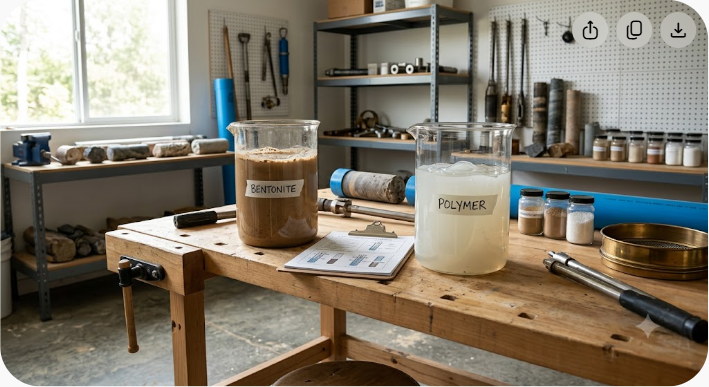
Bentonite can also make economic sense when large fluid volumes are required. But product price is only one part of the calculation. Consistent quality, reliable hydration, field handling, fluid treatment and the ability to manage drilled solids all affect the actual drilling cost.
For water well applications, product selection should therefore be based on the intended fluid properties rather than simply choosing the cheapest bentonite available. Sodium-rich bentonite is commonly used in drilling fluids because it generally hydrates and disperses more strongly than calcium bentonite under suitable conditions.
A practical bentonite program should consider:
The grade that performs well in a laboratory test may still need adjustment in the field. Actual mixing water and formation solids can change the fluid considerably.
Polymer mud becomes attractive when the drilling problem isn't best solved by simply adding more clay.
Consider a formation that produces a large volume of drilled solids. A contractor may want useful carrying capacity without allowing mineral solids to build continuously in the circulating system. A properly selected polymer may provide the required rheology with less clay.
Lubrication is another reason to evaluate polymer. When drill-string friction is a significant concern, the lubricating properties of an appropriate polymer system can be useful.
Polymer can also help where clay control is important. Some formations contain reactive clays that hydrate and disperse into the circulating fluid. That can increase solids loading and make the mud progressively harder to control. A polymer designed for cuttings encapsulation or clay inhibition may help limit this behaviour.
The key phrase is "designed for." Polymer is a category, not a single product. Different chemistries can provide different combinations of viscosity, encapsulation, filtration control, lubrication and degradation behaviour.
Before changing from bentonite to polymer, identify the specific problem the polymer is expected to solve. If the answer is unclear, a product change may simply replace one fluid-management problem with another.
Sandy formations require careful fluid selection because the drilling fluid must support the borehole while limiting unnecessary fluid invasion and maintaining efficient cuttings transport.
Bentonite often fits this requirement well because hydrated clay can create a relatively low-permeability filter cake under suitable conditions. That cake can reduce fluid loss into permeable formations while helping maintain the condition of the borehole wall.
Polymer can also perform effectively in sandy formations when its viscosity and filtration behaviour match the formation. The choice may come down to whether the job benefits more from a clay-based filter cake, a low-solids polymer system or a combination of the two.
One common mistake is assuming that higher viscosity automatically means better sand control. It doesn't. Filtration, borehole-wall condition, solids loading, fluid pressure and the eventual well-development method all matter.
For example, increasing viscosity may improve cuttings transport but also increase pressure losses. If the resulting pressure pushes more fluid into a permeable formation, the change may not solve the underlying problem. Fluid properties have to be considered as a system.
Mixing-water quality is one of the easiest variables to overlook.
Bentonite hydrates in water, so hardness, dissolved salts, chlorides and other dissolved constituents can affect hydration and dispersion. Water that performs well in one drilling program may not produce the same bentonite response elsewhere.
Polymer systems also have compatibility limits. Some polymers tolerate a particular water chemistry well, while others lose performance as salinity, hardness or other dissolved constituents increase.
The practical response is straightforward: test the actual mixing water whenever water chemistry could affect fluid performance.
A simple jar test can reveal useful information before a full mud system is prepared. Compare candidate fluids in the actual water source and observe hydration, viscosity development, settling and the response after representative formation solids are introduced.
The test doesn't replace field monitoring, but it can expose obvious compatibility problems before they become expensive drilling problems.
A drilling fluid can perform well during drilling and still create difficulties if the completed well is hard to develop.
This matters because the finished well must allow groundwater to move efficiently into the screen and through the surrounding filter pack. Drilling-fluid invasion, fine solids and residual material around the productive interval can increase the work required during development.
The objective isn't necessarily to remove every trace of drilling fluid immediately. The goal is to develop the well properly so that drilling-fluid residues, fines and disturbed formation material are removed from the productive interval and the well can produce effectively.
That is why fluid selection should be considered alongside the completion and development plan rather than treated as an isolated drilling decision.
Polymer systems also need deliberate cleanup planning. A polymer that encapsulates drilled solids effectively during drilling may require an appropriate development method afterward. How readily the polymer is removed or broken down depends on its chemistry and concentration.
The drilling fluid should therefore be selected with the end of the job in mind, not just the next few hours at the rig.
Sometimes, a combined system is the most practical option.
A bentonite-polymer fluid can be useful when you want the filtration and filter-cake characteristics of bentonite while using polymer to modify viscosity, lubrication, cuttings behaviour or another specific property.
Combination systems shouldn't be treated as universal recipes. Polymer chemistry can change how bentonite particles interact, and excessive treatment can produce a fluid that is harder to circulate or more difficult to remove during well development.
The order of addition can also matter. A practical approach is to establish and hydrate the bentonite base fluid first, measure its properties, and then introduce the polymer incrementally while monitoring the response.
For a combined system, monitor at least viscosity, filtration, gel behaviour and solids response. If the treatment doesn't produce a measurable improvement in the property you are targeting, adding more product may not be justified.
If you're deciding between bentonite and polymer for a water well, work through the problem in a logical order rather than starting with a product catalogue.
Start with the geology.
Determine whether the borehole will pass through consolidated rock, loose sand, gravel, clay-rich material, fractured rock or a mixed sequence. Identify the intervals most likely to become unstable or produce excessive solids.
Formation changes are particularly important in deep wells. A fluid that works well in the first interval may need adjustment once the geology changes.
Obtain a water-quality report where available, or test the water that will actually be used for mixing.
Consider hardness, salinity or chloride concentration, total dissolved solids and pH where these variables could affect fluid performance.
Decide what the fluid needs to accomplish.
Is the primary requirement borehole support, cuttings transport, lubrication, low solids, filtration control, clay inhibition or some combination of these?
Rank the problems. Asking which fluid is generally better is much less useful than identifying which properties the job actually requires.
If filtration control and clay-based borehole support are major requirements, bentonite deserves serious consideration. If low solids, lubrication or specialised cuttings behaviour is more important, evaluate a suitable polymer system. If both sets of properties matter, test a combined system.
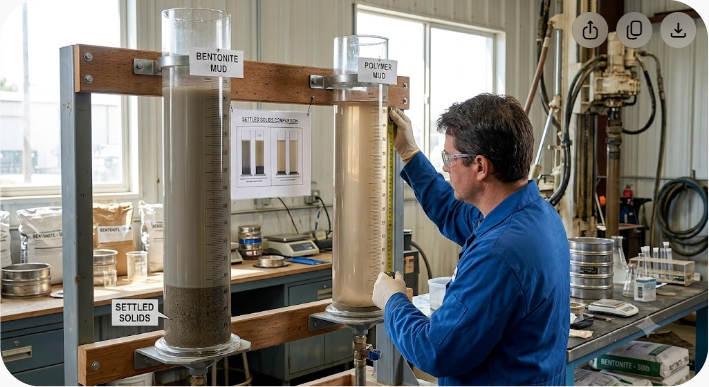
Prepare small batches using the actual mixing water. Add representative formation solids if possible. Measure viscosity and observe settling, filtration and general fluid stability.
This is especially useful when the water source or formation chemistry is unfamiliar.
A fluid that starts correctly can change as formation solids accumulate. Check its properties throughout the job rather than assuming the initial formulation remains unchanged.
A fresh sample and a circulating sample can tell very different stories.
Before committing to a fluid, understand how the well will be completed and developed. A drilling fluid that creates unnecessary residue around the productive interval may increase completion effort even if the drilling stage itself runs smoothly.
This final step is easy to skip because drilling and completion are often managed as separate activities. From a fluid-selection perspective, they are connected.
Four basic properties are especially useful: viscosity, density, gel strength and filtration. Sand or drilled-solids content, pH and relevant water chemistry can provide additional information when fluid problems are suspected.
Viscosity affects cuttings transport and pumping requirements. Don't chase the highest possible number. The useful target is enough carrying capacity for the hole conditions without creating unnecessary pressure losses or poor circulation.
A viscosity increase can result from deliberate treatment, but it can also signal that formation solids are accumulating. That distinction matters when deciding what to do next.
Density influences hydrostatic pressure and provides information about the solids content of the circulating system. An unexpected increase can indicate that drilled solids are accumulating faster than they are being removed.
Density should be considered alongside rheology and solids content rather than interpreted in isolation.
Gel strength describes how strongly the mud structure develops after circulation stops. Adequate gel strength helps keep cuttings suspended during short static periods.
Excessive gel strength can make it harder to restart circulation, while insufficient gel strength may allow solids to settle quickly. The target is controlled suspension, not the strongest possible gel.
Filtration behaviour indicates how readily the liquid phase moves into the formation under pressure. In permeable formations, this can be a critical indicator of how the mud will interact with the borehole wall.
Filtration should be considered together with filter-cake quality. A large quantity of cake isn't necessarily a sign of a better drilling fluid.
Solids management becomes more important as drilling progresses. Formation solids can increase density, change rheology and alter the behaviour of a fluid that was properly mixed at the beginning of the job.
The circulating system should therefore be monitored throughout drilling. Solids control is part of fluid control.
A lower material price doesn't necessarily mean a lower drilling cost. If the fluid causes poor borehole stability, excessive fluid loss, difficult solids management or prolonged cleanup, the apparent saving can disappear quickly.
Look at total fluid consumption, mixing requirements, solids management, disposal, development and drilling time.
Overly viscous mud can increase pumping pressure and complicate circulation. The goal is controlled rheology, not maximum thickness.
The right viscosity is the one that supports the actual drilling conditions while maintaining efficient circulation.
A bentonite selected without considering mixing-water quality may fail to hydrate as expected. Polymer systems also require compatibility testing.
Water testing is usually much cheaper than discovering a compatibility problem after a large volume of fluid has been mixed.
Adding another bag of bentonite or another dose of polymer because the mud "looks thin" isn't a reliable control method.
Measure the relevant property first, identify the likely cause and then make incremental adjustments. Visual appearance alone can be misleading.
A fresh mud sample may look ideal. After several hours of drilling, its solids concentration may be completely different.
Monitor the circulating system rather than relying only on the original mix design.
Polymer chemistry matters. Two products sold for drilling can have very different viscosity, encapsulation, filtration and degradation behaviour.
Choose the polymer based on the property it is expected to provide, then verify performance in the actual water and formation conditions.
The drilling fluid needs to work with the eventual screen, filter pack and development process. In water well construction, that connection is particularly important.
A fluid that makes drilling easy but creates excessive cleanup work may not be the most suitable overall solution.
Drilling mud and annular seal material should not be treated as the same product or application.
A bentonite drilling fluid is formulated to circulate through the borehole. An annular seal is installed to create a durable barrier around the casing. Water well standards and regulations can specify particular materials, placement methods and minimum solids concentrations, and those requirements vary by jurisdiction.
For example, requirements for annular sealing may distinguish between bentonite products used as drilling fluids and those intended for sealing. Seal placement, groundwater conditions, casing configuration and the position of the seal relative to the screen all need to be considered.
Annular seals are intended to limit unwanted vertical movement of water around the casing and help protect groundwater resources from pathways for contamination.
So don't assume that the bentonite mud circulating during drilling is automatically suitable for the completed well's annular seal. Follow the applicable state, local or project specification and the manufacturer's instructions for the selected sealing product.
Suppose a rotary water well passes through alternating layers of loose sand and clay.
The sand creates a borehole-support and filtration challenge. The clay creates a solids-management problem because dispersed clay can quickly increase the circulating solids load.
A conventional bentonite system may provide the borehole support and filter cake needed through the sandy intervals. But if formation clay causes excessive dispersion, simply adding more bentonite can increase the total solids concentration and make the fluid harder to manage.
A polymer-assisted system could then be evaluated for cuttings encapsulation or rheology control. The final formulation should be established through testing rather than assumed from the formation description alone.
This example shows why "bentonite versus polymer" can sometimes be the wrong question. The more useful question is: which fluid system provides the required borehole stability and cuttings transport while remaining compatible with completion and development?
For drilling-fluid applications, bentonite quality matters because hydration, swelling, dispersion and rheology depend on the material's mineral characteristics and processing.
Axewelledge supplies sodium bentonite for industrial applications, including drilling. For a water well program, the useful starting point isn't simply the product name. It is matching the bentonite grade to the required fluid properties and then validating the material with the actual mixing water and drilling conditions.
When sourcing bentonite for a water well project, discuss the intended application, required performance, packaging, particle size and relevant quality requirements with the supplier. Consistency from batch to batch matters as much as the headline specification.
A supplier should be able to provide the information needed to evaluate whether a particular grade fits the intended drilling-fluid program. Field testing should then confirm that the material behaves as expected under actual operating conditions.
For many conventional water well drilling programs, bentonite is a practical general-purpose option because it can provide viscosity, gel strength, suspension and filter-cake formation in one mineral-based system.
Polymer mud becomes more attractive when low solids, lubrication, specialised cuttings control or formation chemistry makes a clay-heavy system less suitable. A combined bentonite-polymer system can also be evaluated when the job requires useful properties from both fluid types.
The practical choice comes down to the formation and the job requirements:
The useful drilling fluid isn't the one with the longest list of claimed benefits. It's the one that behaves predictably in the formation, with the available water, under the actual drilling conditions, and leaves you with a well that can be properly completed and developed.
Bentonite vs polymer mud for water well drilling isn't a simple contest between an established mineral and a newer fluid technology. Bentonite offers a useful combination of swelling, suspension, gel strength and filtration control, while polymer systems can provide low-solids viscosity, lubrication and specialised control of drilled solids.
For some wells, bentonite is the straightforward starting point. For others, polymer may address a specific drilling problem more effectively. In difficult formations, a carefully designed combination may be worth testing.
Start with the formation, test the mixing water, define the drilling and completion objectives, and monitor the fluid throughout the job. If bentonite is part of the formulation, Axewelledge can help evaluate a suitable sodium bentonite supply against the performance requirements of the application.













Have questions about our products? We're here to help!