Axewelledge, a leading exporter from India, specializes in high-quality Bentonite. With a commitment to excellence, we supply premium Bentonite to the Middle East and Southeast Asia markets.


North Angle Complex, 304,
150 Feet Ring Rd, Opposite Ambedkar Nagar BRTS Stop,
Madhav Park, Punit Nagar,
Mavdi, Rajkot, Gujarat 360004
© Axewelledge 2026, All Rights Reserved.
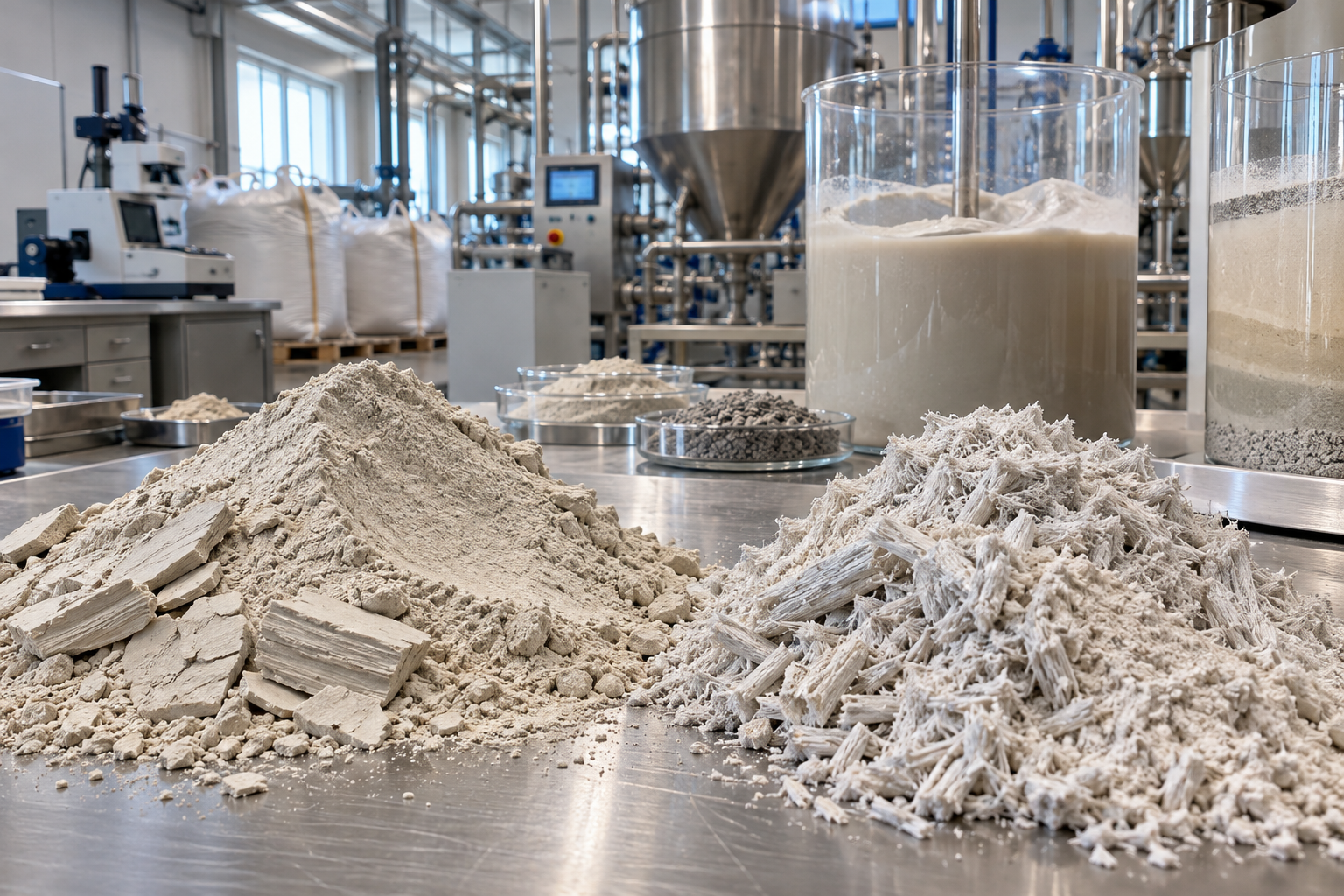
Bentonite and sepiolite can both thicken liquids, absorb materials, and support demanding industrial processes, but they work in fundamentally different ways. Bentonite is usually the better starting point when swelling, sealing, filtration control, binding, or strong water interaction is required. Sepiolite becomes more attractive when absorption, suspension, fibrous rheology, or tolerance to electrolyte-rich systems is the priority.
That distinction matters when selecting an industrial mineral. A product can look similar on a specification sheet and still behave very differently once it enters a real process. Mineralogy, grade, particle size, moisture, water chemistry, temperature, mixing energy, and additives can all change the final result.
This guide compares bentonite vs sepiolite across drilling fluids, absorption, rheology, sealing, construction, agriculture, and other industrial applications. Rather than treating one clay as universally better, it focuses on the practical question: what does your process need the mineral to do?
The simplest difference is their mineral structure.
Bentonite is a clay material dominated by smectite minerals, commonly montmorillonite. Its layered structure allows strong interaction with water and exchangeable ions. Suitable sodium-rich bentonite can hydrate, swell, disperse, and form a viscous suspension or low-permeability gel. These properties explain its widespread use in drilling fluids, sealing systems, foundry bonding, pelletizing, and other water-sensitive applications.
Sepiolite is a naturally occurring magnesium silicate with a fibrous, elongated particle structure. It is generally classified as a nonswelling clay. Its porous structure contributes to absorption, while the fibrous particles can form an interconnected network in liquid systems. That network can produce useful viscosity, suspension, and thixotropic behavior without relying on the same swelling mechanism found in bentonite.
In simple terms, bentonite gets much of its industrial performance from hydration, swelling, dispersion, and particle interactions. Sepiolite relies more heavily on its fibrous morphology, porosity, surface area, and physical particle network.
Neither mechanism is automatically better. The right choice depends on the job the mineral has to perform.
A common purchasing mistake is treating bentonite and sepiolite as straightforward substitutes because both are sold as industrial clays.
They respond differently to water, salts, shear, temperature, and formulation chemistry. Even products within the same mineral family can behave differently because of differences in mineralogy, deposit characteristics, processing, particle size, moisture, and impurities.
For example, a bentonite selected for swelling and filtration control may be a poor replacement for sepiolite in a high-salt suspension system. At the same time, sepiolite's resistance to electrolyte-related changes does not make it a direct substitute for sodium bentonite where swelling and low-permeability sealing are central to the design.
The selection process should therefore start with the required performance, not with the mineral name or price per ton.
Bentonite is generally associated with smectite-rich clay, particularly montmorillonite. Montmorillonite has a layered structure and a high capacity for interacting with water and exchangeable cations.
When suitable sodium bentonite is added to water, hydration occurs between the clay layers. The particles can expand and disperse, increasing viscosity and allowing the suspension to develop gel strength. Under suitable conditions, the dispersed particles can also form a relatively low-permeability filter cake or sealing layer.
This combination of properties makes bentonite useful in water-based drilling fluids, geosynthetic clay liners, foundry applications, iron ore pelletizing, construction slurries, and other industrial processes.
The grade matters, though. Sodium bentonite and calcium bentonite should not be expected to behave identically. Beneficiation, activation, milling, particle-size distribution, moisture, and non-clay minerals can all influence performance.
Sepiolite has a very different architecture. It is a hydrated magnesium silicate with a fibrous morphology and internal channels. Unlike swelling smectites, sepiolite is generally considered nonswelling.
Its porous structure contributes to liquid absorption, while its elongated particles can form a three-dimensional network when properly dispersed. That network can increase viscosity and help keep solid particles suspended.
This behavior can be particularly useful in formulations exposed to high electrolyte concentrations. Because sepiolite's rheological effect is strongly associated with its fibrous structure, it can retain useful suspension characteristics in conditions where some bentonite dispersions lose viscosity or stability.
The difference is fundamental: bentonite depends heavily on hydration and swelling, while sepiolite derives much of its behavior from its fibrous and porous structure.
| Property | Bentonite | Sepiolite |
|---|---|---|
| Mineral type | Mainly smectite-rich clay | Fibrous magnesium silicate clay |
| Swelling | Sodium-rich grades can swell strongly | Generally nonswelling |
| Water interaction | Strong hydration and dispersion | Physical particle-network formation |
| Particle morphology | Predominantly layered or plate-like | Fibrous or needle-like |
| Absorption | Can be high, depending on grade and application | Strong absorption associated with porous structure |
| Salt tolerance | Depends strongly on grade and water chemistry | Generally good electrolyte tolerance |
| Rheology | Can provide viscosity and gel strength | Can provide thixotropy and suspension |
| Sealing | Well suited to many swelling-based sealing systems | Not normally selected for swelling-based seals |
| Drilling fluids | Widely used in many water-based systems | Useful where salt tolerance and rheology are important |
| Absorbent products | Used in selected applications | Widely used in absorbent applications |
| Main selection factors | Swelling, sealing, filtration, binding, hydration | Absorption, suspension, salt tolerance, fibrous rheology |
The table provides a useful starting point, but it should not replace application-specific testing. A mineral that performs well in one process can behave differently in another.
Bentonite's strongest industrial advantage is its interaction with water.
A suitable sodium bentonite can turn from a dry powder into a highly viscous suspension after hydration. That same behavior can help a drilling fluid carry solids, help a sealing material restrict water movement, or help a foundry mixture develop useful bonding characteristics.
Common bentonite applications include:
Not every bentonite is suitable for every use. A drilling-grade material, a foundry-grade material, and a sealing-grade material can have very different specifications.
For a sealing application, a buyer may focus on swelling behavior, hydraulic conductivity, particle size, moisture, and compatibility with the surrounding system. A drilling-fluid customer may instead focus on viscosity, yield point, gel strength, fluid loss, and performance after chemical or thermal exposure.
The word bentonite is only the starting point. The technical grade determines whether the product is actually suitable.
Sepiolite's value comes from a different combination of properties.
Its fibrous particles can form a network that increases viscosity and helps suspend other particles. Its porous structure also makes it useful as an absorbent material. These characteristics support applications such as absorbents, moisture-control products, rheological additives, suspension aids, drilling-fluid additives, construction formulations, coatings, carriers, and selected waste-treatment systems.
Sepiolite is also used in drilling fluids where its rheological behavior and electrolyte tolerance are useful. In some formulations, it can help maintain suspension and structure when dissolved salts make conventional clay systems more difficult to control.
That does not make sepiolite a universally better drilling clay. It simply gives the material a different performance profile.
Bentonite is often selected when swelling and filtration control are central requirements. Sepiolite is often considered when suspension, absorption, fibrous rheology, or performance in electrolyte-rich conditions matters more.
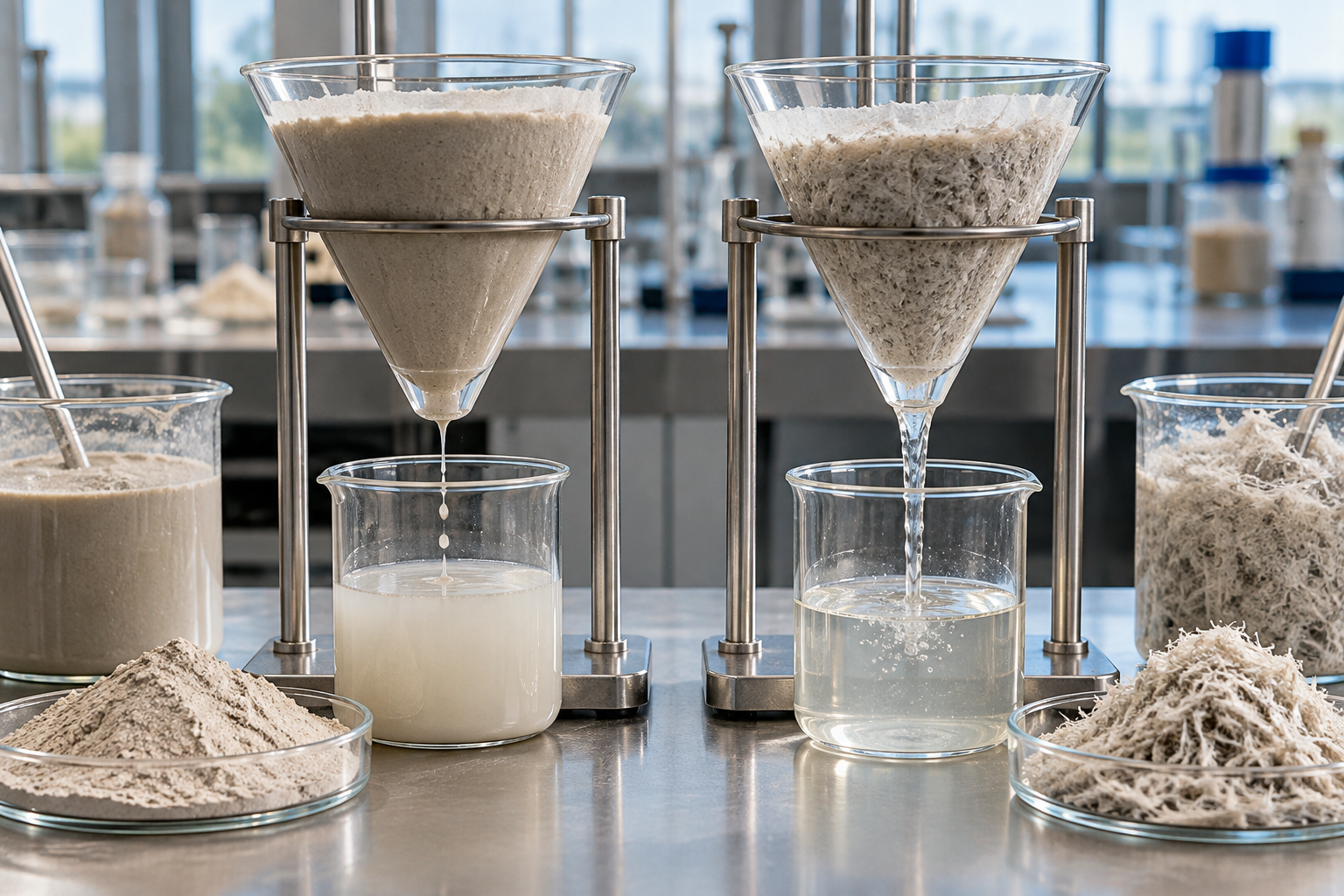
Drilling is one of the applications where the difference between the two minerals becomes especially important.
Bentonite has a long-established role in water-based drilling fluids because hydration and clay-particle interactions can provide viscosity, gel strength, suspension, and filtration control. Its performance depends on mineralogy, concentration, water chemistry, temperature, shear history, and the other additives used in the formulation.
Sepiolite can also be used in drilling fluids. Its fibrous particles create a physical network that contributes to viscosity, gel strength, and suspension. One of its most useful characteristics is its ability to maintain rheological performance in certain electrolyte-rich or saline systems.
The choice should therefore be tied to the drilling environment and the fluid's purpose.
If filtration control and formation of an effective filter cake are major requirements, a suitable bentonite grade may be the more appropriate starting point. If the fluid must maintain suspension and rheology in a high-salt environment, sepiolite deserves consideration.
Temperature is another important variable. Clay suspensions can change significantly as temperature rises, and different mineral structures respond differently. A material that performs well at room temperature may not deliver the same rheology under actual drilling conditions.
Don't approve a drilling clay based on appearance or a single viscosity value. A practical qualification program should consider:
The exact test panel should match the drilling system and the specification being used. Most importantly, test the mineral in the liquid chemistry it will actually encounter in service.
Both minerals can absorb liquids, but the mechanism and the result can be different.
Sepiolite's porous structure and high surface area make it particularly useful for absorbent products. Depending on the grade and particle form, it can absorb liquids while maintaining a relatively stable granular structure. This characteristic is useful in applications such as spill absorption, moisture control, and animal-waste absorbents.
Bentonite can also absorb liquids and is used in absorbent and carrier applications. Its swelling behavior, however, can be either useful or undesirable depending on the product design.
That distinction matters after the liquid has been absorbed.
If the product needs to take up liquid while retaining a granular form, a suitable sepiolite grade may be attractive. If absorption needs to be accompanied by swelling, gel formation, or strong water retention, bentonite may be more appropriate.
There is no meaningful universal answer to which clay absorbs more without specifying the grade, liquid, particle size, dosage, and test method.
Sealing is an area where bentonite has a clear technical role in many applications.
Suitable sodium bentonite can hydrate and swell when exposed to water. When properly confined, the hydrated clay can form a low-permeability layer that restricts water movement. This property is important in many geotechnical and environmental containment systems.
Sepiolite is nonswelling, so it should not be treated as a direct replacement for sodium bentonite when swelling is the primary sealing mechanism.
For a sealing project, consider at least three questions:
A laboratory test using representative site water and realistic confinement conditions is more useful than selecting a material from a generic swelling figure alone.
Water chemistry can change clay performance substantially.
A bentonite that performs well in relatively fresh water may behave differently when exposed to high concentrations of dissolved salts. Electrolytes change the interactions between clay particles and can reduce the stability or viscosity of some bentonite dispersions.
Sepiolite is known for maintaining useful suspension and rheological behavior under higher ionic-strength conditions. This makes it relevant to selected drilling, construction, coating, and industrial formulation problems where water chemistry is difficult to control.
Still, salt tolerance does not mean that sepiolite is unaffected by every formulation variable. Concentration, temperature, pH, particle size, mixing energy, and other ingredients can all change the final behavior.
If your process uses brine, seawater, recycled process water, or another electrolyte-rich liquid, qualify the mineral in that actual liquid before approving a commercial grade.
Rheology is where the structural difference between the two minerals becomes particularly visible.
Bentonite can develop viscosity through hydration and interactions between dispersed clay particles. Depending on grade and concentration, this can produce useful yield stress and gel strength.
Sepiolite can create a network of elongated particles. That network can produce pseudoplastic and thixotropic behavior, meaning the apparent viscosity can decrease under shear and recover as the material returns toward a lower-shear state.
This can be valuable when a formulation needs to flow during pumping or application but resist settling once it is stationary.
For example, a coating or construction formulation may need to move easily through equipment while retaining enough structure to reduce sedimentation or sagging after application. Sepiolite can be useful in this type of formulation.
Bentonite can also provide thixotropic behavior, but its response to water chemistry and other formulation variables is governed by a different mineral structure.
One of the easiest ways to make a poor mineral-selection decision is to compare two supplier datasheets and choose the material with the higher viscosity number.
Viscosity depends on concentration, water quality, shear rate, temperature, mixing procedure, aging time, measurement method, and additives. Two materials can show similar readings under one laboratory condition and behave very differently during production.
For meaningful comparison, use the same test method, liquid, concentration, mixing procedure, temperature, and measurement conditions for every candidate material.
Particle size affects surface area, dispersion, hydration rate, flowability, dust generation, absorption, and rheological response.
A finer bentonite generally provides more surface area for interaction with water and can hydrate differently from a coarser grade. Extremely fine powders, however, can create additional handling and dust-control requirements.
Sepiolite behaves similarly in the sense that particle size and processing affect dispersion. A fine rheological grade can behave very differently from a coarse granular grade intended for absorbent products.
This is why comparing an absorbent-grade sepiolite with a drilling-grade bentonite simply because both are mineral powders can produce misleading conclusions.
The grade exists for a reason.
Ask suppliers for particle-size distribution and recommended mixing or dispersion procedures. If your process uses high-shear mixing, include the actual mixing conditions in the qualification test.
The mineral extracted from a deposit is not necessarily the material that reaches the customer.
Depending on the application, processing may include drying, crushing, milling, screening, purification, activation, blending, or other treatment.
For bentonite, processing and activation can have a substantial effect on hydration and rheology. Suitable calcium bentonite, for example, can be sodium-activated for particular applications, although the result depends on the starting mineral and the activation process.
For sepiolite, grinding and dispersion characteristics affect how readily its fibrous particles develop a network in a liquid system.
Moisture is another practical consideration. Excess moisture can create storage, flow, and packaging problems, while inconsistent drying can affect dispersion and processing behavior.
A useful technical specification therefore covers more than chemical composition. It should describe the properties that actually control performance in the customer's process.

Mineral price is only one part of the total cost.
A lower-priced grade may require a higher dosage to achieve the same functional result. Once dosage, handling, transport, waste, downtime, and production consistency are included, the initial price difference may become much less important.
Compare cost per unit of performance rather than cost per metric ton alone.
Bentonite varies by deposit, mineralogy, exchangeable ions, processing, and particle-size distribution. Sodium-rich and calcium-rich materials can behave differently, and commercial processing can change their performance further.
Always specify the required grade and test method rather than buying on the generic word bentonite alone.
It isn't.
Sepiolite has a fibrous structure and magnesium silicate chemistry that give it a distinct set of properties. It should be evaluated as a different industrial mineral rather than as a modified form of bentonite.
If the real process uses brine, hard water, recycled water, seawater, or another industrial liquid, use representative process water during qualification.
Water chemistry can change clay performance significantly, particularly in systems that depend on particle dispersion and rheology.
A clay's performance depends not only on what you add but also on how you add it.
Mixing order, shear, dispersion time, temperature, concentration, and aging time can all influence the measured result. Establish a repeatable procedure before comparing suppliers.
If you're deciding between bentonite and sepiolite, start with the process rather than the product catalogue.
Bentonite has a broad industrial footprint because its hydration, binding, adsorption, and swelling behavior can serve different purposes across several sectors.
Common applications include drilling fluids, foundry sand bonding, iron ore pelletizing, civil engineering, environmental containment, construction, and selected agricultural and industrial formulations.
The grade requirement changes substantially between these uses.
In drilling, the objective may be viscosity, suspension, and filtration control. In foundry applications, bonding behavior and thermal performance matter. In iron ore pelletizing, green pellet strength and processing behavior become important. In sealing systems, swelling and hydraulic conductivity are central.
The same mineral family can therefore perform very different technical roles depending on its grade and processing.
Sepiolite is used where its absorption, porous structure, suspension behavior, and rheology are valuable.
Common applications include:
Its combination of porosity and fibrous structure makes sepiolite useful in products where both absorption and physical structure matter. In liquid formulations, the same fibrous morphology can help provide suspension and thixotropic behavior.
Yes. In some formulations, combining the two minerals can provide a balance of properties that is difficult to obtain from either material alone.
Bentonite contributes smectitic hydration, swelling, and colloidal behavior, while sepiolite can contribute fibrous structure, suspension, and electrolyte tolerance. This can make mixed-clay systems worth evaluating for selected drilling and industrial applications.
The blend should not be treated as a shortcut, though. Mineral interactions depend on dosage, water chemistry, polymers, salts, temperature, solids concentration, and mixing conditions.
A promising blend still needs laboratory testing and, where appropriate, a controlled field or production trial.
Before placing a large industrial order, request a current technical data sheet and clarify the following:
Most importantly, ask how the reported performance values were measured. A viscosity value without concentration, temperature, water chemistry, mixing procedure, and measurement method is difficult to compare with another supplier's result.
Industrial customers don't buy a mineral only once. They need repeatable performance from one shipment to the next.
A material that performs well in one production batch but changes noticeably in the next can force operators to adjust dosage, water content, mixing time, or other additives. That increases operating complexity and can make quality control harder.
Consistent mining, processing, screening, testing, packaging, and logistics are therefore important parts of industrial mineral supply.
For international buyers, technical communication matters as well. A customer may specify a particular test method, mesh size, moisture limit, viscosity measurement, packaging weight, or delivery term. Clear documentation reduces misunderstandings and makes supplier comparisons more meaningful.
The choice becomes clearer when you describe it in terms of function.
Bentonite is generally worth considering when the application depends heavily on swelling, water interaction, binding, sealing, or filtration control. This includes many drilling, geotechnical, foundry, pelletizing, and containment applications.
Sepiolite is worth considering when absorption, suspension, thixotropic structure, or resistance to electrolyte-rich conditions is more important. Its fibrous and porous structure can be useful in absorbent products, coatings, construction formulations, and selected drilling systems.
A blend may be appropriate when the process needs complementary properties. That is a formulation decision, not a universal recommendation, and it should be supported by controlled testing.
Start with a more useful question: 'Which mineral delivers the required performance at the required dosage under my actual operating conditions?'
That shift makes the selection process much more practical.
Bentonite and sepiolite are both valuable industrial clays, but their strengths come from different mineral structures. Bentonite's hydration and swelling make it useful for sealing, filtration control, binding, and many water-based rheological systems. Sepiolite's porous fibrous structure makes it useful for absorption, suspension, thixotropy, and formulations where electrolyte tolerance is important.
The right choice should come from application-specific testing rather than a generic product label or a single specification value.
Bentonite and sepiolite solve different industrial problems. Bentonite is often the natural starting point for applications that require swelling, sealing, filtration control, binding, or strong water interaction. Sepiolite deserves consideration when absorption, suspension, fibrous rheology, or performance in electrolyte-rich systems is more important.
If you're sourcing bentonite for drilling, construction, sealing, foundry, agriculture, or another industrial application, the grade matters just as much as the mineral name. Axewelledge can help industrial buyers evaluate suitable bentonite specifications according to the intended application, required performance, and supply requirements.
The best material isn't the one with the longest list of properties. It's the one that performs consistently in your process.













Have questions about our products? We're here to help!