Axewelledge, a leading exporter from India, specializes in high-quality Bentonite. With a commitment to excellence, we supply premium Bentonite to the Middle East and Southeast Asia markets.


North Angle Complex, 304,
150 Feet Ring Rd, Opposite Ambedkar Nagar BRTS Stop,
Madhav Park, Punit Nagar,
Mavdi, Rajkot, Gujarat 360004
© Axewelledge 2026, All Rights Reserved.
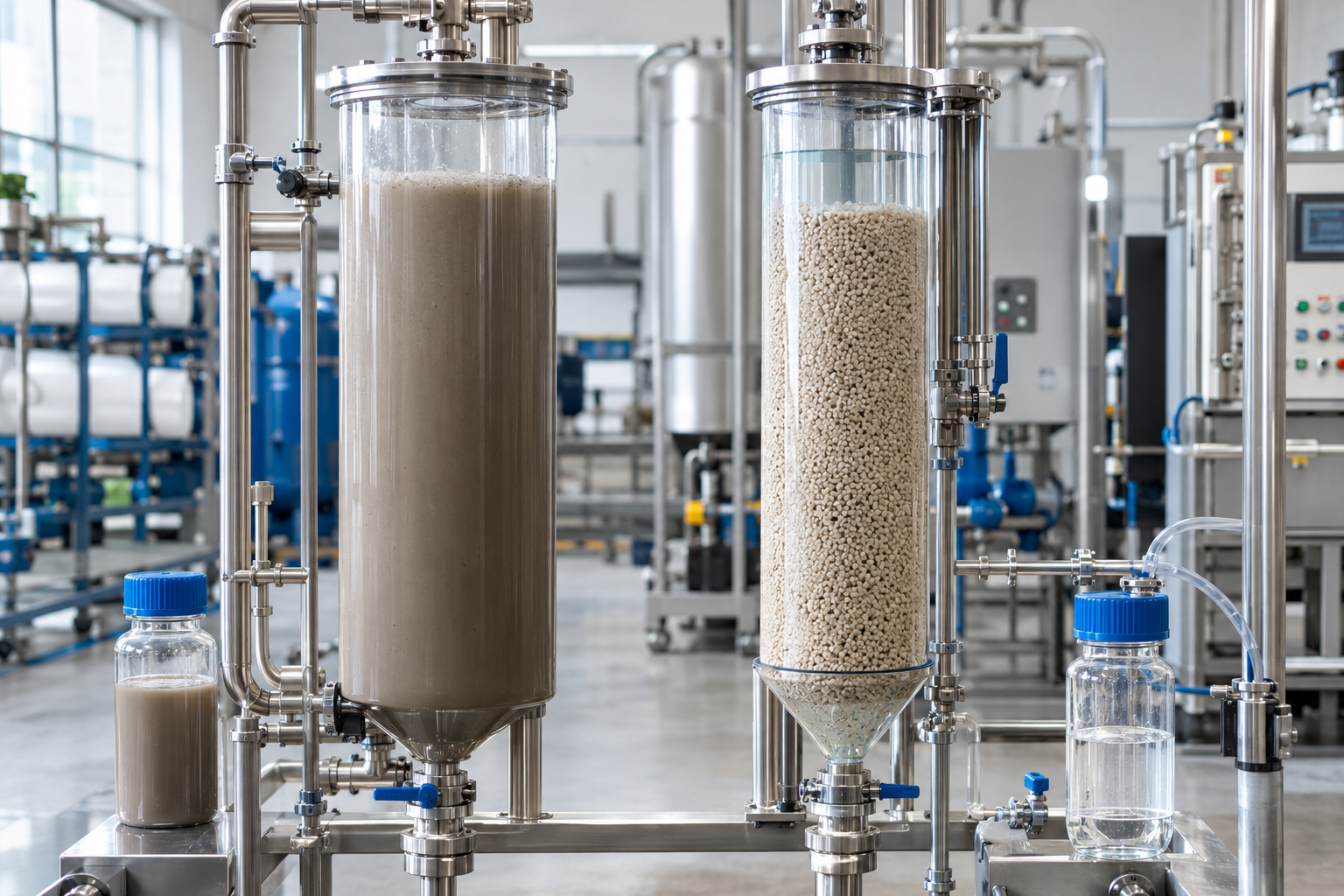
Bentonite and zeolite can both capture ammonium from water, but they are not interchangeable treatment media. For selective ammonium removal, natural zeolite, particularly clinoptilolite, is usually the stronger starting point. Bentonite can also remove ammonium through cation exchange and adsorption, and it may become attractive when clay-based binding, swelling or broader contaminant adsorption is useful to the process.
The important point is that most mineral-based ammonia-removal systems are actually targeting ammonium (NH4+), not molecular ammonia (NH3). That distinction affects how you interpret test results and choose an adsorbent. pH, temperature, competing ions, initial concentration, contact time and mineral properties can all change treatment performance.
A material that performs well in a laboratory solution may behave differently in real wastewater. Calcium, magnesium, sodium, potassium, dissolved salts, organic matter and suspended solids can all affect an ion-exchange or adsorption process. For that reason, the right comparison is not simply which mineral has the higher published adsorption capacity. It is which material can consistently achieve the required outlet concentration in your actual water at an acceptable total operating cost.
If the primary goal is selective ammonium removal from water, clinoptilolite zeolite is generally the better first material to investigate. Its crystalline aluminosilicate framework contains exchangeable cations and channels that support ammonium ion exchange. Granular clinoptilolite can also be used in packed beds, making it practical for continuous treatment.
Bentonite remains a useful option. Its smectite-rich structure provides negatively charged exchange sites that can capture ammonium. Natural bentonite has demonstrated ammonium-removal performance in laboratory studies, while modified bentonites can behave differently and may offer higher uptake under particular test conditions.
The practical comparison is more nuanced than a simple winner-and-loser ranking:
| Factor | Bentonite | Zeolite, especially clinoptilolite |
|---|---|---|
| Main mechanism | Cation exchange and adsorption | Primarily cation exchange and adsorption |
| Ammonium selectivity | Material- and chemistry-dependent | Generally well suited to NH4+ exchange |
| Swelling | Sodium bentonite can swell substantially | Generally non-swelling |
| Particle behaviour | Fine particles can remain suspended | Granular grades are easier to use in beds |
| Fixed-bed treatment | Possible, but swelling and permeability need attention | Well suited to packed-bed systems |
| Regeneration | Possible for selected materials, but requires testing | Established regeneration methods are available |
| Competing ions | Can affect exchange behaviour | Calcium, potassium, sodium and other ions can compete |
| Best fit | Batch treatment, binding, clay-based adsorption or combined applications | Targeted ammonium removal and polishing |
| Main operational concern | Fines, swelling and solid-liquid separation | Capacity loss from competing ions and regeneration effects |
There is no single adsorption-capacity value that can be transferred from one project to another. Bentonite composition varies between deposits, and zeolite performance varies with mineral source, purity and exchangeable cations. Operating conditions matter just as much.
Before choosing either material, establish exactly what the treatment process needs to remove.
In water, ammonia occurs primarily as molecular ammonia, NH3, and ammonium, NH4+. These two forms exist in equilibrium, and their relative proportions depend strongly on pH and temperature. As pH rises, the proportion of un-ionized NH3 increases. At lower pH, the equilibrium shifts toward NH4+.
That distinction matters because bentonite and zeolite generally interact with NH4+ through cation exchange. The minerals contain negatively charged sites balanced by exchangeable cations. Ammonium can replace some of those ions and become associated with the mineral.
So if a wastewater report says the stream contains 20 mg/L of ammonia nitrogen, that figure should not immediately be converted into a mineral dose. First establish how the laboratory reports the result and what the plant specification actually means.
Common reporting forms include:
These measurements are related, but they are not numerically interchangeable. Keeping the reporting basis clear prevents a surprisingly common design mistake: comparing a published adsorption capacity with a plant concentration expressed on a different basis.
Bentonite is a clay-rich material dominated by smectite minerals, commonly montmorillonite. Its layered structure carries a substantial negative charge that is balanced by exchangeable cations such as sodium, calcium, magnesium and potassium.
When bentonite contacts ammonium-containing water, NH4+ can exchange with some of these cations. Surface adsorption can contribute as well. The relative contribution of each mechanism depends on the mineral, particle characteristics and water chemistry.
The word bentonite also covers a range of materials. Two commercial products may differ considerably in mineralogy, smectite content, cation-exchange capacity, particle size, moisture and dominant exchangeable ions. A laboratory result obtained from one deposit should therefore not be treated as a guaranteed performance figure for another supplier's material.
Laboratory research on natural bentonite has demonstrated meaningful ammonium removal under controlled conditions. One study of natural Algerian bentonite reported about 53% ammonium removal under a specified set of conditions and higher removal at increased bentonite dosage. Those results demonstrate the material's ability to capture ammonium, but they should not be interpreted as a universal removal rate or field dosage.
This distinction is important when evaluating a supplier. A published result tells you what happened with a particular mineral under particular conditions. It does not tell you how many kilograms of another bentonite you will need to treat your wastewater.
Sodium bentonite also introduces an operational issue that has little to do with ammonium chemistry: swelling. When hydrated, sodium bentonite can expand and disperse into very fine particles. That can be useful in sealing and binding applications, but it can make post-treatment clarification, filtration and solids handling more demanding.
If a process already uses bentonite for binding, clarification support or adsorption of other contaminants, its ammonium-removal contribution may be useful. If ammonium is the sole target and the process requires a permeable, reusable fixed bed, granular zeolite may be easier to operate.
Zeolite is a family of crystalline aluminosilicate minerals with rigid frameworks containing channels and cavities. Several zeolite types can exchange cations, but clinoptilolite is particularly well known for ammonium removal.
The framework carries a negative charge that is balanced by exchangeable ions. When ammonium-containing water contacts clinoptilolite, NH4+ can replace some of these cations and become retained within the mineral structure.
This ion-exchange mechanism is one reason clinoptilolite has been studied extensively for wastewater, aquaculture and other water-treatment applications. Its rigid structure also makes it practical to produce granular media for columns and other fixed-bed systems.
Published studies have reported a wide range of ammonium capacities for clinoptilolite and other zeolites. Those differences are not surprising. Zeolite source, particle size, activation, initial ammonium concentration, contact time, pH and competing ions all influence the measured result.
Clinoptilolite is also not infinitely selective for ammonium. Other cations can compete for exchange sites. In some experimental systems, potassium has shown strong competition, while calcium and other dissolved ions can also affect usable capacity. The exact selectivity order depends on the zeolite and the solution, so it is better to treat published selectivity sequences as experimental observations rather than universal rules.
For plant design, that means a clean-water batch test is only the beginning. If your actual wastewater has high hardness or salinity, the usable ammonium capacity may be substantially different from the value reported for a simple laboratory solution.
For a treatment system focused specifically on ammonium, zeolite often has two practical advantages: ion-exchange behaviour and physical processability.
A properly graded clinoptilolite can be loaded into a column. Contaminated water flows through the granular bed, ammonium exchanges onto the mineral, and treated water exits the system. The bed can then be monitored for breakthrough and evaluated for regeneration or replacement.
That configuration can suit applications such as:
The fixed-bed approach also makes process monitoring relatively straightforward. Operators can track inlet and outlet ammonium concentrations and observe when the media approaches exhaustion.
There is an important qualification, though. A granular bed is only useful if its hydraulic behaviour remains acceptable. Excessively fine particles can increase pressure drop, while suspended solids and organic matter can foul the bed. Pretreatment may therefore be necessary even when the zeolite itself has sufficient ion-exchange capacity.
The useful question isn't simply, "Which mineral removes more ammonia?" Ask instead: Which material provides reliable ammonium removal in my water, in the equipment I have, for the number of operating cycles I need?
Zeolite's advantages don't make bentonite irrelevant. Bentonite can be the better choice when ammonium removal is only one part of a broader treatment objective.
For example, a clay-based treatment may be useful when adsorption, binding or solids conditioning is already part of the process. A batch system with existing mixing and clarification equipment may also accommodate bentonite more easily than a new fixed-bed installation.
Cost and availability can matter as well. If a suitable bentonite is locally available and the process can handle a slurry, it may be economically attractive even if its ammonium selectivity is lower than that of clinoptilolite.
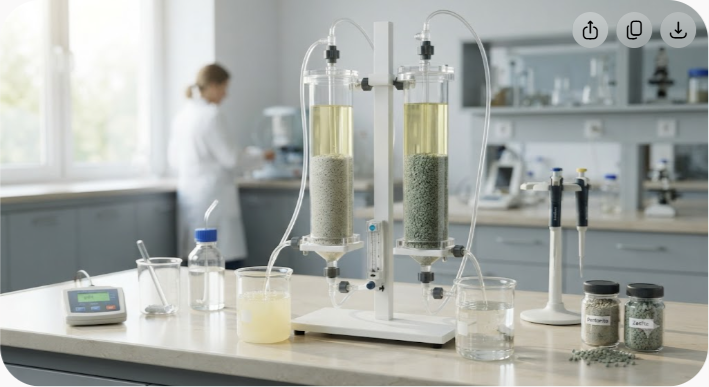
Researchers have also investigated modified bentonites using thermal, alkaline, acid and other treatments. Modification can change surface properties and exchange behaviour, sometimes improving ammonium uptake under specific conditions.
But modification has a price. It can add chemicals, energy, processing time and waste-management requirements. If untreated clinoptilolite already meets the required treatment target, a more heavily processed bentonite may not make economic sense.
The fair comparison is therefore between the actual materials you can buy and operate, not between a highly modified bentonite from one research paper and an untreated zeolite from another.
The two materials can both capture ammonium, but their structures are fundamentally different.
Smectite layers in bentonite carry negative charge that attracts exchangeable cations. Water can enter between the layers, and sodium-rich bentonite can swell significantly as it hydrates.
That combination creates extensive contact with water and provides access to exchange sites. It can be useful for adsorption, but the same physical behaviour can complicate treatment when a process depends on a stable, permeable media bed.
Fine hydrated bentonite may remain suspended after treatment. Depending on the application, the process may therefore require sedimentation, filtration, centrifugation or another solid-liquid separation step.
Clinoptilolite has a more rigid aluminosilicate framework with channels and cavities. Its exchangeable cations can be replaced by ammonium as water passes through or contacts the mineral.
The rigid granular structure provides a major practical advantage for continuous systems. Properly sized clinoptilolite can form a stable bed while allowing water to pass through it, provided the loading rate, particle size and pretreatment are appropriate.
Neither mechanism is automatically superior in every application. Treatment performance has to be considered alongside pressure drop, solids handling, regeneration, replacement frequency and disposal.
For ammonium-focused wastewater polishing, zeolite is usually the more straightforward starting point. Clinoptilolite has a substantial research and application history in ammonium ion exchange, including wastewater and aquaculture systems.
Bentonite may be more appropriate when wastewater contains several contaminants or when the treatment process already relies on clay addition and subsequent solids separation.
Before selecting either mineral, characterise at least the following:
Water chemistry is often the deciding factor. A mineral that performs well in deionised water can behave very differently in real wastewater because competing ions occupy exchange sites and suspended solids or organic matter can interfere with treatment.
This is especially important when a laboratory result looks unusually strong. Ask how the test water was prepared, whether the solution contained competing ions, what solid-to-liquid ratio was used and how equilibrium was defined. Without that information, an adsorption-capacity number is difficult to apply to plant design.
Water chemistry deserves as much attention as the choice of mineral.
pH changes the balance between NH3 and NH4+. It can also influence mineral surface chemistry and the behaviour of exchange sites.
If the process is designed specifically for ammonium ion exchange, test the material at the actual operating pH rather than selecting an operating condition simply because a published study used it.
pH control should also be considered carefully in biological treatment systems. Changing pH to favour one treatment mechanism can affect other parts of the process, so mineral adsorption should be evaluated as part of the complete treatment train.
Calcium and magnesium can compete with ammonium for exchange sites. This is particularly relevant for hard water and for systems in which the mineral will be regenerated and reused.
Repeated regeneration can change the composition of the exchange sites, so a media that performs well during its first cycle may not maintain exactly the same capacity after repeated use.
Potassium can compete strongly for exchange sites in some zeolite systems. This matters in agricultural, aquaculture and wastewater streams where potassium concentrations may be elevated.
The exact impact depends on the mineral and feed composition. It should be measured rather than estimated from a generic selectivity ranking.
Sodium can also affect ion exchange, especially in saline water or streams with high dissolved-solids concentrations. A sodium-rich feed may behave very differently from a dilute laboratory ammonium solution.
This becomes even more important when sodium-based regeneration is part of the treatment process, because regeneration chemistry and wastewater composition then influence one another.
Temperature can affect adsorption kinetics and equilibrium. A test performed at room temperature should not automatically be assumed to represent a cold industrial stream or a warm aquaculture system.
For seasonal operations, testing across the expected temperature range can reveal whether treatment capacity or contact time needs adjustment.
Don't select the mineral from a product description alone. Run a controlled comparison using the water you actually intend to treat.
Record the inlet concentration, required outlet concentration and analytical reporting basis. Confirm whether the specification refers to NH3, NH4+, ammonia nitrogen or total ammonia nitrogen.
For example, reducing ammonium nitrogen from 20 mg/L to 2 mg/L is a different design problem from polishing a stream from 2 mg/L to 0.2 mg/L. The removal percentage, media demand and required contact time may all change.
Measure pH, temperature, conductivity, hardness and the major competing cations. Include suspended solids and organic matter if they are significant in the process stream.
For an industrial project, it is useful to collect representative samples over time rather than relying on one grab sample. Wastewater chemistry can vary substantially between production periods, cleaning cycles and seasonal conditions.
Use the same water, temperature, initial ammonium concentration, mixing conditions, contact time and analytical method for both materials.
Do not compare a 24-hour bentonite test with a two-hour zeolite test and attribute the entire difference to mineral chemistry. Test conditions are part of the result.
A single dosage tells you what happened at one point. A dosage series can show whether additional mineral produces a worthwhile improvement or whether removal is approaching a practical limit.
For batch testing, record both the final concentration and the amount of ammonium removed per unit mass of adsorbent. Looking at removal percentage alone can hide large differences in media efficiency.
Measure ammonium at several time intervals. Some systems remove a large fraction of the available ammonium quickly and then approach equilibrium more slowly.
The result helps determine whether a batch process needs longer mixing or whether a continuous system requires a deeper media bed or lower flow rate.
Once a material looks promising in a controlled solution, repeat the test with actual process water. This is where competing ions, dissolved organic matter and suspended solids become important.
A material that performs well in synthetic water but poorly in the real stream is not a successful treatment medium, regardless of its published laboratory capacity.
Ammonium removal is only one part of the treatment cycle. Determine whether the spent media can be regenerated, reused, dewatered, recovered or disposed of safely.
For bentonite, assess how swelling and fine particles affect separation. For zeolite, assess regeneration efficiency, pressure drop, breakthrough behaviour and the management of spent regenerant.

Don't compare only the purchase price per kilogram or tonne.
Calculate the mineral required to remove the required mass of ammonium, then include pumping, mixing, filtration, clarification, regeneration, replacement, labour and disposal. For continuous systems, include the value of pressure drop and media replacement intervals as well.
The cheapest mineral at the supplier's gate is not necessarily the cheapest treatment medium at the plant.
Bentonite can adsorb ammonium, but that does not mean it should automatically be added to a fish pond as an ammonia-control measure.
Aquaculture is a sensitive application because fish are affected by ammonia species, while water chemistry can change rapidly with feeding, stocking density, temperature and biological activity. The treatment system needs to address the actual water-quality problem rather than simply adding an adsorbent.
Natural clinoptilolite has a longer-established role as an ammonium ion-exchange medium in aquaculture water treatment. Research has examined clinoptilolite in continuous systems associated with fish-farm water treatment.
For a live aquaculture system, mineral treatment should therefore be based on measured water chemistry, the actual ammonia specification, fish requirements, operating pH and the wider treatment process. A controlled media bed or separate treatment stage is generally easier to monitor than adding an unknown amount of fine clay directly to the water.
No. Swelling and ammonium-removal capacity are different properties.
Sodium bentonite's strong hydration and swelling behaviour can be valuable in sealing and binding applications. It does not automatically translate into greater ammonium selectivity.
In a fixed-bed treatment system, swelling can actually create a disadvantage. Hydrated fine clay may reduce permeability, increase pressure drop, migrate from the bed or require additional clarification and filtration.
Zeolite often has the practical advantage here because properly graded granular clinoptilolite can provide ion-exchange capacity while maintaining a defined bed structure.
If the process is a stirred batch treatment followed by solid-liquid separation, however, the swelling behaviour may be manageable. The equipment and treatment sequence determine whether that characteristic is a benefit or a problem.
Always check the analytical method and reporting units. Mineral ion exchange primarily concerns NH4+, while a plant specification may refer to total ammonia or ammonia expressed as nitrogen.
If the analytical basis is unclear, even a technically sound adsorption test can lead to the wrong treatment calculation.
Published capacities belong to particular minerals and test conditions. Natural mineral composition varies between deposits, and real wastewater is more complicated than a synthetic ammonium solution.
Use published data to select candidates and understand mechanisms. Use representative water testing to establish design performance.
Calcium, magnesium, potassium and sodium can change ion-exchange performance. This is especially important in hard, saline or mineral-rich water.
If a supplier provides only a maximum adsorption figure without describing the test solution, ask for the underlying test conditions before using that figure for process calculations.
A low purchase price does not necessarily mean low treatment cost. A material that needs a larger dose, frequent replacement or difficult solids handling may be more expensive over the full operating cycle.
Calculate cost per mass of ammonium or nitrogen removed instead.
Synthetic ammonium solutions are valuable for controlled screening. They do not replace testing with the real feed water.
Once competing ions and organic matter are introduced, adsorption and ion exchange can behave differently. Pilot testing should reproduce the important characteristics of the actual stream.
Fine bentonite can remain suspended after treatment because of its particle size and swelling behaviour. If the process has no suitable clarification or filtration stage, that can become a major operational problem.
This issue is much less prominent with properly graded granular zeolite, although zeolite fines can still need management.
Ion-exchange media can lose usable capacity over repeated cycles. Competing ions can change the exchange balance, and the spent regenerant becomes a new waste stream that must be managed.
A regeneration study should measure capacity before and after repeated cycles rather than assuming that the original adsorption capacity will remain constant indefinitely.
Potentially, yes, but a combination should have a clear process purpose.
A combined system could be useful when the treatment needs different functions. Zeolite can provide targeted ammonium ion exchange, while bentonite can contribute clay-based adsorption or binding. But adding two minerals does not automatically improve treatment.
The physical properties can also work against each other. If granular zeolite is intended for a reusable fixed bed, swelling clay may reduce permeability and make backwashing, regeneration or solids removal more difficult.
For that reason, test the materials separately first. If both provide a useful function, compare a physical blend with a staged treatment process. A staged arrangement may be easier to control because each material can operate under conditions suited to its role.
For example, a process might use granular zeolite for the main ammonium-removal stage and reserve bentonite for a separate batch treatment where clay adsorption or binding is useful. Whether that arrangement makes sense depends on the contaminants, equipment and economics.
The research supports a practical comparison rather than a universal winner.
Reviews of adsorbents for ammonia and ammonium removal include both bentonite and zeolite among conventional materials studied for aqueous treatment. The literature also shows why published performance varies: mineral properties, solution chemistry, dosage, contact time and operating conditions all influence adsorption and ion exchange.
For bentonite, laboratory studies demonstrate that natural material can capture ammonium and that modification can alter or improve performance under selected conditions. Results from individual studies should be treated as evidence of potential rather than direct design specifications.
For zeolite, clinoptilolite has a substantial history of research into ammonium ion exchange, including wastewater and aquaculture applications. Studies have also shown that competing cations and regeneration conditions can affect usable capacity.
Taken together, the evidence supports a useful starting rule: investigate clinoptilolite first when selective ammonium removal is the primary objective, and investigate bentonite when its broader clay properties offer a separate process advantage.
That rule still needs to be validated against the actual water. A different zeolite source may outperform a particular clinoptilolite, and a well-selected or modified bentonite may outperform a poorly matched zeolite. Mineral selection is a process-design decision, not a contest between two names on a product label.
If you're evaluating bentonite for ammonium adsorption, don't ask only for the price per tonne.
Ask about the material's mineral composition, sodium or calcium character, particle-size distribution, moisture, swelling behaviour and available cation-exchange information. Lot-to-lot consistency matters when the mineral will become part of a controlled treatment process.
You should also ask for representative samples for laboratory or pilot testing. Ideally, test more than one production lot if consistency is important to the application.
For an industrial treatment process, useful supplier information may include:
A supplier's generic claim about high adsorption is less useful than a material sample that performs consistently in your actual water.
Axewelledge supplies sodium bentonite for industrial applications, including water-treatment uses. If bentonite is being considered for ammonium removal, the useful next step is to match the material specification to the water chemistry and treatment configuration rather than selecting a grade on swelling performance alone.
For a straightforward question such as bentonite vs zeolite for ammonia removal, zeolite, especially clinoptilolite, is generally the stronger first choice when the real target is selective ammonium removal. Its ion-exchange structure and established use in water-treatment systems make it well suited to this role.
Bentonite should not be dismissed. It can capture ammonium, and modified bentonite can provide stronger performance under particular conditions. Its clay properties may also be valuable when ammonium removal is only one part of a broader treatment objective.
The safest way to choose is not to rely on a universal ranking or one published capacity figure. Measure the actual ammonium concentration, confirm the reporting basis, assess the NH3/NH4+ balance, characterise competing ions and run side-by-side tests using representative water.
Then look beyond removal percentage. Compare media consumption, hydraulic performance, separation requirements, regeneration, replacement frequency and disposal. The material that consistently delivers the required outlet concentration at an acceptable total operating cost is the better choice for your process.













Have questions about our products? We're here to help!