Axewelledge, a leading exporter from India, specializes in high-quality Bentonite. With a commitment to excellence, we supply premium Bentonite to the Middle East and Southeast Asia markets.


North Angle Complex, 304,
150 Feet Ring Rd, Opposite Ambedkar Nagar BRTS Stop,
Madhav Park, Punit Nagar,
Mavdi, Rajkot, Gujarat 360004
© Axewelledge 2026, All Rights Reserved.
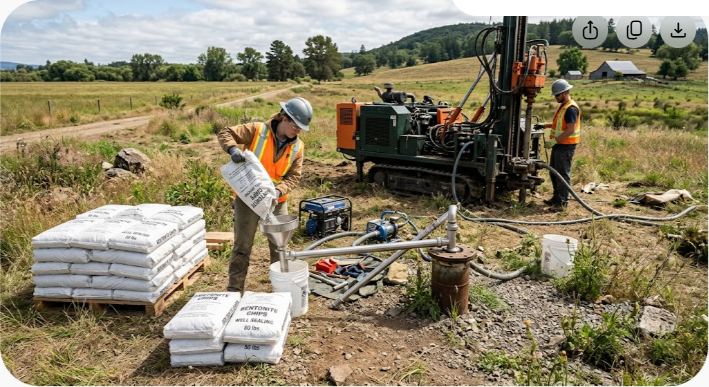
Yes, bentonite can be an effective material for decommissioning and sealing abandoned water wells, but it isn't a universal substitute for cement or a material that can be placed the same way in every well. The right product and placement method depend on the well's depth, diameter, construction, geology, groundwater chemistry, casing condition, and local abandonment rules.
High-swelling sodium bentonite is widely used because hydrated bentonite can form a dense, low-permeability seal. Depending on the product and test method, sodium bentonite can swell substantially when it contacts water and can maintain low hydraulic conductivity when properly confined and hydrated. In a well, that makes it useful for restricting vertical water movement and preventing an abandoned borehole from becoming a pathway between the ground surface and groundwater zones.
The important distinction is between choosing bentonite as part of a compliant plugging design and simply pouring dry clay into an old well. An abandoned well may cross several water-bearing formations, contain damaged casing, hold standing water, or have flowing conditions. A successful decommissioning job has to address those conditions rather than rely on the swelling properties of the material alone.
An unused well can remain a groundwater pathway long after its pump and equipment have been removed. The open bore, damaged casing, annular space, or poorly sealed screen can provide a route for water to move between the surface and subsurface formations that would otherwise be separated by natural geological layers.
That creates several risks:
Proper decommissioning removes equipment and obstructions where possible, seals the well according to the applicable requirements, addresses the casing and annular space, and restores the surface so that water cannot easily collect around the abandoned wellhead.
The idea that an unused well can be left in place because it is no longer being pumped is misleading. Pumping stops when a well is taken out of service, but the borehole remains connected to the subsurface unless it is properly sealed.
The final plugging design should therefore consider the entire well construction. A short surface cap may protect the opening, but it doesn't necessarily stop vertical flow through the full bore. Likewise, filling only the upper section can leave a deeper pathway open.
Bentonite is a clay-rich material containing a high proportion of smectite minerals, commonly dominated by montmorillonite. Sodium bentonite is valued for sealing applications because sodium ions between the clay layers promote substantial hydration and swelling when suitable water is available.
The sealing mechanism is more than simple expansion. As bentonite hydrates, its particles develop a dense, low-permeability structure. When confined, the hydrated material can fill irregularities and maintain contact with surrounding surfaces. The resulting barrier can greatly restrict water movement through the sealed interval.
Dry sodium bentonite contains clay particles with layered structures. When water enters the material, water molecules become associated with the clay surfaces and interlayer spaces. The layers separate, and the material expands.
The amount of swelling depends on the bentonite itself and the water chemistry. Product grade, mineral composition, particle size, exchangeable cations, salinity, and the presence of competing ions can all affect performance. For that reason, a statement such as "15 to 18 times expansion" should be treated as a product-specific property rather than a guaranteed result for every sodium bentonite.
In a confined well, the hydrated clay can develop a continuous, low-permeability mass. The material can also adapt better than a rigid plug to small changes in the surrounding formation, provided the seal remains properly hydrated and confined.
Swelling is useful, but it isn't the only property that determines whether a bentonite seal will perform well. Engineers and regulators are also concerned with hydraulic conductivity, which describes how readily water can move through the sealing material.
A well-designed bentonite seal can achieve very low hydraulic conductivity, but the actual value depends on the material, dry density, hydration conditions, confinement, water chemistry, and test procedure. It is therefore better practice to specify the required performance and product test data rather than assume that every bentonite product will achieve the same result.
For regulated well abandonment, use the hydraulic conductivity, free-swell, viscosity, solids content, or other properties required by the applicable specification. Do not select material solely because it is labeled "sodium bentonite."
Bentonite is often described as self-healing because hydrated clay can swell into small openings or maintain contact when minor changes occur in the surrounding formation. That description has practical value, but it shouldn't be interpreted as a guarantee that a damaged seal will repair itself under every condition.
If bentonite dries substantially, loses confinement, is exposed to unsuitable saline water, or becomes displaced by flowing groundwater, its sealing performance can deteriorate. A good abandonment design prevents those failure conditions rather than depending on self-healing after installation.
There is no single plugging material that is best for every abandoned well. Bentonite and cement each have applications where their properties are useful, and some wells require a combination of materials.
| Property / Feature | Sodium Bentonite Chips / Pellets | Bentonite Grout | Neat Cement Grout | Concrete with Aggregate |
|---|---|---|---|---|
| Main sealing mechanism | Hydration and clay swelling | Hydration and formation of a dense clay grout | Cement hydration and curing | Cement hydration with aggregate support |
| Flexibility | High when properly hydrated and confined | High | Lower after curing | Lower after curing |
| Placement | Gravity placement where permitted | Pumped through a tremie or grout pipe | Pumped through a tremie or grout pipe | Usually limited to suitable large-diameter sections |
| Deep, narrow wells | Product- and regulation-dependent; bridging can be a concern | Often well suited | Often well suited | Generally unsuitable |
| Saline groundwater | Performance can be reduced depending on chemistry | Requires suitable formulation and testing | Often useful where permitted | Generally not used as the primary deep seal |
| Surface structural protection | Not intended as a structural cap | Not intended as a structural cap | Suitable where specified | Suitable for surface restoration where specified |
| Main placement concern | Bridging and incomplete placement | Correct solids, mixing, pumping and tremie placement | Mix quality, shrinkage, heat and placement control | Segregation and difficult placement in narrow bores |
The table illustrates why material selection should be made from the well design rather than from a simple bentonite-versus-cement rule.
Bentonite is particularly useful where a low-permeability, flexible seal is required and the groundwater chemistry is compatible with the selected product. Granular bentonite products can be practical in some shallow wells, while bentonite grout can be used where controlled pumping is required.
Bentonite can also be useful around certain casing configurations and in sealing intervals where maintaining a flexible clay barrier is desirable. However, the exact application must match local requirements.
Cement grout may be required or preferred for flowing artesian conditions, particular saline environments, structural considerations, or regulatory designs that specify cement for certain intervals. Cement can also be used for surface caps or other portions of a well abandonment where a rigid material is appropriate.
The choice shouldn't be based on the assumption that cement is always stronger or bentonite is always better. The objective is to create a continuous, durable seal that meets the performance and regulatory requirements for the specific well.
The physical form of bentonite has a major effect on how it can be placed. A product that works well in a shallow open bore may be a poor choice for a deep, water-filled casing.
Bentonite chips are relatively coarse pieces of bentonite designed for controlled gravity placement where the well configuration and regulations permit that method.
They are commonly considered for shallow or accessible sections because they are easy to handle and don't require grout-mixing equipment. The major concern is bridging. If chips encounter water and begin swelling before reaching the intended interval, they can accumulate higher in the casing and create a false plug.
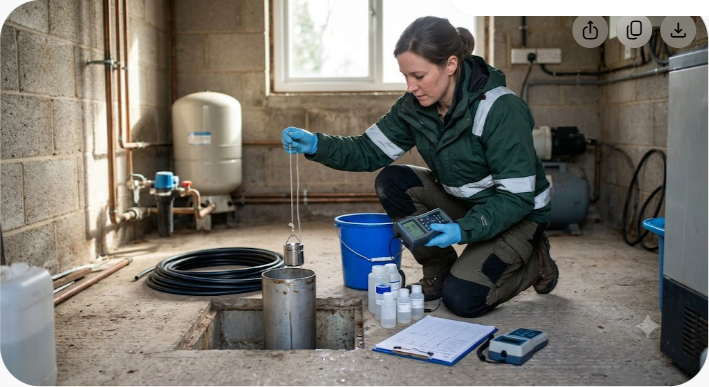
That can leave an unsealed section below the bridge. For this reason, placement rate, particle size, water conditions, and measurement of the material level are important.
Pellets are compressed bentonite products manufactured to provide a more uniform particle size and predictable placement characteristics. Some products are engineered to hydrate more slowly than untreated granular material.
Pellets can be useful where a dense, controlled placement is needed, but the contractor should follow the manufacturer's placement instructions. Coated or delayed-hydration products aren't interchangeable with ordinary bentonite pellets, and the actual hydration time depends on the product and groundwater conditions.
Bentonite grout is prepared from powdered or specially formulated bentonite and water. The formulation is designed to produce a pumpable grout that can be placed through a tremie pipe or other suitable system.
For deeper wells, controlled pumping is often preferable to simply pouring granular material from the surface. The grout can be introduced at the bottom of the interval and placed upward, reducing the risk of leaving voids or creating an uncontrolled bridge.
The correct mixing ratio varies by product and application. Don't substitute a generic solids percentage for the manufacturer's instructions or the requirements of the governing authority.
Well abandonment is a regulated construction activity in many jurisdictions. The following sequence explains the technical workflow, but it isn't a substitute for the applicable well-abandonment rules or a licensed contractor where one is required.
Start by identifying the well and determining which authority governs its abandonment. Requirements can vary by state, province, municipality, aquifer protection zone, well type, and intended land use.
Collect the available well records and determine:
A licensed well contractor, hydrogeologist, or other qualified professional may need to evaluate the well before the abandonment method is selected.
Remove the pump, drop pipe, electrical components, cables, and other equipment where practical. Inspect the casing and determine whether obstructions are present.
An obstruction that prevents a seal from reaching its intended depth is a significant problem. If equipment or debris cannot be removed, document its location and follow the regulator's procedure for addressing the obstruction. Don't simply assume that additional bentonite poured from the surface will solve the problem.
The casing may also need to be perforated, removed, or cut back as required by local rules. The correct treatment depends on the construction of the well and the abandonment specification.
Measure the actual internal diameter and total depth rather than relying only on an old well record. Older records may contain errors, and the current condition of the well may differ from the original construction.
For a simple cylindrical section, the theoretical internal volume is calculated as:
where V is the volume, r is the internal radius, and h is the height of the section being filled.
For field calculations, convert the volume into the units used by the selected product and account for changes in diameter, open-hole sections, casing, screens, and other geometry. A single cylinder calculation may not accurately represent a complex borehole.
The following values represent the geometric volume of a casing section before accounting for product bulk density, annular spaces, irregular borehole geometry, settlement, or regulatory placement requirements.
| Well Casing Diameter | Approximate Volume per 10 ft | Approximate Volume per 10 ft |
|---|---|---|
| 2 inches | 0.22 ft3 | 1.6 gal |
| 4 inches | 0.87 ft3 | 6.5 gal |
| 5 inches | 1.36 ft3 | 10.2 gal |
| 6 inches | 1.96 ft3 | 14.7 gal |
| 8 inches | 3.49 ft3 | 26.1 gal |
| 10 inches | 5.45 ft3 | 40.8 gal |
| 12 inches | 7.85 ft3 | 58.7 gal |
Do not automatically add a fixed percentage of extra bentonite and assume the job is complete. Extra material may be reasonable for procurement planning, but unexplained overconsumption can indicate formation loss, settlement, or bridging. Field measurements should confirm where the material actually went.
Disinfection requirements vary with the jurisdiction and the condition of the well. Some abandonment procedures call for disinfection, while others focus primarily on removing the source of contamination and installing the required seal.
Where disinfection is required, use the specified disinfectant, concentration, contact time, and handling procedure. Sodium hypochlorite is commonly used for water-well disinfection, but adding a fixed chlorine concentration without checking the governing procedure is not appropriate for every abandonment.
The purpose of disinfection is to address microorganisms in the well. It does not replace physical sealing and should never be treated as a substitute for plugging the borehole.
The choice between chips, pellets, and grout should be based on depth, diameter, standing water, groundwater flow, formation conditions, and local regulations.
Where gravity placement is permitted, the material should be placed slowly and continuously enough to reduce bridging while allowing it to reach the intended interval.
Do not use a generic pouring rate as a universal rule. The appropriate rate depends on particle size, casing diameter, water depth, product characteristics, and the manufacturer's instructions.
For deeper or more complex wells, a pumpable bentonite grout may allow better control over placement.
Tremie placement is not simply a matter of putting a pipe down the well and pumping. The pipe position, grout density, pumping rate, mixing quality, groundwater movement, and final volume all need to be controlled.
Once the required subsurface seal has been installed, complete the wellhead according to local requirements. This may include cutting or removing casing below grade, installing a cement or concrete cap, and restoring the surrounding surface.
The exact depth of casing removal and cap thickness should come from the applicable abandonment standard rather than from a universal rule. Surface restoration should also prevent water from ponding around the former well location.
A professional abandonment record should normally identify the well, date of work, contractor, final depth, materials used, quantities, placement method, casing treatment, and final surface condition. Depending on local rules, photographs, measurements, material delivery records, or other evidence may also be required.
Submit the required abandonment documentation to the responsible authority within the specified period. Keeping a copy with the property's permanent records is useful for future owners, environmental assessments, and redevelopment work.
Most bentonite sealing problems aren't caused by the clay's basic properties. They come from selecting the wrong product, placing it incorrectly, or failing to account for field conditions.
Fast placement can cause particles to accumulate and hydrate above the intended depth. The result is a bridge rather than a continuous seal.
The solution is controlled placement and regular depth checks. If the measured level doesn't match the calculated material volume, stop and investigate before continuing.
Fine bentonite dust can hydrate quickly when exposed to water. Excess fines can affect placement and increase the risk of premature bridging.
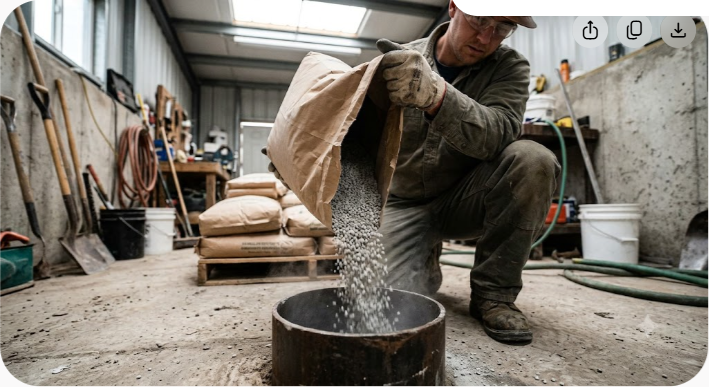
Use the particle size and handling procedure specified for the product. Don't assume that screening or sieving is required for every product; some manufactured pellets are intended to be used as supplied.
Bentonite requires water to hydrate. A dry material column won't immediately behave like a fully hydrated seal simply because it has been placed underground.
If the abandonment design calls for hydration water, use clean water and the quantity specified by the product and regulatory procedure. In some situations, groundwater provides sufficient moisture; in others, controlled hydration is needed.
Salinity can reduce the swelling and sealing performance of sodium bentonite. Divalent ions such as calcium and magnesium can also affect clay behavior.
This matters in coastal aquifers, deep formations, geothermal settings, and other environments where groundwater chemistry differs substantially from fresh water. Test or characterize the water chemistry where required and select a compatible material rather than assuming standard sodium bentonite will perform normally.
A flowing artesian well presents a different problem from a static abandoned well. Moving water can displace or dilute a material before a continuous seal forms.
Flowing wells may require pressure-controlled placement, specialized grout, or cement, depending on the conditions and regulations. The flow should be controlled before attempting a conventional granular bentonite placement.
A concrete cap at ground level can protect the surface, but it doesn't automatically seal the subsurface borehole. The deeper sections must be addressed according to the abandonment design.
This is particularly important when a well crosses multiple aquifers or has an open-hole section below the casing.
Well abandonment is regulated differently across jurisdictions. There isn't a single international procedure that applies to every domestic, agricultural, monitoring, municipal, or industrial well.
In the United States, requirements are primarily established at the state and sometimes local level. State agencies may specify approved materials, minimum seal lengths, casing removal procedures, disinfection requirements, contractor licensing, reporting, and documentation. Federal groundwater-protection principles may also apply in particular circumstances, but federal guidance shouldn't be treated as a replacement for state abandonment rules.
In Canada, provinces and territories regulate water wells through their own legislation and technical requirements. For example, Ontario has specific requirements governing well construction, abandonment, and sealing. Other provinces have their own procedures.
The United Kingdom, European countries, Australia, and other jurisdictions likewise use different regulatory frameworks for borehole construction and abandonment. The applicable authority may distinguish between domestic wells, monitoring wells, investigation boreholes, geothermal wells, and industrial wells.
Before purchasing bentonite or starting field work, verify:
Regulatory compliance is part of the technical design, not paperwork to handle after the physical work is finished.
Not every bag labeled "sodium bentonite" is suitable for well abandonment. Product quality and consistency matter because the seal has to perform underground, often for decades.
Ask the supplier for current technical data covering the properties relevant to the application. Depending on the product, this may include:
The exact tests and acceptance limits should come from the applicable project specification rather than from a generic purchasing checklist.
A granular product intended for gravity placement isn't automatically suitable for pumping. Likewise, a powdered bentonite intended for drilling-fluid preparation isn't necessarily the right product for a permanent abandonment grout.
Tell the supplier how the material will be used. The application should be specified as well-sealing or environmental sealing when that is the intended service.
Bentonite can absorb moisture from humid air, particularly when packaging is damaged or left open. Store bags in dry conditions and keep packaging intact until the material is ready for use.
Moisture pickup can change handling characteristics and make a granular product more difficult to place. For large projects, inspect deliveries and keep batch or lot information with the project records.
For critical engineering work, a certificate of analysis or certificate of conformity can provide useful evidence that the delivered material matches the specified product. Retain the product name, batch number, test information, delivery records, and installation quantities where project documentation requires it.
The same basic sealing principles apply across different well types, but the engineering considerations change with scale and construction.
Domestic wells are often relatively small in diameter, but their abandonment still requires careful attention to depth, casing, screen intervals, and local rules. A shallow well may allow granular bentonite placement where permitted, while a deeper well may require pumped grout.
Homeowners should check whether local law requires a licensed well contractor. In many jurisdictions, well abandonment is not a suitable DIY project because the work must be documented and completed to a prescribed standard.
Agricultural wells can be larger and deeper and may have been constructed in formations containing multiple water-bearing zones. Irrigation equipment may also leave substantial amounts of pipe or other hardware that must be removed before plugging.
The abandonment plan should account for the full borehole geometry and any risk of vertical groundwater movement between formations.
Monitoring wells require special attention because the screen may have been deliberately installed across a specific groundwater interval. Abandonment should prevent the former monitoring point from becoming an artificial pathway between zones.
Small-diameter monitoring wells can also be difficult to plug using coarse granular material, making an appropriate grout placement method important.
Industrial well decommissioning can involve larger diameters, greater depths, complex casing strings, flowing conditions, and more demanding documentation. The plugging program may be designed interval by interval rather than as a single continuous material column.
For these projects, material selection should be part of the engineering design and reviewed against the governing regulatory requirements before field execution.
The cost to seal an abandoned well depends on far more than the price of the bentonite itself. Two wells with the same depth can have very different abandonment costs.
Major cost factors include:
For a meaningful estimate, obtain the well record and field measurements first. A material-only price isn't a reliable estimate of the complete decommissioning cost.
Before the work starts, confirm the following:
This checklist doesn't replace the local abandonment standard, but it helps identify the major decisions that should be resolved before material is placed.
Bentonite can provide an effective low-permeability seal for many abandoned water wells, particularly when a suitable sodium bentonite product is properly placed, hydrated, and confined. Its swelling behavior and flexible clay structure make it valuable for applications where a durable hydraulic barrier is required.
The material itself, however, is only one part of the solution. A successful well decommissioning project starts with understanding the well construction and groundwater conditions, then selecting an approved material and placement method that fits the site.
For shallow wells, bentonite chips or pellets may be practical where regulations permit gravity placement. Deeper, narrow, or complex wells often benefit from controlled bentonite grout placement through a tremie system. Flowing artesian conditions, highly saline groundwater, structural requirements, or specific regulations may make cement or a combination of materials more appropriate.
The safest approach is to treat abandoned-well sealing as a regulated engineering task rather than a simple filling operation. Verify the rules, inspect the well, select the correct material, control placement, document the completed plug, and retain the records.
When those steps are followed, bentonite can be an important part of a long-term groundwater protection strategy and a practical solution for properly decommissioning suitable abandoned wells.













Have questions about our products? We're here to help!