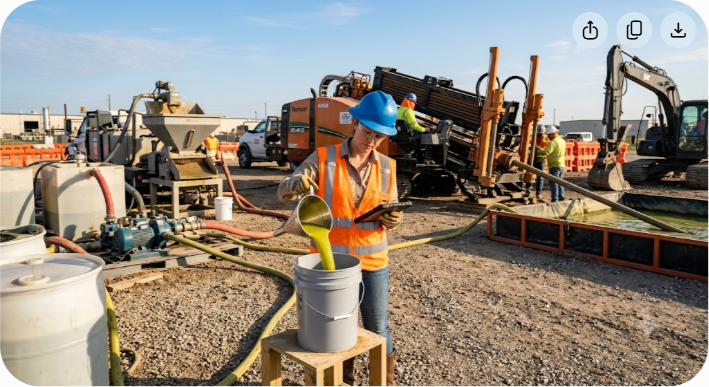
Axewelledge, a leading exporter from India, specializes in high-quality Bentonite. With a commitment to excellence, we supply premium Bentonite to the Middle East and Southeast Asia markets.

Contact Info
Address
North Angle Complex, 304, 150 Feet Ring Rd, Opposite Ambedkar Nagar BRTS Stop, Madhav Park, Punit Nagar, Mavdi, Rajkot, Gujarat 360004
Formulate Bentonite Drilling Mud for HDD & Microtunneling
The Core Recipe for Microtunneling and HDD Bentonite Mud
A standard bentonite drilling fluid for Horizontal Directional Drilling (HDD) and microtunneling requires 25 to 35 pounds of high-yield API 13A Section 9 sodium bentonite per 100 gallons of clean water (30 to 42 kg per cubic meter). In cohesive clay soils, reduce the bentonite content to 15–20 lb/100 gal and incorporate polyacrylamide (PHPA) to inhibit swelling. In highly porous sand and gravel, increase the base bentonite to 35–45 lb/100 gal and add Polyanionic Cellulose (PAC) or carboxymethyl cellulose (CMC) to suppress fluid loss and build a tough, low-permeability filter cake.
Formulating bentonite slurry is not simply dumping dry powder into a tank and turning on an agitator. It is an exact exercise in fluid chemistry. The primary objective is balancing three physical mechanisms: gel strength to suspend cuttings when flow stops, plastic viscosity to minimize pump pressure losses, and filtrate control to lock down the borehole wall.
Why Soil Chemistry Dictates Drilling Mud Design
Microtunneling and HDD operations fail underground for one major reason: treating all ground conditions the same. A fluid formula that glides through tight silt will freeze a pipe string in coarse gravel or cause severe bit balling in sticky reactive clay.
Before mixing a single pound of sodium bentonite, you must evaluate the geotechnical report, focusing on grain size distribution, hydraulic conductivity, and soil reactivity.
Reactive Clays and Shales
Cohesive formations contain active clay minerals (such as native montmorillonite or illite) that absorb water from the drilling fluid. As these clays hydrate, they swell into the borehole, causing bit balling, high torque, and eventual pipe entrapment.
The Strategy: Keep native clay out of the fluid phase. Lower the base bentonite concentration to keep baseline viscosity low. Introduce partially hydrolyzed polyacrylamide (PHPA) at 0.5 to 1.5 lb/100 gal. PHPA encapsulates clay cuttings in a protective polymer shield, preventing them from hydrating and dispersing into the mud stream.
Coarse Sands and Gravels
Granular, non-cohesive soils possess zero inherent cohesion and high hydraulic conductivity. Unfiltered water escapes immediately into the formation, leaving behind loose gravel that collapses onto the drill string or microtunneling pipe casing.
The Strategy: Prioritize wall building and fluid-loss reduction. Increase sodium bentonite yield to 35–45 lb/100 gal. Add high-viscosity Polyanionic Cellulose (PAC-HV) at 0.5 to 1.0 lb/100 gal to build a slick, thin filter cake that seals pore throats instantly. For severe fluid loss in cobbles, integrate cross-linked starch or modified natural gums to boost low-shear yield point (LSYP).
Rock and Hard Formations
Rock drilling with mud motors or air hammers requires efficient hole cleaning rather than filter-cake formation. Cuttings are dense and settle rapidly out of suspension.
The Strategy: Maximize carrying capacity using biopolymers like Xanthan Gum (0.5–1.0 lb/100 gal) paired with medium-density bentonite slurry. Xanthan gum provides high pseudoplasticity: high viscosity inside the annulus at low shear rates to suspend heavy rock chips, and low viscosity inside the drill pipe at high shear rates to lower pump pressure.
Core Components of an HDD/Microtunneling Slurry
A high-performance drilling fluid relies on a layered chemical structure. Every additive serves a specific, measurable rheological purpose.
Base Water Phase (95-98% Total Volume): Clean fresh water conditioned with soda ash to maintain a pH of 8.5 to 9.5 and total hardness under 100 ppm.
Base Viscosifier (API Grade Sodium Bentonite): High-yield sodium bentonite yields over 200 barrels per ton, providing fluid gel strength and wall-sealing cake.
Filtration Control Polymers (PAC / CMC): Long-chain cellulose derivatives that plug micro-voids and reduce fluid loss into porous soil.
Shale Inhibitors (PHPA): Polyacrylamide chains that encapsulate native reactive clay to prevent bit balling and hole swelling.
Low-Shear Rheology Boosters (Xanthan Gum): Biopolymers that elevate yield point for maximum cutting transport without surging pump pressure.
Lubricants and Detergents: Specialty surfactants and oils that reduce pipe friction and keep cutter heads clean during long jacking drives.
1. High-Yield Sodium Bentonite
Natural sodium bentonite (principally sodium montmorillonite) is the foundation of any HDD slurry. When hydrated in freshwater, its stacked crystalline platelets separate and hydrate, creating a loose three-dimensional card-house structure. This structure gives the fluid its thixotropic character: it behaves as a liquid when pumped, but solidifies into a gel when motion stops.
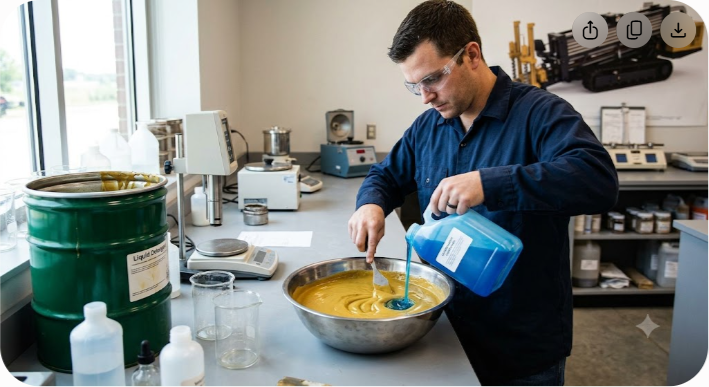
API Standard: Always specify API 13A Section 9 sodium bentonite (or non-treated high-yield bentonite with a yield rating of 200 barrels or more per ton). Avoid calcium bentonite, which lacks the swelling capacity necessary for subterranean wall support.
2. Filtration Control Agents (PAC and CMC)
Filtration loss occurs when the liquid phase of the mud escapes into surrounding soil, leaving behind solid bentonite particles on the borehole wall. If uncontrolled, this wall cake grows thick, sticky, and soft, leading to differential sticking of the drill pipe or pipe-jacking assembly.
PAC (Polyanionic Cellulose): Long-chain polymers that plug micro-voids in the filter cake. Low-viscosity PAC (PAC-LV) controls fluid loss without raising overall viscosity; high-viscosity PAC (PAC-HV) controls fluid loss while simultaneously increasing Marsh funnel viscosity.
3. Clay Stabilizers (PHPA Polymers)
Partially Hydrolyzed Polyacrylamide works via high-molecular-weight polymer chains that adsorb onto negative clay surfaces. By tying the clay platelets together, PHPA seals native formations against water entry, preventing swelling, bit balling, and washouts.
4. Biopolymers for Viscosity (Xanthan Gum)
Xanthan gum is an organic biopolymer that delivers high pseudoplastic behavior. At low shear rates (inside the wide borehole annulus), it maintains an elevated yield point to keep dense gravel and rock cuttings from falling. At high shear rates (inside the narrow nozzles of the drill bit or cutter head), it thins instantly to reduce hydraulic friction.
5. Liquid Lubricants and Detergents
In long microtunneling drives or extended-reach HDD crossings, pipe-to-soil friction creates immense torque and jacking forces. Eco-friendly liquid lubricants (synthetic esters or vegetable-based oils) lower the friction coefficient between the pipe string and borehole wall. Drilling detergents prevent sticky clay from adhering to the cutter head or bottom-hole assembly (BHA).
Step-by-Step Mixing Procedure
Chemical additions must follow a strict, non-negotiable sequence. Adding bentonite before conditioning your water destroys fluid performance.
Step 1: Analyze and Treat the Make-Up Water
Never mix bentonite in untreated tap water, hard well water, or surface run-off. High calcium or magnesium levels cause sodium bentonite platelets to clump together (flocculate), drastically reducing hydration and yield.
Measure Water Hardness: Hardness must remain below 100 ppm (mg/L). If hardness exceeds this threshold, add Soda Ash (Sodium Carbonate) at a rate of 0.5 to 1.5 lb per 100 gallons. Soda ash precipitates calcium ions out of solution as insoluble calcium carbonate.
Adjust pH Levels: Check pH using test strips or a digital meter. Target a pH between 8.5 and 9.5. Sodium bentonite hydrates most efficiently in a mildly alkaline environment.
Step 2: Hydrate the Base Bentonite
Introduce high-yield sodium bentonite slowly into a high-shear venturi hopper system. Dumping dry bentonite directly into a mixing tank creates unhydrated lumps ("fish-eyes") that settle out as wasted mass.
Shear and Agitate: Maintain high tank agitation during introduction.
Allow Hydration Time: High-yield bentonite requires a minimum of 20 to 30 minutes of active mixing to fully hydrate and uncoil its crystalline sheets. Rushing this stage cuts effective mud yield by up to 40%.
Step 3: Add Polymers and Special Additives
Only introduce synthetic polymers (PAC, PHPA, Xanthan Gum) after the bentonite has fully hydrated. Synthetic polymers compete with bentonite for available water molecules. If added simultaneously, the polymer encapsulates unhydrated bentonite granules, rendering them useless.
Sprinkle polymers slowly over the shear hopper to avoid clumping.
Allow an additional 10–15 minutes of shear recirculation.
Step 4: Inject Lubricants and Detergents
Add liquid lubricants, anti-sticking agents, or liquid surfactants last. Adding lubricants early coats unhydrated bentonite particles in oil, blocking water contact and halting hydration completely.
Soil-Specific Slurry Formulations
Use these baseline batch ratios per 1,000 Gallons (3.78 cubic meters) of treated water. Adjust field mixing based on real-time rheology testing.
Soil Conditions
Treated Water
Soda Ash
High-Yield Bentonite
PAC (Polyanionic Cellulose)
PHPA Polymer
Liquid Lubricant / Detergent
Loose Sand & Fine Gravel
1,000 gal
5–8 lb
350–400 lb
5–10 lb (PAC-HV)
--
2–5 gal
Coarse Gravel & Cobbles
1,000 gal
5–8 lb
400–450 lb
10–15 lb (PAC-HV)
--
5 gal
Reactive Clay & Sticky Silt
1,000 gal
3–5 lb
150–200 lb
3–5 lb (PAC-LV)
5–10 lb
3–5 gal (Detergent)
Mixed Soft-to-Hard Rock
1,000 gal
5–8 lb
250–300 lb
5 lb (PAC-LV)
--
2–4 gal (Xanthan: 3-5 lb)
High-Jacking Force Drives
1,000 gal
5–8 lb
300–350 lb
5–8 lb
--
10–15 gal (Lubricant)
Testing and Rheology Targets
Maintaining proper fluid rheology requires regular field testing. Field operators must test mud properties at least twice per shaft setup or every 100 feet (30 meters) of advance.
Marsh Funnel Viscosity
The Marsh Funnel measures fluid thickness in seconds per quart (sec/qt). Standard fresh water runs at 26 seconds per quart at 70°F (21°C).
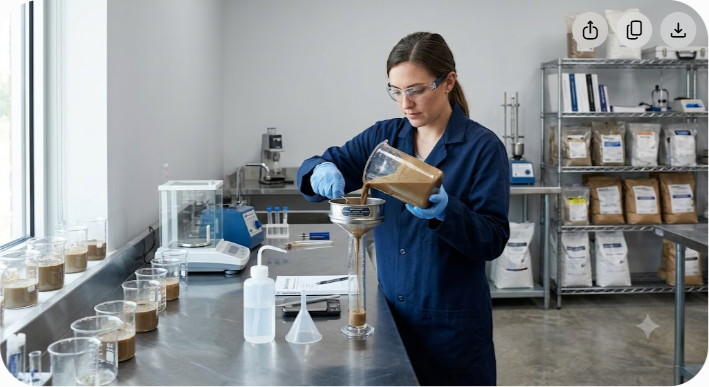
Sand and Gravel Target: 45 to 65 sec/qt
Clay and Silt Target: 35 to 45 sec/qt
Microtunneling Lubrication Ring Target: 60 to 90+ sec/qt
Yield Point (YP) and Plastic Viscosity (PV)
Measured using a rotational viscometer (such as a Fann 35).
Plastic Viscosity (PV): Represents mechanical resistance caused by solids concentration and liquid friction. Keep PV as low as possible to reduce pressure losses in long pipe runs.
Yield Point (YP): Measures electrochemical attractive forces under flowing conditions. YP dictates carrying capacity. Target a YP of 15 to 25 lb/100 sq ft for effective cutting transport.
YP/PV Ratio: Keep this ratio near 1.0 to 1.5 for maximum hole cleaning with minimal circulation pressure.
Filtrate Loss and Filter Cake Quality
Tested using an API low-pressure filter press (100 psi for 30 minutes).
Target Fluid Loss: Under 12 mL total filtrate loss for standard operations; under 8 mL for reactive clays and porous sands.
Filter Cake Thickness: Must be thin, slick, and tough—ideally less than 2/32 inch (1.6 mm). A thick, spongy cake increases pipe friction and risks stuck pipe strings.
Sand Content
Measured using a standard API sand content kit (200-mesh sieve).
Target: Keep returns below 1% by volume before pumping fluid back downhole. Sand concentrations above 2% act as liquid sandpaper, eroding drill pipes, mud pumps, microtunneling cutter heads, and slurry lines.
Troubleshooting Common Field Issues
Issue 1: High Jacking Forces or Pipe Drag
Cause: Inadequate lubrication, filter cake breakdown, or native clay swelling against the pipe wall.
Fix: Increase fluid-loss polymers (PAC-HV) to toughen the filter cake. Inject vegetable-based pipe lubricants directly into the annulus via the tail-skin or intermediate jacking stations. Check mud weight—excess solids build density and increase friction.
Issue 2: Mud Loss to Formation (Frac-Out or Lost Circulation)
Cause: Excessive annular pressure exceeding overburden strength, or entering cavernous gravels and fissures.
Fix: Reduce pump rate. Introduce coarse Lost Circulation Materials (LCM) like organic fibers, swelling cross-linked polymers, or blended mica. Boost Low-Shear Yield Point (LSYP) using biopolymers so the fluid gels rapidly when entering large voids.
Issue 3: Bit Balling / Cutter Head Clogging
Cause: Hydrated sticky clay packing tight inside the cutter teeth and suction ports.
Fix: Immediately inject non-foaming drilling detergent (2–5 gallons per 1,000 gal). Increase PHPA concentration to encapsulate fresh clay faces before they can adhere to steel tooling.
Issue 4: Slurry Pump Wear and Abrasion
Cause: High recirculation of native sand particles due to failing desilting equipment.
Fix: Inspect hydrocyclones, shale shaker screens, and desand units. Ensure screen mesh sizes match cut points. If sand content stays above 2%, discard part of the return mud and rebuild base volume with fresh water and hydrated bentonite.
Quality Control Checklist
Before launching a bore or pipe-jacking drive, verify these control points:
Water Source Verified: Hardness under 100 ppm, pH between 8.5 and 9.5. Soda ash pre-mixed.
Hydration Period Met: Base bentonite sheared for a full 30 minutes minimum before polymer introduction.
Funnel Viscosity Confirmed: Matched to real-time soil type (such as 50 to 60 sec/qt for loose sand).
Recycling System Calibrated: Desander and desilter cones operating at 30 to 40 psi manifold pressure to maintain sand content under 1%.
Density Controlled: Slurry weight maintained under 9.2 lb/gal (1.10 g/cu cm) unless heavy hydrostatic counterbalance is required.
Environmental & Regulatory Compliance
Modern trenchless projects across North America, Europe, and Asia face strict environmental oversight regarding fluid disposal and frac-out management.
Eco-Friendly Formulations: Use NSF/ANSI Standard 60 certified bentonite and polymers, especially when drilling near potable aquifers or water bodies.
Non-Toxic Additives: Ensure all synthetic polymers, detergents, and lubricants are non-bioaccumulative and readily biodegradable.
Slurry Disposal: Spent bentonite slurry must be dewatered using centrifuges or flocculants before land application or transport to authorized non-hazardous landfills.
Advanced Rheology Optimization for Extended Microtunneling Drives
Long-distance microtunneling drives (exceeding 500 meters or 1,600 feet) introduce fluid dynamics challenges that shorter utility bores rarely encounter. As the jacking distance grows, pumping pressures rise sharply due to pipe-wall skin friction and fluid head losses inside long slurry circulation lines.
Batching at Surface Plant: High-yield bentonite, PAC polymers, and pH-conditioned water are sheared and mixed to target viscosity in surface tanks.
Pumping Downhole: Recirculated slurry with sand content under 1% is pumped down through internal slurry lines to the cutting face.
Annular Injection: Dedicated bentonite lubrication is injected through skin ports directly into the annulus, forming a slick, low-permeability shield around the jacked pipe.
Return and Separation: Cuttings-laden slurry returns to the desanding unit for screening, desilting, and re-mixing.
Managing Annular Pressure and Hydrostatic Head
In deep microtunneling drives, maintaining structural support at the tunnel face while preventing face collapse or ground heave requires tight control over fluid density and pressure.
Hydrostatic Balance: Calculate total earth and pore-water pressure at the tunnel crown. Adjust bentonite slurry weight slightly above this pressure (typically by 0.1 to 0.2 bar / 1.5 to 3.0 psi) to ensure face stability without forcing slurry up to the surface.
Lubrication Rings: Long microtunneling runs require dedicated continuous injection of bentonite slurry through lubrication ports spaced along the jacked pipe string. This secondary bentonite fluid must use a higher bentonite concentration (40 to 50 lb/100 gal) combined with liquid polymers to maintain an intact fluid envelope around the entire casing pipe throughout the jacking sequence.
Partnering for Reliable Trenchless Performance
Formulating optimized drilling mud requires a precise balance of fluid chemistry, mixing discipline, and raw material quality. Using subpar sodium bentonite with low yield ratings or high calcium impurities guarantees increased mud consumption, elevated pump wear, and a higher risk of stuck pipes.
At Axewelledge, we supply high-yield, API-grade sodium bentonite mined from high-purity reserves. Processing over 60 million tons of high-grade reserves with advanced refinement techniques, our bentonite delivers rapid hydration, high swelling capacity, and predictable rheology under challenging trenchless conditions. Whether you are navigating reactive clays or stabilizing porous gravels, our technical team provides the mineral foundation your HDD and microtunneling projects demand.