Axewelledge, a leading exporter from India, specializes in high-quality Bentonite. With a commitment to excellence, we supply premium Bentonite to the Middle East and Southeast Asia markets.


North Angle Complex, 304,
150 Feet Ring Rd, Opposite Ambedkar Nagar BRTS Stop,
Madhav Park, Punit Nagar,
Mavdi, Rajkot, Gujarat 360004
© Axewelledge 2026, All Rights Reserved.
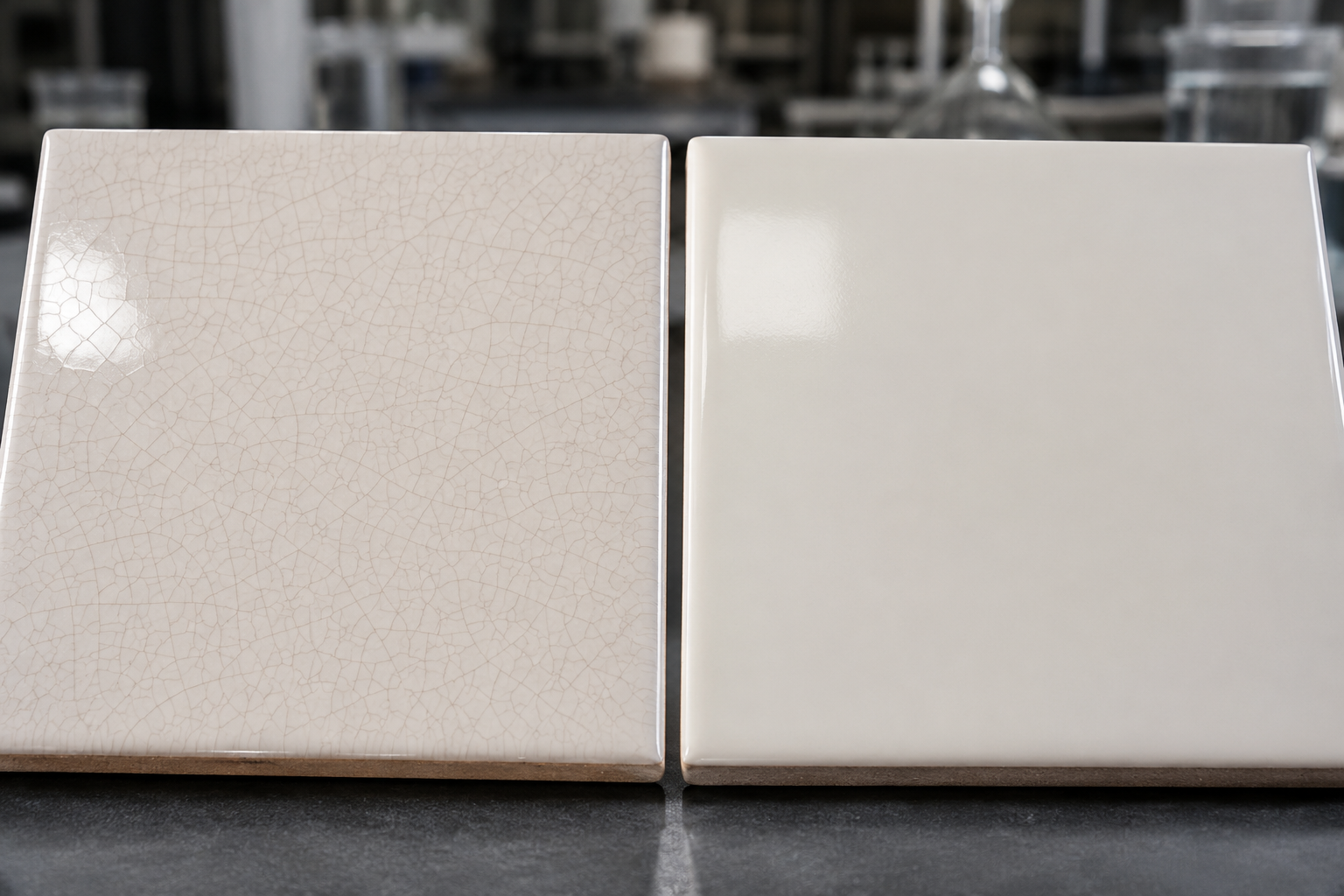
Glaze crazing is the single most destructive cosmetic defect in ceramic tile manufacturing, caused almost entirely by a mismatch in thermal expansion between the glaze layer and the underlying clay body. If a glaze cools with a higher Coefficient of Thermal Expansion (COE) than the tile body, it shrinks faster during cooling, enters extreme tension, and forms a microscopic network of fine cracks. Using fully fritted glazes rather than raw glaze formulations reduces crazing risk by up to 90% because fritting pre-reacts silica, fluxes, and stabilizing oxides into a homogeneous, thermally stable glass.
For commercial ceramic manufacturers, architectural tile producers, and technical ceramists, controlling thermal expansion isn't just about surface aesthetics—it dictates structural integrity, water absorption resistance, and long-term durability. In this deep dive, we will examine the physical chemistry of thermal fit, compare fritted and raw glazes across five core operational parameters, and outline concrete engineering steps to eliminate crazing permanently.
Crazing manifests as a spiderweb pattern of fine hairline fractures across the vitrified surface of a tile. While some decorative pottery deliberately encourages crazing (known as crackle glaze), industrial floor and wall tiles require an impervious, defect-free barrier.
To understand why glazes craze, you must view the tile and glaze as a bonded bi-material strip. As ceramic tiles exit the kilns—often cooling down from peak temperatures between 1,100°C and 1,220°C (2,012°F to 2,228°F)—both the clay body and the molten glass layer contract.
| Thermal Fit Condition | Relative Contraction | Primary Stress Type | Resulting Defect / Outcome |
|---|---|---|---|
| Glaze COE > Body COE | Glaze shrinks MORE than body | Tensile Stress | Crazing (Hairline Surface Cracks) |
| Glaze COE < Body COE | Glaze shrinks LESS than body | Slight Compressive Stress | Ideal Fit (High Surface Durability) |
| Glaze COE << Body COE | Glaze shrinks FAR LESS than body | Excessive Compressive Stress | Shivering / Peeling (Glaze Flaking) |
Manufacturers often encounter two distinct operational headaches:
Raw glazes are composed of un-melted, natural mineral ingredients mixed directly with water and organic binders. Typical raw glaze recipes rely on minerals like feldspar, quartz, kaolin, calcium carbonate (whiting), dolomite, and barium carbonate to supply essential glass-forming, fluxing, and stabilizing oxides.
When a raw glaze batch enters a fast-firing tunnel or roller kiln, a complex series of chemical reactions must occur simultaneously within a tight 30 to 60-minute firing window:
2 ?
) and sulfur dioxide (SO 2 ?
) gas.
Because raw glazes depend on in-situ chemical reactions during firing, complete melt homogenization is exceptionally difficult to achieve in modern fast-firing industrial cycles.
Raw recipes frequently rely on high proportions of alkali oxides—specifically Sodium (Na 2 ?
O) and Potassium (K 2 ?
O) supplied by feldspars—to achieve low melting temperatures without expensive additives. However, sodium and potassium possess the highest thermal expansion factors of all ceramic oxides.
Furthermore, incorporating water-soluble or low-temperature fluxing oxides like Boron (B 2 ?
O 3 ?
) is virtually impossible in raw glazes using raw borax, as soluble salts migrate to the tile surface during drying, causing irregular melting, local COE spikes, and severe crazing.
A glaze frit is a pre-reacted, vitrified glass compound manufactured by melting a precise blend of raw minerals in a high-temperature rotary kiln (typically between 1,300°C and 1,500°C / 2,372°F to 2,732°F) and rapidly quenching the molten glass stream in cold water or between water-cooled steel rollers. This thermal shock shatters the glass into granular friable flakes known as frit.
The production sequence follows four essential steps:
The frit manufacturer then finely grinds these glass granules with a small percentage of suspending clay (such as high-purity Sodium Bentonite) and water to create a stable, ready-to-apply glaze slurry.
Fritting fundamentally changes how oxides behave in a glaze formulation:
2 ?
O 3 ?
), Lithium (Li 2 ?
O), and Sodium (Na 2 ?
O) are permanently locked into an insoluble silicate glass network. They can no longer dissolve in the slip water or migrate during drying.
2 ?
, SO 2 ?
, chemically bound H 2 ?
O) are driven off during the primary smelting process. When the fritted glaze is fired on the tile, it melts smoothly without off-gassing, eliminating pinholes, micro-bubbles, and structural weaknesses in the glaze film.
2 ?
O 3 ?
), Silica (SiO 2 ?
), and Zirconia (ZrO 2 ?
)—that would otherwise be impossible to melt in a raw fast-fire glaze.
To evaluate how these two glaze systems perform in industrial ceramic tile production, let's examine their technical characteristics side by side.
| Operational & Chemical Feature | Raw Glazes | Fully Fritted Glazes | Impact on Crazing & Quality |
|---|
| Coefficient of Expansion (COE) | Generally high (7.5?10.0×10 ?6 / ? C) due to dependence on alkali feldspars. | Highly tailorable (4.5?7.0×10 ?6 / ? C); easily lowered with insoluble boron. | Major victory for Fritted. Lower, controllable COE prevents tensile stress. |
| Melt Homogeneity | Heterogeneous; relies on short firing window to dissolve raw quartz grains. | Completely homogeneous pre-formed glass; melts uniformly at lower energy levels. | Fritted glazes form a uniform stress-free layer without local COE variation. |
| Off-Gassing & Pinholing | High gas evolution from carbonate and sulfate decomposition during firing. | Zero off-gassing from glaze materials; volatile components eliminated during fritting. | Fewer pinholes and micro-fissures in fritted glazes means fewer stress-concentration points where crazing starts. |
| Firing Window & Fast Firing | Requires longer firing cycles and higher heat work to complete chemical synthesis. | Ideal for ultra-fast firing cycles (25–40 minutes) in modern roller kilns. | Fritted glazes fully mature in short cycles without un-dissolved, expansion-altering quartz. |
| Slurry Stability & Rheology | Highly dependent on raw clay content; prone to settling or viscosity shifts. | Excellent stability when suspended with low-percentage additives like Bentonite. | Uniform glaze application density ensures predictable thermal expansion across the entire tile. |
| Raw Material Cost | Lower initial raw material procurement cost. | Higher upfront cost per ton due to thermal processing energy. | Fritted glazes drastically lower total manufacturing cost by reducing scrap and rejection rates. |
To systematically stop glaze crazing, ceramic engineers must calculate and adjust the expansion factors of the glaze oxides using English or Appen factors. The total thermal expansion of a glaze is approximately the sum of the mole fractions of its constituent oxides multiplied by their individual expansion coefficients.
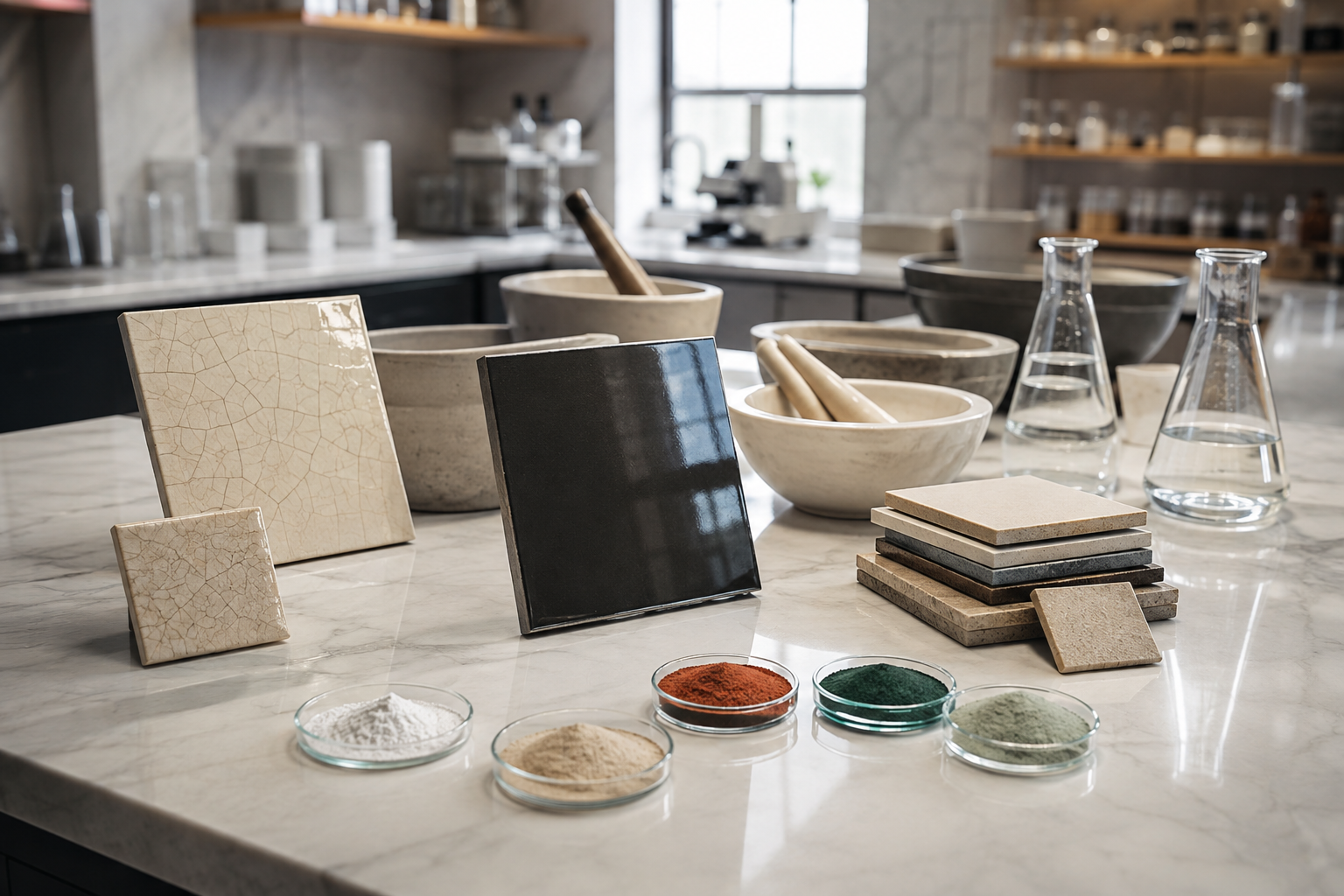
Different oxides contribute radically different thermal expansion characteristics to the final glass structure:
2 ?
O) and Potassium Oxide (K 2 ?
O): These strong alkali fluxes break silica bonds, forming open glass networks that expand drastically when heated. If your glaze is crazing, reducing Na 2 ?
O is often the fastest remedy.
2 ?
): The primary glass former. Increasing SiO 2 ?
reduces thermal expansion by strengthening the dense tetrahedral glass backbone.
2 ?
O 3 ?
): Increases viscosity, hardens glass, and significantly reduces thermal expansion.
2 ?
O 3 ?
): The ultimate weapon against crazing. Boron acts as a low-expansion glass-former and powerful flux. However, because raw boron sources (like borax) are water-soluble, boron can only be reliably introduced in high amounts via fritted glazes.
2 ?
): A powerful opacifier that dramatically lowers thermal expansion while increasing abrasion resistance.
| Oxide Category | Key Chemical Oxides | Expansion Effect | Role in Glaze Crazing |
|---|
| High Expansion | Sodium (Na 2 ?
O), Potassium (K 2 ?
O), Calcium (CaO) | Increases COE significantly | Promotes crazing; must be limited or offset |
| Moderate Expansion | Barium (BaO), Strontium (SrO), Zinc (ZnO) | Balanced expansion curve | Neutral or mild reduction in tensile stress | | Low Expansion | Silica (SiO 2 ?
), Alumina (Al 2 ?
O 3 ?
), Boron (B 2 ?
O 3 ?
), Zirconia (ZrO 2 ?
Switching from a raw glaze or partially fritted glaze system to a fully fritted formulation eliminates thermal mismatch through four distinct physical mechanisms.
In a raw glaze, you are constrained by raw material physics. If you add raw borax, it dissolves in your glaze tanks, ruining slurry viscosity, forming crystals during storage, and causing uneven glaze thickness on the tile face.
By utilizing a fritted glaze—specifically a borosilicate or calcium-borate frit—you can introduce 10% to 25% B 2 ?
O 3 ?
into the glass structure. Boron drastically reduces the melting point of the glaze without introducing high-expansion sodium or potassium. This lowers the total glaze COE to safely match or fall just below the clay body's COE (5.5?6.5×10 ?6 / ? C).
In raw glazes, fine quartz powder (SiO 2 ?
) is added to supply silica. During fast firing, if quartz grains do not fully dissolve into the liquid phase, they remain as crystalline quartz within the glaze film.
As the tile cools down past 573°C (1,063°F), crystalline quartz undergoes the alpha-to-beta phase inversion, experiencing a sudden, rapid volume contraction of roughly 1% to 2%. This localized, violent volumetric change destabilizes the glaze layer and triggers immediate micro-crazing. Fritted glazes contain pre-dissolved silica within an amorphous glass network, entirely bypassing quartz phase inversion stresses within the glaze coat.
Raw glazes rely on mechanical mixing and short kiln residence times. This produces microscopic zones within the fired glaze layer that have differing oxide concentrations—one micron-sized region may be rich in high-expansion potassium from a feldspar grain, while an adjacent zone is rich in calcium. These localized expansion gradients create micro-stresses that easily crack under thermal cycling.
Fritted glazes are smelted to molten liquid homogeneity beforehand, ensuring that every square millimeter of the glaze layer exhibits identical thermal contraction.
A high-quality fritted glaze does not simply sit on top of the tile body; it forms a microscopic intermediate reaction zone with the body or the intermediate engobe layer.
Because fritted glazes form a clean, low-viscosity melt at peak temperatures, they slightly react with the surface aluminosilicates of the tile body, creating a continuous, gradient transition layer. This eliminates sharp mechanical stress boundaries between body and glaze, distributing compressive stresses safely throughout the tile surface.
When crazing appears on your tile production line, follow this diagnostic protocol to isolate the root cause and execute corrective measures.
To distinguish between immediate thermal mismatch and long-term moisture expansion crazing, place fired tile samples into a steam autoclave under 0.5 to 1.0 MPa (70–145 psi) of pressure at 150°C–180°C for 2 to 5 hours (following standard test methods like ISO 10545-11 or ASTM C424).
If immediate thermal expansion crazing is diagnosed, modify your glaze formulation using these practical levers:
2 ?
) in the Frit Blend: Add 3% to 8% fine quartz or high-silica frit to the ball mill batch. Higher silica lowers glaze expansion, provided it completely dissolves in the melt.
4 ?
): Adding 2% to 6% micronized zircon opacifier to the glaze mill additions not only increases opacity and whiteness but also effectively lowers the overall expansion coefficient.
2 ?
O 3 ?
): Increase the percentage of high-boron frit in your formulation to lower melting temperature while simultaneously dropping the COE.
Even the best fritted glaze formulation will fail if it settles unevenly or forms density gradients across the tile face during application. Because fritted glass particles possess no natural plasticity or clay-like electrical charge, fritted glaze slurries are prone to rapid hard-settling in spray tanks and application booths.
To maintain perfect glaze suspension without altering the chemical COE fit:
When ceramic factory managers evaluate glaze systems, raw glazes often appear far cheaper on a per-ton raw material invoice. However, examining the Total Cost of Quality (TCOQ) reveals why high-efficiency tile plants worldwide rely on fritted glazes.
Let's break down the economics for a modern ceramic tile facility producing 10,000 square meters (m 2 ) of wall or floor tile per day:
,m 2 /day saves hundreds of thousands of dollars annually in wasted body clay, pressing energy, and kiln fuel that can never be recovered.
Raw glazes that off-gas heavy carbon, fluorine, or sulfur compounds shorten the operational lifespan of kiln refractories, exhaust ductwork, and roller bearings. Fritted glazes emit virtually no corrosive volatiles, extending major overhaul cycles for roller kilns.
In global architectural specifications, tile crazing is treated as a critical compliance failure. Whether supplying ceramic floor tiles to high-traffic commercial spaces in North America, residential wall tiles in Europe, or outdoor cladding in Southeast Asia, tiles must meet rigorous performance standards.
| Standard | Test Pressure & Conditions | Pass / Fail Criteria |
|---|---|---|
| ISO 10545-11 | 5 bar (72 psi) steam pressure for 2 hours | Zero dye penetration along surface cracks |
| ASTM C424 | Incremental steam pressure steps up to 150 psi | No visible surface crazing under magnification |
| EN 14411 | Mandates ISO 10545-11 autoclave protocol | Mandatory First Quality rating for commercial sale |
Using fully fritted glaze systems backed by consistent industrial mineral additives—such as specialized bentonite binders and refined engobes—ensures that tile lines consistently pass these stringent international autoclave protocols without unexpected batch-to-batch failures.
Eliminating crazing in ceramic tile production is an exact science governed by thermal expansion dynamics. While raw glazes may seem appealing for low upfront material costs, their high expansion coefficients, unpredictable melting behavior, and off-gassing risks make them a liability in modern fast-firing industrial tile manufacturing.
By transitioning to fully fritted glazes, ceramic engineers gain total chemical control over the Coefficient of Thermal Expansion (COE). Incorporating insoluble boron, removing free un-dissolved quartz, and maintaining uniform glass chemistry allows you to place the glaze layer under optimal, protective compressive stress.
To ensure your fritted glaze slurries achieve maximum suspension, application smoothness, and green bonding strength, partnering with experienced mineral processors is essential. Axewelledge provides high-purity, industry-leading Sodium Bentonite and specialty ceramic mineral solutions designed to stabilize glaze suspensions, optimize body plasticity, and ensure defect-free tile production for global manufacturers.













Have questions about our products? We're here to help!