Axewelledge, a leading exporter from India, specializes in high-quality Bentonite. With a commitment to excellence, we supply premium Bentonite to the Middle East and Southeast Asia markets.


North Angle Complex, 304,
150 Feet Ring Rd, Opposite Ambedkar Nagar BRTS Stop,
Madhav Park, Punit Nagar,
Mavdi, Rajkot, Gujarat 360004
© Axewelledge 2026, All Rights Reserved.
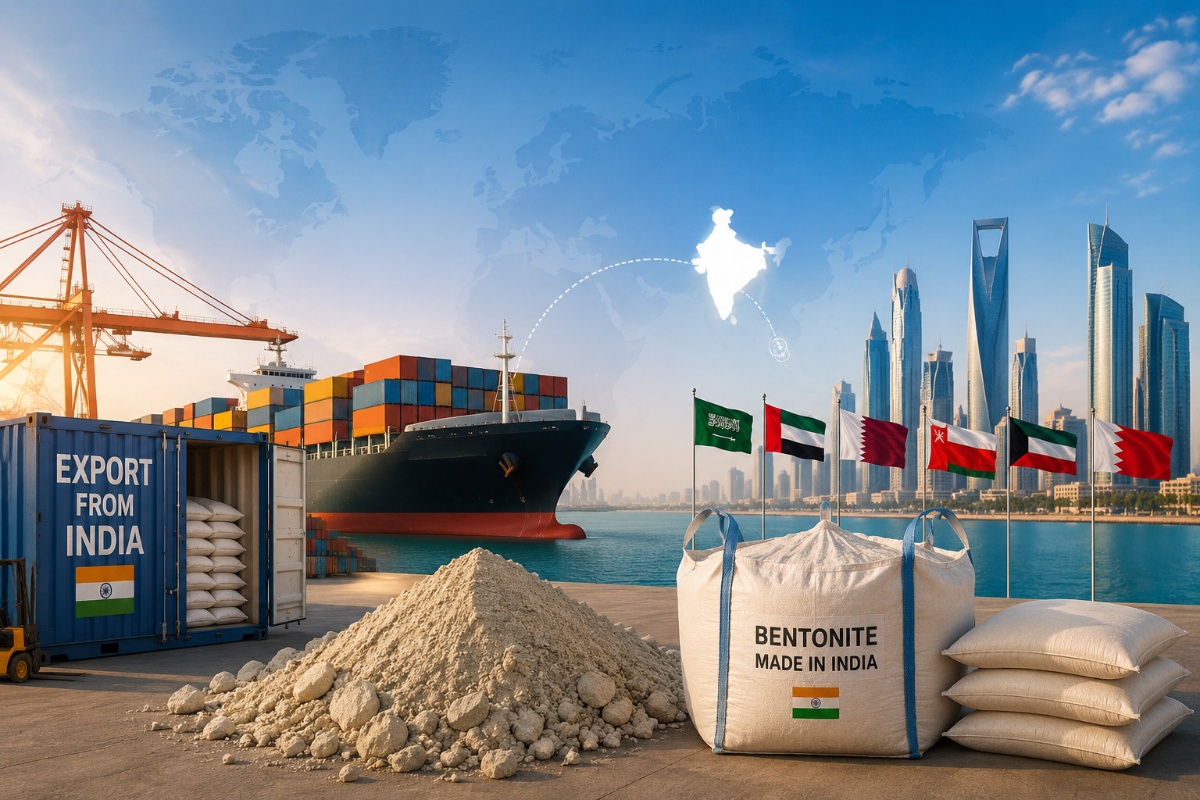
The Gulf Cooperation Council (GCC) region, comprising the Saudi Arabia, United Arab Emirates, Qatar, Kuwait, Oman, and Bahrain, has become one of the most important markets for Indian bentonite exports. Industries such as oil & gas drilling, construction, water treatment, foundry, agriculture, civil engineering, and industrial manufacturing continue to drive strong demand for high-quality bentonite throughout the region.
India is globally recognized as one of the leading producers and exporters of bentonite, particularly due to the rich mineral reserves found in Gujarat and Rajasthan. Importers across GCC countries prefer Indian bentonite because of its quality consistency, competitive pricing, reliable supply chain, and proximity to Gulf ports. India is among the leading suppliers of bentonite to several GCC markets including Oman and Bahrain.
If you are planning to import bentonite from India into any GCC country, this comprehensive guide will help you understand every step of the process, from selecting the right supplier to customs clearance and final delivery.
For premium-quality bentonite exports from India, visit:
Bentonite is a naturally occurring clay primarily composed of montmorillonite. Its unique swelling, adsorption, viscosity, and sealing properties make it useful across numerous industries.
Sodium bentonite offers:
Common applications:
Calcium bentonite provides:
Common applications:
Activated bentonite is chemically treated to improve adsorption capacity.
Applications include:
Selecting the correct grade is the first and most important step before placing an import order.
Several factors make India the preferred sourcing destination.
India possesses some of the world's highest-quality bentonite deposits, primarily located in Gujarat and Rajasthan.
Indian mining and processing facilities offer economical production costs compared to many Western suppliers.
Indian manufacturers can handle bulk industrial orders ranging from a few containers to thousands of metric tons monthly.
Suppliers can customize:
Indian ports offer short transit times to GCC countries, reducing freight costs and ensuring faster delivery.
The GCC region is home to some of the world's largest oil and gas operations.
Bentonite is widely used in:
Mega infrastructure projects require bentonite for:
Bentonite helps in:
Agricultural industries use bentonite in:
Metal casting facilities use bentonite as a binding material in molding sands.
Indian bentonite exports are widely distributed across the Gulf region.
Major importing destinations include:
Trade data shows India is among the leading bentonite suppliers to GCC markets such as Oman and Bahrain.
Before contacting suppliers, determine:
Estimate:
Define:
Having precise specifications helps suppliers provide accurate quotations.
Selecting the right exporter is crucial.
Evaluate suppliers based on:
Choose exporters with extensive GCC export experience.
Ensure they can meet long-term demand.
Look for:
A reliable exporter should have:
One example is Axewelledge, which specializes in bentonite exports to international markets.
Never place a large order without testing samples.
Evaluate:
Testing minimizes procurement risks.
A professional quotation should include:
The supplier delivers goods to the Indian port.
Buyer manages:
The exporter handles:
Many GCC importers prefer CIF because it simplifies logistics.
The standard HS Code for bentonite exports is:
HS Code: 250810
This code is used globally for customs classification and import documentation. Accurate classification helps avoid customs delays.
Indian suppliers typically offer:
Suitable for smaller industrial users.
Most common packaging option.
Available in:
Ideal for large industrial consumers.
Packaging should be selected according to handling facilities at the destination.
The contract should clearly define:
A detailed agreement protects both importer and exporter.
Common international payment methods include:
Often used for first transactions.
Provides security for both parties.
Common among established business partners.
Essential export documents include:
Shows:
Provides packaging information.
Issued by the shipping line.
Confirms Indian origin of goods.
Shows laboratory-tested product specifications.
Required for CIF shipments.
Major Indian export ports include:
Major GCC destination ports include:
Transit times typically range from 3 to 15 days depending on destination.
The GCC operates under a customs union framework that simplifies trade across member countries, although each country may still have its own regulatory requirements and documentation procedures.
Importers should work closely with:
Required documents generally include:
Many GCC countries apply a common customs framework with import duties often around 5% for many imported goods, though specific rates and exemptions may vary depending on product classification and local regulations. Importers should always verify current customs duties with local authorities before shipment.
Always request:
Incorrect paperwork can delay customs clearance.
Work with experienced logistics partners.
Choose bentonite grades based on actual application requirements.
Reliable partnerships often result in:
Evaluate performance before placing bulk orders.
Monitor consistency across shipments.
Import requirements may change periodically.
Established exporters can simplify documentation and logistics management.
When importing bentonite into GCC countries, choosing a reliable supplier can significantly impact cost, quality, and delivery performance.
Axewelledge offers:
Whether you are importing into Saudi Arabia, UAE, Qatar, Kuwait, Oman, or Bahrain, working with an experienced exporter helps ensure smooth procurement and uninterrupted supply.
Importing bentonite from India to GCC countries offers significant advantages in terms of quality, pricing, availability, and logistics efficiency. With strong industrial demand across oil & gas, construction, water treatment, foundry, and agriculture sectors, GCC markets continue to be among the most important destinations for Indian bentonite exports.
By selecting the correct bentonite grade, partnering with a trusted exporter, verifying documentation, and understanding GCC import procedures, buyers can establish a reliable and profitable supply chain.
For businesses seeking dependable bentonite exports from India, visit:
to explore customized bentonite solutions for GCC markets.













Have questions about our products? We're here to help!