Axewelledge, a leading exporter from India, specializes in high-quality Bentonite. With a commitment to excellence, we supply premium Bentonite to the Middle East and Southeast Asia markets.


North Angle Complex, 304,
150 Feet Ring Rd, Opposite Ambedkar Nagar BRTS Stop,
Madhav Park, Punit Nagar,
Mavdi, Rajkot, Gujarat 360004
© Axewelledge 2026, All Rights Reserved.
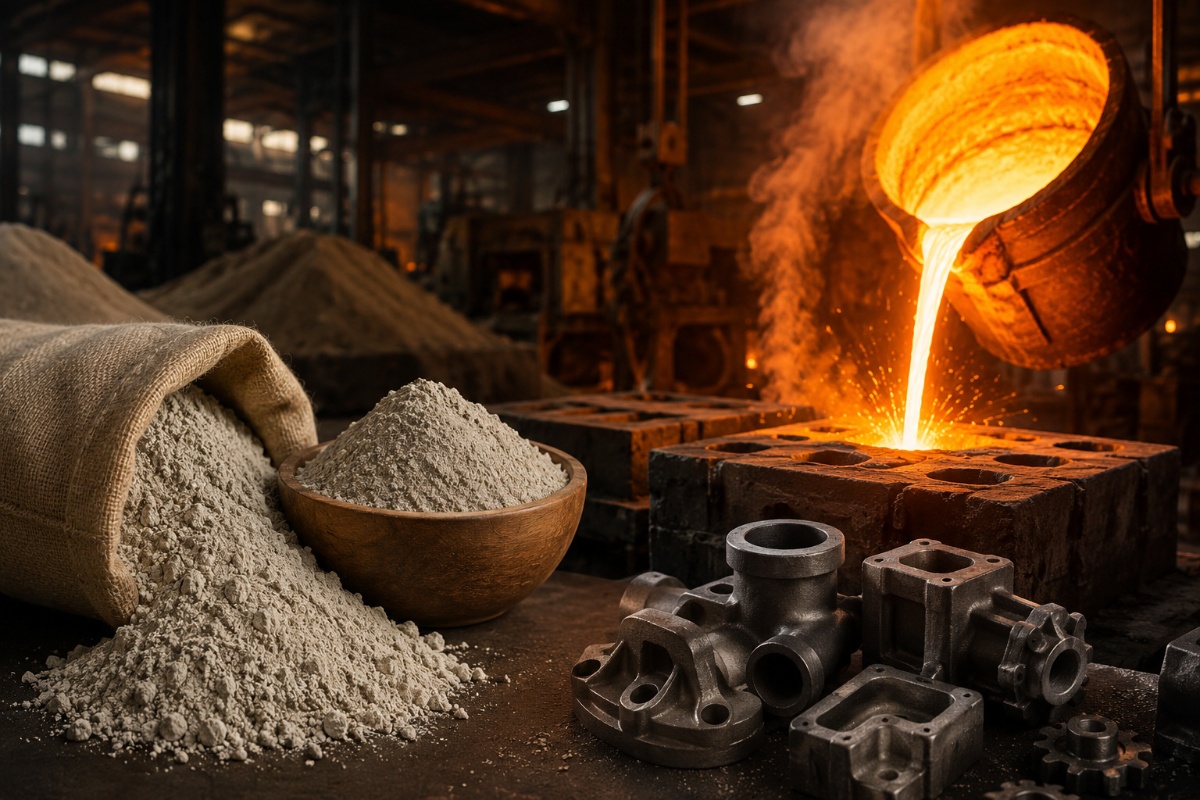
The Gulf Cooperation Council (GCC) region—which includes Saudi Arabia, United Arab Emirates, Qatar, Kuwait, Oman, and Bahrain—has witnessed rapid industrial growth over the last two decades. Massive investments in infrastructure, manufacturing, automotive components, oil & gas equipment, machinery, and metal fabrication have fueled the expansion of foundry operations across the region. As a result, the demand for high-performance foundry raw materials has increased significantly.
Among these materials, bentonite plays a critical role in ensuring casting quality, mold strength, dimensional accuracy, and production efficiency. Foundries across the GCC rely heavily on bentonite as a binder in green sand molding systems, making supplier selection a crucial business decision.
Over the years, Indian bentonite has emerged as the preferred choice for many GCC foundries. Importers and foundry operators increasingly favor Indian suppliers over competitors from other producing countries because of superior quality, consistent performance, cost-effectiveness, and reliable export logistics.
Companies such as Axewel Ledgerge have contributed significantly to strengthening India's reputation as a trusted global bentonite supplier by delivering export-grade materials tailored to industrial requirements.
This article explores why Indian bentonite continues to outperform competitors in the GCC foundry industry.
Before examining India's advantages, it is important to understand why bentonite is indispensable in foundry operations.
Foundry-grade bentonite serves as a natural binder in molding sand systems. When mixed with silica sand and water, bentonite creates strong, flexible molds capable of withstanding the extreme temperatures of molten metal during casting. Bentonite improves mold strength, moisture retention, permeability, and surface finish while helping reduce casting defects.
Typical benefits include:
Because bentonite directly affects casting quality, foundries cannot compromise on material consistency.
The GCC region has become a major manufacturing hub due to:
These sectors require high-quality cast components, driving continuous demand for foundry consumables and binders.
Countries such as Saudi Arabia and the UAE are heavily investing in industrial diversification programs that encourage domestic manufacturing and metal casting operations. This has increased the need for reliable bentonite suppliers capable of delivering large volumes consistently.
India possesses some of the world's largest and highest-quality bentonite reserves, particularly in the state of Gujarat.
The Kutch region is globally recognized for premium sodium bentonite deposits. These deposits contain high concentrations of montmorillonite, the mineral responsible for bentonite's swelling, binding, and adsorption properties.
The geological quality of Indian bentonite provides:
This natural advantage gives Indian suppliers a strong competitive edge.
Green strength is one of the most important properties in foundry molding sands.
High-quality Indian sodium bentonite delivers exceptional green compressive strength, allowing molds to maintain shape during handling and metal pouring. Stronger molds reduce breakage and improve casting accuracy.
Benefits include:
Many GCC foundries report improved casting consistency after switching to premium Indian bentonite grades.
Metal casting involves temperatures exceeding 1,300°C depending on the alloy being poured.
Indian foundry-grade bentonite exhibits strong thermal resistance, helping molds maintain structural integrity during pouring operations. High thermal stability minimizes:
This results in smoother cast surfaces and lower finishing costs.
Moisture control is critical in green sand systems.
Indian sodium bentonite demonstrates a wider moisture tolerance range compared to many competing products. This means foundries can maintain stable molding conditions even when environmental temperatures fluctuate.
For GCC foundries operating in extremely hot climates, moisture stability provides major operational advantages.
Benefits include:
Swelling capacity directly impacts binding performance.
Indian sodium bentonite typically offers superior swelling characteristics, enabling stronger sand bonding with lower dosage rates. High swelling capacity enhances mold plasticity and cohesion.
Advantages include:
Price remains an important factor for GCC importers.
Indian bentonite provides one of the best price-to-performance ratios in the global market. Buyers benefit from:
Compared with suppliers from Europe, North America, and some African countries, Indian exporters often offer superior value without sacrificing quality.
India enjoys a strategic geographic location close to GCC markets.
Major ports such as:
provide efficient shipping routes to Gulf destinations.
Shorter transit times mean:
For GCC importers, logistics efficiency often becomes a deciding factor when selecting suppliers.
Modern Indian bentonite manufacturers operate sophisticated processing facilities equipped with:
These facilities ensure consistent product quality across shipments.
Export-oriented companies perform regular testing for:
This consistency is highly valued by GCC foundries that require predictable production performance.
Every foundry has unique operating conditions.
Indian suppliers often provide customized bentonite grades based on:
Customized solutions help foundries optimize performance while minimizing costs.
This flexibility is one of the major reasons GCC buyers continue to expand procurement from India.
Supply disruptions can significantly impact foundry operations.
India's extensive bentonite mining industry ensures dependable availability throughout the year.
Advantages include:
This reliability reduces procurement risk for GCC manufacturers.
| Factor | Indian Bentonite | Competitor Sources |
|---|---|---|
| Swelling Capacity | Excellent | Moderate to High |
| Green Strength | Excellent | Variable |
| Thermal Stability | Excellent | Moderate |
| Cost Efficiency | High | Medium |
| Export Availability | Excellent | Variable |
| Shipping Time to GCC | Short | Longer |
| Product Customization | Extensive | Limited |
| Supply Reliability | High | Variable |
| Technical Support | Strong | Moderate |
| Overall Value | Excellent | Medium |
The GCC foundry sector serves several industries:
Engine blocks, brake systems, transmission housings, and structural components.
Valves, pumps, pipe fittings, drilling equipment, and refinery components.
Heavy equipment parts, excavator components, and industrial castings.
Municipal castings, drainage systems, utility covers, and structural components.
Wind turbine parts and specialized industrial castings.
All these industries depend on high-quality molding materials, making premium Indian bentonite an essential raw material.
Modern foundries increasingly focus on sustainability.
Bentonite contributes by enabling:
Bentonite-bonded sands can often be reclaimed and reused multiple times, supporting environmentally responsible manufacturing practices.
As global demand for high-performance bentonite continues to grow, importers seek suppliers capable of delivering quality, consistency, and technical support.
Axewel Ledgerge supplies premium bentonite solutions designed to meet the demanding requirements of GCC foundries and industrial manufacturers.
Key advantages include:
Whether supplying large-scale foundries or specialized casting operations, Axewel Ledgerge helps customers improve casting quality while optimizing production costs.
The GCC foundry industry continues to expand as regional governments invest heavily in manufacturing, infrastructure, and industrial diversification. This growth has increased demand for reliable foundry consumables, particularly bentonite.
Indian bentonite has established itself as the preferred choice among GCC foundries due to its superior swelling capacity, excellent green strength, high thermal stability, cost-effectiveness, consistent quality, and logistical advantages. These characteristics help foundries achieve better casting performance while reducing production costs.
With world-class reserves in Gujarat, advanced processing facilities, and strong export infrastructure, India remains one of the most dependable sources of foundry-grade bentonite globally. Companies such as Axewel Ledgerge continue to support GCC manufacturers by delivering premium bentonite solutions that outperform competing products in both performance and value.
As the GCC foundry sector grows in sophistication and scale, Indian bentonite is expected to remain a key ingredient in achieving high-quality, cost-efficient, and sustainable casting operations.













Have questions about our products? We're here to help!