Axewelledge, a leading exporter from India, specializes in high-quality Bentonite. With a commitment to excellence, we supply premium Bentonite to the Middle East and Southeast Asia markets.


North Angle Complex, 304,
150 Feet Ring Rd, Opposite Ambedkar Nagar BRTS Stop,
Madhav Park, Punit Nagar,
Mavdi, Rajkot, Gujarat 360004
© Axewelledge 2026, All Rights Reserved.
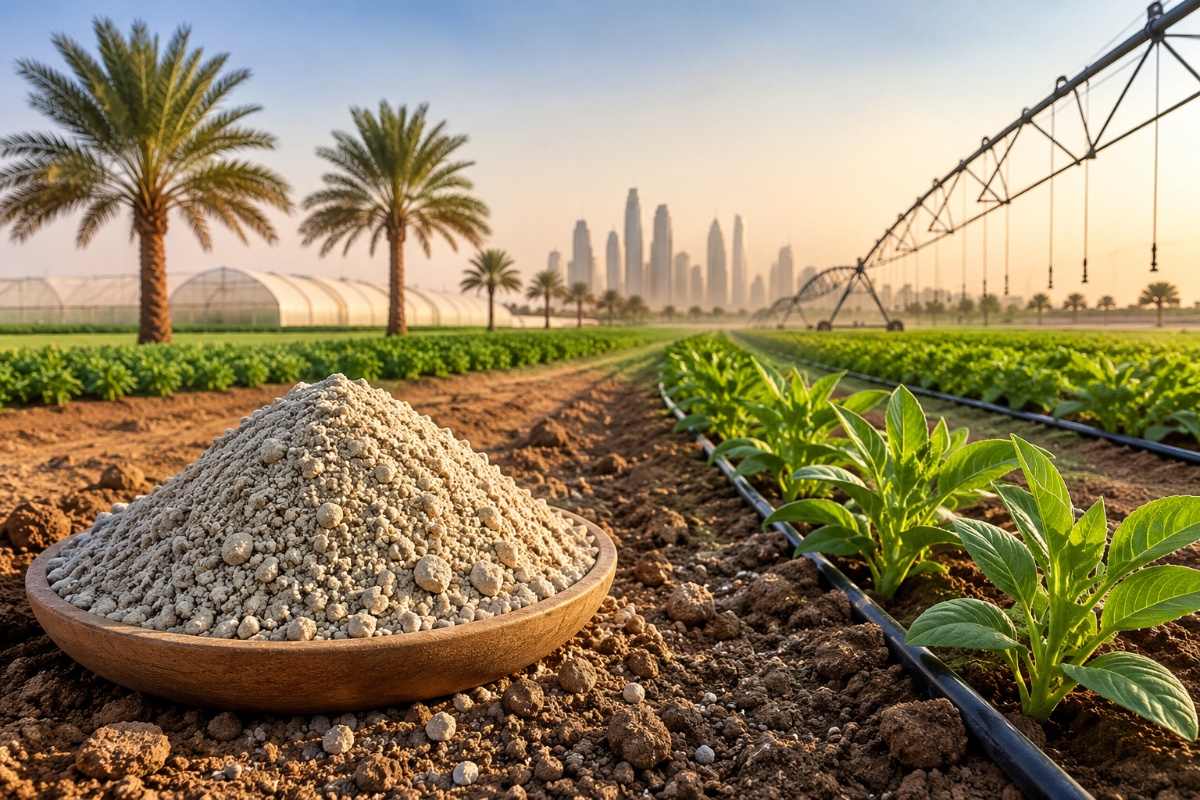
Agriculture in the Gulf Cooperation Council (GCC) countries faces unique environmental challenges. Nations such as Saudi Arabia, United Arab Emirates, Qatar, Kuwait, Oman, and Bahrain experience extremely hot temperatures, limited rainfall, sandy soils, and increasing pressure on water resources. Despite these challenges, the Gulf region continues to invest heavily in agriculture to improve food security and reduce dependence on imports.
One of the most effective natural solutions helping Gulf agriculture overcome soil and water limitations is bentonite clay. Bentonite is a naturally occurring absorbent clay mineral primarily composed of montmorillonite. Due to its exceptional water retention, nutrient-holding capacity, and soil-conditioning properties, bentonite has become increasingly valuable for farming in arid and semi-arid regions. Studies show that bentonite can significantly improve water-holding capacity, nutrient retention, soil aggregation, and crop productivity, making it highly suitable for Gulf agricultural conditions.
This article explores how bentonite is transforming agriculture across the Gulf region, the benefits it provides, application methods, and why sourcing high-quality bentonite from India has become a preferred choice for GCC agricultural projects. Companies like Axewel Ledgerge Pvt. Ltd. are helping international buyers access premium-grade bentonite products tailored to agricultural applications.
Bentonite is a naturally occurring clay formed from the weathering of volcanic ash. It is known for its remarkable swelling ability when exposed to water. This property allows bentonite to absorb several times its weight in moisture and retain it within the soil profile.
There are two primary types of bentonite:
For Gulf agriculture, sodium bentonite is often preferred because of its superior ability to retain moisture under harsh climatic conditions.
The Gulf region faces several natural limitations that affect agricultural productivity.
Most agricultural land in GCC countries consists of sandy soils. Sandy soils have large particle sizes, causing rapid water drainage and poor nutrient retention. Valuable irrigation water often moves below the root zone before plants can utilize it.
Water availability remains one of the biggest challenges in Gulf agriculture. Farmers rely heavily on groundwater, desalinated water, and advanced irrigation systems.
Many agricultural lands suffer from elevated salt levels due to high evaporation rates and irrigation practices. Excess salts can inhibit plant growth and reduce yields.
Desert soils generally contain very low levels of organic matter, resulting in weak soil structure and limited microbial activity.
Summer temperatures often exceed 45°C, increasing water loss through evaporation and creating stress on crops.
These challenges require innovative soil improvement strategies, and bentonite has emerged as one of the most effective solutions.
Perhaps the greatest advantage of bentonite is its exceptional ability to retain water. When mixed into sandy soil, bentonite particles absorb moisture and slowly release it back to plant roots as needed.
Research demonstrates that bentonite significantly increases soil water storage and water-use efficiency, particularly in semi-arid environments.
Benefits include:
For Gulf farmers, this translates directly into cost savings and improved crop performance.
Sandy soils often lack cohesion and stability. Bentonite helps bind loose soil particles together, creating a more balanced soil structure.
Advantages include:
Studies indicate that bentonite creates stable soil aggregates that improve moisture distribution and support healthier root development.
Nutrients such as nitrogen, potassium, magnesium, and calcium are essential for plant growth. However, sandy soils frequently lose these nutrients through leaching.
Bentonite possesses a high Cation Exchange Capacity (CEC), allowing it to hold positively charged nutrients and release them gradually to crops.
This results in:
Farmers can achieve higher productivity while reducing input expenses.
Salinity is a major concern throughout the GCC region. Excess sodium in the soil can reduce nutrient uptake and damage crop roots.
Bentonite helps:
Combined with proper irrigation management, bentonite contributes to long-term soil rehabilitation.
Numerous agricultural studies have demonstrated positive yield responses following bentonite application.
Research conducted under semi-arid conditions found that bentonite improved:
Yield increases of up to 20% were observed depending on application rates and crop type.
For commercial farms in GCC countries, such improvements can significantly enhance profitability.
Bentonite can benefit a wide range of crops grown throughout the Gulf region.
The versatility of bentonite makes it valuable across both commercial agriculture and landscaping projects.
Greenhouse agriculture is rapidly expanding across GCC countries due to its ability to conserve water and maximize yields.
Bentonite supports greenhouse operations by:
As protected agriculture continues to grow in the Gulf region, demand for agricultural-grade bentonite is expected to increase.
Sustainability has become a major focus of agricultural development throughout the Gulf.
Bentonite contributes to sustainability by:
Water savings remain one of the most significant benefits of bentonite use.
Improved nutrient retention reduces fertilizer runoff and groundwater contamination.
Bentonite encourages improved soil structure and microbial activity.
Reduced irrigation and fertilizer requirements decrease overall environmental pressure.
These advantages align closely with national sustainability goals across GCC countries.
The most common method involves incorporating bentonite directly into the soil before planting.
Bentonite can be concentrated near root zones for maximum effectiveness.
It can be mixed with peat, compost, coco peat, or other growing substrates.
Bentonite is frequently used as a carrier material in fertilizer formulations to provide controlled nutrient release.
Application rates vary according to soil type, crop requirements, and environmental conditions.
Although bentonite requires an initial investment, the long-term financial benefits are substantial.
Lower water usage decreases operational expenses.
Less fertilizer is lost through leaching.
Increased productivity improves farm profitability.
Enhanced soil quality supports sustainable long-term cultivation.
Many agricultural projects achieve positive returns within a relatively short period after implementation.
India has become one of the world's leading suppliers of premium-quality bentonite.
Key advantages include:
Regions such as Gujarat and Rajasthan possess some of the world's finest sodium bentonite reserves.
Indian manufacturers maintain strict quality control procedures.
Large-scale production helps keep costs competitive.
Indian exporters have extensive experience serving GCC markets.
Suppliers can provide specialized grades designed for agricultural applications.
This combination of quality, availability, and affordability makes India a preferred sourcing destination.
Axewel Ledgerge Pvt. Ltd. supplies high-quality bentonite products for international agricultural, industrial, and environmental applications.
The company focuses on:
With growing demand for soil conditioning products across the Gulf region, Axewel Ledgerge continues to support sustainable agricultural development through dependable bentonite supply.
The future of bentonite in Gulf agriculture appears highly promising.
Several trends are driving demand:
As governments and private sector stakeholders continue investing in agricultural innovation, bentonite is expected to play an increasingly important role in improving soil productivity and resource efficiency.
Research continues to demonstrate that bentonite can improve soil moisture retention, nutrient availability, plant growth, and crop yields under arid conditions.
The Gulf region faces some of the world's most challenging agricultural conditions, including sandy soils, water scarcity, salinity, and extreme temperatures. Bentonite has emerged as a highly effective soil-conditioning solution capable of addressing many of these issues simultaneously.
By improving water retention, enhancing nutrient availability, strengthening soil structure, reducing irrigation requirements, and increasing crop yields, bentonite supports both agricultural productivity and environmental sustainability. Scientific studies consistently show its value in arid and semi-arid farming systems.
As GCC countries continue pursuing food security and sustainable agricultural development, demand for premium agricultural-grade bentonite will continue to grow. Trusted suppliers such as Axewel Ledgerge Pvt. Ltd. are well-positioned to provide the high-quality bentonite solutions needed to support the future of Gulf agriculture.













Have questions about our products? We're here to help!