Axewelledge, a leading exporter from India, specializes in high-quality Bentonite. With a commitment to excellence, we supply premium Bentonite to the Middle East and Southeast Asia markets.


North Angle Complex, 304,
150 Feet Ring Rd, Opposite Ambedkar Nagar BRTS Stop,
Madhav Park, Punit Nagar,
Mavdi, Rajkot, Gujarat 360004
© Axewelledge 2026, All Rights Reserved.
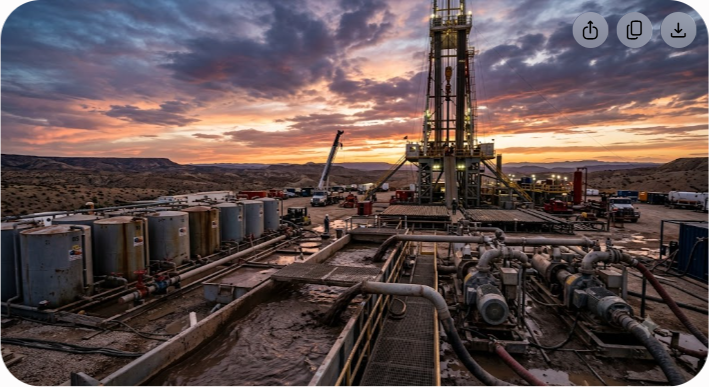
Picture a modern oil rig. You likely imagine towering steel derricks, massive drill bits, and roughnecks working around the clock. But beneath the surface, hidden from view, flows the actual lifeblood of the entire operation: drilling fluid. At the heart of that fluid is high-grade sodium bentonite.
If you try to punch a hole thousands of feet into the earth without the right fluid, you run into serious trouble. Friction melts the drill bit. The surrounding rock collapses into the empty hole. Pressurized gases from deep formations blow back up to the surface. It is a hostile environment. To survive it, engineers rely on 'drilling mud'—a carefully engineered slurry that cools, cleans, and stabilizes the wellbore.
Sodium bentonite is the workhorse of this mud system. Extracted from volcanic ash deposits, this specific type of clay possesses remarkable properties when mixed with water. It swells up to twenty times its original dry size, transforming ordinary water into a highly functional, thixotropic fluid.
In this guide, we break down exactly how high-grade sodium bentonite keeps modern oil and gas drilling operations running smoothly, safely, and profitably. From the complex rheology of non-Newtonian fluids to the practical realities of sourcing top-tier materials, here is everything you need to know about this vital industrial mineral.
Before looking at how it works in a well, we need to understand what bentonite is on a microscopic level. It is an absorbent aluminum phyllosilicate clay consisting mostly of montmorillonite.
The magic lies in its molecular structure. Montmorillonite consists of stacked platelets—microscopic flat sheets. In sodium bentonite, sodium ions sit between these platelets. When exposed to water, these sodium ions allow water molecules to rush in, pushing the platelets apart. This causes the clay to expand dramatically.
Not all bentonite is created equal. Calcium bentonite, for example, is highly absorbent but does not swell much. It is great for cat litter or clarifying wine, but useless on an oil rig. Sodium bentonite is the true swelling champion.
'High-grade' refers to the purity and performance metrics of the clay. In the oil and gas industry, these standards are governed by the American Petroleum Institute (API). API Specification 13A dictates exactly how much the clay must yield, its maximum moisture content, and how it must perform under pressure. When we talk about high-grade sodium bentonite, we mean meticulously processed, API-compliant material that performs predictably every single time it goes downhole.
To appreciate the role of bentonite, you have to understand the jobs drilling mud is hired to do. A good bentonite-based mud system acts as a multi-tool, solving several mechanical and physical problems simultaneously.
As the drill bit chews through bedrock, it creates rock shavings and debris called cuttings. If these cuttings are not removed immediately, they pile up, choke the bit, and eventually lock the drill string in place—a catastrophic event known as a 'stuck pipe.'
Bentonite gives water the viscosity needed to grab these rock chips and carry them thousands of feet back to the surface. Think of dropping a pebble into a glass of water versus a glass of thick syrup. The syrup slows the fall. Bentonite mud carries the heavy rock up against gravity.
Drilling is not always a continuous process. Crews must stop to add new lengths of drill pipe or perform maintenance. When the pumps turn off, the fluid stops moving. If the mud is just dirty water, gravity wins, and all those heavy rock cuttings instantly fall to the bottom of the hole, burying the drill bit.
This is where bentonite's thixotropic property shines. The fluid gets thick and gel-like when it stops moving, but becomes thin and liquid when agitated. The moment the rig's pumps shut down, the bentonite mud instantly forms a rigid gel structure, freezing the rock cuttings in mid-mud. When the pumps kick back on, the gel liquefies, and the cuttings resume their journey to the surface. It is a stunning display of physical chemistry in action.
Drilling through solid granite or shale generates immense friction and heat. Left unchecked, the drill bit would rapidly degrade. The continuous flow of bentonite mud acts as a liquid coolant, absorbing the heat and carrying it away from the cutting face. The slick nature of the clay also provides vital lubrication, reducing torque on the drill string and extending the lifespan of expensive drilling equipment.
Deep underground, you find highly pressurized pockets of oil, gas, and water. If you drill into one of these pockets without counter-pressure, those fluids will blast up the empty wellbore to the surface. This is a blowout.
Bentonite mud prevents blowouts through hydrostatic pressure. Because bentonite slurry is heavier than water, the sheer weight of the mud column pushing down the hole acts as a liquid cork. It holds the dangerous formation pressures back, keeping the rig and its crew safe.
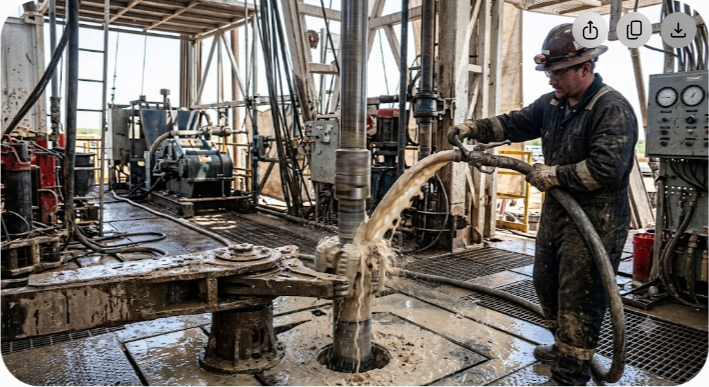
When you drill into porous rock, such as sandstone, the liquid mud naturally wants to seep out into the surrounding rock, bleeding away from the well. This is called 'fluid loss.'
Sodium bentonite prevents this by building a 'filter cake.' Because of their flat, platelet-like structure, bentonite particles plaster themselves against the porous walls of the wellbore. They interlock like microscopic bricks, forming a thin, tough, impermeable layer. This filter cake seals the well, keeping the drilling fluid inside the hole and keeping the surrounding rock stable.
If you want to sound like an expert on the rig floor, you do not talk about 'thick' or 'thin' mud. You talk about Plastic Viscosity (PV) and Yield Point (YP). High-grade sodium bentonite is prized specifically for how it influences these two metrics.
Plastic Viscosity represents the mechanical friction between the solid particles in the mud. You generally want PV to be as low as possible. High PV means the mud pumps have to work harder, burning more diesel and putting strain on the equipment.
Yield Point, on the other hand, is the mud's actual ability to lift cuttings out of the hole. It measures the fluid's resistance to initial flow. You want a high YP to ensure the mud has the strength to carry heavy rocks.
The mark of a truly premium sodium bentonite—like the reserves managed by Axewelledge—is its ability to deliver an exceptionally high Yield Point while maintaining a manageable Plastic Viscosity. Low-grade clays force you to add massive amounts of material to get a good YP, which skyrockets the PV and ruins your pumping efficiency. High-grade bentonite gets the job done efficiently, requiring less material per barrel of mud.
The US oil and gas landscape has shifted dramatically over the last two decades. We are not just drilling straight vertical holes into friendly formations anymore. The rise of horizontal drilling and hydraulic fracturing in places like the Permian Basin and the Bakken Formation requires pushing drilling technology to its absolute limits.
Horizontal drilling means the drill bit turns 90 degrees and drills sideways for miles. In a vertical hole, gravity helps keep the pipe centered. In a horizontal hole, the heavy steel pipe rests on the bottom side of the wellbore, creating massive friction. Furthermore, rock cuttings do not just fall to the bottom; they settle on the low side of the horizontal pipe, forming debris beds that can lock up the drill string.
High-grade sodium bentonite is vital here. Its superior lubricating properties reduce the drag on horizontal pipe. Its robust suspension capabilities sweep those horizontal debris beds clean, pushing the cuttings out to the surface. Without premium bentonite, modern horizontal drilling would be vastly more expensive and prone to failure.
Similarly, High-Pressure, High-Temperature (HPHT) environments severely test drilling mud. At extreme depths, temperatures can exceed 350°F. At these temperatures, cheap synthetic polymers break down and fail. Natural sodium bentonite, however, is a mineral. It maintains its structural integrity and rheological properties under severe heat, making it the most reliable backbone for HPHT mud systems.
While oil and gas operations are heavily scrutinized for their environmental impact, the choice of drilling mud offers an opportunity to improve sustainability.
Historically, the industry often relied on Oil-Based Muds (OBMs) for difficult wells. OBMs offer great lubrication, but they are highly toxic, expensive, and difficult to dispose of. Every cutting of rock brought up by an OBM must be treated as hazardous waste.
Water-Based Muds (WBMs) powered by natural sodium bentonite offer a greener alternative. Bentonite is a naturally occurring earth mineral. It is non-toxic and environmentally benign. In many cases, cuttings coated in bentonite mud can be safely spread on land or disposed of with minimal environmental treatment. This drastically reduces the environmental footprint of the drilling site.
Economically, the advantages are just as clear. High-grade bentonite is highly efficient. Because it yields more volume and better viscosity per ton than lower-grade clays, operators need to buy, transport, and mix fewer bags of material. When rig time costs tens of thousands of dollars an hour, the reliability and efficiency of premium bentonite translate directly to the bottom line.
Understanding the science of bentonite is only half the battle. The other half is actually getting your hands on a reliable, consistent supply. The global supply chain for industrial minerals can be volatile, and a bad batch of mud can cost an operator millions of dollars in rig downtime.
This is where strategic partnerships come into play. India has emerged as a global powerhouse in the production of high-grade sodium bentonite, boasting some of the richest and most accessible reserves on the planet.
At Axewelledge, we understand the critical nature of this supply chain. As India's largest mine owner and exporter of bentonite, sitting on over 60 million tons of high-quality reserves, we offer something crucial to the US market: total vertical integration.
Because we control the process from the mine to the shipping port, we control the quality. Our processing plants utilize advanced refinement techniques to ensure every ton of our API-grade bentonite meets the exact specifications required by modern drilling operators. We test for moisture content, yield point, and particle size distribution.
When a US drilling operator sources bentonite from Axewelledge, they are buying the engineered reliability that comes from 15+ years of expertise and an unbroken chain of quality control. We bridge the gap between India's massive natural reserves and the high-tech demands of American oilfields.
Even with the best bentonite, drilling fluid engineers face constant challenges downhole. The mud is a living system that reacts to the geology it passes through.
One common issue is calcium contamination. If the drill bit hits a layer of gypsum or cement, calcium ions flood into the mud system. Calcium is the enemy of sodium bentonite. It swaps places with the sodium ions in the clay platelets, causing the bentonite to flocculate and lose its swelling power. The mud suddenly drops its cuttings, and the yield point plummets.
Experienced mud engineers combat this by treating the mud with soda ash (sodium carbonate). The soda ash precipitates the calcium out of the solution, allowing the sodium bentonite to recover its structure.
Another challenge is saltwater flows. If you drill into a brine pocket, the high salinity can inhibit the bentonite's ability to hydrate and swell. In these cases, engineers may pre-hydrate the bentonite in fresh water before adding it to the active mud system, or they may supplement the mud with specialized saltwater-resistant polymers.
Having a baseline of highly reactive, high-grade sodium bentonite makes these troubleshooting processes vastly easier. A strong, premium clay will withstand chemical contamination far better than a weak, marginal clay, giving the engineer a wider margin of error to correct the mud system before the wellbore destabilizes.
Drilling technology never stands still. As the easy-to-reach oil reserves are depleted, the industry is forced to drill deeper, faster, and in more complex geologies. The demands on drilling fluids are increasing exponentially.
We are seeing a rise in 'designer muds'—hybrid systems that combine the reliable, heat-resistant foundation of natural bentonite with highly specialized, lab-created nanoparticles and polymers. These hybrid systems aim to provide the ultra-thin filter cakes needed for sensitive reservoirs while maintaining the raw lifting power and cost-effectiveness of a bentonite base.
Furthermore, automation is coming to the mud pit. Sensors can now monitor mud weight, viscosity, and chemical composition in real-time, feeding data directly to systems that adjust the mud mix on the fly. But even the most advanced systems still require high-quality raw materials to do their job. You cannot optimize a mud system if the underlying bentonite is inconsistent or low-yield.
For operators in the USA looking to secure their supply chain and optimize their drilling efficiency, the quality of your raw materials dictates the success of your operation. High-grade sodium bentonite is not just an additive; it is the structural foundation of safe, efficient drilling.
Axewelledge stands ready to support the global energy sector. With our massive reserves, stringent quality control, and deep expertise in mineral processing, we deliver the premium bentonite solutions required by today's most demanding industrial applications. Whether you are drilling horizontal wells in Texas, managing wastewater, or sealing industrial sites, our commitment to excellence ensures you have the right materials for the job.
The next time you see a drilling rig towering over the landscape, remember what is happening below ground. Remember the immense pressures, the crushing friction, and the microscopic clay platelets working tirelessly to hold it all together. Quality matters. And when it comes to sodium bentonite, there is no substitute for high-grade performance.













Have questions about our products? We're here to help!