Axewelledge, a leading exporter from India, specializes in high-quality Bentonite. With a commitment to excellence, we supply premium Bentonite to the Middle East and Southeast Asia markets.


North Angle Complex, 304,
150 Feet Ring Rd, Opposite Ambedkar Nagar BRTS Stop,
Madhav Park, Punit Nagar,
Mavdi, Rajkot, Gujarat 360004
© Axewelledge 2026, All Rights Reserved.
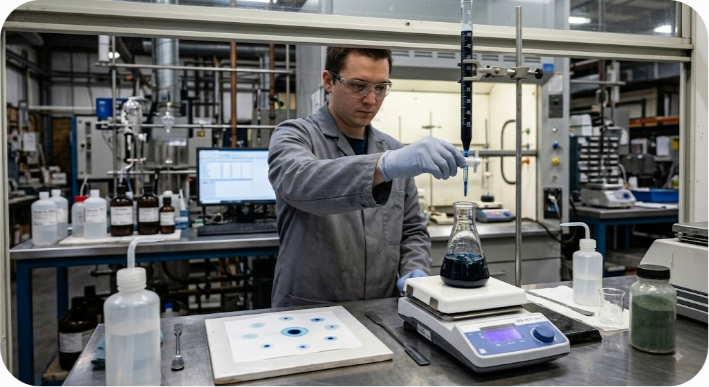
Active clay content directly dictates whether a green sand mold maintains dimensional integrity during pouring or collapses under the extreme thermal and mechanical stresses of molten metal. In modern green sand foundries, maintaining active clay within an optimal range—typically 6.5% to 8.5% depending on casting geometry and metal alloy—is the single most effective way to eliminate mold wall movement, expansion scabs, wash defects, and dimensional variance. If your active clay drops too low, green compression strength collapses and sand grains wash into the liquid stream; if it rises too high, working moisture demands skyrocket, triggering severe gas porosity and blowholes.
Green sand casting accounts for more than 70% of all ferrous castings globally. Yet, foundries continue to scrap millions of dollars in iron and aluminum components due to mismanaged sand chemistry. Understanding active clay is not just a laboratory exercise—it is the core operational control variable that dictates foundry yield, surface finish, and profitability.{ "seo_title": "Active Clay Content in Green Sand Mold Stability Guide", "meta_title": "Active Clay & Green Sand Mold Stability Guide", "meta_description": "Learn how active clay content controls green sand mold stability, prevents casting defects, and boosts yield with accurate methylene blue testing.", "tagline": "The ultimate foundry guide to bentonite chemistry, sand testing, and defect-free metal casting.", "slug": "active-clay-content-green-sand-mold-stability", "keywords": [ "active clay content green sand", "active clay in green sand mold stability", "methylene blue test green sand", "bentonite in green sand casting", "green compression strength green sand", "compactability green sand molds", "foundry sand system control", "dead clay vs active clay green sand", "sodium bentonite foundry sand", "sand inclusions metal casting", "expansion defects green sand", "green sand mold stability factors", "thermal durability bentonite", "foundry sand binder ratio", "how to measure active clay foundry", "active clay percentage green sand", "mold wall movement green sand", "scabbing defects foundry", "calcium vs sodium bentonite foundry", "green sand system optimization" ], "blog": "Active clay content directly dictates whether a green sand mold maintains dimensional integrity during pouring or collapses under the thermal and mechanical stresses of molten metal. In modern green sand foundries, maintaining active clay within an optimal range (typically 6.5% to 8.5% depending on casting geometry and metal alloy) eliminates mold wall movement, expansion scabs, wash defects, and dimensional variance. If active clay drops too low, green compression strength collapses and sand grains wash into the liquid stream; if it rises too high, working moisture demands skyrocket, triggering severe gas porosity and blowholes.
Green sand casting accounts for more than 70% of all ferrous castings globally. Yet, foundries continue to scrap substantial volumes of iron and aluminum components due to mismanaged sand chemistry. Understanding active clay is the core operational control variable that dictates foundry yield, surface finish, and profitability.
To control a green sand system, you must first distinguish between total clay, dead clay, and active clay. Green sand is a mixture consisting of silica sand grains, water, carbonaceous additives such as sea coal, and a clay binder, which is almost exclusively bentonite.
Active clay refers specifically to the fraction of bentonite within the sand mixture that retains its swelling capacity, layer-charge double-layer hydration potential, and mechanical bonding capability. It is the un-degraded binder capable of absorbing water, expanding, and coating silica grains to create strong clay-water bridges.
When molten iron or steel enters a sand mold at temperatures between 1,200°C and 1,550°C (2,190°F to 2,820°F), the sand immediately adjacent to the casting interface experiences severe thermal shocks.
Bentonite is a smectite clay mineral (primarily montmorillonite) structured as microscopic sheets of alumina octahedra sandwiched between silica tetrahedra. Between these crystal sheets sit exchangeable cations, sodium (Na+) or calcium (Ca2+), and interlayer water molecules.
As the mold heats up during pouring:
Dead clay no longer contributes to green compression strength or mold stability. Instead, it acts as a fine, inert silt that absorbs excess water, increases system dust, lowers permeability, and destabilizes mold properties if not continuously removed via dust extraction or diluted with fresh silica sand additions.
Green sand mold stability is defined as the ability of a compacted sand aggregate to resist physical deformation, erosion, mold wall movement, and thermal cracking when subjected to high metallostatic pressure and radiant thermal energy during casting solidification.
Active clay delivers mold stability through two distinct mechanical and chemical phenomena: clay coating thickness and crystalline double-layer swelling.
When active sodium bentonite is thoroughly mulled with water, the clay platelets disperse and hydrate. Cations on the platelet surfaces attract water molecules, forming structured water layers around each clay particle. When compacted around silica sand grains, these hydrated clay films overlap, creating intergranular bridges.
Under mechanical squeeze or jolt-squeeze molding machines, these bridges deform plastically, locking the sand grains in a tight matrix. The strength of this bond directly correlates to the volume of active montmorillonite present in the thin coating around each grain.
As molten metal fills the mold cavity, it exerts intense outward hydrostatic pressure against the mold walls, known as metallostatic head pressure. If the green compression strength (GCS) and wet tensile strength (WTS) of the sand are insufficient, the mold wall yields under pressure.
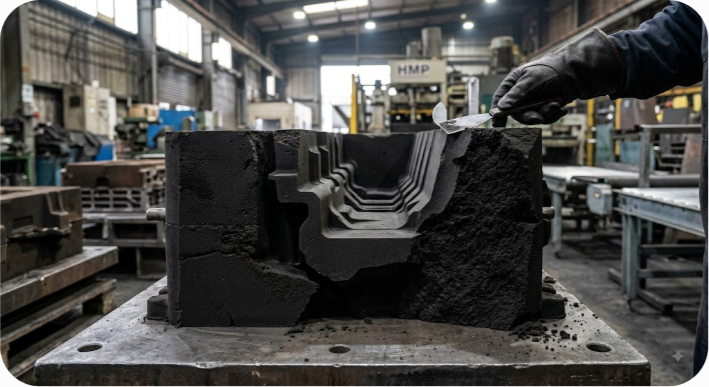
This phenomenon, called mold wall movement or mold yield, causes the casting dimensions to swell beyond design tolerances. In heavy-section ductile iron castings, mold wall movement relieves internal liquid pressure during eutectic expansion, directly inducing internal shrink porosity and feeding failures. Sufficient active clay ensures high green hardness and high yield stress in the sand matrix, forcing the mold walls to remain rigid under heavy liquid metal loads.
Silica sand undergoes a sudden crystallographic phase change at 573°C (1,063°F), transitioning from alpha-quartz to beta-quartz. This phase transformation causes an abrupt volumetric expansion of approximately 1.4%.
When liquid metal hits the mold face, the heat causes the skin layer of sand to expand rapidly while the cooler sand layers behind it remain stationary. This differential expansion creates shear stress along the mold surface.
If the active clay content is high and properly hydrated, the clay layer acts as a flexible, plastic cushion that absorbs the expanding quartz grains. Furthermore, high active clay provides the necessary wet tensile strength in the condensation zone (the moist layer formed just behind the hot face) to prevent the mold surface from buckling or tearing away into the molten metal stream.
Understanding the distinct roles of the three clay states in your foundry system is vital for accurate sand lab control and binder dosing.
| Property / Aspect | Active Clay (Live Bentonite) | Dead Clay (Calcined Clay) | Total Clay (Loss-on-Ignition / AFS Clay) |
|---|---|---|---|
| Mineral Structure | Intact montmorillonite crystal lattice | Collapsed, dehydroxylated lattice | Combination of active clay, dead clay, and non-clay fines |
| Swelling Capability | High (5x to 15x dry volume for sodium type) | Zero | Partial (proportional only to active fraction) |
| Binding Energy | High plastic cohesion and water bonding | Zero binding power; acts as inert silt | Varies depending on active-to-dead clay ratio |
| Impact on Moisture | Holds water constructively in plastic hydration layers | Absorbs water passively without producing strength | Reflects total water demand across all fine particles |
| Primary Measurement Method | Methylene Blue (MB) Titration test | Calculated (AFS Clay minus Active Clay) | AFS Clay wash test / Hydrometer settling method |
| Target System Level | 6.5% - 8.5% (ferrous); 5.0% - 6.5% (non-ferrous) | Below 2.0% (ideally kept as low as possible) | 8.5% - 11.5% total fine fraction |
| Effect of Deficiency | Sand erosion, cuts, washes, scabbing, mold swelling | Minimal direct negative binding impact | Weak sand matrix, low durability |
| Effect of Excess | High water demand, gas blowholes, stickiness | High moisture demand, low permeability, burn-in | High gas evolution, pinholes, expansion flaws |
Operating Limits: What Happens When Active Clay Is Out of Balance?
Managing active clay is a balancing act. Operating outside the optimal window introduces immediate casting defects.
When the active clay level drops below design specifications, the binder matrix on the sand grains becomes thin and brittle.
While adding extra bentonite might seem like a solution against erosion, excessive active clay causes a different set of casting flaws.
Active clay content alone does not guarantee mold stability. Two sand systems with identical 7.5% active clay levels can perform differently based on three critical variables: sodium vs. calcium chemistry, mulling energy, and thermal durability.
Not all bentonites are created equal. The interlayer exchangeable cation determines the hydration mechanics and thermal resilience of the active clay:
Active clay is ineffective if it sits in undispersed dry lumps in the sand matrix. The binder must be mechanically sheared and smeared over every individual silica grain through mulling.
Under-mulled sand may test as having high active clay in a laboratory Methylene Blue test, but its functional performance will mimic a low-clay sand. Proper mulling requires sufficient batch time, correct wheel pressure, and optimal water addition timing. Water must be added to dry sand and clay to initialize hydration before heavy shear forces are applied.
In continuous system sand, active clay is constantly destroyed near the casting skin and diluted by burned core sand entering the shakeout stream. High sand-to-metal ratios (such as 5:1 versus 2:1) reduce thermal stress on the sand system, slowing down the conversion of active clay into dead clay. Foundries must adjust new bentonite additions based on daily pour weights and core sand carry-in volumes.
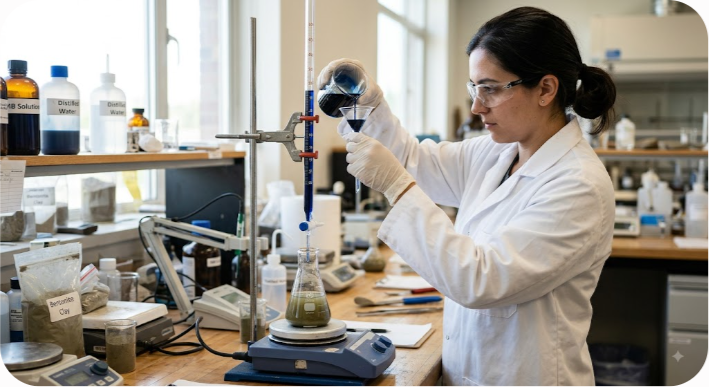
The industry standard method for measuring active clay is the Methylene Blue Titration Test (AFS Procedure 2210-00-S). Methylene blue dye is a cation that replaces the exchangeable sodium and calcium ions on the active montmorillonite surfaces. Because dead clay, silica flour, and sea coal cannot exchange ions with the dye, the test selectively measures only the functional, active montmorillonite.
Here is the step-by-step procedure for conducting an accurate Methylene Blue test in the sand laboratory:
Required Equipment and Reagents
Step 1: Sample Preparation
Step 2: Dispersion and Digestion
Step 3: Titration Procedure
Step 4: Identifying the End Point (Halo Effect)
Step 5: Calculation of Active Clay Percentage Calculate the percentage of active clay using the standardized formula:
Active Clay (%) = (Titration Volume in mL Normality Equivalent Weight Factor / Sample Weight in g) * 100
Simplified Standard Formula (for 5.00 g sample using 3.74 g/L MB solution calibrated to Western Bentonite): Active Clay (%) = Titration Volume (mL) * 0.55
For instance, if your titration takes 13.6 mL of MB solution, your active clay content is 13.6 * 0.55 = 7.48%.
When green sand molds experience failure, shop-floor operators need rapid diagnostics. Match casting defects with active clay imbalances and corrective actions using the table below.
| Casting Defect / Symptom | Primary Sand Root Cause | Secondary Contributing Factors | Corrective Action at the Muller / System |
|---|---|---|---|
| Sand Wash and Erosion | Low active clay content (below 6.0%) | Low green compression strength, poor mulling shear, dry sand | Increase new sodium bentonite addition; increase mulling time; check return sand moisture. |
| Expansion Scabs / Buckles | Low wet tensile strength; low active sodium bentonite ratio | High silica sand expansion, low sea coal cushion | Switch to high-swelling natural sodium bentonite; boost active clay to 7.5%; check grain fineness. |
| Gas Blowholes / Pinholes | Excess active clay driving high working moisture requirements | Low sand permeability, high dead clay silt levels, under-dried cores | Reduce bentonite additions; introduce fresh silica sand additions to dilute total fines; clean dust extractors. |
| Mold Wall Movement / Shrinkage | Weak green sand matrix; low mold hardness (below 85-90 B-scale) | Inadequate molding machine squeeze pressure; low active clay | Boost active clay to 7.5% - 8.2%; increase squeeze pressure; inspect muller wheel wear. |
| Pattern Sand Sticking | Excess active clay combined with high compactability (above 45%) | Hot sand (above 45°C / 113°F), worn pattern release coatings | Reduce moisture target; lower bentonite feed slightly; cool return sand below 40°C before mulling. |
| Sand Friability / Brittle Edges | High dead-clay-to-active-clay ratio (above 0.4:1) | Excess core dilution sand, insufficient fresh bentonite feed | Bleed off system sand; add high-quality sodium bentonite; increase baghouse exhaust suction to strip dead fines. |
Optimizing your green sand system requires establishing a disciplined daily sand laboratory routine and making gradual adjustments to keep active clay stable.
A healthy ferrous sand system should maintain an Active Clay to AFS Clay (Total Clay) ratio of 0.65 to 0.75. If your total clay is 10.0%, your active clay should sit between 6.5% and 7.5%.
If this ratio drops below 0.55, your sand system is loaded with dead clay and inert fines. To fix this:
Return sand entering the muller at temperatures above 45°C (113°F) causes water to evaporate rapidly off the clay surfaces during mixing. This creates false compactability readings, unhydrated active clay pockets, and sand stickiness. Install return sand coolers to keep batch sand under 40°C prior to mulling.
The quality of your incoming raw bentonite dictates how much active clay survives each pouring cycle. Natural sodium bentonites with high montmorillonite content (above 85%), high methylene blue values, and thermal durability reduce overall bentonite consumption per ton of iron melted.
Controlling active clay begins with raw material consistency. Axewelledge processes sodium bentonite engineered for high-demand foundry applications worldwide. With high montmorillonite purity, swelling capacity, and thermal stability, Axewelledge bentonite ensures high wet tensile strength and active clay longevity cycle after cycle.
Whether you operate an automated high-pressure molding line or a jobbing gray and ductile iron foundry, Axewelledge delivers standardized bentonite solutions tailored to your sand system requirements. Contact the foundry materials team at Axewelledge to request technical specifications, lab samples, or bulk export quotations.













Have questions about our products? We're here to help!