Axewelledge, a leading exporter from India, specializes in high-quality Bentonite. With a commitment to excellence, we supply premium Bentonite to the Middle East and Southeast Asia markets.


North Angle Complex, 304,
150 Feet Ring Rd, Opposite Ambedkar Nagar BRTS Stop,
Madhav Park, Punit Nagar,
Mavdi, Rajkot, Gujarat 360004
© Axewelledge 2026, All Rights Reserved.
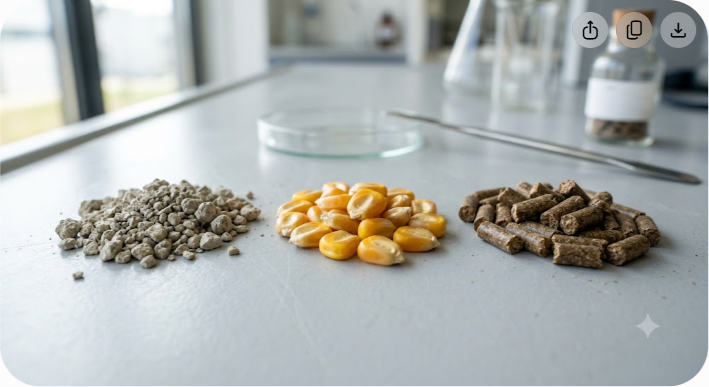
Mycotoxins cause billions of dollars in agricultural losses every year, quiet performance drops in swine and poultry operations, and sudden spikes of Aflatoxin M1 in dairy milk. These toxic fungal metabolites contaminate grain in the field and during storage, often without changing the appearance, smell, or taste of the feed.
While complete elimination of fungal spores from field crops is practically impossible, neutralizing mycotoxins inside the animal's digestive tract is realistic. Bentonite clay binds planar mycotoxins like Aflatoxin B1 through high-capacity ion exchange and interlayer adsorption, locking the toxins inside its mineral lattice so they pass harmlessly through the gut without entering the bloodstream.
In this comprehensive guide, we examine the precise biophysical mechanisms behind clay-based toxin binding, evaluate sodium versus calcium bentonite, lay out exact inclusion rates across species, and explain how to protect your herd's health and bottom line.
Mycotoxins are toxic secondary metabolites produced by filamentous fungi (molds) that naturally infect grains, oilseeds, and silages. Crop stress—such as droughts, insect damage, late rains during harvest, or improper drying—accelerates fungal development.
The progression from crop field to systemic animal stress follows four clear stages:
The most prevalent and dangerous mycotoxin classes encountered in global livestock feed include:
Without targeted mitigation, mycotoxin ingestion causes intestinal mucosal erosion, liver degeneration, impaired nutrient absorption, lower average daily gain (ADG), and heightened susceptibility to secondary bacterial infections.
Bentonite is an absorbent aluminum phyllosilicate clay formed primarily from weathered volcanic ash. The primary active mineral responsible for its functional characteristics is montmorillonite, belonging to the smectite clay family.
Montmorillonite consists of a 2:1 layered structure: one central octahedral sheet of alumina ($Al_2O_3$) sandwiched between two tetrahedral sheets of silica ($SiO_2$). These thin platelets stack on top of each other, forming a dynamic crystalline network.
Crucially, during the formation of montmorillonite, isomorphous substitution occurs within the crystal lattice. Trivalent aluminum ions ($Al^{3+}$) in the octahedral layer are frequently replaced by divalent magnesium ions ($Mg^{2+}$) or ferrous iron ($Fe^{2+}$), without altering the physical shape of the crystal. This substitution creates a permanent net negative charge across the face of the clay platelets.
To balance this negative charge, mobile cations—predominantly Sodium ($Na^+$), Calcium ($Ca^{2+}$), and Magnesium ($Mg^{2+}$)—are attracted into the interlayer space between the platelets. The ease with which these exchangeable cations can swap places with other molecules is called the Cation Exchange Capacity (CEC), typically measured in milliequivalents per 100 grams (meq/100g).
High-grade bentonite exhibits:
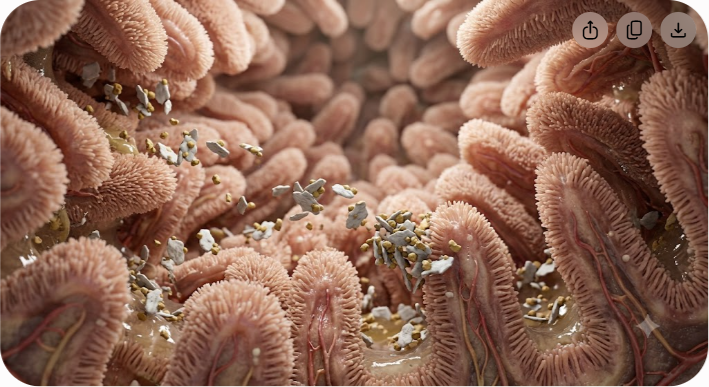
Bentonite does not destroy or degrade mycotoxins chemically. Instead, it operates via physical adsorption, acting as an inorganic sponge that immobilizes toxins within the gastrointestinal tract.
The binding pathway works in three distinct continuous actions:
The principal mechanism for binding Aflatoxin B1 is the insertion (intercalation) of the toxin molecule into the hydrated interlayer space of montmorillonite. The carbonyl groups ($C=O$) on the beta-dicarbonyl moiety of the aflatoxin molecule interact directly with exchangeable cations ($Na^+$ or $Ca^{2+}$) seated on the clay matrix.
This forms an ion-dipole complex. The negative charges on the oxygen atoms of the toxin are attracted to the positive exchangeable cations anchored to the negatively charged clay platelet. Hydrophobic interactions and van der Waals forces further lock the aromatic rings of AFB1 against the siloxane planar surface.
For non-intercalated binding, the exterior surfaces and broken edges of bentonite platelets carry charge variations (edge charges become positive under acidic stomach conditions, while basal faces remain negative). Polar mycotoxin molecules are drawn to these charged sites via dipole-dipole attraction and hydrogen bonding.
An effective toxin binder must maintain its bond across variable pH levels in the animal's digestive system:
Quality bentonites exhibit high desorption resistance. Once Aflatoxin B1 is bound in the acidic stomach environment, the chemical bond remains stable as the feed matrix transitions into the small intestine. Because the bound complex is too large to pass through the intestinal epithelium, it moves through the colon and is excreted in manure.
Not all bentonites perform identically in animal nutrition. The dominant exchangeable cation occupying the interlayer space defines whether a bentonite is categorized as Sodium Bentonite or Calcium Bentonite.
| Property / Feature | Sodium Bentonite ($Na$-Bentonite) | Calcium Bentonite ($Ca$-Bentonite) |
|---|---|---|
| Dominant Cation | Sodium ($Na^+$) | Calcium ($Ca^{2+}$) |
| Swelling Capacity | High (10x–20x dry volume) | Low (1.5x–3x dry volume) |
| Hydration / Dispersion | Forms persistent gels in water | Agglomerates quickly, lower gelation |
| Aflatoxin Binding Capacity | High to Very High (> 90-95%) | Moderate to High (70-90%) |
| Pellet Binding Utility | Excellent (durable feed pellets) | Fair / Moderate |
| Interlayer Expansion | Expands widely, exposing internal sites | Restricted expansion due to $Ca^{2+}$ cross-linking |
| Activation Requirement | Effective in natural state | Often requires soda-ash activation for top performance |
Sodium ions carry a single positive charge ($Na^+$) with a relatively large hydrated ionic radius. This allows water molecules to enter the interlayer space easily, causing the clay platelets to delaminate and expand. This expansion exposes millions of internal binding sites to target toxins.
Conversely, calcium ions ($Ca^{2+}$) carry a double positive charge, bridging adjacent silicate layers tightly together. This prevents maximum hydration and restricts access to internal adsorption sites unless the clay undergoes physical processing or chemical activation.
While natural Sodium Bentonite generally exhibits superior swelling, pelleting characteristics, and binding kinetics, high-purity Calcium Bentonite modified through precise processing can achieve comparable mycotoxin affinity.
A common question among nutritionists is whether bentonite can bind all mycotoxins equally. The short answer is no—binding efficiency depends on the molecular geometry and polarity of the toxin.
| Mycotoxin Category | Primary Target Examples | Binding Efficiency | Key Binding Mechanism |
|---|---|---|---|
| High Affinity | Aflatoxins (AFB1, AFB2, AFG1) | High (> 90%) | Interlayer intercalation & ion-dipole bonding |
| Moderate Affinity | Ochratoxin A, Ergot Alkaloids | Moderate (30%–60%) | Surface adsorption & hydrogen bonding |
| Low Affinity | Zearalenone, Fumonisins | Variable (15%–40%) | Weak hydrophobic surface interaction |
| Poor Affinity | DON (Vomitoxin), T-2 Toxin | Low (< 10%) | Poor fit due to non-polar bulky structure |
Aflatoxins feature a planar, compact, highly polar chemical structure with accessible carbonyl groups. This geometry fits into the montmorillonite interlayer space, yielding binding efficiencies exceeding 90% to 98% in standardized in vitro and in vivo trials.
Ochratoxin A and ergot alkaloids possess moderate polarity and partial planar arrangements. High-grade bentonites regularly achieve 30% to 60% adsorption rates for these compounds, which can be further optimized by adjusting inclusion rates or blending with complementary organoclays.
Zearalenone is non-polar and bulky, making it difficult to slip between standard montmorillonite layers. Fumonisins are large, elongated molecules that require specific pore-size access. Plain bentonites typically bind 15% to 40% of these toxins.
Deoxynivalenol (DON) lacks a strong dipole moment, is non-planar, and possesses bulky epoxy rings. Natural bentonite alone exhibits binding rates under 10% for DON. Mitigating DON effectively usually requires modifying the clay surface (e.g., organo-cationic modification) or combining bentonite with enzymatic or yeast-cell-wall components.
To ensure maximum toxin protection without compromising dietary nutrient density, bentonite must be included at correct, scientifically validated rates.
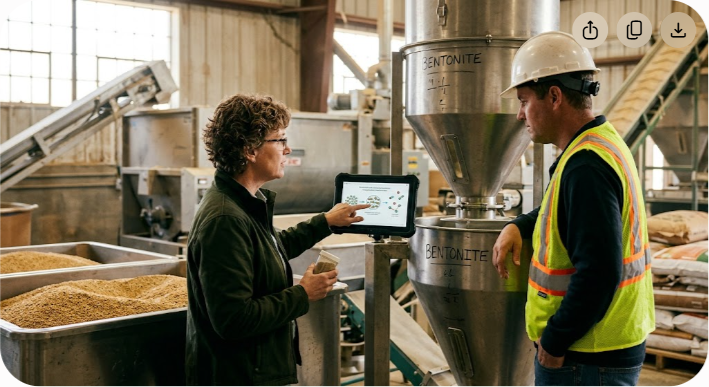
Beyond its role as a toxin binder, adding bentonite to feed manufacturing provides distinct processing advantages:
A common myth among feed formulators is that adding bentonite to livestock feed strips out essential vitamins, minerals, and amino acids.
Extensive research demonstrates that at standard inclusion rates (0.25% to 0.8% of diet), high-purity bentonite does not cause vitamin or mineral deficiencies.
| Nutrient Class | Representative Examples | Molecular Characteristics | Binding Risk Level |
|---|---|---|---|
| Target Mycotoxins | Aflatoxin B1 | Small, planar, strongly polar | High (Desired) |
| Vitamins | Vitamins A, D, E, B-complex | Large, branched, non-planar | Negligible |
| Amino Acids | Lysine, Methionine | Highly soluble, zwitterionic in chyme | Negligible |
| Trace Minerals | Copper, Zinc, Manganese | Hydrated or chelated ionic forms | Negligible |
Not all commercial clays sold as toxin binders perform effectively. Industrial construction clays or low-purity soils can lack binding capability and may introduce heavy metal contamination.
When purchasing feed-grade bentonite, require suppliers to provide certified laboratory analyses verifying the following parameters:
| Parameter | Test Method / Basis | Industry Standard Target Threshold |
|---|---|---|
| Montmorillonite Content | X-Ray Diffraction (XRD) | $\ge$ 75% to 85% active smectite purity |
| In Vitro AFB1 Binding | Isothermal adsorption (pH 3.0 & 6.8) | $\ge$ 90% binding capacity |
| Heavy Metals (Pb, Cd, As) | Atomic Absorption / ICP-MS | Well below legal FDA / EU safety ceilings |
| Dioxins and PCBs | High-Resolution GC-MS | Non-detectable / regulatory compliance |
| Cation Exchange Capacity | Ammonium acetate extraction | $\ge$ 70 to 90 meq / 100g |
| Moisture Content | Gravimetric drying | 8% to 12% maximum (prevents clumping) |
Even with high-grade materials, improper implementation can reduce effectiveness. Here are common operational errors and how to fix them:
To establish a robust mycotoxin control program on your farm or mill, follow this five-step protocol:
Managing mycotoxin risks requires reliable, consistently high-grade raw materials. As one of the world's leading miners and exporters of premium bentonite reserves, Axewelledge delivers high-purity mineral solutions tailored for the global livestock and feed manufacturing industries.
Axewelledge operates state-of-the-art mining and processing facilities backed by extensive high-grade reserves. Our feed-grade bentonite products feature:
Whether you operate a commercial feed mill or manage large-scale livestock production, Axewelledge provides the technical expertise and natural mineral quality needed to safeguard animal health.
Explore high-performance feed-grade bentonite solutions by contacting the mineral specialists at Axewelledge.













Have questions about our products? We're here to help!