Axewelledge, a leading exporter from India, specializes in high-quality Bentonite. With a commitment to excellence, we supply premium Bentonite to the Middle East and Southeast Asia markets.


North Angle Complex, 304,
150 Feet Ring Rd, Opposite Ambedkar Nagar BRTS Stop,
Madhav Park, Punit Nagar,
Mavdi, Rajkot, Gujarat 360004
© Axewelledge 2026, All Rights Reserved.
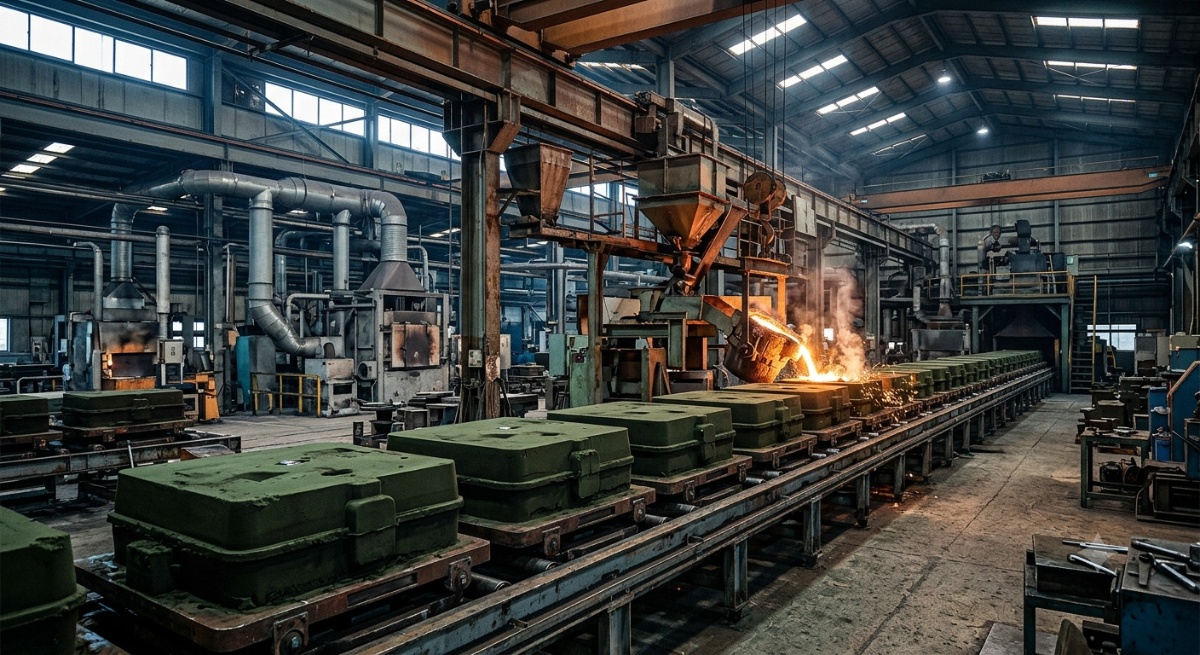
South Korea’s manufacturing powerhouse is built on precision. From heavy automotive blocks for Hyundai and Kia to massive marine engine components crafted in the shipyards of Ulsan, the nation's metal casting foundries require flawless mold integrity. In the world of high-pressure, automated green sand molding lines, the choice of your binding agent can make or break your entire production run.
To sustain rapid cycle times and eliminate defects like scabbing or sand burn-in, Korean foundries are increasingly relying on high-purity Indian Sodium Bentonite.
Let's dive deep into the chemical mechanics, physical characteristics, and operational strategies behind why South Korea's metal casting giants look to Indian mineral reserves to achieve perfect castings.
At its fundamental level, green sand molding relies on a precise mixture of silica sand, water, carbonaceous additives (like sea coal), and a clay binder. When molten iron or steel is poured into a mold at temperatures exceeding 1,500°C (2,732°F), the mold must withstand intense thermal shock, static pressure, and erosive forces without washing away or collapsing.
This is where the unique atomic structure of sodium bentonite becomes irreplaceable. Chemically classified as a hydrous aluminum silicate rich in the mineral montmorillonite, sodium bentonite functions as the structural "glue" of the green sand matrix. Unlike calcium-based clays, sodium bentonite exhibits exceptional swelling capacity—often absorbing water to expand up to 15 to 20 times its original dry volume.
When hydrated, the sodium ions ($Na^+$) trapped between the microscopic silicate platelets create a highly efficient electrical double layer. This causes the clay to form a cohesive, highly plastic gel wrapper around every individual grain of foundry sand. This specialized gel provides three critical strengths required by automated molding lines:
Green Compression Strength (GCS): The ability of the moist sand mold to maintain its shape after the pattern is withdrawn and during transport along the automated conveyor.
Dry Compression Strength (DCS): The capacity of the sand to resist the intense pressure of the molten metal stream as it fills the cavity.
Hot Shear Strength: The structural integrity of the mold at peak pouring temperatures, preventing internal erosion and sand inclusions.
Understanding how bentonite revolutionizes industrial applications across various metal and engineering sectors highlights why its mineral composition is heavily guarded by quality control engineers.
While bentonite deposits exist globally, South Korean procurement teams prioritize material sourced from the Kutch and Bhuj regions of Gujarat, India. As a globally recognized partner and a leading exporter of high-quality Bentonite, companies like Axewelledge have built dedicated supply chains directly linking Indian mining reserves to East Asian industrial hubs.
There are three primary reasons why Indian sodium bentonite outperforms alternative options in high-vibration, high-volume automated lines:
The efficiency of a foundry binder is directly tied to its active clay content. Low-grade clays require foundries to use a higher percentage of binder in their system, which degrades sand permeability and leads to gas defects. Indian deposits are naturally rich in high-purity montmorillonite. This allows Korean foundries to achieve optimal binding properties using lower additive percentages, keeping their sand systems clean, highly permeable, and predictable.
When molten metal heats the mold, the clay closest to the casting loses its chemically bound water and turns into an inert, non-plastic powder known as "dead clay." Foundries must constantly discard a portion of their system sand and add fresh bentonite to compensate.
Indian sodium bentonite features an exceptionally high thermal durability point. It resists structural degradation at elevated temperatures longer than synthetic or activated calcium alternatives, dramatically lowering the "burn-out" rate and reducing overall binder consumption costs.
Modern Korean casting lines operate at breakneck speeds using high-pressure squeezing and blowing machines (such as DISAMATIC systems). These systems demand sand with immediate thixotropic recovery—meaning the sand must flow perfectly when blown into the mold space but lock into an unyielding solid matrix the millisecond pressure is applied. The natural rheology of Indian sodium bentonite delivers exactly this property.
For Korean quality assurance managers, purchasing bentonite isn't about buying generic clay; it's about matching strict metallurgical parameters. When sourcing a specialized foundry grade bentonite from an international supplier, the material must hit specific chemical and physical targets:
| Property Parameter | Standard Target Value for High-Pressure Lines | Industrial Significance |
| Montmorillonite Content | Greater than 85% | Maximizes binding efficiency per kilogram. |
| Swelling Index | 25 - 35 ml / 2g | Ensures adequate hydration and gel distribution. |
| Liquid Limit | 450% - 600% | Defines the clay's water retention capabilities. |
| Methylene Blue Value | 320 - 400 mg/g | Measures the active, exchangeable clay surface area. |
| Green Compression Strength | Min 9.0 N/cm² (when blended) | Prevents mold dropouts and handling breakage. |
| Dry Compression Strength | Min 25.0 N/cm² | Resists the static pressure of the liquid metal head. |
By utilizing advanced refinement and customized particle sizing, global suppliers can guarantee that every shipment arriving at ports like Busan or Gwangyang meets these exact specifications consistently, batch after batch.
The journey from an open-cast mine in Gujarat to a finished automotive component in Changwon follows a highly structured engineering protocol.
1.Selective Extraction & Homogenization:At the Source in India.
Raw sodium bentonite is carefully mined from verified seams. It undergoes extensive solar drying to optimize moisture content before being crushed, mechanically milled, and air-classified into ultra-fine powders to maximize surface area contact.
2.High-Speed Mulling and Hydration:Foundry Sand Preparation.
Inside the Korean foundry, the pulverized bentonite is introduced to recycled system sand and fresh silica grains. Water is added during high-intensity mulling. The clay must hydrate rapidly, spreading evenly across the sand surfaces to establish structural bonds.
3.Automated Mold Compaction:High-Pressure Squeezing.
The prepared sand is blown or gravity-fed into molding flasks surrounding the component pattern. High-pressure hydraulic rams compact the sand, forcing the bentonite-bound matrix to replicate micro-details of the design without tearing.
4.Pouring and Heat Dissipation:Casting Execution.
As liquid metal is poured, the moisture in the sand evaporates away from the mold face, creating a vapor transport zone. The dry and hot strengths of the Indian sodium bentonite keep the mold walls rigid against the liquid metal flow, preventing expansion defects.
5.Shakeout and Reclamation:System Sand Cycling.
Once solidified, the mold is mechanically vibrated during "shakeout" to free the metal casting. The non-calcined clay remains active and is channeled back into the recycling silos, ready for re-hydration and the next casting loop.
In a high-margin industry, casting defects result in catastrophic financial losses through rejected batches and wasted machining time. Indian sodium bentonite directly eliminates the root causes of several prominent foundry issues:
Scabbing and Rattails: When molten metal heats the mold face, the silica sand grains expand. If the clay binder is too rigid or lacks adequate hot elasticity, the mold surface buckles, causing thin metallic crusts (scabs) on the casting. The high expansion tolerance and structural elasticity of high-purity sodium bentonite cushion this expansion, absorbing the stress cleanly.
Sand Wash and Erosion: If a binder lacks hot shear strength, the heavy rushing stream of liquid iron will physically erode the channel walls, washing sand particles straight into the metal matrix. The strong thixotropic gel strength of Indian bentonite ensures the sand remains locked tightly in place.
Pinholes and Blowholes: Poor quality clays containing high levels of organic impurities generate excessive gas when heated. Indian sodium bentonite processed by trusted operators undergoes strict laboratory verification to ensure low organic content, keeping gas evolution to a absolute minimum.
For procurement managers looking to stabilize their automated casting operations, selecting a mine-owning supplier with international logistical capabilities is crucial. By working with an industry champion like the Top Bentonite Exporter from India, foundries gain reliable batch traceability, expert grade customization, and ocean-ready bulk packaging designed to resist humidity and moisture contamination during transit.
As manufacturing lines advance toward higher pressures and even faster turnaround times, the molecular resilience of Indian sodium bentonite will remain an essential cornerstone of South Korea's world-class casting infrastructure.













Have questions about our products? We're here to help!