Axewelledge, a leading exporter from India, specializes in high-quality Bentonite. With a commitment to excellence, we supply premium Bentonite to the Middle East and Southeast Asia markets.


North Angle Complex, 304,
150 Feet Ring Rd, Opposite Ambedkar Nagar BRTS Stop,
Madhav Park, Punit Nagar,
Mavdi, Rajkot, Gujarat 360004
© Axewelledge 2026, All Rights Reserved.
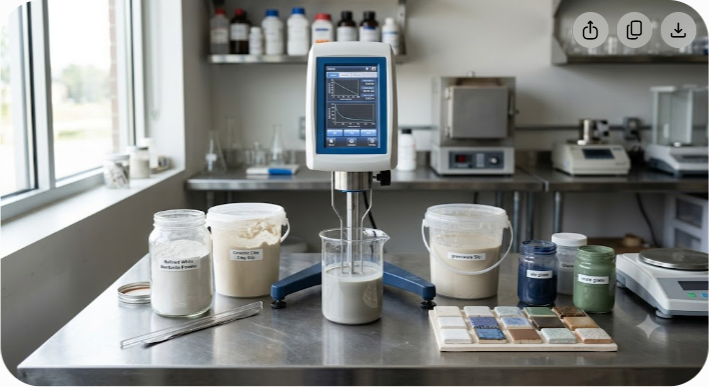
Choosing bentonite for ceramic manufacturing is less about finding the bentonite with the highest swelling value and more about finding a grade that fits the entire formulation. The right material can improve plasticity, green strength, suspension, and handling. The wrong one can increase slip viscosity, drying shrinkage, fired color variation, or glaze defects.
For most ceramic applications, start with four questions: how much green strength do you need, how sensitive is the product to iron and other impurities, how will bentonite affect slurry rheology, and what happens to the additive during firing? From there, compare montmorillonite content, cation exchange capacity, swelling behavior, particle size, moisture, loss on ignition, chemical composition, and batch consistency.
Bentonite is a naturally occurring clay dominated by smectite minerals, particularly montmorillonite. Its properties vary significantly with deposit geology, exchangeable cations, mineral purity, milling, activation, and purification. A sodium-rich grade generally produces stronger swelling and greater viscosity than a calcium-rich grade, while activated products can be engineered to provide a different balance of performance and cost.
This guide explains how to evaluate bentonite for ceramic bodies, porcelain tiles, wall and floor tiles, glazes, engobes, sanitaryware, and extruded products. It also shows how to validate a grade in the laboratory before committing to a production-scale supply.
Bentonite's useful behavior comes primarily from smectite minerals. Montmorillonite has a layered structure with a negatively charged clay surface and exchangeable cations between its layers. When water enters the structure, the particles hydrate and disperse. The extent of hydration depends on mineral composition, exchangeable cations, water chemistry, particle size, and processing conditions.
That combination gives bentonite several useful functions in ceramic processing. It can act as a plasticizing clay, a temporary binder, and a rheology modifier. In glaze and engobe systems, it can help keep suspended particles from settling too quickly. In ceramic bodies, a small addition can improve green handling strength and reduce the risk of damage during pressing, drying, trimming, or transportation.
The important point is that these benefits are connected. A grade that gives excellent suspension may also raise viscosity too much. A highly active grade may improve green strength but increase drying shrinkage. A low-iron grade may be essential for porcelain but unnecessary for a red-body product. Selection therefore has to be application-specific.
Montmorillonite is the principal active mineral responsible for bentonite's swelling and rheological behavior. A higher proportion of active smectite generally means greater interaction with water, although mineral purity alone does not predict performance in every ceramic formulation.
The remaining minerals may include quartz, feldspar, mica, calcite, gypsum, and other accessory phases. These materials can dilute the active clay fraction and change firing behavior. For demanding whiteware and glaze applications, mineralogical analysis is therefore more useful than relying on a single commercial grade name.
X-ray diffraction can help identify the major mineral phases. Methylene blue testing, cation exchange capacity, swelling tests, particle-size analysis, and chemical analysis provide additional information about how the material is likely to behave in a formulation.
In a ceramic body, bentonite can improve the cohesion of the unfired material. Its fine particles occupy spaces between coarser clay and non-plastic raw materials, while its interaction with water contributes to plasticity and green strength.
This is especially useful when a body contains substantial amounts of feldspar, quartz, grog, or other relatively non-plastic materials. However, adding more bentonite is not automatically better. Excess active clay can increase water demand and drying shrinkage and may make spray-dried granules or slips harder to control.
The practical target is the lowest addition that delivers the required production performance.
In a glaze or engobe, bentonite can build a weak structure that slows sedimentation. When the slurry is mixed, pumped, or sprayed, shear breaks down much of that structure. When the slurry returns to rest, the structure can rebuild.
This behavior is useful when a formulation contains dense frit, zircon, quartz, pigments, or other solids that would otherwise settle rapidly. The same property can become a problem if the bentonite causes excessive yield stress or makes the glaze difficult to pump and atomize.
For this reason, glaze evaluation should include viscosity and flow measurements under the actual processing conditions rather than relying only on a bentonite specification sheet.
Bentonite does not remain unchanged throughout firing. Its hydrated and structural components respond to temperature, and the resulting phases become part of the broader ceramic reaction system.
The exact transformation path depends on the bentonite's mineralogy and on the surrounding body formulation. It is therefore risky to assign one universal reaction temperature or claim that every bentonite produces the same fired phases.
Before firing begins, free water is removed during drying. Bentonite can hold substantial amounts of water because of its fine particle size and surface activity. A body containing bentonite may therefore require careful control of drying rate, moisture distribution, and green-body permeability.
Rapid drying is not automatically a problem, but a formulation with excessive water demand or poor moisture distribution can develop internal stresses. These stresses may appear as edge cracks, laminations, or other defects before the piece reaches the kiln.
At elevated temperature, structural hydroxyl groups in clay minerals are removed. Smectite undergoes dehydroxylation and loses its original layered structure. The temperature range depends on mineral composition and heating conditions rather than following a single fixed point for every bentonite.
This change is important because the original clay structure no longer controls the material's behavior after dehydroxylation. The resulting phases then participate in the reactions taking place in the ceramic body.
At higher firing temperatures, the products of clay decomposition interact with quartz, feldspathic fluxes, and other body components. Depending on the overall formulation, aluminosilicate phases and glassy phases can develop during firing and cooling.
It is not accurate to assume that a small bentonite addition independently creates a specific amount of mullite or guarantees a particular fired microstructure. The final result depends on the complete body composition, firing schedule, peak temperature, soaking time, atmosphere, and cooling profile.
For production work, the useful question is simpler: does the selected bentonite provide the required unfired performance without creating unacceptable changes in firing shrinkage, color, porosity, or surface quality?
The exchangeable cations associated with smectite strongly influence hydration and swelling. Sodium-dominant bentonite generally hydrates and disperses more extensively than calcium-dominant bentonite. Calcium-rich material usually has lower swelling and can produce different rheological behavior.
Neither type is automatically the best choice for every ceramic application.
Natural sodium bentonite is valued for strong hydration, swelling, plasticity, and suspension behavior. These characteristics can make it useful in ceramic bodies where green strength is important and in glazes or engobes where controlled suspension is required.
The trade-off is water demand and rheology. A highly active sodium bentonite can raise slurry viscosity quickly, particularly when the addition is not optimized. It can also increase drying shrinkage if used excessively.
Calcium bentonite generally has lower swelling capacity and a different hydration response. It can be useful where moderate plasticity or suspension is needed without the strong viscosity increase associated with some sodium-rich materials.
Its performance depends heavily on the particular deposit. Two calcium bentonites can behave differently because of differences in smectite content, accessory minerals, particle size, and soluble salts.
Some bentonite deposits are naturally calcium-rich but can be treated with sodium carbonate to exchange part of the calcium for sodium. This process is commonly called sodium activation.
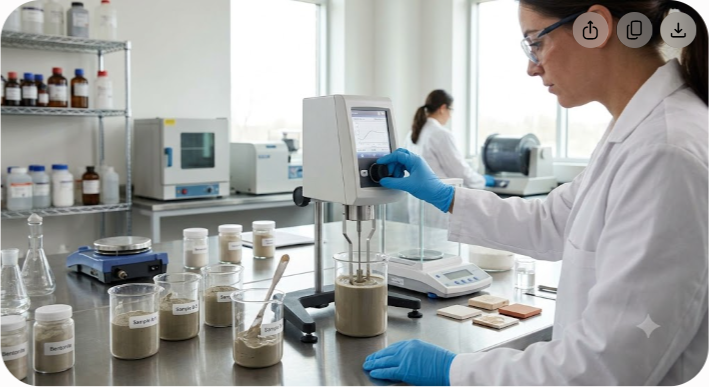
Activated bentonite can provide a useful balance between performance and raw-material cost, but the quality of activation matters. Residual soluble salts, incomplete exchange, moisture, and variations in the original mineral can all influence ceramic processing.
| Property | Natural Sodium Bentonite | Natural Calcium Bentonite | Sodium-Activated Bentonite |
|---|---|---|---|
| Hydration and swelling | Generally high | Generally lower | Moderate to high, depending on activation |
| Typical rheology impact | Often high | Often lower | Intermediate to high |
| Green binding potential | High | Moderate | Moderate to high |
| Suspension potential | High | Moderate | Moderate to high |
| Main selection concern | Excess viscosity and water demand | Lower activity | Activation consistency and soluble salts |
| Suitable applications | Green binders, suspension, selected glazes and engobes | Moderate plasticity and selected body formulations | Bodies, engobes, and other applications requiring controlled activation |
These categories are useful starting points, not fixed specifications. Always test the actual commercial grade in the target ceramic formulation.
A supplier's product name is not enough to qualify a ceramic-grade bentonite. Ask for a current certificate of analysis and compare the material against your own laboratory results.
Iron is particularly important in white-firing ceramic bodies, porcelain tiles, sanitaryware, and transparent or lightly colored glazes. Even a small amount of iron-bearing contamination can affect fired color when the base formulation is designed for high whiteness.
There is no universal Fe2O3 limit that applies to every ceramic product. A practical specification might be very tight for a white porcelain body and much more relaxed for a red-body tile. Set the limit according to the fired color requirement and the sensitivity of the formulation.
Do not evaluate iron using a single number alone. Ask how the iron is distributed and whether coarse iron-bearing particles are present. A bulk chemical analysis can miss the practical impact of localized coarse contamination.
Titanium, calcium, magnesium, sodium, potassium, and other major oxides can also influence the formulation. The significance of each depends on the body or glaze in which the bentonite will be used.
A high active-clay fraction is generally desirable when bentonite is being used for binding or rheology control. However, there is no universal minimum montmorillonite percentage that guarantees ceramic performance.
Ask the supplier for mineralogical information and, where necessary, verify it through X-ray diffraction. Look for consistency from batch to batch rather than focusing only on the highest reported value.
Accessory minerals matter because they can influence fired color, shrinkage, flux balance, abrasion, and gas release. For white ceramic products, purification may be more important than simply increasing the total bentonite addition.
Methylene blue testing is commonly used as an indicator of clay activity and available surface area. Cation exchange capacity provides another way to assess the ability of the clay to exchange ions.
These tests are useful for comparing batches, but they are not interchangeable and should not be treated as direct predictors of final ceramic performance. A high value can indicate an active clay, but the same activity can increase viscosity and water demand.
Use these measurements as part of a broader specification that includes rheology, moisture, chemical composition, particle size, and production trials.
Swelling tests are particularly useful for distinguishing highly active sodium-rich bentonites from lower-swelling materials. ASTM D5890 is commonly associated with free swell testing of sodium bentonite and related materials.
Do not select a ceramic additive simply because it has the highest swell value. A glaze may require moderate suspension rather than maximum swelling, while a body may need strong green binding without excessive water demand.
The right value is the one that works in your formulation at the required addition rate.
Particle size affects dispersion, hydration rate, and the presence of coarse particles. Fine milling can improve the uniformity of a bentonite addition, but finer is not automatically better.
For glazes and engobes, coarse grit is especially undesirable because it can produce surface defects or interfere with spraying. Ask for a particle-size distribution and a controlled residue specification rather than relying solely on a nominal mesh number.
A 325-mesh specification, for example, describes a screening condition but does not fully describe the particle-size distribution of a powder. Laser diffraction can provide additional information where tighter control is required.
The most useful bentonite specification may be the one that tells you how the material behaves in your actual slip.
Prepare a representative laboratory batch and measure apparent viscosity, yield behavior, thixotropy, and response to the selected deflocculant. A Brookfield viscometer can be useful for routine comparisons, while more advanced rheometers can characterize yield stress and shear-dependent behavior in greater detail.
The test should reproduce the plant process as closely as practical. A bentonite that behaves well in distilled water may behave differently in a high-solids ceramic slip containing dissolved salts and several different clay minerals.
Moisture affects weighing, dosing, storage stability, and effective active content. Loss on ignition can reflect structural water and the decomposition or combustion of other components, so it should not be interpreted as a direct measure of organic content.
If gas-related defects are a concern, investigate the complete source of volatile material rather than applying an arbitrary LOI limit. Thermogravimetric analysis, chemical testing, and controlled firing trials can help identify the relevant behavior.
One of the biggest practical challenges in ceramic processing is balancing bentonite's useful structure-building behavior with the need for a pumpable, highly concentrated slip.
Clay particles carry electrical charges that influence how they interact with one another in water. Bentonite can increase the tendency of a suspension to form a weak network. Deflocculants are then used to promote dispersion and reduce the water required to achieve a workable viscosity.
A highly active bentonite exposes a large surface area to the liquid phase. More surface area means more interaction with water and dissolved ions. If the addition rate is too high, the slip can become excessively viscous or develop strong thixotropy.
This is particularly important in porcelain and tile slips where high solids loading and stable spray-drying behavior are required.
Sodium silicate, sodium polyphosphate compounds, and polymeric dispersants are among the materials used in ceramic processing, depending on the formulation. Their performance depends on pH, soluble salts, clay mineralogy, water chemistry, and dosage.
It is therefore misleading to say that one deflocculant will always work with one type of bentonite. A new bentonite supply should be evaluated using the plant's existing deflocculation system.
A simple laboratory deflocculation study can reveal whether a bentonite grade is compatible with the body slip.
This approach is much more reliable than selecting a bentonite solely from a supplier's swelling or CEC value.
The ideal bentonite grade changes with the manufacturing process. A tile body, porcelain body, glaze, and sanitaryware slip may all need different properties.
Dry-pressed tiles need enough green strength to survive pressing, ejection, transfer, drying, and handling. Bentonite can be useful when the existing body lacks sufficient plasticity or green cohesion.
For this application, focus on green flexural strength, moisture demand, drying shrinkage, spray-dried granule behavior, and compatibility with the deflocculant system. A sodium-rich or sodium-activated grade may be suitable, but the final choice should come from laboratory and production testing.
A typical starting trial might use a low addition level and increase it gradually. The goal is not to maximize bentonite content; it is to find the point at which additional bentonite no longer provides enough benefit to justify its effect on rheology and shrinkage.
Porcelain bodies are especially sensitive to raw-material contamination because the finished product is expected to have low water absorption and a clean, uniform appearance.
For white-firing products, low iron and low coarse contamination are important. However, a supplier should not be approved simply because a specification sheet reports low Fe2O3. Fire the actual material in the target body and compare fired color, shrinkage, water absorption, bulk density, and visible defects.
A refined, low-iron bentonite can be useful at low dosage when additional green strength is required. The precise addition level depends on the existing clay balance and the forming process.
In glazes, bentonite is generally used as a suspension and rheology modifier rather than as a primary binder. The addition has to be small enough to avoid unwanted viscosity, drying behavior, or surface defects.
Micronized material with low grit and appropriate chemical purity is often preferred for demanding surface applications. The actual dosage should be established by measuring settling, viscosity, application behavior, drying, and fired appearance.
A glaze that remains perfectly suspended in a storage tank but becomes difficult to spray is not a successful formulation. Both storage and application matter.
Engobes need stable suspension, good application characteristics, adequate dry film strength, and compatibility with the ceramic body beneath them. Bentonite can help maintain suspension and improve the cohesion of the unfired layer.
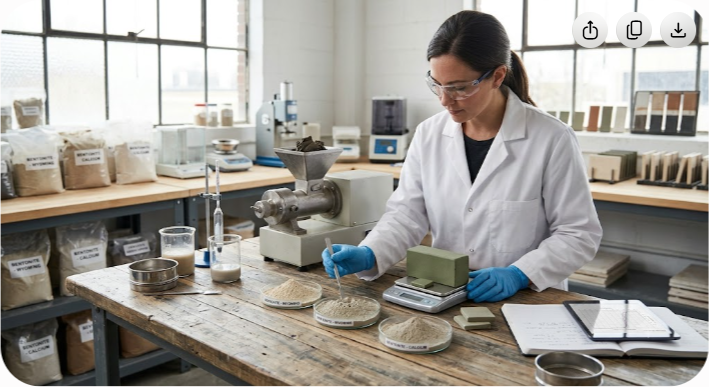
Because engobes can be applied at relatively high solids concentrations, rheology should be tested under the same application method used in production. A formulation designed for curtain coating may need different flow behavior from one designed for spraying.
Sanitaryware slips require a careful balance between casting rate, viscosity, thixotropy, green strength, and demolding behavior. Bentonite can improve handling strength, but excessive addition can slow casting or make the slip difficult to control.
For sanitaryware, test the bentonite in the complete slip rather than in a simplified clay-water system. Casting performance depends on the entire mineral mixture, deflocculation chemistry, mold condition, temperature, and solids concentration.
Extruded bodies can benefit from bentonite when additional plasticity and green cohesion are required. The main measurements should include extrusion pressure or torque, plasticity, column stability, drying shrinkage, and fired properties.
A cost-effective industrial grade may be entirely appropriate for structural products where fired whiteness is not a major requirement. For lighter-colored or higher-value products, tighter impurity control may justify a refined grade.
A disciplined qualification process reduces the risk of changing a raw material and discovering problems only after the material reaches production.
Start with the problem rather than the product name. If tiles are breaking during handling, measure green strength and drying behavior. If a glaze settles, measure sedimentation and rheology. If a sanitaryware slip casts too slowly, examine viscosity and thixotropy before adding more suspension agent.
This prevents bentonite from being used as a solution to a problem that actually comes from another raw material or process variable.
Define acceptable limits for the properties that matter to your product. Depending on the application, these may include:
Avoid creating specifications that are unnecessarily tight. Every requirement should have a clear relationship to product performance or process control.
Ask for a current certificate of analysis rather than a generic technical data sheet. Review the test methods and units carefully.
If the material is critical to a white ceramic product, consider independent testing of representative samples. This is particularly useful when the supplier sources material from multiple mine benches or processing facilities.
Test at several addition levels instead of one fixed percentage. For example, a body trial might compare 0.25%, 0.5%, 0.75%, and 1.0% additions by dry weight, provided these levels are appropriate for the formulation.
Measure green strength, water demand, drying shrinkage, fired shrinkage, fired color, water absorption, and relevant rheological properties. For glaze and engobe trials, also evaluate settling, application viscosity, drying behavior, and fired surface quality.
Run the candidate bentonite through the same deflocculation system used in production. Compare viscosity curves and working windows.
A material that requires significantly more dispersant than the existing grade may increase operating cost or make the process less tolerant of normal batch variation.
Move the best laboratory formulation to a controlled plant trial. Use enough material to observe normal production variation, but keep the trial traceable so any changes can be linked to the bentonite batch.
Record press behavior, granule moisture, drying performance, breakage, glaze application, kiln defects, and final quality.
One successful sample does not prove long-term supply reliability. Review several batches over time and track the properties that correlate with plant performance.
The best supplier is not necessarily the one offering the highest activity or lowest price. Consistent raw material can be worth more than a specification that looks impressive on paper but varies significantly from shipment to shipment.
Many ceramic defects have several possible causes. Bentonite should be treated as one variable in the investigation rather than automatically identified as the source.
Highly active bentonite can increase water demand and drying shrinkage. If the addition is too high, the body may develop greater drying stresses or require a slower drying schedule.
The first response should be to measure moisture, drying shrinkage, green strength, and the overall plastic-clay balance. Reducing bentonite may help, but the body formulation and drying conditions may also need adjustment.
Coarse iron-bearing particles or elevated iron content can create visible defects in white-firing bodies and glazes. The risk is higher when the bentonite is poorly processed or contains contaminated accessory minerals.
Use chemical analysis together with visual inspection and fired test pieces. Magnetic separation may help with certain iron-bearing contaminants, but it should not be presented as a universal solution for chemically bound iron.
Crawling can result from excessive dry-film shrinkage, poor wetting, contamination, dust, application thickness, binder behavior, or other formulation problems. Bentonite can contribute when its addition significantly changes the unfired film's rheology or drying behavior.
Do not assume that a particular dosage, such as 1.5%, is universally responsible. Reduce or increase the bentonite systematically while controlling the other variables and compare the resulting fired surfaces.
Pinholes and blisters can be associated with gases released during firing, glaze maturity, application thickness, body permeability, firing rate, or raw-material impurities. Bentonite may contribute through its water demand or volatile components, but the defect needs to be diagnosed within the complete body-glaze system.
A useful investigation compares the candidate bentonite against the approved material under the same firing cycle. Thermal analysis can provide additional evidence when volatile release is suspected.
If a slip becomes difficult to pump or spray after changing bentonite, compare the new grade's activity, particle size, soluble salts, and interaction with the existing deflocculant.
The solution may be a lower bentonite dosage, a different grade, a revised hydration sequence, or an adjustment to the dispersant system. Avoid changing several variables at once because it becomes difficult to identify the actual cause.
Bentonite is sensitive to moisture and should be stored in conditions that prevent unintended hydration and contamination. Keep bags sealed, dry, and off the floor. Protect the material from rain, condensation, and high-humidity storage areas.
For wet applications, the hydration procedure should be validated for the particular grade. Some bentonites benefit from a controlled pre-hydration period before the rest of the glaze or engobe formulation is added. The exact time depends on particle size, mixing intensity, water chemistry, and grade activity, so a fixed two- or four-hour rule should not be treated as universal.
For dry-body applications, uniform distribution is critical. Poor blending can create local concentrations of bentonite that behave very differently from the surrounding body. The mixing sequence should therefore be established through the plant's normal raw-material preparation process.
Batch tracking is equally important. Record the supplier lot, mine or processing source where available, moisture, key chemical values, activity indicators, and production results. Over time, these records can reveal which laboratory measurements best predict plant performance.
A ceramic manufacturer should compare suppliers on technical consistency as well as commercial terms. Price per tonne alone does not show the real cost of a bentonite grade.
Ask prospective suppliers for:
For imported material, also consider lead time, packaging integrity, container loading, documentation, and the supplier's ability to maintain the same specification over multiple shipments.
A supplier that can provide representative samples and technical support during formulation trials is often easier to qualify than one that supplies only a generic specification sheet.
For ceramic manufacturers, the objective should be a reliable grade that performs consistently in the actual body, glaze, engobe, or slip. Producers and exporters such as Axewelledge can be evaluated as potential sources of bentonite, but the material should still pass the buyer's own technical qualification process.
When evaluating a supplier such as Axewelledge, ask for application-specific samples rather than accepting a broad classification such as sodium bentonite. A ceramic body, glaze, and sanitaryware slip may require different combinations of activity, particle size, iron content, and rheological behavior.
If a supplier offers refined or customized material, ask what property is being controlled and how that property is measured. For example, a low-iron specification should be supported by a defined test method, while a micronized product should have a clear particle-size or residue specification.
The same principle applies to supply claims. Reserve size, production capacity, export history, and processing capability can be useful when assessing a supplier, but the most important question for a ceramic plant is whether the supplied material remains within specification from batch to batch.
The best bentonite for ceramic manufacturing is not necessarily the material with the highest swelling capacity, highest CEC, or lowest price. It is the grade that delivers the required process performance without creating new problems elsewhere in the formulation.
For ceramic bodies, focus on green strength, plasticity, moisture demand, drying shrinkage, and compatibility with milling and spray drying. For porcelain and whiteware, give additional attention to iron, coarse contamination, fired color, and the effect on water absorption and shrinkage. For glazes and engobes, concentrate on suspension, viscosity, settling, application behavior, and fired surface quality. For sanitaryware, casting rate and rheological stability are especially important.
A reliable selection process is straightforward: define the production problem, set measurable specifications, compare representative samples, test the bentonite in the complete formulation, run a controlled production trial, and monitor several supply batches before final approval.
That approach turns bentonite selection from a catalogue decision into a controlled raw-material qualification process. It also makes future supplier changes easier because the plant has clear performance criteria rather than relying on a product name alone.
Before placing a bulk order, request representative samples, compare them with your current approved grade, and validate the material under your actual processing and firing conditions. If you are evaluating ceramic-grade bentonite from Axewelledge, request the relevant technical data and application samples so your laboratory team can assess the material against your existing formulation and quality standards.













Have questions about our products? We're here to help!