Axewelledge, a leading exporter from India, specializes in high-quality Bentonite. With a commitment to excellence, we supply premium Bentonite to the Middle East and Southeast Asia markets.


North Angle Complex, 304,
150 Feet Ring Rd, Opposite Ambedkar Nagar BRTS Stop,
Madhav Park, Punit Nagar,
Mavdi, Rajkot, Gujarat 360004
© Axewelledge 2026, All Rights Reserved.
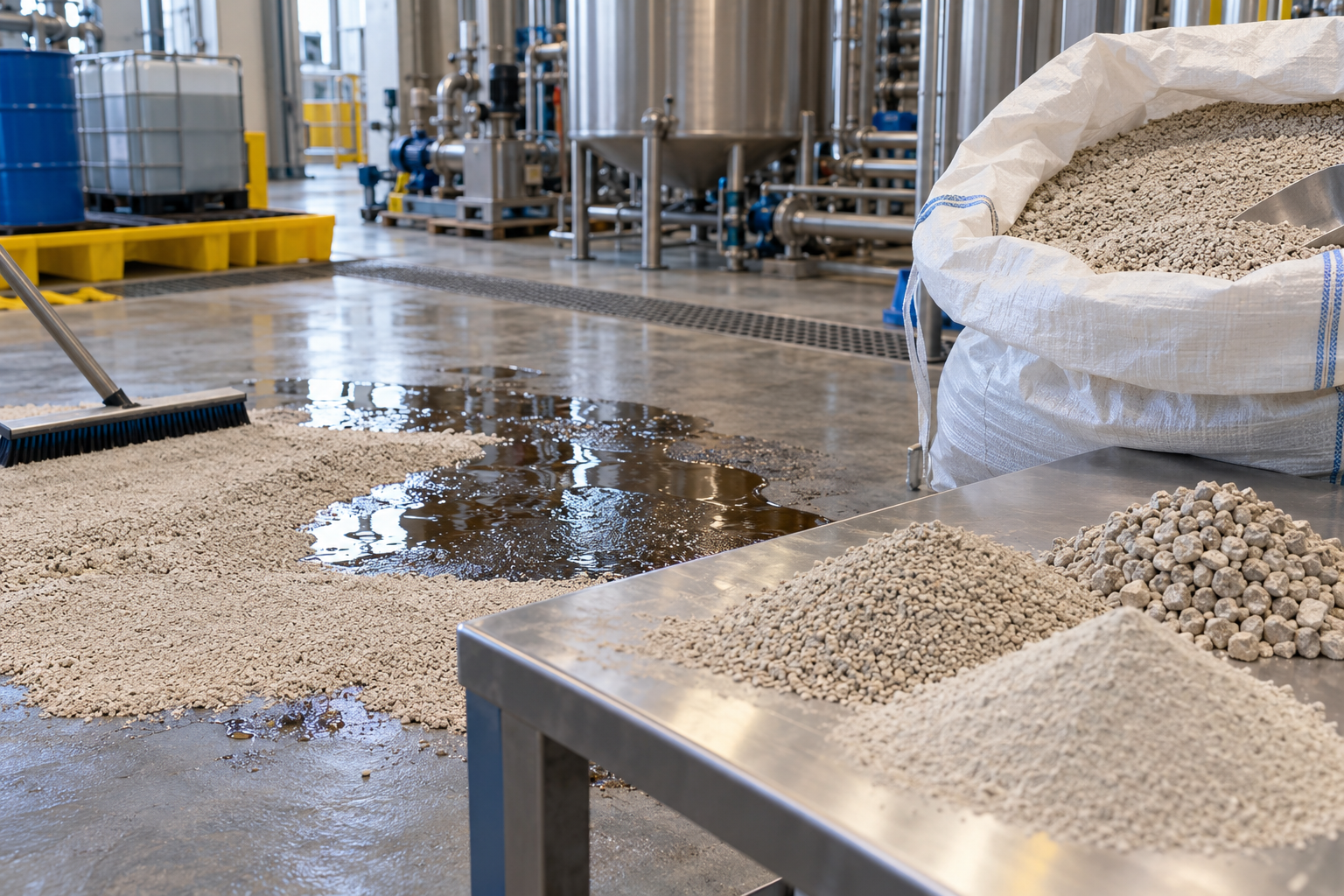
The best bentonite for an industrial absorbent isn't necessarily the grade with the highest swelling capacity. The right choice depends on the liquid being handled, the required pickup and retention, particle size, mineral chemistry, moisture, processing, dust control and how the spent material will be collected.
That distinction matters because bentonite grades developed for drilling fluids, foundry work or sealing applications can behave differently when used in a spill-control product. A good selection process starts with the job the absorbent must perform and then works backward to the mineral specification.
Bentonite is a naturally occurring clay material commonly rich in smectite minerals such as montmorillonite. Its layered structure, fine particle size and interaction with water and other liquids make it useful in a range of industrial formulations.
In absorbent products, bentonite can act as a mineral component that captures liquid and helps reduce its mobility. It may be supplied as a fine powder, screened material, granule or processed ingredient in a blended absorbent.
Common applications include:
The word "absorbent" covers a wide range of products, so the performance target needs to be specific. A material intended to pick up hydraulic oil from a workshop floor has different requirements from one designed to handle water, aqueous waste or a particular process liquid.
Bentonite should therefore be selected as part of a complete absorbent system, not as an isolated mineral with a single headline performance number.
Start with the liquid, not the bentonite.
Identify the target liquid, required pickup rate, desired retention, finished product format, particle-size range, operating conditions and disposal requirements. Then compare representative bentonite samples using controlled tests rather than relying on one specification such as swelling index.
A practical selection process should examine these factors:
For commercial production, also consider what happens after the raw material is dried, milled, screened, blended or granulated. Laboratory performance matters, but the material has to work reliably in manufacturing, storage, transport and actual use.
The liquid is the first specification to define, and it is often the one buyers leave vague.
Water, oils, fuels, solvents and chemical solutions do not interact with mineral absorbents in the same way. A bentonite that performs well with an aqueous liquid may not provide the same result with a hydrocarbon-based fluid.
Before choosing a grade, define the liquid as precisely as possible.
Ask:
These details can change the specification substantially.
For example, a workshop floor absorbent may need rapid pickup, good spreading and easy collection. A specialized industrial formulation may place greater emphasis on retention, low dust, controlled granule breakdown or compatibility with downstream processing.
Avoid choosing a material because a supplier simply describes it as having "high absorption." Ask what was absorbed, how the test was performed and whether the result represents the conditions in your application.
Absorption and adsorption are related but different terms, and mineral suppliers sometimes use them loosely.
Absorption generally describes a substance taking a liquid into its internal volume or structure. Adsorption refers to molecules or substances accumulating at a surface. Bentonite-based absorbents can involve several physical and surface interactions at the same time, including surface effects, capillary action, pore spaces and interactions associated with the clay structure.
The exact behavior depends on mineral composition, particle size, moisture, processing and the liquid being handled.
That is why one laboratory number rarely tells the whole story.
A supplier may report water absorption, oil absorption, swelling index or another performance value. Such figures can be useful for screening, but you need to understand the test method before using them to compare products.
When comparing two suppliers, make sure the measurements were obtained under comparable conditions. A value measured with water at one particle size cannot automatically be compared with a value measured using oil at another particle size and a different test procedure.
For product development, it is better to establish a repeatable internal test that reflects the intended application. That gives your purchasing team a meaningful benchmark for future batches and suppliers.
Bentonite mineral chemistry has a strong influence on its behavior, particularly when water is involved.
Sodium bentonite generally has greater water-swelling capacity than calcium bentonite. Calcium bentonite generally shows lower swelling and different surface and handling characteristics. Neither should automatically be called the best absorbent for every industrial application.
The right choice depends on what the finished material needs to do.
| Feature | Sodium Bentonite | Calcium Bentonite |
|---|---|---|
| Water swelling | Generally higher | Generally lower |
| Water interaction | Strong swelling response | Lower swelling response |
| Sealing applications | Often well suited | Often less focused on high swelling |
| Absorbent suitability | Application-dependent | Application-dependent |
| Handling | Depends on particle size and processing | Depends on particle size and processing |
| Selection method | Test against the target liquid | Test against the target liquid |
If the application is mainly concerned with water or aqueous liquids, swelling behavior may be important. For a granular spill product, however, granule strength, dust generation, spreading, pickup speed and collection can matter just as much.
Mineral type is therefore a useful screening criterion, not a substitute for application testing.
Absorption capacity is an important specification, but the highest laboratory value does not automatically produce the best commercial absorbent.
The finished product has to be manufactured, packaged, stored, applied and collected. Those steps can expose weaknesses that aren't obvious in a simple laboratory test.
Imagine two candidate materials. Material A retains slightly more liquid under a particular test but produces excessive fines during handling. Material B retains slightly less but forms stable granules, spreads evenly and can be collected without leaving a large amount of residue. Depending on the application, Material B may be the better commercial material.
Evaluate characteristics such as:
A useful internal comparison keeps the test conditions constant. Use the same liquid, sample mass, particle-size range, contact time and collection method for each candidate.
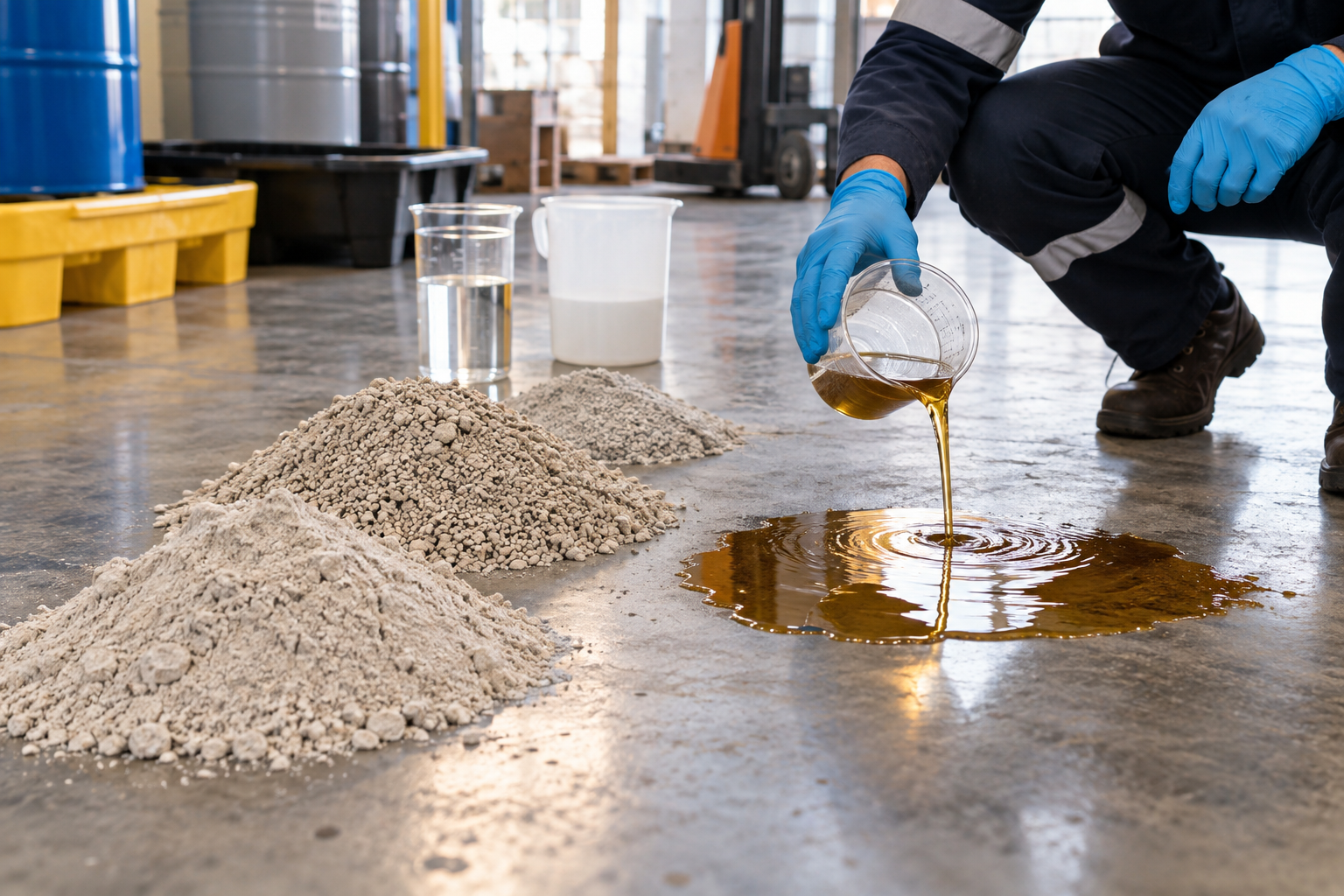
The goal isn't to find one impressive number. It is to identify a material that performs consistently under the conditions where customers will actually use it.
Particle size is easy to dismiss as a basic specification, but it can have a major effect on how an absorbent spreads, contacts a spill and is collected afterward.
Fine bentonite exposes more surface area, but very fine material can generate dust and become difficult to handle. Larger particles are generally easier to spread and recover, but they may interact with a liquid more slowly if the formulation and pore structure are not suitable.
For industrial absorbents, particle size is usually a balance between contact, handling and collection.
Fine material can be useful when rapid contact and high surface exposure are important. It may also be incorporated into blended or processed absorbent formulations.
The trade-off is handling. Fine mineral powder can become airborne, settle during transport or require additional workplace controls. If the finished product is intended for manual application, dust behavior deserves particular attention.
Granules are often easier to spread, package and recover. A controlled granular structure can also help a spill-control product remain practical after it has absorbed liquid.
There is no universal ideal granule size. The appropriate range depends on the application, packaging, spreading equipment, target liquid and collection method.
Don't settle for descriptions such as "fine" or "coarse" when you are qualifying a commercial raw material. Ask for a particle-size specification or sieve distribution where appropriate.
A product containing a large proportion of fines can behave very differently from a controlled granular material even when both are sold under a similar grade description.
Bentonite interacts strongly with moisture, so its own moisture content deserves attention before the material reaches the customer.
Excess moisture can affect flow, packaging stability, storage behavior and the amount of dry mineral delivered for a weight-based purchase. It can also contribute to caking and make downstream processing less predictable.
For commercial absorbent manufacturers, incoming moisture should be part of routine quality control where it affects the finished product.
Pay attention to:
A material that performs well at the point of production can become difficult to handle if it picks up moisture during storage or transit.
This is particularly relevant for international shipments. The product may move through different temperatures and humidity conditions between the processing site, port, warehouse and final customer. Packaging and storage should therefore be considered part of the material specification, not an afterthought.
Bentonite is a natural mineral, so composition can vary between deposits and processing operations. Natural variation is not automatically a quality problem, but buyers need to understand which components matter for their particular use.
Depending on the application, technical evaluation may include:
The appropriate limits depend on the finished product and its use.
For a general industrial floor absorbent, some mineral variations may have little practical effect. In a specialized formulation, the same variation could influence processing, product behavior or compliance requirements.
A supplier should be able to provide a technical specification and, where appropriate, a certificate of analysis for the supplied grade. If a particular impurity is important to your process, state the requirement explicitly rather than assuming a generic bentonite grade will meet it.
Bulk density isn't a direct measure of absorbency, but it becomes important as soon as you buy, transport or package industrial minerals at scale.
Two materials can have the same weight while occupying different volumes. That difference affects warehouse capacity, bag size, feeder settings, transportation and packaging efficiency.
Bulk density can also influence how a finished absorbent feels and behaves during application.
For example, when developing a packaged granular product, the relationship between weight and volume determines how much material fits into a particular bag or container. That affects packaging design, production settings and customer expectations.
For international buyers, it makes sense to evaluate material performance and logistics together. A technically suitable product can still be commercially unattractive if its physical characteristics create unnecessary storage or freight costs.
This is one of the most useful steps in the entire selection process.
A water test tells you something about water interaction. It does not automatically predict how the same material will behave with hydraulic oil, diesel, cutting fluid, process liquid or another industrial contaminant.
Whenever possible, obtain representative samples and run a controlled test using the liquid the finished absorbent is expected to encounter.
A practical screening procedure can include:
For demanding products, establish a documented internal test method and use the same conditions for every supplier comparison.
The purpose isn't to reproduce every detail of a real spill in the laboratory. It is to create a repeatable test that helps you compare candidates fairly and identify the properties that matter in actual use.
Before approving a material, request a technical data sheet and identify the properties that directly affect your application.
A useful supplier checklist includes:
| Specification | Why it matters |
|---|---|
| Bentonite type | Indicates broad mineral behavior and chemistry |
| Smectite or montmorillonite content | Helps characterize mineral quality |
| Moisture | Affects handling, storage and delivered dry material |
| Particle-size distribution | Influences pickup, spreading and dust |
| Bulk density | Important for packaging and logistics |
| Swelling characteristics | Relevant to water interaction and some formulations |
| Absorption or adsorption data | Helps compare performance when methods are comparable |
| Chemical composition | Helps assess application compatibility |
| pH or slurry properties | Useful for selected process applications |
| Certificate of analysis | Supports batch-level quality verification |
Don't request every possible number simply because it appears on a technical sheet. Focus on properties that can change the finished product's performance or create a production problem.
For critical parameters, agree on the test method as well as the acceptable range. A specification is much more useful when both the buyer and supplier understand how compliance will be measured.
Price per metric ton is a poor basis for comparison when the materials have different performance, moisture levels or physical characteristics.
A better approach is to calculate the cost of achieving the required result.
For example, Supplier A may offer a lower price per ton but require more material to achieve the same spill-retention performance. Supplier B may cost more per ton but provide a more stable absorbent at a lower application rate. The second material could have the lower effective cost.
Compare suppliers across five areas.
Does the material perform consistently with your target liquid under controlled test conditions?
Are moisture, particle size and mineral characteristics controlled from batch to batch?
Can the supplier provide the required powder, granule or processed grade rather than only a general raw mineral?
Can the supplier support your required volume without unpredictable changes in quality or delivery conditions?
Consider product price, packaging, freight, applicable duties, storage and expected usage rate rather than comparing the quoted material price alone.
This gives procurement teams a clearer picture of total value and reduces the risk of choosing a low-cost material that creates problems later in production or use.
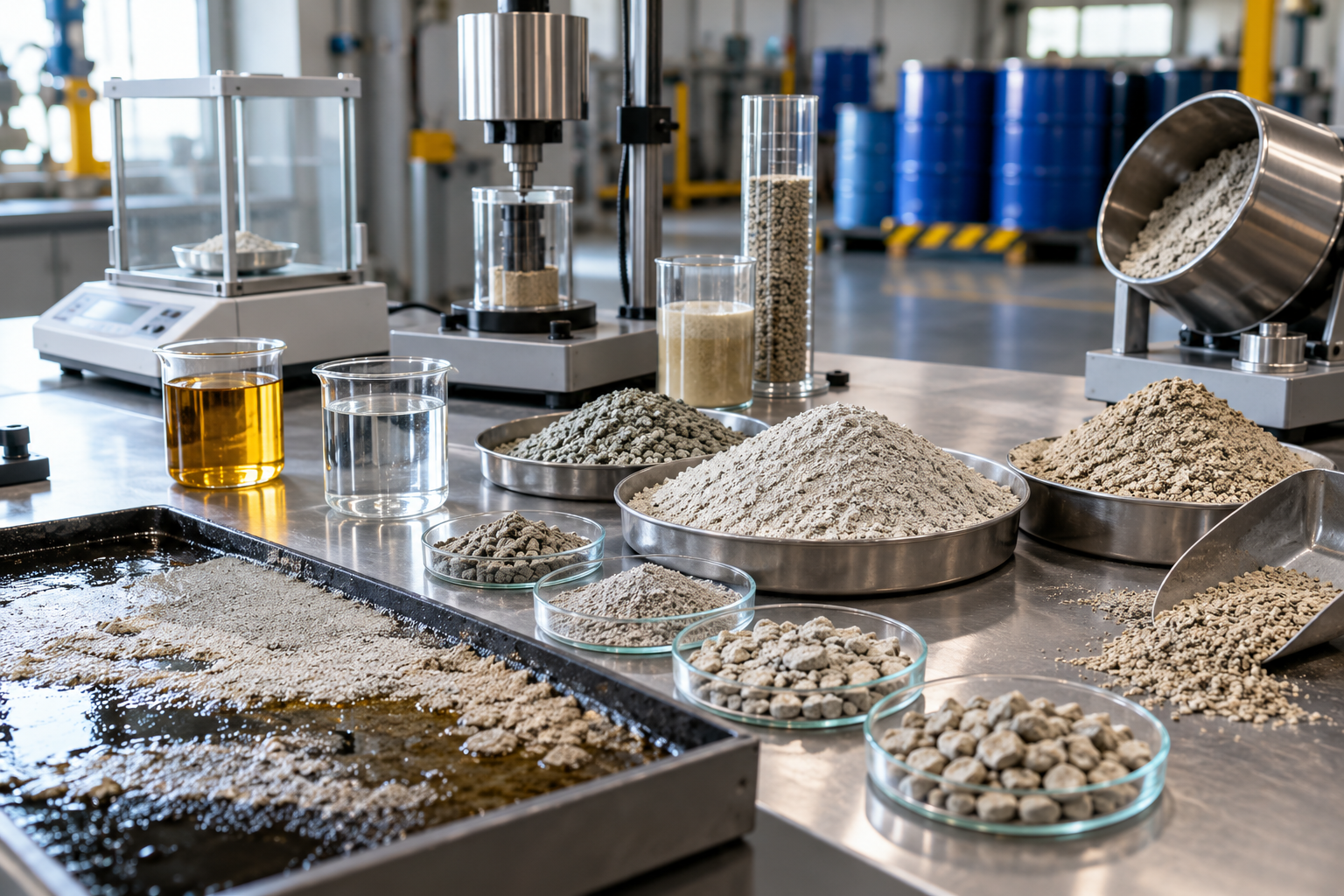
High swelling is valuable when expansion or water sealing is the main objective. It does not automatically mean better performance in every absorbent product. For spill-control applications, particle structure, pickup, retention and collection can be more important.
An absorption value has little meaning without its test conditions. Different liquids, particle sizes, temperatures and procedures can produce very different results. Confirm that supplier data is comparable before ranking materials.
A mineral can have strong intrinsic properties and still perform poorly in a finished absorbent if its physical form does not suit the application. Dust, spreading and collection are part of product performance.
A low-cost raw material can become expensive if it increases dosage, creates dust, produces inconsistent batches or causes production downtime. Evaluate cost per unit of useful performance instead.
Water is convenient for screening, but industrial spills often involve oils, fuels, process fluids or other liquids. Use the actual target liquid whenever practical.
A material that meets the specification when packed still needs to remain stable during transport and storage. Moisture exposure, caking and packaging failure can turn a good raw material into a difficult one to process.
Two products can have similar commercial descriptions while differing in mineral composition, particle size or processing. Qualify a new source before moving full production to it.
Natural bentonite does not always arrive in the physical form required for an industrial absorbent. Depending on the product, processing may include drying, grinding, milling, screening, blending or granulation.
Each operation can influence the final material.
Grinding changes particle-size distribution. Drying changes moisture. Screening separates size fractions. Granulation can improve handling and reduce the amount of loose fines. Blending can create a more controlled performance profile when more than one mineral or grade is used.
That is why raw bentonite and a finished absorbent should not be treated as interchangeable products.
If you are purchasing bentonite as a raw material, ask what processing has already been performed and which properties are guaranteed for the supplied grade. If you will process it again, specify which characteristics must remain within range after your own manufacturing steps.
Suppose you're developing a granular absorbent for workshops, maintenance areas or industrial facilities where the primary contaminant is hydrocarbon-based oil.
You could begin by screening several bentonite grades for physical stability, liquid pickup and handling rather than choosing a grade simply because it has the highest water-swelling value.
Your evaluation might compare:
Now imagine that one sample picks up oil quickly but breaks down into a muddy mass, while another forms stable saturated granules that are easier to collect. The second material may be more useful in day-to-day operations even if one laboratory absorption result favors the first.
That is the difference between selecting a mineral and selecting a material for a real product. The finished absorbent has to work for the person applying it, the person collecting it and the manufacturer paying for it.
Once you've tested several materials, turn the results into a purchasing specification.
Separate critical parameters from informational parameters.
Critical parameters are properties that can directly cause the product to fail or behave differently. Depending on the application, these could include moisture, particle-size range, mineral composition and a defined application-specific performance test.
Informational parameters help characterize the material but may not need strict acceptance limits.
A practical specification could include:
Keep the specification focused. A short list of meaningful, measurable limits is generally more useful than a long document containing numbers that have no clear connection to finished-product performance.
The first shipment is only the beginning.
Industrial customers need the material to perform consistently across production runs. If one batch forms stable granules while another produces excessive fines, the finished absorbent can change even when the formulation itself has not changed.
Batch consistency is especially important for manufacturers selling under their own brand. A raw-material variation can become a customer complaint even when the manufacturing process was unchanged.
Track incoming material against the agreed specification. Keep retained samples where appropriate, record batch numbers and investigate meaningful deviations rather than assuming natural mineral variation is harmless.
A supplier's ability to control processing and maintain consistent specifications can therefore be just as important as the performance of a single sample.
Before moving from sample testing to a commercial purchase, ask the supplier:
That last question is particularly useful. A development sample may perform well, but the purchasing decision should ultimately be based on the material that will be manufactured and shipped at commercial scale.
For buyers sourcing bentonite internationally, supplier capability matters alongside mineral quality. Axewelledge supplies bentonite for industrial applications and supports customers evaluating grades, processing requirements and export specifications.
If you're evaluating bentonite for an absorbent formulation, the most useful starting point isn't simply asking for the "best bentonite." Share the application, target liquid, preferred particle size, expected volume and key performance requirements. Those details provide a much better basis for recommending a grade and designing an appropriate test.
For large-volume buyers, consistent specifications, technical documentation and dependable logistics can be just as important as the initial laboratory result. A supplier should be able to explain what is being supplied and how that material is controlled from batch to batch.
If you need a practical way to narrow down your options, use this sequence.
This process avoids a common purchasing mistake: selecting a mineral first and then trying to force the application to fit it.
Bentonite can be useful in industrial absorbent formulations because its mineral structure and surface characteristics allow it to interact with liquids. Its suitability depends on the target liquid, particle size, processing and required retention. Buyers should test the selected grade under application-specific conditions instead of relying on a generic claim that a bentonite is highly absorbent.
There is no single best bentonite grade for every oil-absorbent product. The suitable choice depends on the oil, formulation, particle size, pickup requirements and handling characteristics. Compare candidate grades using the intended oil and measure pickup speed, retention, granule stability, dust generation and ease of collection before selecting a commercial grade.
Not necessarily. Sodium bentonite generally has stronger water-swelling behavior, while calcium bentonite has lower swelling and different surface and handling characteristics. The better choice depends on the target liquid and finished product. For industrial absorbents, testing both suitable grades under the intended application conditions is more reliable than selecting one solely because of its mineral type.
Industrial buyers should consider mineral composition, moisture, particle-size distribution, bulk density, swelling behavior and application-specific absorption performance. Batch consistency, processing method, packaging and documentation also matter for commercial supply. The final specification should focus on properties that affect the finished absorbent rather than copying a generic bentonite specification without considering the intended use.
Yes. Particle size affects surface exposure, contact with the liquid, flowability, dust generation and collection. Fine material can provide rapid contact but may create handling challenges, while larger granules can be easier to spread and recover. The appropriate particle size depends on the liquid, finished formulation, application method and balance between pickup and practical handling.
Use a controlled test with the actual target liquid whenever possible. Keep sample mass, particle size, liquid volume, temperature and contact time consistent. Measure pickup, retention and physical stability, then assess how easily the spent material can be collected. Repeat the test across several samples or batches to determine whether performance is consistent enough for commercial production.
Price per ton is only one part of the purchasing decision. A cheaper material may require a higher application rate, generate more waste or create handling problems. Compare the effective cost of achieving the required performance, including dosage, processing, freight, packaging, storage and relevant waste-handling costs. This gives a more realistic view of total material value.
Choosing bentonite for industrial absorbents is not about finding a universally superior mineral. It is about matching mineral characteristics and physical form to the job.
Start with the liquid. Define the required performance. Then evaluate mineral type, particle size, moisture, composition, bulk density and processing. Test candidate grades under realistic conditions and compare effective cost rather than headline price.
That approach gives you a stronger basis for selecting an absorbent material that works in practice and a supplier that can maintain the required specification over time.
If you're sourcing bentonite for an industrial absorbent application, Axewelledge can help you evaluate the relevant requirements and identify a suitable grade for testing. The more specific the application, target liquid and performance requirements, the more useful the technical discussion will be.













Have questions about our products? We're here to help!