Axewelledge, a leading exporter from India, specializes in high-quality Bentonite. With a commitment to excellence, we supply premium Bentonite to the Middle East and Southeast Asia markets.


North Angle Complex, 304,
150 Feet Ring Rd, Opposite Ambedkar Nagar BRTS Stop,
Madhav Park, Punit Nagar,
Mavdi, Rajkot, Gujarat 360004
© Axewelledge 2026, All Rights Reserved.
Choosing bentonite for wastewater treatment is not simply a matter of buying the grade with the highest swelling number. The right product depends on the contaminants in the water, the chemistry of the treatment process, the required separation method, and how the clay behaves after dosing.
For example, a sodium bentonite that performs well as a sealing material may create too much sludge in a clarification process. An organophilic bentonite may be a better choice for hydrophobic organic compounds, but it is not a universal replacement for a conventional coagulant. Likewise, a high Cation Exchange Capacity (CEC) can indicate strong ion-exchange potential, but it does not guarantee a particular heavy-metal removal rate in real wastewater.
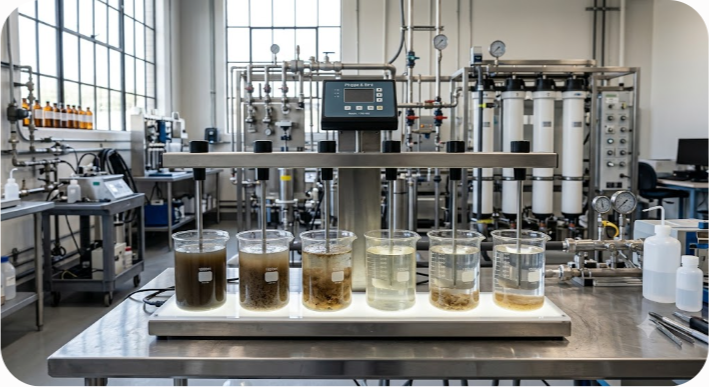
The most reliable approach is to start with an analysis of the actual effluent, shortlist bentonite grades based on their mineral and chemical properties, and then confirm performance with jar testing or another representative bench-scale trial. This guide explains how to do that, from selecting the clay type to setting a practical starting dose and evaluating sludge performance.
Bentonite is a naturally occurring clay rich in smectite minerals, especially montmorillonite. Montmorillonite has a layered 2:1 structure made of two silica-rich tetrahedral sheets surrounding an alumina- or magnesia-rich octahedral sheet. Isomorphic substitution within this structure creates a net negative charge on the clay surfaces.
That charge is balanced by exchangeable cations such as sodium, calcium, and magnesium. When bentonite contacts water, those ions and the clay layers interact with the surrounding solution. The result can be swelling, dispersion, ion exchange, adsorption, or floc formation, depending on the clay chemistry and wastewater conditions.
Bentonite therefore has several possible roles in treatment systems. It can act as an adsorbent, a coagulation or flocculation aid, a solids-conditioning material, or a component of an engineered barrier. It should not, however, be treated as a one-product solution for every wastewater problem.
Adsorption and ion exchange. The negatively charged surfaces and exchange sites of montmorillonite can interact with positively charged dissolved species. Divalent metal ions such as lead, copper, cadmium, zinc, and nickel can participate in ion-exchange and surface-adsorption reactions. Actual removal depends on pH, competing ions, contact time, clay dose, and the chemical form of the contaminant.
Swelling and dispersion. Sodium-dominant bentonite generally hydrates and disperses more readily than calcium-dominant bentonite. In fresh water, this can create a larger hydrated clay structure and increase the effective surface available for interactions with contaminants.
Flocculation support. Bentonite can become part of a larger floc when used with suitable inorganic coagulants or polymers. In this role, the clay provides mineral solids and surface area that can become incorporated into the settling structure. The exact dosing sequence matters because excessive shear or poorly selected polymer chemistry can break the floc apart.
Organic adsorption after modification. Conventional bentonite is strongly hydrophilic. It is therefore not automatically effective against non-polar hydrocarbons. Organophilic or organo-modified bentonite uses organic cations to change the clay surface, making it more compatible with hydrophobic compounds.
The practical lesson is simple: select the mechanism first, then select the bentonite grade that supports it.
The dominant exchangeable cation and any chemical modification have a major effect on bentonite behavior. Sodium and calcium bentonites can have very different swelling and dispersion characteristics, while organophilic products are deliberately modified for organic adsorption.
Sodium bentonite generally has higher swelling capacity and stronger gel formation than calcium bentonite in low-salinity water. It is often selected when dispersion, hydrated surface area, or sealing behavior is important.
Typical characteristics include:
The actual swelling value varies substantially with mineralogy, exchangeable cations, particle size, salinity, and test method. A supplier's swelling number should therefore always be read alongside the test standard and sample preparation procedure.
Calcium bentonite generally has lower free swelling and a greater tendency to form less expansive aggregates than sodium bentonite. It can still provide useful surface area and ion-exchange capacity, but it behaves differently during hydration.
It may be considered where high gel strength is not required or where a lower-swelling mineral is more compatible with the separation process. Calcium bentonite should not be rejected simply because its swelling value is lower. The important question is whether its performance in the actual wastewater justifies its use.
Sodium activation is commonly used to improve the swelling behavior of calcium-rich bentonite. Treatment with sodium carbonate can replace some exchangeable calcium with sodium, producing a clay with more sodium-like hydration characteristics.
Activated bentonite can be useful where a controlled, higher-swelling material is required. Buyers should ask whether the product is naturally sodium bentonite or sodium-activated bentonite because the two materials can behave differently under high salinity, temperature, and repeated hydration conditions.
Organophilic bentonite is modified with organic cations, often quaternary ammonium compounds. The modification changes the surface chemistry of the clay from strongly hydrophilic toward a more organophilic character.
This type of bentonite is considered for applications involving hydrocarbons, hydrophobic organic compounds, some solvents, and selected pesticide or dye streams. It should be selected on the basis of the specific contaminant and treatment objective rather than simply because the wastewater contains oil.
For stable oil-in-water emulsions, the clay may need to be combined with an appropriate coagulant or emulsion-breaking treatment. Bentonite alone may not destabilize a chemically stabilized emulsion.
| Feature | Natural Sodium Bentonite | Natural Calcium Bentonite | Sodium-Activated Bentonite | Organophilic Bentonite |
|---|---|---|---|---|
| Dominant exchangeable ion | Sodium | Calcium | Increased sodium fraction | Organic cation modification |
| Water swelling | Generally high | Generally low | Moderate to high | Not normally evaluated as conventional water swelling |
| Dispersion in fresh water | High in suitable grades | Lower | Moderate to high | Depends on formulation |
| Ion-exchange potential | Often high | Moderate to high | Variable | Modified by organic treatment |
| Heavy-metal applications | Potentially useful | Potentially useful | Potentially useful | Usually not the first choice |
| Hydrophobic organic compounds | Limited without modification | Limited without modification | Limited without modification | Better suited |
| Sludge contribution | Can be significant at high doses | Usually lower swelling contribution | Variable | Depends on formulation and dose |
| Relative cost | Moderate | Often lower | Moderate | Usually higher |
| Best selection method | Confirm by jar testing | Confirm by jar testing | Confirm by jar testing | Confirm against target organics |
The table is a screening guide, not a guarantee of treatment performance. Two bentonites with the same product name can behave differently because of differences in montmorillonite content, exchangeable cations, grinding, activation, and impurities.
A wastewater treatment buyer should avoid selecting clay on the basis of a single specification. Several properties need to be considered together.
Cation Exchange Capacity, or CEC, describes the quantity of exchangeable cations that a material can hold. It is commonly reported in milliequivalents per 100 grams.
A higher CEC can indicate a greater number of available exchange sites, but CEC should not be interpreted as a direct percentage-removal guarantee. Wastewater contains competing ions, and metal speciation changes with pH and other chemical conditions.
When comparing suppliers, ask for:
For many sodium bentonites used in industrial applications, a CEC around or above 80 meq/100g may be a useful screening point. The correct target depends on the mineral deposit and treatment application.
Free swelling measures how much a defined quantity of dry clay expands in a specified liquid under a defined test procedure. It is particularly useful for comparing sodium-dominant and calcium-dominant bentonites.
A commonly used test places a measured quantity of powdered bentonite into water and records the settled volume after hydration. However, test methods vary, so two numbers should not be compared unless the procedures are equivalent.
High swelling is useful for some slurry and containment applications, but it is not automatically desirable in a wastewater clarification system. Excessive swelling can increase sludge volume and make dewatering more difficult.

Particle size affects hydration speed, dispersion, dust generation, handling, and the amount of surface exposed during treatment.
Coarse or granular material hydrates more slowly and may be useful in applications where controlled hydration or dust reduction is important.
Fine powder is commonly used for slurry preparation and automated dosing because it disperses more quickly when properly mixed.
Micronized material can hydrate and disperse rapidly, but finer particles can increase dust-control requirements and may require better slurry preparation equipment.
Do not choose the finest available powder simply because it has a smaller particle size. The correct size is the one that provides reliable dispersion without creating unnecessary handling or equipment problems.
Bentonite deposits contain varying amounts of accessory minerals. Quartz, feldspar, calcite, gypsum, and other minerals can dilute the active clay fraction.
Montmorillonite content is therefore an important specification. X-ray diffraction can help characterize mineralogy, while other analytical methods can provide supporting information.
A high montmorillonite content can support stronger swelling and ion-exchange performance, but it still does not replace actual wastewater testing. The relationship between mineral composition and treatment performance is affected by the chemistry of the effluent.
Moisture affects storage, flowability, weighing accuracy, and milling behavior. Excessive moisture can cause clumping and poor flow through hoppers. Very dry powders can create more dust and may require additional handling controls.
Instead of applying a universal moisture target to every product, compare the supplier's specification with your storage and dosing equipment. The material should remain free-flowing enough for accurate feeding and consistent slurry preparation.
For slurry-based systems, viscosity and yield behavior can be just as important as swelling. A clay that creates excessive viscosity may overload mixers, pumps, and dosing lines. A clay that disperses poorly may settle in tanks and produce inconsistent dosing.
Ask suppliers for slurry viscosity or rheology data when the application involves continuous pumping. Ideally, test the product using the same slurry concentration, water chemistry, temperature, and mixing conditions expected at the plant.
The best grade depends on the contaminant and the separation mechanism. A useful starting point is to classify the wastewater before selecting the clay.
Textile wastewater can contain dyes, surfactants, salts, suspended solids, and organic matter. Dye chemistry varies widely. Some dyes are anionic, while others are cationic or non-ionic, so a single bentonite recommendation cannot cover every textile stream.
For anionic organic compounds, an organo-modified bentonite or a bentonite used with a suitable coagulant may be worth testing. Natural sodium bentonite can provide mineral surface area and support floc formation, but it may not be sufficiently selective for dissolved dyes on its own.
A useful test program compares bentonite alone against the proposed coagulant-bentonite and polymer-bentonite combinations. Measure both color reduction and the resulting sludge properties.
Electroplating wastewater may contain copper, nickel, zinc, chromium, cadmium, and other metals. The chemical form of each metal matters. For example, chromium may occur in different oxidation states that require different treatment strategies.
Bentonite can support removal through adsorption and ion exchange, but it should not automatically replace precipitation chemistry. Hydroxide or sulfide precipitation, specialized adsorbents, ion exchange, membranes, or other technologies may be more appropriate for particular streams.
If bentonite is being considered, test it after controlling the wastewater pH within the range appropriate for the target metals and the overall treatment process. Measure dissolved metal concentrations before and after treatment rather than relying only on visual clarity.
Oil-contaminated wastewater is especially sensitive to emulsion chemistry. Free oil, dispersed oil, and chemically stabilized emulsions behave differently.
Organophilic bentonite can be useful for hydrophobic compounds, but a stable emulsion may first require pH adjustment, an inorganic coagulant, a demulsifier, dissolved air flotation, or another separation step.
The right test should measure oil and grease in the treated water and examine whether the resulting solids float, settle, or remain suspended. A visually clear jar is not enough if dissolved or finely dispersed hydrocarbons remain in the water.
Food and dairy wastewater commonly contains suspended solids, proteins, fats, oils, grease, and high organic loads. Bentonite may be useful as a conditioning or adsorption aid, but biological treatment and conventional coagulation often play a more important role in reducing biodegradable organic load.
Use only a grade that is legally and technically suitable for the intended application. Do not assume that a mineral described as natural or food-grade is automatically appropriate for direct treatment of every wastewater stream or for land application of the resulting sludge. Sludge disposal or reuse must be assessed separately under the applicable regulations.
The safest way to choose bentonite is to treat the selection as an engineering test rather than a product-name decision.
Collect representative wastewater samples and establish a baseline. At minimum, consider:
Sampling should cover normal operating variation where possible. A single clean sample can produce a misleading treatment result.
Request technical data sheets and representative samples from suppliers. Compare mineralogy, CEC, swelling, moisture, particle size, and slurry behavior.
Do not compare grades using different test methods as though their numbers were directly equivalent. Ask suppliers to identify the method used for each critical specification.
Prepare each candidate at the same starting concentration, unless the supplier specifies a different preparation method. A 2% to 5% solids slurry can be a practical laboratory starting range for many applications, but the correct concentration depends on mixing equipment and clay rheology.
Allow adequate hydration before testing. Record hydration time and mixing conditions so that the experiment can be reproduced.
Jar testing should reproduce the intended treatment sequence as closely as practical.
A practical laboratory dose range might begin around 100 to 500 mg/L and extend into the gram-per-liter range where justified by the wastewater. There is no universal optimum dose. The correct dose is the lowest practical dose that meets the treatment objective while maintaining acceptable sludge characteristics.
For each test, record:
A bentonite that produces slightly better water clarity but doubles the sludge volume may not be the better commercial choice.
Once the laboratory tests identify a promising grade and dose, run a pilot or controlled plant trial. Full-scale equipment introduces factors that are difficult to reproduce in a small beaker, including hydraulic residence time, mixing intensity, pump shear, temperature variation, continuous dosing, and sludge recycling.
Pilot testing is particularly important before making a long-term procurement decision for a high-volume wastewater plant.
Good bentonite can perform poorly when the powder is added in a way that prevents proper dispersion. The goal is to get the clay hydrated and uniformly distributed before it has to interact with the contaminants.
Dry bentonite added directly to water can form partially hydrated lumps. The outside of the particle hydrates first, while dry material remains trapped inside. These lumps are often called fish eyes.
A better approach is to prepare a separate make-down slurry using clean water. A starting concentration of 2% to 5% solids is often practical for laboratory and plant evaluation, subject to the product's rheology and the dosing system.
The required hydration time varies with bentonite type, particle size, water chemistry, temperature, and mixing intensity. Rather than assuming that every clay needs exactly 30 or 60 minutes, determine the minimum preparation time that produces a uniform slurry with the selected product.
A typical treatment sequence can be described in four stages:
The exact order should be established by jar testing. There are wastewater streams where adding bentonite before the primary coagulant performs better, and others where the reverse sequence is more effective.
High shear can be useful during initial dispersion but harmful after flocs have formed. If a plant continues aggressive mixing through the flocculation stage, large flocs can break into smaller particles that settle poorly.
Record mixing speed and, where possible, use mixing intensity or velocity gradient rather than RPM alone. A given RPM can create very different shear conditions in different tank geometries and impellers.

There is no single bentonite dose that applies to all industrial wastewater. The required amount can range from relatively low concentrations to several grams per liter, depending on the wastewater and the treatment objective.
For preliminary laboratory screening, a broad dose series is more useful than selecting one assumed dose. For example, a plant engineer may test 100, 250, 500, 1,000, 2,000, and 5,000 mg/L when the expected treatment range is uncertain.
The final dose should be selected by comparing both treatment performance and operating cost.
A useful calculation is:
For example, if a plant treats 500 cubic meters per day and the selected dose is 500 mg/L, the theoretical dry bentonite requirement is approximately 250 kg per day.
That number is only a dosing calculation. It does not prove that 500 mg/L is the correct treatment dose. The dose still needs to be validated against removal targets, sludge production, and plant performance.
Bentonite, polymers, alum, ferric salts, and polyaluminum chloride do different jobs. They should not be treated as interchangeable chemicals.
| Treatment material | Main role | Typical strength | Main limitation |
|---|---|---|---|
| Bentonite | Mineral adsorbent and flocculation aid | Surface area, ion exchange, solids formation | Adds mineral solids to sludge |
| Polyaluminum chloride | Primary coagulant | Rapid colloid destabilization | Performance depends strongly on pH and alkalinity |
| Alum | Primary coagulant | Established treatment chemistry | Can increase chemical sludge and affect pH |
| Ferric salts | Coagulation and precipitation | Strong performance for many suspended and dissolved contaminants | Requires appropriate pH and chemical control |
| Organic polymer | Flocculation aid | Produces large, settleable or floatable flocs at low doses | Sensitive to polymer type, dose, and mixing |
In many industrial systems, bentonite works best as part of a treatment train rather than as the only chemical. Jar testing should compare the complete chemical sequence, not just individual products in isolation.
High swelling can sound attractive, but it can also create more sludge and higher viscosity. If the treatment system needs compact flocs and easy dewatering, an extremely expansive clay may be counterproductive.
Better approach: choose the lowest practical swelling grade that meets the treatment objective, then confirm it through jar testing.
CEC indicates exchange capacity, not guaranteed removal efficiency. Wastewater chemistry, competing ions, pH, contact time, and contaminant concentration all affect performance.
Better approach: use CEC to screen suppliers, then measure actual contaminant removal using representative wastewater.
A swelling value has little meaning if the test procedure, sample mass, water quality, particle preparation, or settling period differs.
Better approach: request the test method and compare like with like.
Poor dispersion can create hydrated lumps and leave part of the clay underutilized.
Better approach: prepare a controlled slurry and verify that the dosing line can keep the clay suspended.
High concentrations of dissolved salts can suppress swelling and change clay dispersion behavior. A grade that performs well in low-conductivity water may behave differently in brackish or highly saline wastewater.
Better approach: perform jar testing with the actual wastewater, including its native salt concentration.
Clear water is not necessarily compliant water. Dissolved metals, COD, dissolved hydrocarbons, or residual color may remain even when turbidity is low.
Better approach: define measurable treatment targets before selecting the clay.
Every kilogram of mineral added to the treatment process eventually has to go somewhere. If bentonite is over-dosed, sludge handling, dewatering, transport, and disposal costs can rise.
Better approach: calculate total treatment cost per cubic meter, including chemical use and sludge management.
Different wastewater streams can require completely different clay characteristics. Even within one factory, equalization tanks, process streams, and final polishing streams may need different treatment chemistry.
Better approach: select the product for the specific stream and treatment stage.
Water chemistry can change bentonite behavior significantly.
High ionic strength compresses the electrical double layer around clay particles and can reduce swelling and dispersion. Sodium bentonite may therefore show much less expansion in saline wastewater than in distilled or low-salt water.
This is one reason supplier laboratory values should not be treated as plant-performance guarantees. If the plant operates at high conductivity, run the test using actual wastewater.
pH influences both the clay surface and the chemical form of contaminants. Metal ions can precipitate as hydroxides as pH rises, which means apparent metal removal may come from precipitation rather than bentonite adsorption.
This distinction matters. If a treatment test shows excellent metal removal at a particular pH, determine whether the clay contributed meaningfully or whether precipitation was responsible for most of the result.
Calcium, magnesium, sodium, potassium, ammonium, and other ions can compete for exchange sites. A clay that performs well in a simple laboratory solution may behave differently in a complex industrial effluent.
For that reason, representative wastewater is far more useful for final product selection than a clean-water adsorption test alone.
Bentonite becomes part of the solids generated by the treatment process. That makes sludge performance an essential selection criterion.
After jar testing, evaluate settling speed and sludge volume. Where dewatering is important, run a simple filtration test or use the same filter press, belt press, centrifuge, or other equipment used at the plant.
Important measurements can include:
A treatment chemical that produces excellent supernatant but creates a difficult-to-dewater sludge may not be economical at full scale.
A professional technical data package should contain enough information to compare the material with alternative grades.
Ask for:
For wastewater applications, also ask whether the supplier has data for the specific contaminant class being treated. A generic drilling-grade specification is not enough to establish suitability for industrial effluent treatment.
Supplier selection should focus on consistency as much as on headline specifications. A wastewater plant needs a material that behaves predictably from one shipment to the next.
Axewelledge is an India-based bentonite producer and exporter that supplies sodium bentonite and other bentonite products for industrial applications. Its product range can be evaluated for wastewater, environmental containment, and related uses where the mineral properties match the treatment requirement.
For procurement, request a representative sample and the current technical data sheet before committing to a large-volume order. Compare the supplier's specification against your required CEC, swelling, particle size, moisture, mineralogy, and contaminant limits. Then validate the selected grade with your own wastewater.
For large treatment plants, supply consistency and logistics are also important. A product that performs well in one laboratory trial is not enough if future batches vary significantly or the supplier cannot maintain the required particle size and mineral specifications.
Use the following checklist when evaluating a bentonite grade for wastewater treatment:
The right bentonite for wastewater treatment is the one that fits the chemistry of the wastewater and the operating requirements of the treatment plant. There is no universal grade that delivers the best performance across heavy metals, dyes, hydrocarbons, suspended solids, and high-organic-load effluent.
Start with the wastewater rather than the product catalogue. Characterize the contaminants, pH, salinity, suspended solids, and other important water-quality parameters. Use CEC, swelling, mineralogy, particle size, and rheology to narrow the supplier list. Then use jar testing to determine the dose, chemical sequence, mixing conditions, and resulting sludge behavior.
For heavy-metal streams, pay close attention to pH, competing ions, and whether precipitation is already responsible for most of the removal. For oil and hydrophobic organics, investigate organophilic bentonite and emulsion-breaking chemistry. For textile wastewater, test the clay against the actual dye chemistry rather than assuming that all dyes respond in the same way.
Finally, evaluate economics on a treatment-system basis. The best bentonite is not necessarily the cheapest material per kilogram or the one with the highest swelling value. It is the grade that consistently reaches the required water-quality target at a practical chemical dose while keeping sludge, equipment, handling, and disposal costs under control.













Have questions about our products? We're here to help!