Axewelledge, a leading exporter from India, specializes in high-quality Bentonite. With a commitment to excellence, we supply premium Bentonite to the Middle East and Southeast Asia markets.


North Angle Complex, 304,
150 Feet Ring Rd, Opposite Ambedkar Nagar BRTS Stop,
Madhav Park, Punit Nagar,
Mavdi, Rajkot, Gujarat 360004
© Axewelledge 2026, All Rights Reserved.
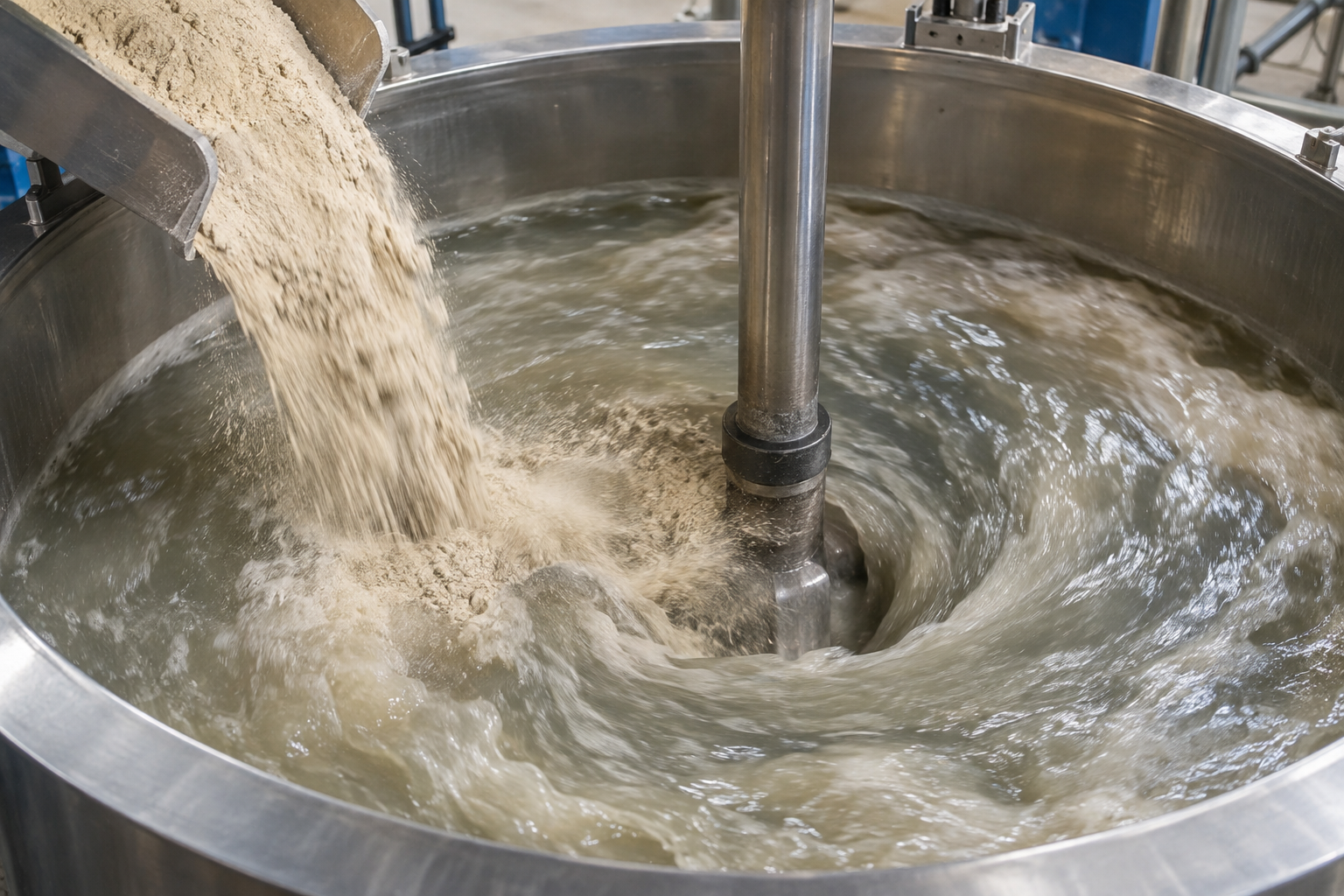
Bentonite doesn't actually dissolve in water. It hydrates and disperses, and the way you add the dry powder largely determines whether you get a smooth slurry or a bucket full of stubborn lumps.
The most reliable way to disperse bentonite in water is to start agitation before adding the powder, create enough circulation to draw the clay into the moving water, and feed the powder gradually rather than dumping it in all at once. The correct mixing method also depends on the bentonite grade, water quality, concentration, equipment, and final application.
This matters because bentonite's performance comes from its ability to hydrate, swell, and form a stable suspension. Poor dispersion can leave partially hydrated particles in the mix, giving you inconsistent viscosity, uneven sealing, or poor suspension properties. A little care during mixing can prevent most of these problems.
Bentonite is a clay rich in smectite minerals, particularly montmorillonite. Sodium bentonite is valued for its ability to absorb water and swell substantially. That property is useful in drilling fluids, geosynthetic and soil sealing systems, foundry applications, construction, and other industrial processes. It is also the reason bentonite can be surprisingly difficult to mix when the powder is introduced incorrectly.
When dry bentonite contacts water, the particles at the outside of an agglomerate hydrate first. They can develop a thick, hydrated layer before water reaches the dry material inside. The result is a soft but persistent lump often called a fish-eye. From the outside, it looks wet and fully mixed. Inside, however, dry or only partly hydrated powder may remain.
Once these agglomerates form, ordinary stirring may not be enough to break them apart. The hydrated outer layer can resist further penetration, particularly as the surrounding slurry becomes thicker.
The problem isn't simply that bentonite absorbs too much water. The real issue is how quickly and unevenly water reaches the powder. Good dispersion keeps individual particles moving through the water while they hydrate. Poor dispersion lets several particles hydrate together and form larger masses.
It helps to separate two terms that are often used interchangeably.
Dispersion is the process of distributing bentonite particles throughout the water and breaking up agglomerates. Hydration is the subsequent interaction between water and the clay particles that produces swelling and develops the desired rheological properties.
A slurry can look reasonably uniform immediately after mixing and still need additional hydration time before it reaches its intended viscosity or suspension behavior. For that reason, mixing and aging should be treated as related but separate stages.
For most applications, the basic procedure is straightforward: prepare the water, start mechanical agitation, introduce bentonite gradually into a moving body of water, keep the material circulating, and allow enough time for hydration.
The exact equipment and mixing time will vary with the bentonite grade and application, so there isn't one universal water-to-bentonite ratio or mixing duration that works for every job. Follow the supplier's technical data and the requirements of the specific process whenever they are available.
Measure the required water volume first. The amount of water should be based on the slurry concentration and the purpose of the mixture rather than on a generic ratio copied from another application.
For example, a drilling-fluid formulation may require very different solids content and rheological properties from a bentonite slurry prepared for pond or soil sealing. A laboratory suspension may have different requirements again.
Check the water for obvious quality issues before mixing. Very hard water can affect the behavior of some sodium bentonite grades because dissolved calcium and magnesium can interfere with clay hydration and dispersion. If the process is sensitive to water chemistry, test the water rather than assuming that all water sources will behave the same way.
Use clean equipment as well. Residual cement, salts, oils, polymers, or other chemicals from a previous batch can change slurry behavior.
Don't put dry bentonite into still water and plan to mix it afterward. Start the mixer first and establish circulation throughout the container.
For small batches, a suitable variable-speed mechanical mixer can work well. Larger operations may use dedicated slurry mixers, jet hoppers, venturi systems, centrifugal pumps, or other equipment designed to introduce and disperse powdered materials efficiently.
The goal is to keep the water moving strongly enough that incoming powder is pulled into the liquid instead of sitting on the surface.
A visible vortex can be useful, but the shape of the vortex isn't the main objective. What matters is effective circulation through the mixing zone.
If the mixer only moves water around the top while material collects at the bottom or along the vessel walls, the system has dead zones. Bentonite that remains in those areas can hydrate into dense masses that are difficult to redisperse.
Position the mixer so that it produces circulation through as much of the vessel as practical. For larger tanks, mixer geometry, impeller diameter, tank shape, liquid depth, and rotational speed all affect performance.
A strong mixing pattern should draw newly added powder into the liquid quickly while keeping previously added material suspended.
This is one of the most important steps.
Instead of dumping an entire bag into the tank, introduce the powder at a controlled rate. A steady feed gives each portion of bentonite enough access to water and mixing energy before the next large quantity arrives.
Add the powder where the liquid is moving most effectively. Avoid simply pouring it against the tank wall, where it can stick and accumulate. If the equipment has a dedicated powder induction or hopper system, use it according to the manufacturer's operating instructions.
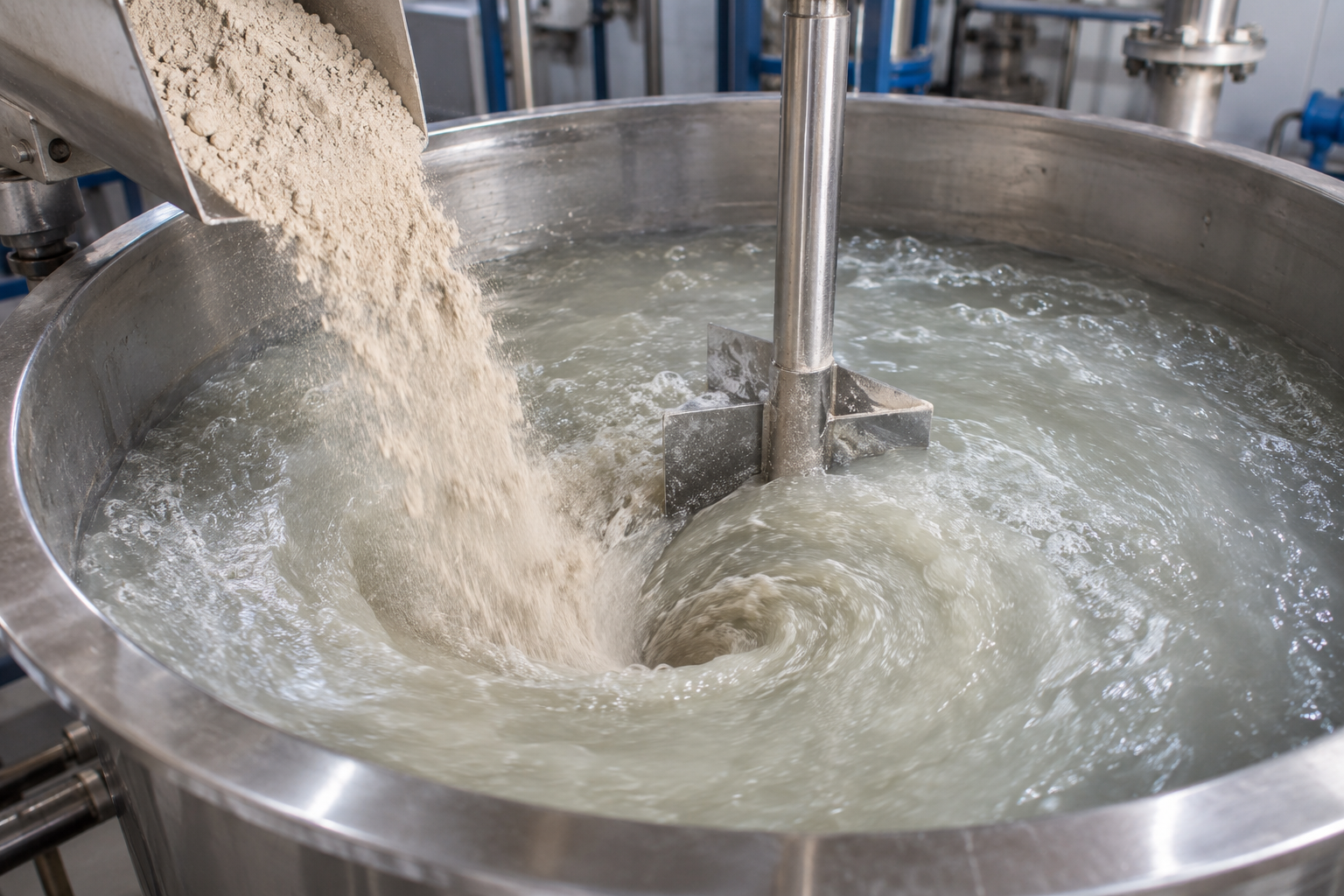
The ideal feed rate depends on mixer capacity and slurry concentration. If the slurry becomes noticeably overloaded with dry powder, slow the feed rather than trying to compensate by adding more mechanical force later.
Don't stop the mixer as soon as the last scoop of bentonite enters the tank. Continue agitation long enough to break up remaining agglomerates and distribute the hydrated clay throughout the liquid.
A stated mixing time such as 15 or 30 minutes can be useful as a starting point, but it shouldn't be treated as a universal rule. A small batch with a powerful mixer may reach a uniform state faster than a large batch with limited circulation. Conversely, a high-solids slurry may need considerably more time.
Judge the result by the actual condition of the slurry, together with the specifications of the application.
Some bentonite systems benefit from additional hydration time after mechanical mixing. During this period, water continues interacting with the clay particles and the slurry can develop more of its expected viscosity and suspension characteristics.
The appropriate aging period depends on the bentonite grade, chemistry, concentration, temperature, and intended use. Some formulations may be used relatively soon after mixing, while others are deliberately hydrated for longer periods.
If you're preparing drilling fluid or another performance-critical slurry, use the product's technical guidance and test the resulting properties rather than relying on an arbitrary aging period.
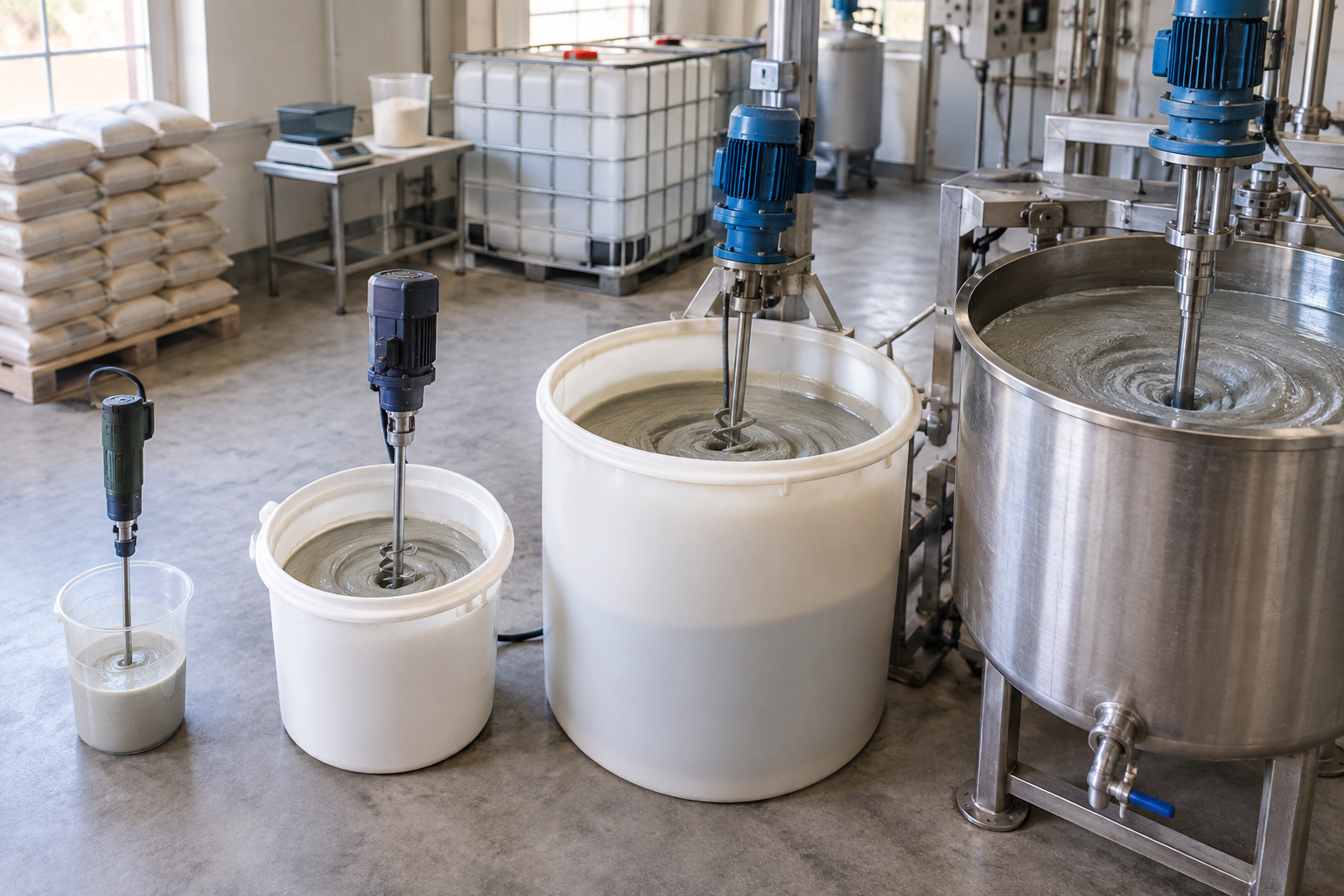
The best mixing equipment depends on batch size and the properties you need from the finished slurry. A tool that works for a five-gallon container isn't automatically suitable for a thousand-gallon tank.
| Mixing Method | Typical Mixing Intensity | Suitable Uses | Main Advantage | Main Limitation |
|---|---|---|---|---|
| High-shear overhead mixer | High to very high | Laboratory and controlled small-batch work | Strong particle breakup and circulation | Equipment cost and limited batch size |
| Jet or venturi mixing system | High | Drilling fluids and larger field operations | Rapid powder induction and continuous circulation | Requires suitable pumping equipment |
| Mechanical paddle or propeller mixer | Moderate to high | General slurry preparation | Practical for many batch sizes | Performance depends heavily on mixer design |
| Drill-mounted mixing blade | Moderate | Small construction, pond, and DIY batches | Relatively accessible and portable | Not ideal for large volumes or prolonged operation |
| Manual paddle stirring | Low | Limited agitation after mixing | Simple and inexpensive | Poor choice for dispersing dry bentonite into water |
For a small batch, a variable-speed drill and appropriate mixing blade can be adequate if the container and slurry concentration are within the tool's practical limits. Add bentonite gradually and avoid running the mixer so aggressively that it splashes the material out of the container.
The blade should generate circulation through the slurry rather than simply spinning in one spot. If the mixture becomes too thick for the drill or blade, stop and reassess the concentration and equipment instead of forcing the motor to operate beyond its intended load.
Industrial operations require more control. A dedicated mixing tank, pump, hopper, or high-shear system can provide consistent powder induction and circulation across larger volumes.
In drilling applications, for example, a mud hopper or venturi-style induction system can introduce dry bentonite into a high-velocity water stream. The resulting turbulence helps wet and disperse the powder before it enters the main circulation system.
For production work, equipment should be selected based on slurry volume, target concentration, throughput, powder feed rate, viscosity, and required mixing quality. Simply choosing the most powerful motor available isn't necessarily the best solution.
Water temperature can influence hydration and slurry viscosity, but it is usually less important than proper powder addition and adequate agitation.
Very cold water can slow hydration. Warmer water may speed the process, although excessive heat isn't a substitute for proper mixing and may be unsuitable for particular formulations or equipment. In routine applications, ambient or moderately warm water is generally practical unless the product specifications state otherwise.
If temperature is important to your process, keep it controlled and consistent between batches. That makes it easier to compare viscosity, hydration time, and other performance measurements.
Water chemistry deserves more attention when a slurry behaves differently from one batch to another. Hard water contains dissolved minerals, particularly calcium and magnesium. These ions can interact with clay surfaces and alter swelling, dispersion, and rheological behavior.
The effect varies with the bentonite grade and the chemistry of the water, so it's better to test than to assume that hard water will always cause a serious problem.
Sodium carbonate, commonly called soda ash, is sometimes used in drilling-fluid preparation to condition hard water. It can reduce the effect of calcium hardness by promoting precipitation of calcium carbonate, which can make the water more suitable for sodium bentonite hydration.
However, the amount should not be guessed. Excess chemical treatment can create its own problems, and the appropriate treatment depends on water chemistry and the formulation. If water hardness is causing inconsistent slurry performance, test the water and follow the bentonite supplier's recommendations for treatment.
Bentonite behavior is influenced by water chemistry and pH, but there is no single pH value that guarantees perfect dispersion for every product. Avoid adding chemicals simply to force the pH into a preferred range unless the application calls for it.
For industrial formulations, monitor the relevant water and slurry properties and use established formulation procedures.
Searches for a single bentonite-to-water ratio can be misleading because the correct concentration depends on what the slurry needs to do.
A thin suspension, drilling fluid, grouting material, and sealing slurry can have very different solids concentrations. Even within the same application, the appropriate concentration can vary according to bentonite grade, required viscosity, water chemistry, equipment, and operating conditions.
Instead of starting with an arbitrary ratio, determine the target properties first. Then use the supplier's recommended formulation or establish the concentration through controlled testing.
For field work, make a small trial batch when practical. Record the amount of water and bentonite used, mixing conditions, hydration time, and observed slurry behavior. That simple record can make full-scale production much more consistent.
Most clumping problems can be traced to a handful of avoidable practices.
A large powder addition overwhelms the available water and mixing energy. The outside of the mass hydrates first, trapping dry bentonite inside.
Better approach: feed the powder gradually into actively circulating water.
Dry bentonite can settle, float, or accumulate on the bottom before agitation begins. Once it hydrates in a concentrated mass, breaking it apart becomes much harder.
Better approach: establish circulation first, then begin the powder feed.
Even a powerful mixer can struggle if powder enters faster than the system can wet and disperse it.
Better approach: match the powder feed rate to the actual capacity of the mixer and liquid circulation system.
A small, low-power mixer may appear to work at first but lose effectiveness rapidly as viscosity increases.
Better approach: select equipment based on the final slurry volume and concentration, not just the size of the container.
Material that collects against the walls, in corners, or beneath an improperly positioned mixer can hydrate into dense masses.
Better approach: adjust mixer position, impeller design, and circulation pattern so that the whole batch participates in the mixing process.
Bentonite products differ in mineral composition, processing, particle size distribution, exchangeable ions, and performance characteristics. Two products sold as sodium bentonite can still behave differently in the same water.
Better approach: use the product's technical data and validate the mixing procedure with the actual material you intend to use.
Longer mixing isn't automatically better. A slurry can remain inconsistent because the feed rate, mixer design, water chemistry, or concentration is wrong.
Better approach: assess uniformity and application-specific properties rather than relying on the clock alone.
A smooth-looking surface isn't enough to confirm that a slurry is properly mixed. Check the material throughout the batch when practical.
Look for visible fish-eyes, soft lumps, dry cores, sediment accumulation, or large particles that remain intact after the expected mixing period. A properly dispersed slurry should have a reasonably consistent appearance and behavior throughout the vessel.
For industrial applications, visual inspection should be supported by appropriate measurements. Depending on the process, these may include viscosity, density, filtrate loss, solids concentration, pH, or other application-specific tests.
For example, drilling-fluid operators may monitor rheological and filtration properties rather than judging the mud solely by appearance. A pond-sealing slurry may instead be evaluated according to its intended placement method and soil or liner design.
Drilling-fluid preparation places particular emphasis on consistent hydration and rheological properties. Bentonite can help control fluid viscosity, suspend cuttings, and contribute to filter-cake formation when the formulation and operating conditions are appropriate.
The basic mixing sequence remains the same: condition the water as required, establish circulation, introduce the bentonite gradually, and provide enough mixing and hydration time before relying on the fluid for demanding work.
The order of addition can become especially important when other drilling-fluid additives are present. Polymers, salts, weighting materials, and other chemicals can alter clay behavior. Follow the drilling-fluid formulation rather than treating bentonite as an isolated ingredient.
If a drilling fluid repeatedly develops poor viscosity or excessive fluid loss, simply adding more bentonite may not solve the problem. Check water chemistry, concentration, mixing quality, hydration time, and the rest of the formulation first.
Bentonite is used in some pond and soil-sealing systems because hydrated clay can reduce water movement through suitable soil when the material is correctly incorporated and compacted.
The preparation method depends heavily on the sealing technique. A slurry used to treat a specific surface is not the same as dry bentonite mixed into soil. For soil modification, uniform distribution and compaction are critical. For slurry placement, the focus shifts toward producing a consistent suspension that can be applied evenly.
If the goal is to repair a leaking pond, don't assume that simply pouring a bentonite slurry into the existing water will solve the leak. Leakage can result from unsuitable soil, cracks, animal activity, structural defects, hydraulic gradients, or other causes. The sealing method should match the site conditions.
For dry application methods, bentonite should be distributed as uniformly as practical and incorporated according to the engineered design. The soil must then be compacted properly. A well-mixed material cannot compensate for poor site preparation or inadequate compaction.
Industrial mineral processing often requires repeatable slurry properties rather than merely a visually lump-free mixture. Consistency becomes more difficult as batch size increases because mixing energy, powder feed rate, circulation, and hydration time all have to remain within workable ranges.
A useful production procedure should therefore define more than just the quantity of bentonite. It should specify the water source, water volume, material grade, powder feed rate, mixing equipment, operating conditions, hydration period, and quality checks.
Operators should also watch for changes in raw material behavior. If a new lot of bentonite produces a noticeably different slurry under the same conditions, investigate the material specification and test results before changing the entire process.
This approach makes troubleshooting much easier. Instead of asking whether the clay is simply "bad," you can identify whether the change came from water chemistry, material properties, equipment performance, feed rate, or another part of the process.
Before starting a batch, confirm the following:
Bentonite clumps when several dry particles hydrate together faster than water can penetrate the entire agglomerate. The hydrated material on the outside can form a gel-like barrier around relatively dry powder inside. Rapid dumping, weak agitation, and poor powder distribution make this problem worse. Gradual feeding into actively circulating water helps prevent these hydrated lumps.
Start the mixer before adding bentonite, create strong circulation through the water, and introduce the powder gradually into the most active mixing zone. Avoid dumping large quantities into stagnant water. For demanding applications, use a mixer or induction system sized for the batch and allow sufficient hydration time after mixing. Water chemistry should also be considered.
A stick can be useful for light agitation after a slurry has already been dispersed, but it is a poor method for introducing dry bentonite into water. Manual stirring usually cannot distribute powder quickly enough to prevent hydrated agglomerates. For reliable dispersion, use suitable mechanical agitation and add the bentonite slowly while the water is already moving.
There is no single aging time that applies to every bentonite slurry. Hydration can depend on the product grade, concentration, water chemistry, temperature, and intended use. Some applications can use the slurry relatively soon after mixing, while others benefit from longer hydration. Follow the product guidance and, where performance matters, verify the required properties before use.
Hard water contains dissolved calcium and magnesium that can alter the hydration, swelling, and rheological behavior of bentonite. The severity depends on the water and clay chemistry. If hardness is causing inconsistent results, test the water and follow the supplier's conditioning procedure. Soda ash is sometimes used in drilling-fluid preparation to reduce calcium hardness, but the dosage should be determined appropriately.
Large batches generally need equipment capable of maintaining strong circulation while introducing powder at a controlled rate. Depending on the application, this can include dedicated slurry mixers, high-shear mixers, jet hoppers, venturi induction systems, centrifugal pumps, or combinations of these. Equipment should be selected according to batch volume, bentonite concentration, required throughput, and the properties of the finished slurry.
Bentonite is easier to disperse when you control the first few minutes of contact between the powder and water. The most important practices are simple: use suitable water, start agitation first, introduce the powder gradually, maintain effective circulation, and give the clay enough time to hydrate.
Don't rely on a universal mixing ratio or a fixed number of minutes for every application. Bentonite grades and operating conditions vary, and the right procedure is the one that consistently produces the properties your application requires.
For industrial work, good dispersion starts with good material selection. A consistent bentonite supply, clear technical specifications, suitable mixing equipment, and basic quality control make it much easier to produce repeatable results from batch to batch.













Have questions about our products? We're here to help!