Axewelledge, a leading exporter from India, specializes in high-quality Bentonite. With a commitment to excellence, we supply premium Bentonite to the Middle East and Southeast Asia markets.


North Angle Complex, 304,
150 Feet Ring Rd, Opposite Ambedkar Nagar BRTS Stop,
Madhav Park, Punit Nagar,
Mavdi, Rajkot, Gujarat 360004
© Axewelledge 2026, All Rights Reserved.
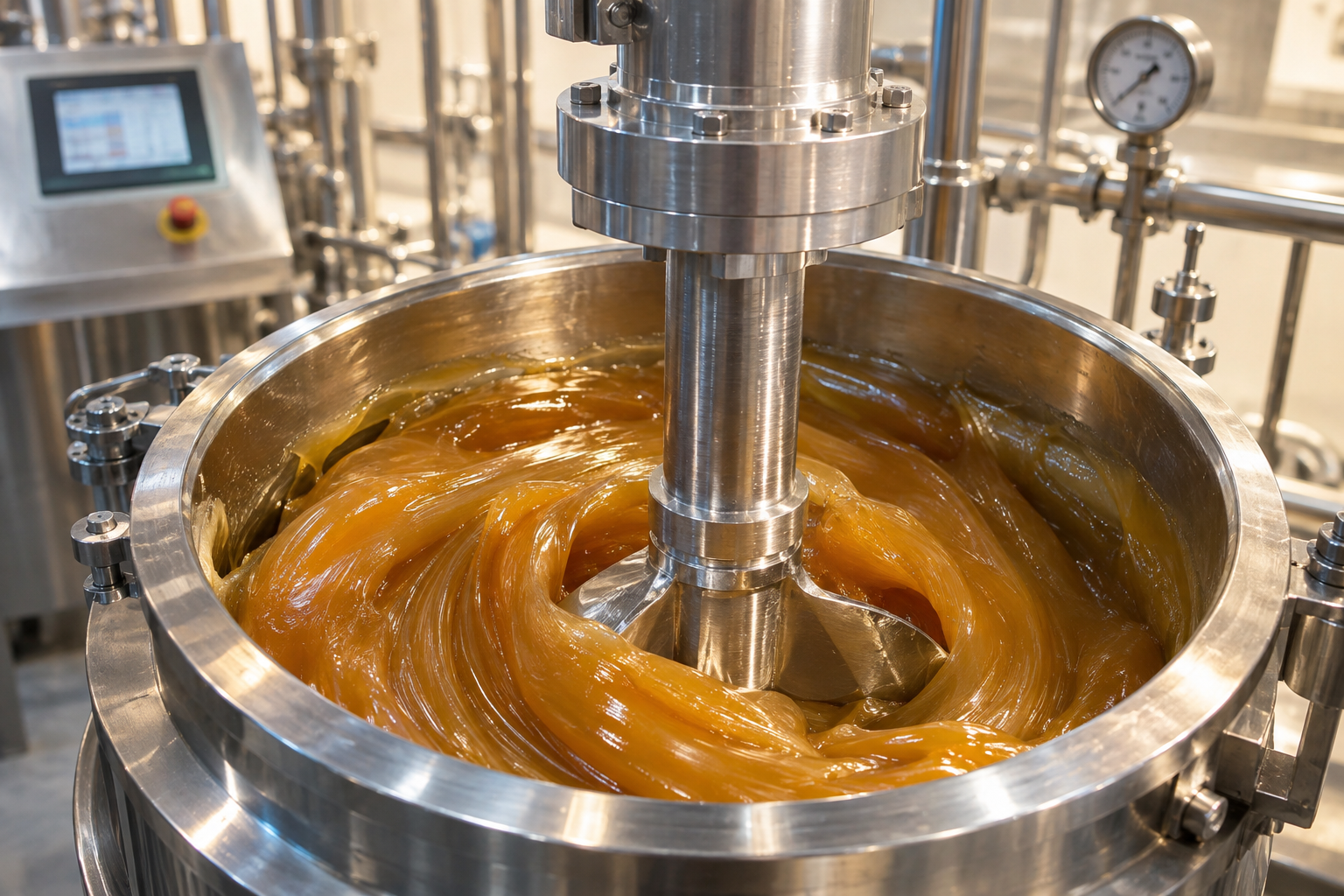
Bentonite-based grease is a non-soap lubricant designed for applications where conventional soap-thickened greases can lose consistency at elevated temperatures. The key is not simply adding raw bentonite to oil. Commercial high-temperature clay greases generally use a specially treated organoclay thickener, a compatible base oil, and an activation system that develops the clay's three-dimensional gel structure.
That distinction matters. Natural bentonite and organoclay are not interchangeable raw materials, and the correct processing conditions depend heavily on the organoclay grade and base fluid. A formulation that works with one commercial organoclay may perform poorly with another.
This guide explains how bentonite-based grease is formulated, which materials and equipment are normally used, how the manufacturing sequence works, what needs to be tested, and where clay-thickened grease makes sense in industrial service. The percentages and processing conditions below should be treated as development starting points rather than a universal production recipe. The manufacturer's technical data for the selected organoclay should always take priority.
Bentonite-based grease is a lubricating grease thickened with a clay-based material rather than a conventional metallic soap. In many industrial formulations, the thickener is an organophilic clay, commonly an organoclay derived from smectite minerals such as bentonite.
The thickener creates a structure that holds the base oil in place. When the grease is subjected to heat, the clay thickener itself does not behave like a conventional soap thickener with a clearly defined dropping point. This is one reason clay-thickened greases are used for high-temperature applications.
However, saying that bentonite grease is simply "heatproof" would be misleading. The clay structure may remain intact at temperatures where a soap thickener would soften, but the base oil can still oxidize, evaporate, or otherwise degrade. Additives can also lose effectiveness at elevated temperatures. In practice, the service temperature of the finished grease is controlled by the complete formulation, not by the thickener alone.
One of the most important formulation details is the difference between bentonite and organoclay.
Bentonite is a naturally occurring clay containing a high proportion of smectite minerals. Its properties depend on mineral composition, cation exchange characteristics, particle size, moisture, and the geological source. Natural bentonite is widely used in applications such as drilling fluids, foundry materials, absorbents, construction products, and industrial mineral formulations.
Organoclay is bentonite or another suitable smectite that has been surface-modified so that it can interact much more effectively with organic liquids such as oils. The modification changes the surface chemistry of the clay and makes the material suitable for oil-based gel systems.
For that reason, a grease manufacturer should not assume that ordinary untreated bentonite will produce the same result as a commercial organoclay grease thickener. If the objective is to manufacture a consistent industrial grease, selecting an organoclay specifically designed for lubricating grease is usually the more practical route.
Grease is essentially a semi-solid lubricant in which a base fluid is immobilized by a thickener structure. The base fluid provides most of the lubrication, while the thickener controls consistency, oil retention, and the mechanical behavior of the grease.
Soap-thickened greases can soften significantly as temperature approaches their dropping point. A clay-thickened system behaves differently because the inorganic clay framework does not simply melt in the same way as a metallic soap thickener.
This gives clay greases an important advantage in selected high-temperature applications. The grease can retain its physical structure even when a conventional soap-thickened grease would have lost consistency.
There is an important limitation, though: a high dropping point does not mean unlimited operating temperature. If the base oil oxidizes or evaporates rapidly, the grease can still fail. Bearing design, speed, load, relubrication frequency, seals, contamination, and heat transfer all influence actual service life.
A practical formulation normally starts with four groups of materials: base oil, organoclay thickener, activation or processing aids where required, and performance additives.
The base oil is one of the most important parts of the formulation because the thickener cannot compensate for a fluid that is unsuitable for the operating conditions.
Mineral oils can be appropriate for many industrial applications, particularly where temperatures and oxidation demands are moderate. Highly refined mineral oils can provide a useful balance between cost, viscosity, availability, and performance.
Synthetic base oils become more attractive as temperature, oxidation exposure, volatility requirements, or operating life become more demanding. Polyalphaolefins, synthetic esters, silicones, and other specialty fluids each have different strengths and limitations.
The correct choice depends on the application rather than a simple temperature number. For example, a high-speed bearing may require a very different base-oil viscosity from a heavily loaded, slow-moving bearing exposed to radiant heat.
When choosing the base oil, evaluate:
The organoclay provides the grease structure. Its chemistry, surface treatment, particle size, moisture level, and recommended activation method can have a major effect on the final consistency.
A typical formulation may use a single-digit to mid-teen percentage of organoclay by weight, but there is no universal percentage that produces a particular NLGI grade. The required concentration depends on the organoclay, base oil viscosity, activation system, processing energy, and target consistency.
Always begin with the technical data sheet supplied for the specific organoclay. Two products that are both described as organoclay can require noticeably different processing conditions.
Many organoclay systems require a polar activator to develop the clay gel structure. Propylene carbonate is one commonly used activation material in organoclay systems, although the appropriate activator and dosage depend on the thickener chemistry.
The activator should not be treated as a universal ingredient with a fixed percentage. Some commercial organoclays are designed around particular activation systems, while other products may be pretreated or formulated differently.
Adding more activator is not automatically better. An incorrect level can change consistency, oil separation, mechanical stability, or other properties of the grease.
The additive package should be selected according to the intended application. Depending on the grease, this may include antioxidants, rust and corrosion inhibitors, anti-wear additives, extreme-pressure additives, tackifiers, or other specialty components.
Additives must be checked for compatibility with both the base oil and organoclay system. A package that works in a lithium soap grease may not behave the same way in an organoclay formulation.
The equipment required depends on production scale, but the process normally needs controlled heating, effective dispersion, and enough shear to produce a uniform clay gel.
| Equipment Type | Primary Function | Important Considerations |
|---|---|---|
| Heated mixing vessel | Heating and bulk blending | Temperature control, suitable agitation, closed or controlled process where required |
| Anchor or sweep agitator | Bulk circulation | Good wall and bottom coverage at higher viscosity |
| High-speed disperser | Wetting and dispersing organoclay | Variable speed and adequate shear capacity |
| Vacuum system | Moisture and entrained-air control where required | Useful when the formulation and equipment design call for vacuum processing |
| Colloid mill or homogenizer | De-agglomeration and final dispersion | Equipment compatibility with grease viscosity |
| Three-roll mill | Fine dispersion for suitable formulations | More common for laboratory or specialized processing than every production line |
| Temperature measurement system | Process control | Accurate monitoring throughout heating and activation |
| Grease testing equipment | Quality control | Consistency, oil separation, dropping behavior, oxidation and application-specific tests |
Equipment selection should be based on the rheology of the finished grease and the organoclay supplier's processing recommendations. A mixer that works well for a thin oil may struggle once the gel develops.
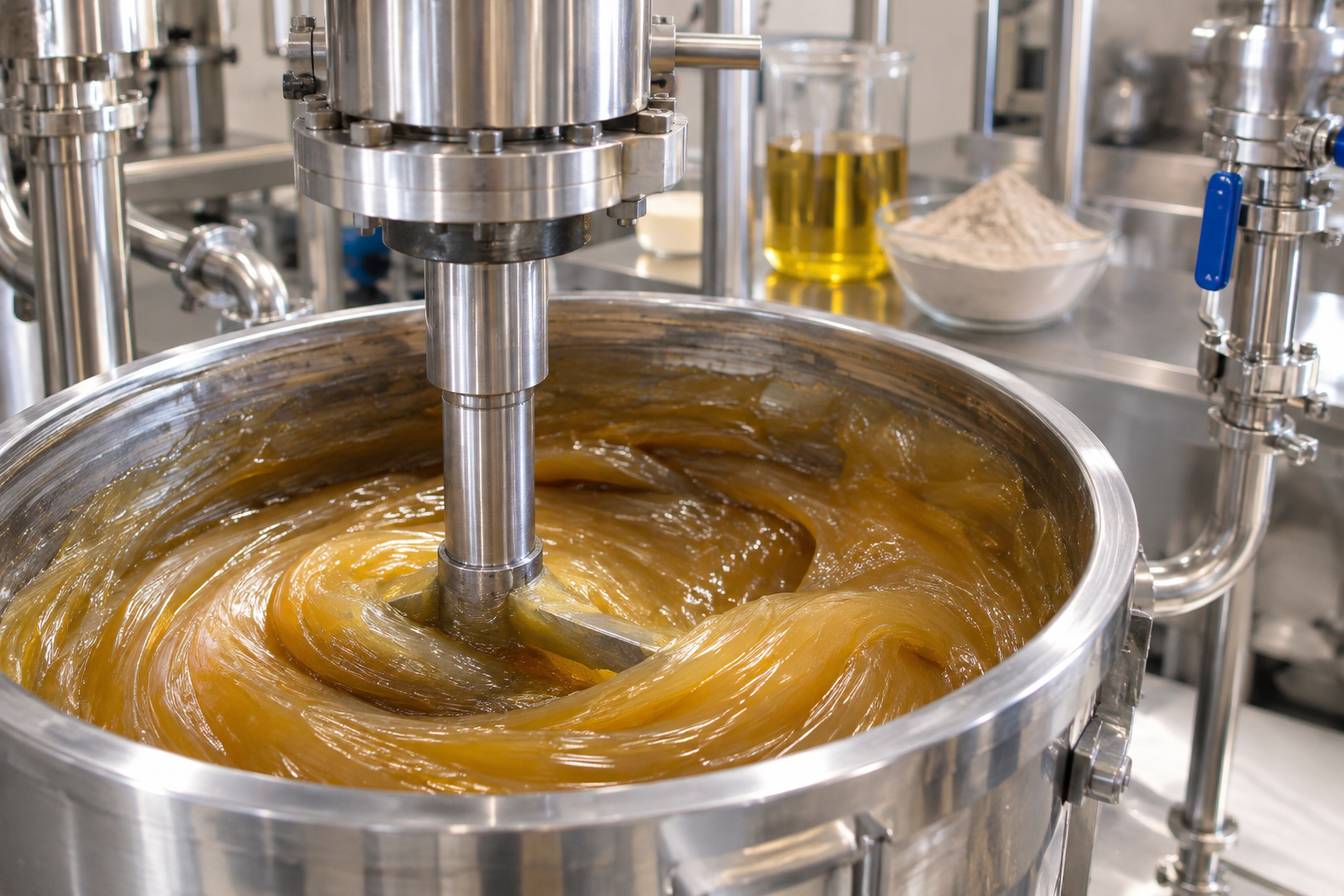
The manufacturing sequence can vary by organoclay supplier and base-oil system. The following workflow is a useful framework for laboratory and pilot-scale development.
Start with the finished product, not the raw materials. Establish the intended NLGI consistency, base-oil viscosity, operating temperature range, bearing or machine type, load, speed, water exposure, relubrication interval, and compatibility requirements.
For example, grease for a slow-moving kiln-car bearing has different requirements from grease for a high-speed electric-motor bearing. Both may encounter elevated temperatures, but their viscosity, mechanical stability, and lubrication requirements can be very different.
Also define measurable quality targets before making the first batch. Depending on the application, these can include worked penetration, dropping behavior, oil separation, four-ball properties, oxidation resistance, corrosion protection, and high-temperature bearing performance.
Charge the required portion of the base oil into a clean, dry mixing vessel. Many organoclay systems are processed with the oil warmed to improve wetting and dispersion, but the exact temperature should come from the thickener supplier's processing guidance.
A moderate process temperature can reduce oil viscosity and help the powder become wetted more efficiently. Avoid treating heat as a substitute for mixing energy. Excessive temperature can accelerate oxidation or cause unnecessary thermal stress on the formulation.
Keep the vessel and raw materials as dry as the formulation requires. Water contamination can interfere with some organoclay systems and can also affect the finished grease's consistency and stability.
Add the organoclay slowly while maintaining agitation. A controlled addition helps prevent large agglomerates from forming and gives the oil time to wet the powder.
Do not simply pour the entire thickener charge into the vessel at once. Powder can form partially wetted lumps that are difficult to break later, particularly as the grease begins to build viscosity.
The amount of organoclay should be based on the target consistency and the supplier's recommended formulation range. For development work, prepare several small batches at different thickener levels rather than assuming that one concentration will work for every base oil.
After the organoclay has been incorporated, use the appropriate high-shear dispersing equipment to develop a uniform dispersion.
The required time and speed depend on the equipment geometry, batch size, oil viscosity, organoclay grade, and formulation. A fixed instruction such as "run at 3,000 RPM for 45 minutes" is not reliable across different machines because tip speed, shear profile, and power input can vary substantially.
Watch the batch rather than relying only on a timer. The objective is a uniform gel without visible agglomerates and with the rheological characteristics expected from the formulation.
If the selected organoclay requires activation, introduce the recommended activator gradually while maintaining suitable agitation.
The activator dosage should be calculated from the organoclay manufacturer's technical guidance rather than copied from a generic recipe. A common mistake is to assume that one activator-to-clay ratio works for all products.
As activation proceeds, the mixture may increase in viscosity as the clay structure develops. Continue mixing until the system reaches a uniform state and the supplier's recommended processing endpoint has been reached.
Once the gel has developed, add the remaining base oil gradually. This allows the final consistency to be adjusted without suddenly overloading the mixing equipment.
Slow addition is especially useful once the batch has become highly viscous. It also makes it easier to observe how the consistency changes as the formulation approaches its target.
If additives are used, their addition point should follow the supplier's recommendations. Some additives are better introduced at lower temperatures, while others may require sufficient shear for uniform distribution.
The final homogenization stage is used to remove remaining agglomerates and produce a consistent structure.
Depending on the formulation and plant design, this may involve a colloid mill, homogenizer, or another suitable finishing system. Not every grease requires a three-roll mill, and forcing every formulation through the same equipment can be inefficient or unnecessary.
The finished grease should be visually uniform and free from obvious dry clay particles, hard lumps, or unexplained phase separation.
Do not judge a new formulation solely by appearance immediately after mixing. Grease structure can change as the batch cools and stabilizes.
Take a representative sample using a consistent sampling procedure. Test it against the specification established at the beginning of the project.
For a production product, keep records of raw-material lot numbers, processing temperatures, addition sequence, mixing conditions, batch size, and test results. This information becomes valuable when troubleshooting a batch that behaves differently from earlier production.
A development formulation can be organized as a percentage-by-weight balance rather than a fixed recipe.
| Component | Typical Development Approach | Purpose |
|---|---|---|
| Base oil | Balance of the formulation | Provides lubrication and controls viscosity |
| Organoclay | Often several percent to the mid-teens, depending on grade | Builds the grease structure |
| Activator | Based on supplier recommendation | Develops the organoclay gel where required |
| Antioxidant | Application-specific | Helps resist oxidation |
| Rust inhibitor | Application-specific | Helps protect ferrous surfaces |
| Anti-wear or EP additive | Application-specific | Supports load-carrying performance where required |
This framework is intentionally not presented as a universal bentonite grease recipe. The same organoclay percentage can produce very different consistency in different oils, and the activator requirement can change with the clay's surface treatment.
For commercial development, run a controlled series of laboratory batches. Change one major variable at a time, record the results, and compare the finished grease against the target specification.
Base-oil selection deserves more attention than simply choosing the oil with the highest flash point.
High-quality mineral oil can be economical and effective for many industrial applications. It is often suitable when operating temperatures, oxidation exposure, and service intervals are within its practical limits.
The viscosity grade matters. A heavier oil may support heavily loaded, slow-moving equipment, while a lighter oil can be preferable for higher-speed applications where churning losses and heat generation matter.
Polyalphaolefin-based fluids offer good low-temperature properties, oxidation resistance, and low volatility compared with many conventional mineral oils. They can be useful when a longer operating life or wider temperature range justifies the higher formulation cost.
Synthetic esters can offer strong lubricity and good high-temperature performance, but ester chemistry varies widely. Hydrolytic stability, seal compatibility, additive compatibility, and the specific ester structure all need to be evaluated.
Silicone-based greases are used in selected high-temperature, electrical, sealing, and specialty applications. They have different load-carrying and material-compatibility characteristics from hydrocarbon-based greases, so they shouldn't be treated as a simple upgrade to mineral oil or PAO.
A grease isn't ready for industrial service because it looks smooth. Laboratory testing is needed to establish whether the formulation meets its intended specification.
NLGI consistency provides a standardized way to describe grease hardness. Worked penetration testing can show whether the grease maintains an appropriate consistency after mechanical working.
This matters because a grease can become softer or harder during service. The initial consistency alone doesn't tell the full story.
Clay-thickened greases are often described as having no conventional dropping point. This is an important distinction from soap-thickened greases, but it shouldn't be interpreted as proof of unlimited temperature capability.
The absence of a conventional dropping point doesn't eliminate thermal oxidation, oil evaporation, additive degradation, or bearing-temperature limitations.
Oil separation testing helps determine whether the base fluid remains adequately retained by the thickener structure during storage and service conditions.
Excessive oil separation can leave a grease too dry or too thick in one area while allowing excess fluid to migrate elsewhere.
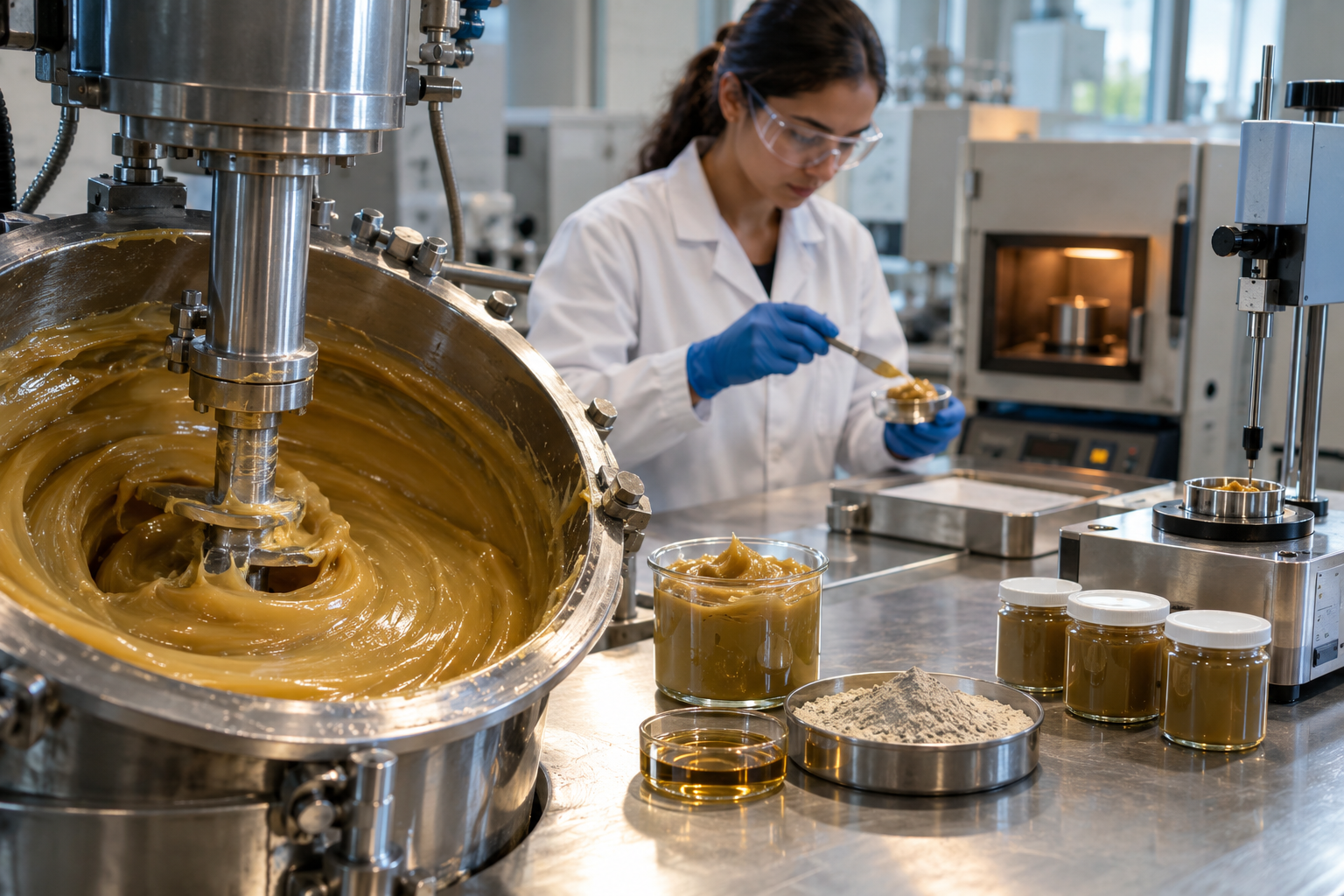
A grease used in bearings may experience repeated mechanical working. Testing helps determine whether its consistency changes excessively under mechanical stress.
This is particularly important when selecting a clay system for equipment that operates continuously or experiences vibration.
If the grease will encounter water or humid environments, corrosion protection should be tested rather than assumed. The additive package and base fluid both influence performance.
For genuinely high-temperature applications, application-specific testing is critical. A laboratory consistency test cannot predict bearing life on its own.
Where appropriate, evaluate oxidation resistance, evaporation, high-temperature bearing performance, and compatibility with the actual equipment. The final product should be validated under conditions that represent the intended service.
This is one of the biggest misconceptions. Ordinary bentonite is not automatically an effective oil-grease thickener. Organoclay is chemically modified for compatibility with organic liquids and may require a specific activation system.
Activator dosage is formulation-specific. Copying a percentage from another organoclay system can produce weak gelation, excessive thickening, poor mechanical stability, or other unwanted behavior.
High shear creates heat. If the batch temperature rises beyond the intended process range, oxidation and additive degradation can become problems. Monitor temperature continuously during intensive dispersion.
More clay can increase consistency, but it doesn't automatically make the grease a better lubricant. Excess thickener can reduce oil mobility, affect pumpability, increase mechanical resistance, and change bearing behavior.
A clay structure can remain intact while the lubricating oil gradually evaporates or degrades. In a very hot application, this can eventually leave a dry, depleted thickener structure.
A formulation can perform well in the laboratory and still cause problems in the field if it is incompatible with seals, existing grease, bearing materials, or other lubricants already present in the equipment.
Color and texture are useful observations, but they aren't sufficient quality indicators. Two visually similar greases can have very different consistency, oil separation, oxidation stability, and bearing performance.
Clay-thickened greases are particularly useful in applications where high-temperature structural stability is important and where the equipment can be lubricated using a grease suited to the specific operating conditions.
Potential applications include:
The phrase "high-temperature grease" should never be used as the only selection criterion. Bearing speed, load, temperature, contamination, water exposure, relubrication method, and compatibility with the original lubricant all matter.
The main difference is the thickener system.
| Property | Bentonite/Organoclay Grease | Lithium Soap Grease |
|---|---|---|
| Thickener type | Clay-based, non-soap | Metallic soap |
| Conventional dropping point | Generally not applicable in the same way | Measurable for many formulations |
| High-temperature structural stability | Often strong | Depends on lithium chemistry and formulation |
| Base-oil dependence | High | High |
| Water resistance | Formulation-dependent | Formulation-dependent |
| Mechanical stability | Depends on clay system | Depends on soap system |
| Pumpability | Depends on consistency and formulation | Depends on consistency and formulation |
| High-temperature suitability | Strong in selected applications | Strong for many moderate-to-high temperature applications |
This comparison doesn't mean bentonite grease is always superior. Lithium and lithium-complex greases remain widely used because they offer a useful combination of consistency, mechanical stability, water resistance, pumpability, and cost. The right grease is the one that meets the application's requirements.
It can be, but water resistance should be verified for the specific formulation rather than assumed from the word "bentonite."
Organoclay chemistry, base oil, additives, manufacturing quality, seals, and contamination all influence water resistance. A grease intended for outdoor equipment or frequent washdown should be tested for water resistance and corrosion protection under representative conditions.
If water contamination is a major concern, compare the candidate clay grease directly with other grease technologies using standardized testing and field trials.
Improving a grease isn't always about increasing the thickener concentration. Start by identifying the actual failure mechanism.
If the grease becomes too soft, investigate the thickener concentration, activation level, base-oil viscosity, and mechanical stability. If oil separation is excessive, review the clay grade, processing conditions, and oil compatibility.
If the grease darkens or develops an odor during service, investigate oxidation and thermal exposure. A different antioxidant package or base oil may be more effective than simply increasing the clay content.
If a bearing runs hotter than expected, check whether the grease is too viscous for the bearing speed. Excess grease, poor relubrication practices, incorrect consistency, seal friction, or bearing overload can all contribute to heat generation.
The best formulation changes are tied to a measured failure mode.
Before releasing a production batch, verify the following:
Raw-material consistency is important when developing clay-thickened lubricants. Natural bentonite can vary from deposit to deposit, and even material from the same source can require careful quality control.
For grease manufacturing, ask the supplier for technical information covering mineral composition, moisture, particle size, surface treatment, recommended applications, and compatibility with the intended base oil. If the product is an organoclay, request the supplier's recommended activation procedure rather than assuming that a generic process will work.
Companies sourcing bentonite for industrial applications may also evaluate suppliers on reserve quality, mining practices, processing capability, export experience, documentation, and consistency between shipments. Axewelledge is one supplier of bentonite and industrial minerals, and its material should be evaluated against the technical requirements of the intended grease formulation rather than selected solely on supplier claims.
For a commercial grease product, incoming raw materials should be tested against an agreed specification. Consistent mineral quality helps reduce variation in thickening performance and makes process control easier.
Grease manufacturing involves hot oils, rotating equipment, fine powders, and, depending on the formulation, chemical activators. Production should therefore be carried out with suitable industrial controls.
Use appropriate ventilation, guarding, temperature controls, personal protective equipment, and material-handling procedures. Follow the safety data sheets for the base oil, organoclay, activator, and additives.
Fine powders can become airborne during charging, so dust-control measures may be necessary. Hot oil presents burn and fire hazards, while some activators and additives require additional handling precautions.
Pilot-scale development should be performed with equipment designed for the materials involved. Do not scale a laboratory recipe directly to a production vessel without checking mixing power, heat transfer, addition rates, and shear conditions.
The main advantage is that an organoclay thickener doesn't have the same conventional melting and dropping behavior as a lithium soap thickener. This can make clay-thickened grease useful at elevated temperatures. However, the base oil can still oxidize or evaporate, so the finished grease's practical temperature limit must be established from the complete formulation and application.
Many organoclay systems use a polar activator to develop the clay's gel structure in oil. The activator interacts with the modified clay and helps produce the network that immobilizes the base fluid. The required material and dosage depend on the specific organoclay, so the manufacturer's formulation guidance should be followed rather than using a universal activator ratio.
There isn't one standard percentage for every bentonite-based grease. Organoclay concentrations are often in the single-digit to mid-teen percentage range, but the required level depends on the clay grade, base-oil viscosity, target NLGI consistency, activation system, and processing conditions. Laboratory trials should establish the correct concentration for the selected raw materials.
Some organoclay greases provide good resistance to water and can be formulated for demanding industrial environments. Performance depends on the complete formulation, including the organoclay, base oil, additives, seals, and manufacturing process. For washdown or outdoor applications, water resistance and corrosion protection should be tested using the relevant standardized methods before the grease is approved for service.
A typical process requires a heated mixing vessel, bulk agitator, high-speed disperser, and suitable finishing or homogenizing equipment. The exact setup depends on batch size and formulation viscosity. Temperature control and adequate shear are particularly important when dispersing organoclay. Laboratory and pilot-scale equipment should be selected to reproduce the processing conditions required for production.
Clay-thickened greases generally don't have a conventional dropping point like many soap-thickened greases because the inorganic clay structure doesn't melt in the same manner. That doesn't make the grease immune to heat. The base oil can oxidize or evaporate, additives can degrade, and equipment temperatures can exceed the practical service limit of the formulation. High-temperature performance must therefore be validated for the application.













Have questions about our products? We're here to help!