Axewelledge, a leading exporter from India, specializes in high-quality Bentonite. With a commitment to excellence, we supply premium Bentonite to the Middle East and Southeast Asia markets.


North Angle Complex, 304,
150 Feet Ring Rd, Opposite Ambedkar Nagar BRTS Stop,
Madhav Park, Punit Nagar,
Mavdi, Rajkot, Gujarat 360004
© Axewelledge 2026, All Rights Reserved.
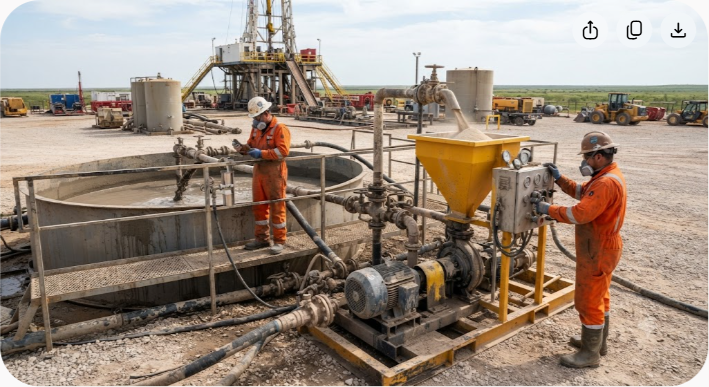
The right way to mix bentonite for drilling fluid is to control the water quality, introduce the powder gradually under strong agitation, give the clay enough time to hydrate, and then adjust the finished mud against measured properties. The goal isn't simply to make the fluid look thick. A useful drilling mud must carry cuttings, control fluid loss, lubricate the drilling system, and provide enough borehole support for the formation being drilled.
That distinction matters because a mud can look viscous in the tank and still perform poorly downhole. Poorly hydrated bentonite may contain dry cores, unstable gels, or incompletely dispersed clay. Water chemistry can suppress swelling, while excessive bentonite can create a fluid that is difficult to pump and may increase pressure losses.
This guide explains how to mix bentonite for drilling fluid from makeup water through final testing. It covers water treatment, mixing equipment, powder addition, hydration, concentration, viscosity checks, common mistakes, and practical adjustments for HDD, water wells, geotechnical drilling, and similar water-based drilling applications.
Bentonite is a clay rich in montmorillonite, a layered aluminosilicate mineral. Sodium bentonite is widely used in water-based drilling fluids because its montmorillonite content can hydrate and disperse in fresh water, producing a suspension with useful viscosity and gel-forming properties.
Once dispersed, the clay particles interact with water and with one another. The resulting structure gives the fluid non-Newtonian behaviour. Under sufficient shear, the apparent viscosity falls so the mud can circulate through the drilling system. When circulation stops, the clay structure rebuilds and helps keep suspended solids from settling quickly.
For drilling, several properties matter at the same time:
These properties are related, but they aren't interchangeable. Increasing bentonite concentration may increase viscosity and gel strength, for example, but simply making the mud thicker isn't always the correct solution to a fluid-loss or hole-cleaning problem.
Sodium bentonite generally has a much higher swelling and dispersion capacity than calcium bentonite when used in fresh-water systems. That makes sodium-rich grades particularly useful where the drilling fluid needs suspension, filtration control, and borehole support.
The actual performance still depends on mineralogy, montmorillonite content, particle-size distribution, water chemistry, mixing energy, and the product specification. Two materials both sold as sodium bentonite can produce noticeably different drilling-fluid properties.
For that reason, a product's technical data and laboratory test results are more useful than the name on the bag alone.
One of the most overlooked parts of mud preparation is the makeup water. If the water is unsuitable, increasing the bentonite dosage may not solve the problem.
Fresh, relatively low-hardness water generally gives sodium bentonite the best opportunity to hydrate and disperse. Calcium and magnesium can interfere with the clay's normal behaviour, while high dissolved-salt concentrations can reduce swelling and change rheology.
Before mixing a large batch, check the water source. If the job uses municipal water, well water, recycled water, or water from a surface source, its chemistry may vary substantially.
| Parameter | What to Watch | Why It Matters |
|---|---|---|
| pH | Mildly alkaline mixing conditions are commonly preferred | Strongly acidic or highly alkaline water can change clay dispersion and additive performance |
| Calcium hardness | Elevated calcium can interfere with sodium bentonite hydration | Can reduce swelling and promote undesirable flocculation |
| Magnesium | High magnesium can also affect clay behaviour | May reduce effective hydration and alter rheology |
| Total dissolved solids | High salinity can suppress swelling | Particularly important when using brackish or recycled water |
| Temperature | Very cold water can slow hydration | Longer mixing and hydration may be required |
| Suspended solids | Excess solids can affect mud properties | May increase background viscosity and complicate testing |
There isn't one universal water specification that fits every bentonite product and drilling system. Use the bentonite supplier's technical data together with the drilling-fluid program rather than treating a single pH or hardness number as a guarantee of performance.
Soda ash, or sodium carbonate, is commonly used to treat calcium hardness before bentonite is added. It can convert soluble calcium into less soluble forms that can be removed or controlled, reducing the calcium available to interfere with clay hydration.
The dosage should be based on a water-hardness test and the treatment procedure used on the job. Adding soda ash by guesswork can create a different problem by pushing the water chemistry too far in the other direction.
A practical sequence is to add the calculated treatment to the makeup water, circulate until it is well dispersed, allow the reaction to occur as required by the treatment procedure, and then verify the water before introducing bentonite.
The equipment required depends on batch size, bentonite grade, water volume, and the performance target. A small laboratory or field batch can be prepared with suitable mechanical agitation, but production drilling normally benefits from a properly designed mud-mixing system.
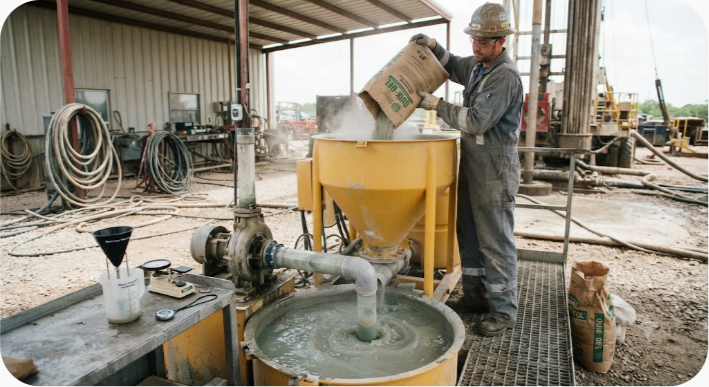
A venturi or jet hopper uses a high-velocity water stream to draw dry bentonite into the mixing circuit. The turbulent zone disperses the powder rapidly and reduces the chance of large agglomerates entering the tank.
The hopper needs enough water flow and pressure to maintain effective suction. If the powder begins to accumulate around the hopper throat, the feed rate is probably too high for the available hydraulic capacity.
A centrifugal pump provides circulation through the mixing system and can supply the velocity needed for effective initial dispersion. Pump selection should account for the required flow rate, pressure, pipe diameter, solids loading, and system configuration.
The pump should not be treated as a substitute for a properly sized hopper. A system can have a powerful pump and still mix poorly if the dry powder enters the tank faster than it can disperse.
Agitators keep the tank contents moving and reduce dead zones where clay or solids can accumulate. They are particularly useful once the initial powder addition is complete and the mud is being conditioned.
Agitation should produce circulation throughout the tank rather than simply creating a strong vortex in one location. Tank geometry, impeller position, and agitator speed all affect the result.
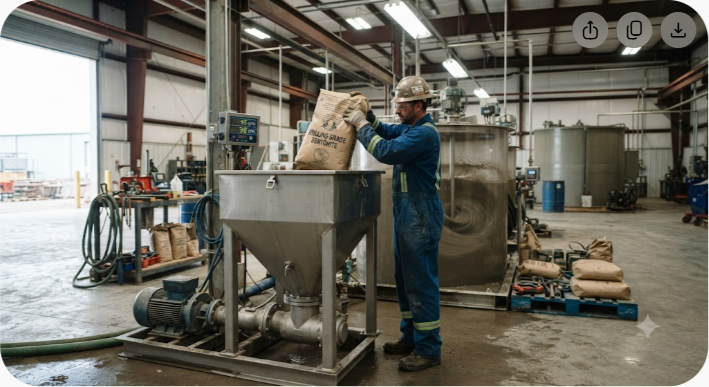
For larger drilling operations, the mixing system may also include storage tanks, mud guns, screens, desanders, desilters, centrifuges, chemical dosing equipment, and laboratory testing equipment. The complete solids-control system should be considered when planning mud preparation, not just the initial mixing tank.
A consistent sequence makes the mud easier to reproduce from one batch to the next. The following procedure is a practical starting point, but the exact dosage and conditioning time should follow the bentonite grade and drilling program.
Determine the actual working volume of the mixing tank rather than relying on its nominal capacity. Leave enough headspace for circulation and powder addition.
For example, if a tank holds 1,000 litres but the safe working volume is 800 litres, calculate the bentonite requirement from 800 litres. Overfilling the tank makes mixing less effective and can cause spills when the clay hydrates.
Measure the water properties that are relevant to the product and drilling application. At minimum, consider pH and hardness when water chemistry is uncertain. If the water source is saline or recycled, check total dissolved solids or salinity as appropriate.
If treatment is needed, complete it before adding bentonite. Record the treatment and water test results so the batch can be reproduced later.
Start the mixing pump and establish a stable flow through the hopper or mixing circuit. Don't add dry bentonite to a tank of nearly stagnant water and expect circulation to fix the resulting lumps later.
The water should already be moving when the powder enters the system.
Introduce the powder at a controlled rate. The correct feed rate depends on the hopper design and available water flow, so there isn't one universal number of bags per minute.
A useful field rule is simple: the powder should disappear into the mixing stream rather than accumulate on the water surface or around the hopper. If the system begins to overload, reduce the feed rate.
Do not dump several bags directly into the tank at once. Rapid addition can create agglomerates whose hydrated outer surfaces protect dry bentonite inside.
Continue circulating the slurry after the powder addition is complete. Mechanical energy helps disperse the clay and develop its rheological properties.
The exact conditioning time depends on the bentonite, equipment, water temperature, and target properties. A short laboratory mix may behave differently from a full-scale field system, so use measured viscosity and other relevant tests to determine when the batch is ready.
Hydration isn't necessarily complete when the last bag has disappeared into the hopper. Clay dispersion and property development continue after initial mixing.
Many field operations allow roughly 30 to 60 minutes of conditioning or hydration before using the fluid, but this should be treated as a starting point rather than a universal rule. Some products and operating conditions require longer. Cold water, poor water chemistry, insufficient shear, and coarse or lower-yield products can all extend the time needed.
Before sending the batch downhole, check the properties that matter for the application. Depending on the drilling program, these may include funnel viscosity, Marsh funnel viscosity, density, pH, sand content, fluid loss, rheology, and gel strength.
Don't adjust a batch simply because it looks thick or thin. Test it first, identify the property that is outside the operating range, and then make a controlled adjustment.
There is no single bentonite-to-water ratio that works for every drilling operation. The required concentration depends on formation type, hole size, circulation rate, expected fluid loss, borehole stability, product yield, and whether polymers or other additives are also being used.
As a starting point, some conventional fresh-water drilling applications may use approximately 20 to 25 pounds of sodium bentonite per 100 gallons of water. More demanding loose or sandy formations may require higher concentrations, while other applications may operate successfully at lower concentrations.
For metric calculations, 20 to 25 pounds per 100 US gallons is roughly 24 to 30 kilograms per 1,000 litres. Always calculate from the actual water volume and verify the resulting properties rather than treating the dosage as a fixed recipe.
Suppose a drilling contractor needs to prepare 5,000 litres of mud and the selected product's starting field concentration is 25 kilograms per 1,000 litres.
The calculation is:
The calculation provides a starting quantity, not a guarantee of final viscosity. A high-yield product may require less material than a lower-yield grade to reach the same target properties.
HDD drilling fluids need to balance suspension, hole cleaning, filtration control, lubrication, and pumpability. Excessively thick mud can increase circulating pressure and make fluid handling more difficult, while insufficient viscosity may allow cuttings to settle in the annulus.
For HDD, the formation is especially important. Coarse sand and gravel can accept large quantities of fluid, while reactive clay can create a very different set of problems. Bentonite concentration should therefore be adjusted with formation response and measured mud properties in mind.
Polymers may also be used with bentonite when additional fluid-loss control, encapsulation, lubrication, or hole-cleaning performance is required. Compatibility should be established through testing rather than assuming that adding more polymer will always improve the system.
Water well drilling often uses bentonite mud to maintain borehole stability and transport cuttings. The required fluid properties can change as the formation changes.
A fluid suitable for a loose sand interval may be unnecessarily viscous in a more stable formation. Excessive mud solids can also make later well development more difficult. The drilling-fluid program should therefore consider both drilling performance and the requirements of well completion.
Geotechnical work often involves smaller fluid volumes and frequent formation changes. Consistency between batches becomes important when borehole conditions must be compared across multiple locations.
Environmental drilling can impose additional requirements around additives, waste handling, and potential contamination. In these applications, the selected bentonite and any supporting chemicals should be compatible with the project specification and disposal requirements.
Viscosity should be managed as a measured property, not as a visual impression. A mud that looks thick in the tank may still have unsuitable low-shear behaviour, while a fluid that appears relatively thin may perform adequately under the actual drilling conditions.
A Marsh funnel can provide a quick field indication of fluid consistency. More detailed drilling-fluid programs may use a rotational viscometer to measure rheological properties at different shear rates and calculate parameters such as plastic viscosity and yield point.
When viscosity is too low, investigate the cause before simply adding more bentonite. Possible causes include:
When viscosity is too high, consider whether the batch contains too much clay or drilled solids, whether hydration has progressed further than expected, or whether another additive is contributing to the rheology.
Dilution with suitable makeup water may be appropriate in some cases, but the resulting fluid should be retested rather than adjusted by appearance alone.
Yield point and gel strength are often discussed together, but they describe different aspects of mud behaviour.
Yield point is associated with the stress required to initiate flow and move suspended material. It can therefore provide useful information about low-shear carrying capacity and hole cleaning.
Gel strength describes the fluid's ability to develop structure when it remains static. Adequate gel strength helps keep cuttings suspended when circulation pauses.
Too little structure can allow solids to settle. Excessive static gel strength can make restarting circulation more difficult and may increase the pressure required to break the gel. The target should therefore be appropriate for the drilling system rather than simply as high as possible.
Hydration time is frequently misunderstood. Adding bentonite to water starts the process, but the final drilling-fluid properties may continue to develop during mixing and subsequent conditioning.
The rate depends on several factors:
Instead of relying on a fixed waiting period, compare the mud's measured properties over time. When the readings become stable within the operating target, the batch is more likely to be adequately conditioned.
This is one of the easiest ways to create fish eyes. The outside of a particle cluster hydrates first, while dry material remains trapped inside. Those agglomerates can survive circulation and later cause problems at screens, nozzles, or pumps.
Better approach: Match the powder feed rate to the hopper's water flow and mixing capacity.
Standing water doesn't provide enough dispersion energy to separate a large quantity of dry clay efficiently. The result can be uneven hydration and persistent lumps.
Better approach: Establish circulation before powder addition begins.
A contractor may increase the bentonite dosage when the real problem is calcium-rich makeup water. The additional clay increases cost without necessarily solving the underlying chemistry problem.
Better approach: Test the water and treat hardness when the drilling-fluid program calls for it.
A freshly mixed sample isn't always representative of the fluid after it has been properly conditioned. Testing too early can lead to unnecessary changes in concentration.
Better approach: Establish a repeatable mixing and conditioning procedure, then test at a consistent point in the process.
High viscosity isn't automatically better. An unnecessarily thick mud can increase pumping pressure, complicate solids control, and make circulation less efficient.
Better approach: Set operating targets for the actual drilling conditions and monitor several properties rather than one number.
The mud doesn't contain only bentonite once drilling begins. Formation cuttings accumulate and can change density, rheology, and flow behaviour.
Better approach: Maintain appropriate solids-control practices and monitor the circulating fluid throughout the run.
A concentration that works in one soil may be unsuitable in another. Sand, gravel, reactive clay, fractured rock, and mixed formations place different demands on the fluid.
Better approach: Start with the bentonite manufacturer's recommended concentration range and adjust using actual field measurements and formation response.
| Problem | Likely Causes | Practical Checks |
|---|---|---|
| Low viscosity | Poor hydration, hard water, low dosage, low-yield product | Check water chemistry, mixing time, product specification, and concentration |
| Persistent fish eyes | Powder added too quickly, weak hopper suction, inadequate shear | Inspect hopper flow and reduce powder feed rate |
| Excessive viscosity | Too much bentonite, excess drilled solids, additive interaction | Check concentration, solids content, and additive program |
| High fluid loss | Inadequate clay concentration, poor filter-cake development, formation effects | Check bentonite quality and fluid-loss properties |
| Rapid settling of cuttings | Insufficient low-shear carrying capacity or poor gel development | Check rheology and solids loading |
| Difficult circulation restart | Excessive gel strength or solids accumulation | Measure gels and inspect tank and annular conditions |
| Unstable properties between batches | Inconsistent water, dosage, mixing, or product quality | Standardize batch procedure and record test results |
| Mud changes after entering the hole | Formation water, drilled solids, temperature, or chemical contamination | Compare fresh and circulating-fluid samples |
Bentonite is often only one part of a drilling-fluid system. Depending on the application, contractors may use polymers such as PAC, CMC, PHPA, or other products to modify filtration, encapsulation, lubrication, or rheology.
The order of addition matters because some chemicals can interfere with clay dispersion if introduced at the wrong stage. A common approach is to establish a properly hydrated bentonite base first and then introduce compatible additives according to the drilling-fluid program.
Don't assume that more additives will produce better mud. Incompatible chemistry can increase viscosity unexpectedly, destabilize the clay structure, or create a fluid that is difficult to process. Small laboratory or field trials are useful when introducing a new product combination.
A good mixing procedure ends with testing. The exact test list depends on the drilling application, but useful field checks can include:
Record the test results alongside the batch number, water source, bentonite quantity, mixing time, and additive quantities. A simple batch record can reveal trends that are difficult to spot from memory alone.
The quality of the starting clay has a direct effect on the consistency of the finished mud. When buying bentonite in bulk, look beyond the product name and request technical documentation for the specific grade.
Useful information can include:
For drilling applications, consistency between shipments can be just as important as the headline swelling value. A supplier that can provide repeatable specifications and batch documentation makes it easier to maintain a stable mud program.
Industrial suppliers such as Axewelledge can be considered when sourcing sodium bentonite for drilling and other bulk mineral applications. Buyers should match the supplied grade to their own drilling-fluid specification and verify current technical data before placing a production order.
Before starting a new batch, run through this checklist:
Mixing bentonite for drilling fluid is a controlled preparation process, not simply a matter of combining clay and water. The best results come from matching the bentonite grade to the application, starting with suitable water, dispersing the powder under adequate shear, and giving the slurry enough time to develop stable properties.
Keep the main principles simple:
When these factors are controlled together, sodium bentonite can provide a dependable water-based drilling fluid for applications ranging from HDD and water wells to geotechnical and other borehole construction work.













Have questions about our products? We're here to help!