Axewelledge, a leading exporter from India, specializes in high-quality Bentonite. With a commitment to excellence, we supply premium Bentonite to the Middle East and Southeast Asia markets.


North Angle Complex, 304,
150 Feet Ring Rd, Opposite Ambedkar Nagar BRTS Stop,
Madhav Park, Punit Nagar,
Mavdi, Rajkot, Gujarat 360004
© Axewelledge 2026, All Rights Reserved.
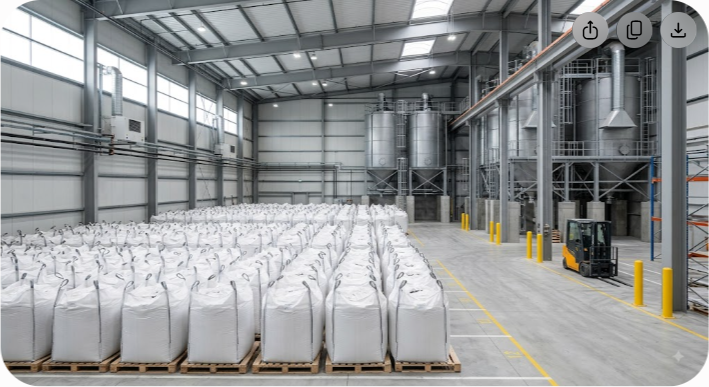
Bulk bentonite should be kept dry, protected from liquid water, and stored in packaging or vessels that limit exposure to humid air. The right approach depends on the grade, moisture specification, storage period, packaging format, and how the material will be discharged. For large inventories, sealed silos with controlled vents can work well. For palletized material, moisture-resistant FIBCs with intact liners and indoor storage are usually more practical.
The key point is simple: bentonite does not need to get wet enough to form a visible slurry before storage problems begin. Moisture from humid air can change powder flow, encourage caking, and make discharge equipment harder to operate. Condensation can create an even more concentrated problem when warm, humid air contacts a cold silo wall, roof, or bag surface.
Whether you're storing a few pallets or hundreds of metric tons, good storage starts before the material enters the warehouse. Incoming moisture, packaging condition, floor construction, ventilation, temperature changes, inventory age, and handling practices all affect how well bentonite performs later.
This guide explains how to store bulk bentonite, how sodium and calcium bentonite respond to moisture, which storage systems work best, how to prevent caking, and what to do when material has already started to clump.
Bentonite is a clay dominated by smectite minerals, particularly montmorillonite. Its useful properties come partly from the way its mineral structure interacts with water. Sodium bentonite is especially well known for its ability to hydrate and swell, which is why it is widely used in drilling fluids, geosynthetic and civil engineering applications, foundry binders, and other industrial formulations.
That same property creates a storage challenge. Dry bentonite can interact with moisture in the surrounding environment even when there is no obvious water leak. Once moisture begins to change the powder, particles can become more cohesive and the material may lose the free-flowing behavior required for pneumatic conveying, screening, metering, or controlled feeding.
The severity of the problem depends on the specific bentonite grade. There is no single moisture percentage at which every bentonite suddenly becomes unusable. Product specifications, particle size, mineral composition, processing history, packaging, temperature, and intended application all matter.
Montmorillonite has a layered structure with exchangeable cations between mineral sheets. Water can enter these interlayer spaces and cause the layers to separate. Sodium-dominant bentonite generally develops much greater swelling than calcium-dominant bentonite because the exchangeable ions affect how strongly the clay interacts with water.
In storage, the important issue isn't simply whether the clay swells dramatically. Even smaller amounts of moisture can create localized bonding between particles. That can increase the bulk density of stored material, reduce flow through hoppers, produce crusts near exposed surfaces, and create lumps that need mechanical processing before use.
The practical lesson is that storage should be designed around the customer's required product specification rather than a generic claim that all bentonite behaves the same way.
Both grades need protection from uncontrolled moisture, but their behavior differs.
For either grade, the safest approach is to keep the material dry from receipt through final processing.
Relative humidity matters because dry mineral powders can exchange moisture with surrounding air. The exact equilibrium moisture content varies with the mineral and environmental conditions, so a universal humidity threshold shouldn't be treated as a specification for every product.
As a practical operating target, many facilities benefit from keeping indoor storage areas dry, limiting prolonged exposure to relative humidity above about 50 to 60 percent where the product specification and local climate make that achievable. This is a control target, not a universal bentonite failure point.
Condensation is another major risk. If humid air enters a silo or warehouse and a surface cools below the air's dew point, liquid water can form. A cold steel silo roof, exterior wall, or wrapped bulk bag can therefore create a moisture problem even when the storage building has no obvious roof leak.
| Storage condition | Likely risk | What operators should watch |
|---|---|---|
| Dry, enclosed storage with stable temperature | Low moisture exposure | Packaging integrity and normal inventory rotation |
| Moderate humidity with good ventilation | Manageable but requires monitoring | Caking, bag condition, and changing powder flow |
| High humidity for extended periods | Increased moisture uptake and caking risk | Clumping, discharge problems, and rising product moisture |
| Temperature swings with humid air | Condensation risk | Damp bag surfaces, silo roof drips, crust formation |
| Direct rain or standing water | Severe local hydration | Hardened material, swollen clay, contaminated product |
These conditions should be interpreted alongside the supplier's product specification. A moisture limit suitable for one bentonite application may not be appropriate for another.
The best storage system depends on inventory volume, climate, storage duration, packaging, and the way the material is consumed. The three most common approaches are silos, flexible intermediate bulk containers, and enclosed warehouse storage.
Silos are suitable for facilities that consume bentonite continuously and need automated bulk transfer. A properly engineered silo can protect material from rain and reduce exposure to uncontrolled ambient air, but simply placing bentonite in a standard silo doesn't solve every moisture problem.
Pay particular attention to the following areas:
Silo design should be reviewed by the equipment supplier or a bulk-solids engineer when the material has a high tendency to cake. Flow testing is often more useful than relying on a generic cone-angle recommendation.
Flexible intermediate bulk containers, commonly called FIBCs or super sacks, are practical for packaged bentonite because they are easy to move and can be stored without installing a permanent silo system.
The important detail is the liner. A standard woven polypropylene FIBC is not automatically a moisture barrier. If moisture protection is important, specify a compatible polyethylene liner or another barrier construction appropriate for the product and storage period.
Consider these points when selecting bags:
For extended storage or ocean transport, packaging specifications should be agreed with the bentonite supplier and packaging manufacturer rather than chosen solely by nominal liner thickness.
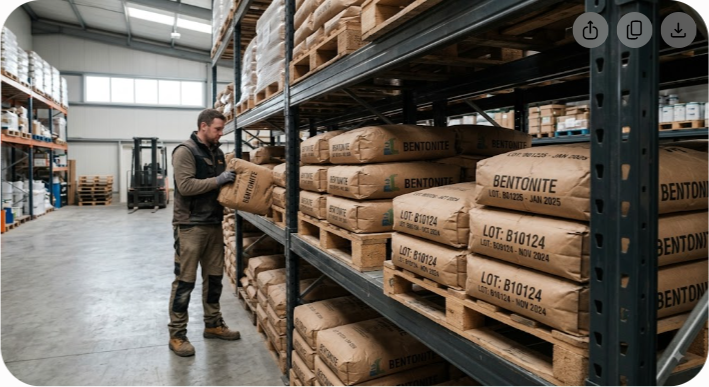
An enclosed warehouse is often the most flexible solution for palletized FIBCs and smaller packaged quantities. The building should provide a dry environment, a sound roof, controlled drainage, and enough clearance to inspect every storage area.
Avoid placing bags directly on concrete floors. Concrete can transmit moisture from the ground, particularly when the slab lacks an effective vapor barrier. Pallets or suitable dunnage create a physical separation between the bags and the floor.
Keep stored material away from exterior walls where condensation can occur. Leave enough clearance for inspection, cleaning, and air movement. Don't position bentonite beneath roof joints, chilled surfaces, leaking pipes, or other locations where dripping water is possible.
A reliable storage program begins when the shipment arrives. The following sequence works well as a general operating framework, although product specifications and site procedures should take precedence.
Check the transport vehicle, container, bulk bags, or other packaging before material enters the storage system.
A moisture test is useful, but it doesn't replace visual inspection. A shipment can meet an average moisture specification while still containing localized wet or caked areas.
Before loading new material, inspect the storage location.
Good housekeeping isn't cosmetic. Bentonite dust can interfere with equipment, contaminate adjacent materials, and create additional cleanup work when moisture turns loose powder into a hard deposit.
Monitor the environment rather than assuming the warehouse is dry because it feels comfortable to people.
Install calibrated temperature and relative-humidity sensors at representative locations. In large buildings, one sensor near an office door isn't enough to identify conditions near exterior walls, the roof, or floor-level storage.
Where climate conditions justify it, use dehumidification to maintain a stable, dry environment. Desiccant and refrigeration-based systems have different operating characteristics, so equipment should be selected according to warehouse size, outdoor climate, air leakage, and required humidity level.
Temperature stability matters as well. A rapid drop in surface temperature can create condensation even when average room humidity appears acceptable.
Place FIBCs on clean, dry pallets or another suitable support system. Keep them away from walls and potential sources of water. Avoid excessive stacking unless the FIBC manufacturer has confirmed that the stacking arrangement is safe for the specific bag, product density, pallet, and storage duration.
Compression can increase bulk density and make a cohesive powder harder to discharge. This is particularly important when bags remain untouched for long periods.
Don't wrap warm bags tightly in an impermeable outer film immediately after loading if condensation could become trapped. Packaging decisions should account for the temperature and humidity of the product and surrounding air.
Use first-in, first-out rotation unless the product specification or customer requirement calls for another system.
FIFO doesn't prevent moisture damage by itself. It simply reduces unnecessary residence time and makes inventory condition easier to control.
Facilities near coastal ports or in consistently humid climates may need additional protection. The right solution is usually a combination of good building design, packaging, monitoring, and controlled air exchange rather than a single moisture-control product.
Every time material enters or leaves a silo, air moves in or out. If that replacement air is humid, the storage system can gradually introduce moisture even when the silo is physically sealed from rain.
Where appropriate, a facility can use filtered, conditioned, or desiccant-dried air for silo breathing. The required dew point and flow rate should be determined from the vessel design and local operating conditions. Extremely dry air may be useful in some systems, but it should not be specified automatically without checking the equipment and energy requirements.
Nitrogen blanketing is another option for certain closed storage systems, but it is not necessary for ordinary bentonite storage in every facility. It adds equipment, operating cost, and an asphyxiation hazard that requires appropriate safety controls. It should be used only when the process actually benefits from an inert atmosphere.
Desiccants can help manage residual moisture inside a sealed package, but they aren't a substitute for a sound liner. A small desiccant pack cannot compensate for a punctured bag, continuous humid-air leakage, or outdoor exposure to rain.
If desiccants are used, select the type and quantity based on the internal package volume, expected moisture load, storage duration, transport conditions, and compatibility with the product. Keep the desiccant physically separated from the bentonite unless the packaging system specifically permits direct contact.
For ocean freight, cargo sweat is a real packaging concern. Container temperature changes can produce condensation on internal surfaces. Moisture-barrier packaging, appropriate container loading practices, and suitable desiccant systems can reduce that risk.
Anti-caking additives shouldn't be treated as a universal storage solution. Some bentonite applications require a specific mineral chemistry and untreated surface, while others may tolerate processing aids.
If an additive is being considered, verify compatibility with the final application, customer specification, regulatory requirements, and performance tests. The safest way to prevent storage caking is still to control moisture and avoid unnecessary storage time.
Storage failures usually provide warning signs before they become complete blockages. Operators should treat changes in flow, surface texture, bag shape, or product moisture as signals to investigate the cause.
Likely cause: Moisture has increased the cohesive strength of the powder, or the silo and discharge equipment aren't matched to the material's flow properties.
What to do: Stop forcing the material through equipment that is already blocked. Follow the silo manufacturer's procedure for aeration or other discharge-assist equipment. If dry aeration is part of the system, verify that the compressed air is clean and dry. Persistent flow problems may require a flowability assessment and changes to the hopper or feeder design.
Avoid striking the outside of a silo with improvised tools. Uncontrolled impact can damage the vessel, and vibration isn't a universal solution for cohesive powders.
Likely cause: Moisture has entered through a damaged or poorly sealed liner, or condensation has formed inside the package.
What to do: Quarantine affected bags and assess the extent of the damage. Don't assume the entire bag is unusable, but don't send large hardened pieces directly into sensitive feeding equipment either. Depending on the product specification, a suitable lump breaker or screening step may recover material that remains within specification.
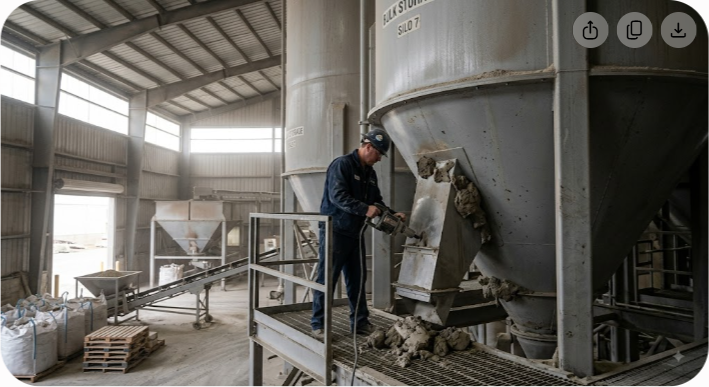
If the moisture damage is significant, test the material before reintroducing it to production.
Likely cause: Warm, humid air has reached a surface that later cooled below its dew point.
What to do: Identify where the condensation forms and when it occurs. Check the roof, insulation, vents, and headspace conditions. Improve insulation or controlled ventilation where appropriate and prevent humid air from entering unnecessarily.
Simply removing a wet crust without addressing the condensation source will not solve the problem.
Likely cause: Moisture has increased particle adhesion and created agglomerates that accumulate on the screen surface.
What to do: Check product moisture, ambient humidity, feed rate, and particle size. Clean the screen according to the equipment manufacturer's procedure and determine whether the incoming material remains within specification. Screen-deblinding equipment may help with certain applications, but it shouldn't be used to mask a persistent moisture problem.
| Failure mode | Likely root cause | Operational symptom | Immediate response | Long-term prevention |
|---|---|---|---|---|
| Silo arching or bridging | Increased cohesion from moisture or unsuitable flow design | Little or no discharge from the outlet | Follow the approved discharge-assist procedure and check material condition | Control moisture and review hopper, feeder, and flow properties |
| FIBC crusting | Damaged liner, poor closure, or condensation | Hard crust near bag surfaces or discharge area | Isolate and inspect affected bags | Improve liner selection, sealing, handling, and indoor storage |
| Silo condensation | Temperature changes and humid headspace air | Wet or caked material near the upper surface | Remove the moisture source and protect affected inventory | Improve insulation, air control, and condensation monitoring |
| Screen blinding | Moisture-driven agglomeration | Reduced screening capacity | Inspect and clean equipment safely | Control product and environmental moisture |
Storage conditions aren't only about humidity. The way material moves through the facility can expose it to moisture and damage that wouldn't occur during stationary storage.
Keep loading and unloading areas protected from rain. If FIBCs must pass through an exterior doorway, minimize the time they spend in open weather. Don't stage bags overnight beside an open dock simply because they are scheduled for loading the next morning.
Use dedicated areas for receiving, approved inventory, quarantine, and damaged packaging. This prevents a wet or suspect lot from being mixed accidentally with material that has already passed quality checks.
Forklift operators should avoid dragging bags, catching liners on rack components, or puncturing packaging with forks. A tiny liner puncture may not be visible from the outside but can compromise moisture protection during weeks of storage.
There isn't one universal temperature range that applies to every bentonite product. Normal indoor temperatures are generally suitable when the material is protected from moisture and excessive heat, but the product's technical specification should be the final reference.
The larger concern is often temperature change rather than a particular absolute temperature. A warm bag moved into a much cooler environment can develop condensation if the surrounding conditions reach the dew point.
Avoid storing bentonite beside steam lines, hot process equipment, chilled surfaces, or other areas where sharp temperature gradients are common.
Bentonite storage also needs to account for dust, spills, traffic, and environmental controls.
Dry bentonite is a fine powder, so facilities should assess airborne dust and any respirable crystalline silica exposure based on the actual mineral analysis and process. Bentonite products can contain varying amounts of crystalline silica, so the hazard shouldn't be assumed or dismissed without checking the supplier's safety documentation.
Use suitable local exhaust ventilation at transfer points, bulk bag unloaders, silo filling points, and other locations where dust can become airborne. Follow the applicable occupational exposure limits and the recommendations in the product's safety data sheet.
For housekeeping, avoid practices that unnecessarily put settled dust back into the air. Use industrial vacuum systems designed for the dust hazard or other approved methods rather than uncontrolled dry sweeping where that could increase airborne exposure.
Wet bentonite can also become extremely slippery. A spill exposed to water may spread across a floor quickly and create a serious slip hazard. Isolate the area, prevent additional water from reaching the material, and follow the site's spill response procedure.
Outdoor storage needs additional environmental controls. Rain can carry fine bentonite into drains and surface water, increasing turbidity and depositing sediment. Keep bulk bags and loose material under suitable cover and prevent contaminated runoff from leaving the storage area.
Several storage mistakes are easy to make because the material can look perfectly dry when it first arrives.
A roof protects against direct rain, but it doesn't control humidity or condensation. Check actual relative humidity and temperature rather than relying on appearance.
Woven polypropylene provides strength but isn't automatically a moisture barrier. Specify a suitable liner and keep the complete bag system protected from rain and condensation.
Different products have different specifications and applications. Use the supplier's approved moisture range instead of applying a generic number to every shipment.
A bag can look intact while its internal liner is torn. Inspect the liner during receiving and after significant handling events.
Flow problems can result from moisture, consolidation, poor hopper geometry, feeder design, or unsuitable aeration. Diagnose the cause before changing the equipment setting.
Even a well-protected package deserves periodic inspection. Long storage increases the chance that small packaging defects, temperature changes, or environmental leaks will go unnoticed.
Storage cannot correct material that arrives outside specification. A supplier's drying, milling, screening, packaging, and quality-control practices influence how consistently the product behaves after delivery.
Before buying large quantities, ask for the relevant technical specification and confirm the parameters that matter to your process. Depending on the application, these may include moisture, particle size distribution, swelling or rheological properties, gel strength, chemical composition, and packaging configuration.
For recurring shipments, establish a consistent product specification rather than changing acceptable limits from one delivery to another. Consistency makes storage conditions easier to manage and helps operators identify unusual batches quickly.
At Axewelledge, we supply sodium and calcium bentonite for industrial applications and support customers with product specifications, packaging options, and export supply requirements. Storage conditions should still be matched to the specific grade and application rather than treated as a one-size-fits-all procedure.
Before placing a bulk order, confirm:
These questions are more useful than simply asking whether the bentonite is "moisture resistant." Bentonite itself is designed to interact with water; the objective of storage is to keep that interaction from happening prematurely.
Use the following checklist as a starting point for your facility procedure:
The most effective way to store bulk bentonite is to prevent uncontrolled moisture exposure from the beginning. That means more than keeping the roof watertight. It requires suitable packaging or silo design, dry storage surfaces, humidity monitoring, condensation control, careful handling, and disciplined inventory management.
For FIBCs, the liner and sealing method matter as much as the outer bag. For silos, air exchange, roof design, insulation, discharge geometry, and dry aeration all deserve attention. In either system, the product's own technical specification should guide moisture limits and quality checks.
If bentonite starts to cake, don't treat the symptom first. Find out where the moisture or temperature change is coming from, isolate affected material, and verify its quality before returning it to production.
The goal isn't to make bentonite permanently resistant to water. That's not how the mineral works. The goal is to keep it dry and free-flowing until the moment its water-absorbing properties are actually needed.
If you are sourcing bulk sodium or calcium bentonite and need help selecting a grade, packaging format, or export configuration, contact Axewelledge to discuss your application and supply requirements.













Have questions about our products? We're here to help!