Axewelledge, a leading exporter from India, specializes in high-quality Bentonite. With a commitment to excellence, we supply premium Bentonite to the Middle East and Southeast Asia markets.


North Angle Complex, 304,
150 Feet Ring Rd, Opposite Ambedkar Nagar BRTS Stop,
Madhav Park, Punit Nagar,
Mavdi, Rajkot, Gujarat 360004
© Axewelledge 2026, All Rights Reserved.
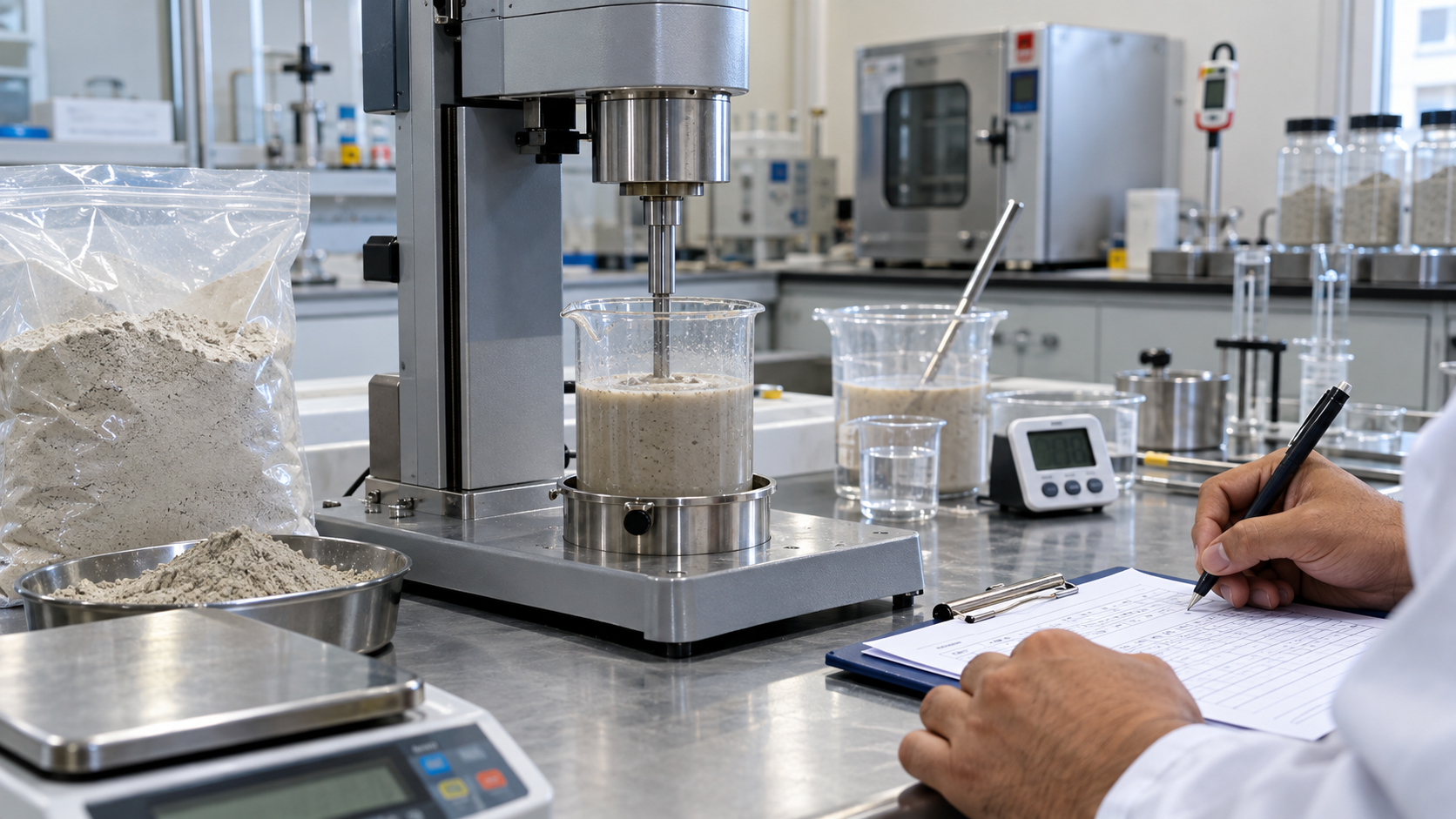
Bentonite gel strength can't be judged reliably from the dry powder alone. If gel strength matters to your application, prepare the bentonite suspension under controlled conditions and measure its low-shear behavior after a defined static period. For drilling-fluid testing, 10-second and 10-minute gel-strength measurements are commonly used.
The important part is not simply getting a number. It is making sure the number means something. The bentonite concentration, water quality, mixing procedure, temperature, hydration or aging time, instrument, and measurement procedure can all affect the result.
That makes controlled side-by-side testing one of the most useful ways to evaluate bentonite before a bulk purchase. Test samples from different suppliers under the same conditions, compare the complete rheological profile, and judge the results against the requirements of your actual application.
A supplier's specification sheet is useful, but it should be the starting point rather than the only evidence behind a purchasing decision.
Gel strength is the shear stress required to start moving a fluid after it has remained static for a specified period. In drilling-fluid rheology, it describes the structure that develops in the suspension while circulation is stopped.
This matters because a drilling fluid doesn't spend its entire life moving through the well. Pumps may stop during connections, maintenance, or other operating periods. During that time, the fluid can develop a gel structure that helps keep solids suspended. When circulation resumes, the fluid must also be capable of breaking that structure and moving again.
Gel strength is normally reported with a defined static time. In drilling-fluid work, 10-second and 10-minute gel measurements are commonly reported. The two readings can reveal how the suspension changes as it remains undisturbed.
Gel strength is often reported in lbf/100 ft² in oilfield practice. SI units can also be used, but the unit and test method should always accompany the result. A number without its units and test conditions isn't enough for a meaningful supplier comparison.
This distinction causes a lot of confusion during purchasing.
Viscosity describes a fluid's resistance to flow under specified conditions. Gel strength measures the low-shear strength that develops after the suspension has been static for a defined period. The two properties are related to the same fluid system, but they answer different questions.
A bentonite suspension can have an acceptable viscosity and still show a gel-strength profile that doesn't suit the application. That's why a supplier's viscosity figure shouldn't automatically be treated as a gel-strength specification.
A direct-indicating rotational viscometer, often referred to as a Fann-type viscometer or VG meter in drilling-fluid laboratories, can be used for viscosity-related measurements and gel-strength testing when the appropriate procedure is followed.
If a supplier gives you only one viscosity value, ask what was measured, under which conditions, and whether gel strength was actually determined.
Bentonite is a natural mineral, and its performance can vary with mineral composition, processing, particle-size distribution, moisture, exchangeable ions, hydration conditions, and the chemistry of the water used for testing. Two products sold under the same broad bentonite description can therefore behave differently in a prepared suspension.
Testing a representative sample before a large purchase gives you evidence about the material rather than relying entirely on a product description or certificate.
A controlled pre-purchase test can help you:
The financial reason is straightforward. A lower price per tonne isn't necessarily a lower cost in use. If a weaker material requires a higher dosage, additional additives, longer processing, or replacement material, the apparent saving can disappear.
For that reason, technical qualification should be part of the purchasing process when bentonite performance has a direct effect on production or field operations.
The equipment depends on the application and the standard you need to follow. For drilling-fluid testing, a direct-indicating rotational viscometer or suitable rheometer is commonly used to characterize gel strength.
A practical laboratory setup may include:
The instrument matters, but test consistency matters just as much. If Sample A is mixed for five minutes and Sample B for fifteen minutes, or one sample is tested at a different temperature, you can't confidently attribute the difference to the bentonite.
For standardized qualification, use the current procedure specified by the applicable API or ISO standard, customer specification, or internal laboratory method. A general screening procedure should not be presented as an equivalent replacement for a required standardized test.
The following process provides a practical framework for supplier qualification. The exact concentration, preparation, aging, temperature, and measurement settings should come from the applicable test method for your application.
Start with a sample that actually represents the material you may purchase. A carefully performed laboratory test is of limited value if the sample came from an unrepresentative bag or an unidentified lot.
For a bulk purchase, ask the supplier for a sealed sample from the intended production grade or lot whenever possible. Record the supplier, product grade, lot or batch number, date received, and any certificate of analysis supplied with the material.
If a shipment contains several production lots, don't automatically assume that one small sample represents the entire shipment. Your sampling plan should reflect the size of the purchase, the supplier's lot-control system, and the consequences of receiving material outside specification.
Before mixing, document what you're testing.
Useful information includes:
This information doesn't replace your laboratory result. It gives you context for investigating differences between the supplier's published specification and your own measurements.
Water chemistry can have a substantial effect on bentonite hydration and rheological behavior. Dissolved salts, hardness, pH, and other water characteristics can change the way bentonite disperses and develops structure.
For a controlled supplier comparison, use the same water source for every candidate. If your application uses a known process-water or field-water source, perform a separate application-simulation test with that water.
Keeping the two tests separate makes the results easier to interpret:
| Test purpose | Water to use | Main question |
|---|---|---|
| Controlled supplier comparison | Same controlled water for every sample | Which material behaves differently under identical conditions? |
| Application simulation | Actual process or field water | How is the selected material likely to behave in service? |
If you change both the bentonite and the water at the same time, it becomes difficult to identify the cause of a performance difference.
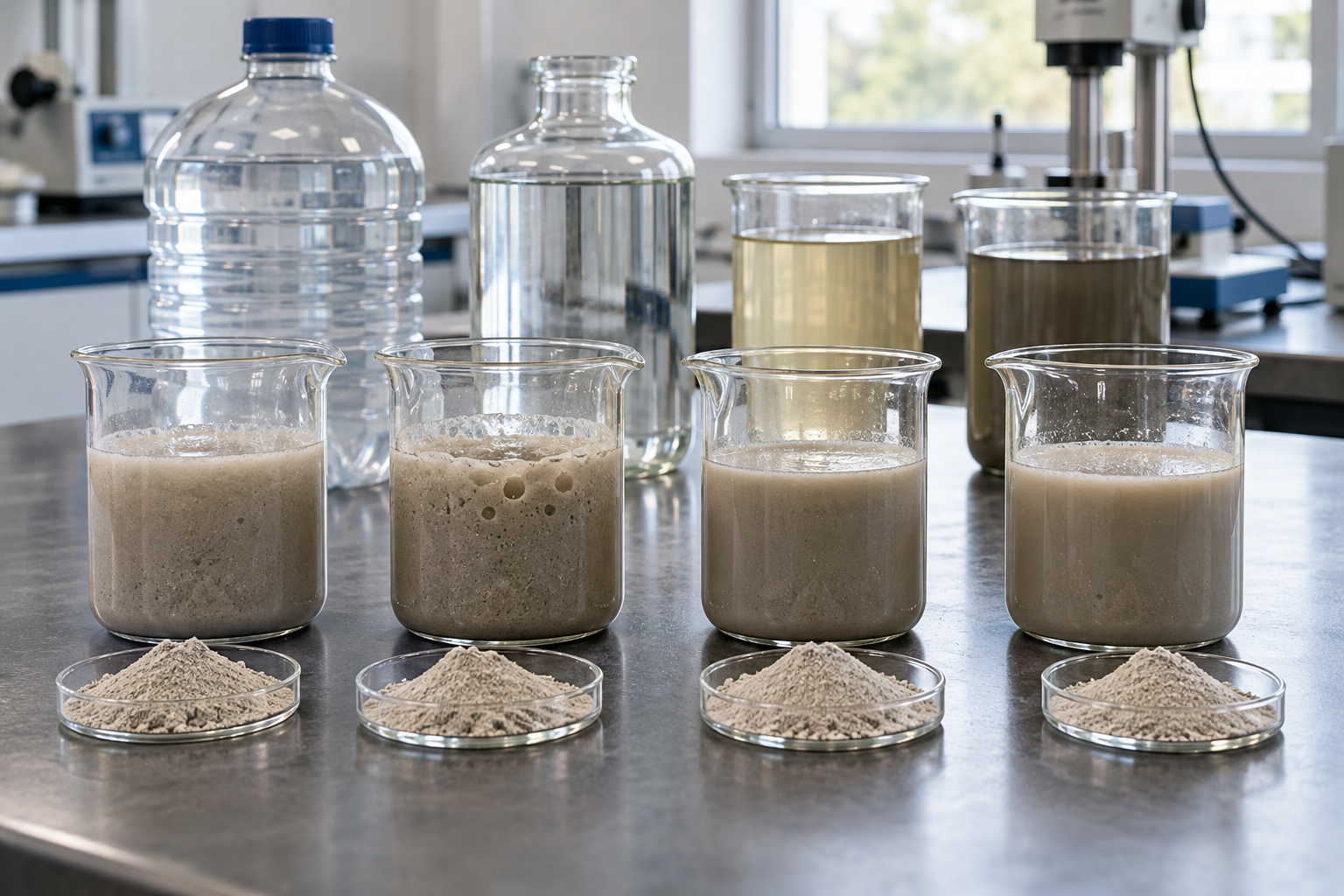
Choose a concentration specified by your test procedure and use exactly the same concentration for every supplier sample.
For example, if your laboratory method calls for a particular bentonite concentration, weigh each sample accurately and use the same final liquid volume or mass basis. Don't compare a 6% suspension from one supplier with a 7% suspension from another and then conclude that the higher reading proves better material.
Record the actual bentonite mass and water mass or volume. Avoid relying only on a nominal percentage written on a sample label.
The concentration basis should also be consistent. If one calculation uses mass of bentonite divided by total suspension mass and another uses mass divided by water mass, the reported percentages are not directly interchangeable.
Use the same mixing sequence, equipment, speed, and duration for every sample unless your test standard specifies otherwise.
This step is easy to underestimate. Bentonite needs to disperse and hydrate in water, and differences in mixing can affect the resulting rheology. A poorly dispersed sample may appear weaker than it would under the specified preparation procedure.
Record at least:
For drilling-fluid qualification, follow the preparation procedure required by the applicable specification instead of creating a convenient laboratory recipe and treating it as a standardized result.
Don't assume that the sample should be measured immediately after mixing. The required hydration or aging period depends on the material, application, and test method.
Some standardized drilling-fluid procedures specify defined aging periods before rheological measurement. If your chosen standard calls for an aging period, follow it exactly and document the start and end times.
The important point is that the preparation history is part of the test. A gel-strength number without the associated hydration, aging, and conditioning information is difficult to reproduce or compare.
Temperature affects fluid rheology, so temperature control is an essential part of a controlled comparison.
Don't test one supplier sample at 20 °C and another at 30 °C and assume the difference is caused entirely by the bentonite. Use the temperature specified by your test method and record the actual test temperature.
If you're performing an application simulation rather than a standardized qualification test, document the reason for using the selected temperature. That makes the result easier to interpret later.
Before taking a gel-strength measurement, prepare the suspension for measurement according to the selected method. With a rotational viscometer, this normally involves controlled conditioning followed by a defined static period before the low-speed measurement.
The goal is to ensure that each sample reaches the measurement stage with the same preparation history.
Avoid giving one sample extra mixing immediately before measurement or handling another sample differently. Small procedural differences can become significant when you're trying to compare materials with similar performance.
For drilling-fluid testing, allow the conditioned suspension to remain static for the specified short period, commonly 10 seconds. The viscometer is then operated according to the applicable procedure, and the relevant maximum response is recorded as the gel-strength measurement.
Record the actual reading, units, instrument identification, temperature, and test method. Don't write down a bare number such as "5" without the measurement unit and conditions.
The 10-second value provides information about the structure that develops during a relatively short static period. It is useful, but it should not automatically be treated as the complete rheological picture.
Repeat the measurement after the longer static period specified by the method, commonly 10 minutes for drilling-fluid reporting.
The purpose isn't simply to find a larger number. The difference between the short- and long-time measurements can show how strongly the suspension develops structure while it remains at rest.
For example, imagine two samples tested under identical conditions:
| Sample | 10-second gel | 10-minute gel | Interpretation |
|---|---|---|---|
| A | 4 lbf/100 ft² | 7 lbf/100 ft² | Moderate increase during static time |
| B | 5 lbf/100 ft² | 15 lbf/100 ft² | Much stronger time-dependent buildup |
The table doesn't establish that A or B is universally better. The acceptable profile depends on the drilling-fluid design and operating requirements. It does show that looking at only one time point can hide an important difference between materials.
There is no universal gel-strength value that makes every bentonite product good or bad.
The correct acceptance range depends on the application, formulation, test method, and operating conditions. A drilling fluid designed for one well condition may require a different rheological profile from another. Other bentonite applications may not use drilling-fluid gel strength as a primary quality parameter at all.
Instead of asking only, "Which sample has the highest gel strength?", evaluate the result against the job the material must perform.
Ask:
A higher value isn't automatically a better value. In drilling-fluid systems, gel strength has to be considered alongside other rheological and operational requirements.
Consider two supplier reports:
If the purchasing specification asks only for the 10-second result, the samples appear identical on that single measure. The longer static measurement shows that their behavior isn't identical.
A larger increase between the short and longer static periods can indicate stronger time-dependent gel development. Whether that is useful or undesirable depends on the fluid design and operating requirements.
That's why acceptance criteria should be defined before testing. Decide which measurements matter, what range is acceptable, and which additional properties must be considered before you see the supplier results.
A drilling-fluid report may contain plastic viscosity, yield point, and gel-strength values together. These properties are useful, but they are not interchangeable.
Plastic viscosity is commonly used to describe the flow resistance associated with the continuous phase and dispersed solids under the selected rheological model. Yield point describes flow behavior within that model and is commonly used when assessing carrying and suspension characteristics. Gel strength describes the low-shear structure developed after static time.
For a direct-indicating viscometer, plastic viscosity and yield point can be calculated from specified dial readings when the relevant rheological model and procedure apply. Gel strength is obtained through a different measurement sequence after static conditions.
A useful purchasing report should therefore keep the properties separate.
| Property | What it describes | Why it may matter to a buyer |
|---|---|---|
| Plastic viscosity | Flow resistance associated with the fluid and dispersed solids under the selected model | Helps assess flow behavior and solids effects |
| Yield point | Flow behavior associated with initiating and maintaining flow under the selected model | Useful when evaluating carrying and circulation behavior |
| Gel strength | Low-shear structure after a defined static period | Helps assess behavior while circulation is stopped |
| Swelling | Hydration-related expansion or volume increase measured by the selected method | Important for sealing and other bentonite applications |
| Filtration behavior | Fluid loss and filter-cake characteristics | Important for many drilling-fluid systems |
The right test panel depends on the application. A drilling-fluid buyer may need a broader rheological profile, while a construction or sealing buyer may need to focus on swelling, permeability, particle size, and compatibility instead.
You can perform simple screening tests without a laboratory viscometer, but a manual or visual test shouldn't be treated as equivalent to a standardized quantitative gel-strength measurement.
For early screening, a controlled suspension can be compared after standing to see whether there are obvious differences in structure or ease of movement. Such a test can help decide which samples deserve more detailed laboratory testing.
However, if a purchase specification requires a numerical gel-strength value, use the specified viscometer or rheometer and test method. A manual observation doesn't provide the same controlled measurement or traceability.
A Marsh funnel is also not a direct substitute for a gel-strength test. Funnel viscosity measures the time required for a specified volume of fluid to pass through the funnel. Gel strength is measured after static conditions using a low-shear rheological procedure. They describe different properties.
For supplier qualification, use screening tests as screening tests. Don't present them as standardized gel-strength results.
A clean-looking, fine powder may still produce a suspension that doesn't meet your requirements. Color, texture, and appearance can be useful observations, but they aren't performance tests.

A higher concentration will generally change the measured rheology, so supplier samples must be prepared on the same basis. Otherwise, the comparison is fundamentally uneven.
Water chemistry can change hydration and rheology. If one sample uses softened laboratory water and another uses hard process water, you aren't isolating the effect of the bentonite.
Rheological measurements depend on test conditions. Record and control temperature according to the selected procedure.
Differences in mixing time, speed, sequence, equipment, or hydration history can produce different results even when the dry bentonite is similar.
A short-time gel value may not show how the structure develops during a longer static period. When the applicable drilling-fluid method calls for both 10-second and 10-minute measurements, record both.
A number is only useful when you know how it was obtained. Ask for the test method, concentration, water conditions, temperature, mixing procedure, aging time, instrument, and units.
Set your target before testing suppliers. Otherwise, it's easy to rationalize a result after the fact simply because you prefer one sample.
This is a technical mistake rather than just a purchasing mistake. The correct gel-strength profile depends on the application. A stronger gel may be useful in one formulation and problematic in another.
A successful qualification sample doesn't guarantee that every future production lot will behave identically. Your quality plan should define how incoming shipments will be checked after supplier approval.
A useful technical discussion with a supplier should cover more than price, availability, and delivery time.
Ask for:
If a supplier can't clearly explain how its published rheology numbers were generated, ask for clarification before using those numbers as the basis for a technical purchasing decision.
A simple spreadsheet is often enough to organize a supplier qualification test. The goal isn't to create a huge report. It is to ensure that every sample is evaluated under the same rules.
| Test item | Supplier A | Supplier B | Supplier C |
|---|---|---|---|
| Product grade | Record | Record | Record |
| Lot number | Record | Record | Record |
| Bentonite concentration | Same | Same | Same |
| Water source | Same | Same | Same |
| Mixing procedure | Same | Same | Same |
| Hydration or aging time | Same | Same | Same |
| Test temperature | Same | Same | Same |
| 10-second gel | Record | Record | Record |
| 10-minute gel | Record | Record | Record |
| Plastic viscosity | Record | Record | Record |
| Yield point | Record | Record | Record |
| Swelling or yield | Record | Record | Record |
| Filtration result | Record | Record | Record |
| Visual observations | Record | Record | Record |
| Test method | Record | Record | Record |
Keep the original laboratory records as well. A summary table is useful for purchasing, but the underlying data should remain available if a result needs to be investigated later.
A practical qualification program can be organized into three stages.
Start with the supplier's technical specification and certificate of analysis. Check whether the stated properties match the needs of your application and whether the test methods are clearly identified.
This first stage can eliminate unsuitable products before you spend time on laboratory testing.
Prepare the samples using a consistent laboratory procedure. For critical applications, consider independent laboratory testing in addition to your internal evaluation.
Run repeat measurements when reproducibility matters. A single unexpected result should be investigated rather than immediately used to characterize an entire product grade.
Once a supplier and product grade are approved, continue checking incoming material according to your quality plan.
This is an important distinction: qualification isn't the end of quality control. It establishes the benchmark against which future material can be checked.
If later shipments show a meaningful change, compare the lot information, certificate, laboratory results, and production records before deciding what caused the difference.
Reject a sample because it fails a defined requirement, not simply because another supplier produced a higher number.
For example, if your application specifies a particular gel-strength range and a candidate falls outside it, that result provides a clear technical reason for further investigation or rejection. If two samples both meet the requirement, other factors may become more important, including consistency, filtration behavior, swelling, particle size, delivery reliability, technical support, and total cost.
Avoid a purchasing rule that says higher gel strength is always better. It isn't a sound general rule.
For drilling-fluid systems, the gel-strength profile needs to work with the rest of the mud system. The fluid may need sufficient static structure to suspend solids while also remaining practical to circulate and restart. The right target is therefore the one defined by the application and technical specification, not the largest number on a supplier comparison sheet.
A useful report should allow another technician to understand the test without having to ask the original operator what happened.
At minimum, record:
For standardized drilling-fluid testing, the applicable current API or ISO procedure should take precedence over a generic laboratory recipe. If your customer or contract specifies a particular standard, use that requirement as the controlling reference.
Good documentation also makes supplier discussions easier. When a result looks unusual, you can check the preparation conditions before assuming the raw material itself changed.
This is an important qualification point. Gel strength is especially common as a rheological measurement in drilling-fluid work, but bentonite is also used in construction, foundry applications, sealing systems, agriculture, animal feed, water treatment, and other industries.
You shouldn't automatically apply drilling-fluid acceptance criteria to every bentonite purchase.
A construction sealing application, for example, may place greater emphasis on swelling behavior, permeability, particle size, filtration characteristics, and compatibility with the surrounding material. A foundry application may use a different set of physical and processing requirements. A drilling-fluid buyer may need a broader rheological profile.
Ask instead, "Which measurable properties demonstrate that this bentonite will perform the job I am buying it for?"
That approach keeps laboratory testing connected to real performance. It also prevents buyers from selecting material simply because one specification number looks impressive.
For an industrial bentonite purchase, use a defined qualification sequence:
This process gives purchasing and technical teams a common basis for making the decision. It also creates a record that can be used when the same product is purchased again.
When sourcing bentonite for an industrial application, the supplier should be able to discuss technical requirements as well as availability, packaging, and price.
Axewelledge supplies bentonite for industrial applications and can discuss product requirements with buyers evaluating material for their specific use. If you're considering an Axewelledge grade, the same qualification framework described in this article can be used to compare its sample with other candidates under identical laboratory conditions.
For a serious purchase, provide the supplier with your application, required properties, applicable test standard, target specification, and expected operating conditions before ordering. This gives both sides a clear definition of what the material needs to achieve.
A supplier should also be able to explain its available product grades and provide the technical documentation appropriate to the application. Independent testing can then be used where the purchase risk or customer specification justifies it.
The most reliable way to evaluate bentonite gel strength before buying is to prepare the material under controlled conditions and measure its low-shear behavior after defined static periods. For drilling-fluid applications, 10-second and 10-minute measurements can show how the suspension develops structure during rest.
The key is consistency. Use the same bentonite concentration, water, mixing procedure, temperature, hydration or aging conditions, instrument, static times, and reporting units for every supplier sample.
Then look beyond gel strength. Depending on the application, viscosity, yield point, swelling, filtration behavior, particle size, moisture, and other properties may be just as important.
A supplier's specification sheet gives you a starting point. A controlled test tells you whether the material performs against your own requirements.
If you're sourcing bentonite for drilling, sealing, construction, water treatment, or another industrial application, define the required properties first and then qualify the material against those requirements before committing to a large shipment.













Have questions about our products? We're here to help!