Axewelledge, a leading exporter from India, specializes in high-quality Bentonite. With a commitment to excellence, we supply premium Bentonite to the Middle East and Southeast Asia markets.


North Angle Complex, 304,
150 Feet Ring Rd, Opposite Ambedkar Nagar BRTS Stop,
Madhav Park, Punit Nagar,
Mavdi, Rajkot, Gujarat 360004
© Axewelledge 2026, All Rights Reserved.
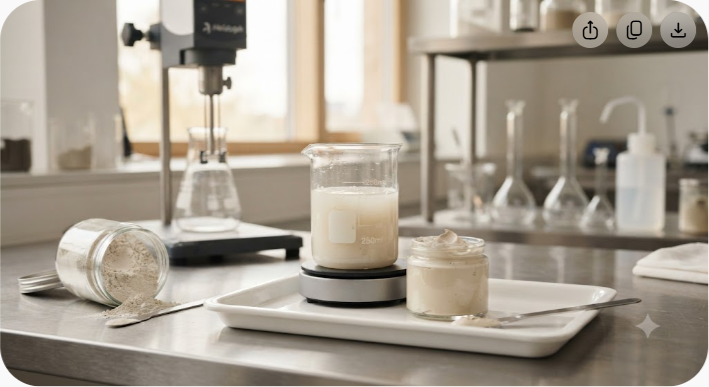
Bentonite is useful in cosmetic formulations for far more than giving a product a clay-based appearance. Depending on its grade and how it is processed, it can increase viscosity, suspend insoluble particles, absorb oils, add body, and create the dense texture expected from many clay masks and cleansing products.
The important part is controlling how the clay behaves in the formula. Bentonite is a fine smectite clay, and its performance depends on factors such as mineral composition, particle size, water quality, ionic conditions, pH, mixing, hydration time, and the other ingredients present.
For many cosmetic development projects, a sensible starting point is to select a cosmetic-appropriate bentonite, disperse it gradually in a suitable aqueous phase, allow it to hydrate, and then adjust the concentration based on measured performance. A screening range of about 1% to 5% can be useful for many applications, while clay masks and other highly mineralized products may require considerably more. There is no universal dosage.
Adding more clay isn't automatically an improvement. Too much bentonite can produce excessive drag, poor spreadability, cracking, syneresis, difficult rinsing, or an unpleasant powdery after-feel. The goal is not maximum viscosity. It is a stable formula with the right performance and sensory profile.
Bentonite is a naturally occurring clay composed predominantly of smectite minerals, especially montmorillonite. Its layered mineral structure gives it a strong ability to interact with water and other substances. Depending on the grade, this can translate into swelling, absorption, rheology modification, and suspension properties that are useful during cosmetic formulation.
For a cosmetic formulator, those properties can address several needs at the same time. Depending on the grade and product, bentonite can function as:
The word "bentonite" alone doesn't tell you how a material will perform. Sodium-rich and calcium-rich bentonites can have different swelling behavior, while purified cosmetic grades can behave differently from clays intended for drilling, foundry, construction, or other industrial applications.
That is why cosmetic development should start with the material specification and intended function, not simply with the name or price of the clay.
Bentonite's main contribution depends on the structure of the product.
In a clay mask, its absorption and rheological properties can help create a thick, spreadable paste. In a liquid suspension, a properly hydrated bentonite may help keep insoluble particles distributed rather than allowing them to settle quickly. In a cleansing product, its absorbency can contribute to the product's texture and oil-management characteristics.
When bentonite is adequately hydrated, its fine particles can form a structured dispersion that increases viscosity and provides yield-like behavior. In practical terms, the product can remain relatively structured at rest while flowing more readily when stirred, squeezed from packaging, or spread across the skin.
That behavior can be useful when a formula contains particles that would otherwise settle.
There is a catch. Poorly dispersed bentonite can hydrate around the outside of an agglomerate while remaining dry inside. The result may be lumps, uneven viscosity, gritty patches, or a product that becomes noticeably thicker several hours after processing.
The processing method therefore matters almost as much as the selected grade.
There isn't one universally best bentonite for every cosmetic product. The right material depends on the job it needs to perform and the sensory profile you want in the finished product.
Sodium-rich bentonite generally has relatively strong water absorption and swelling characteristics. It can be useful when a formulation needs substantial hydration, structure, or suspension support.
That makes sodium bentonite worth considering for aqueous gels, masks, pastes, and selected suspension systems. Strong swelling can also become a drawback. A highly swelling grade may make a formula excessively thick, difficult to spread, or more sensitive to electrolytes.
The useful question isn't simply whether a sodium bentonite swells strongly. It is whether its swelling and rheology fit the complete formula.
Calcium-rich bentonite generally has lower swelling than sodium-rich bentonite, although actual behavior varies with mineral composition and processing. It can be useful when a formulator wants clay absorbency and mineral character without the same degree of expansion associated with a strongly swelling sodium bentonite.
Calcium bentonite can be considered for clay masks, cleansing products, and other applications where a particular clay texture and absorbency are desired.
A technically useful industrial bentonite isn't automatically suitable for personal-care products.
A cosmetic raw material should have specifications appropriate for its intended use. Depending on the product and market, this can include identity and purity information, microbiological specifications, elemental or heavy-metal controls, contaminant controls, batch traceability, and appropriate supplier documentation.
A useful technical specification may include:
Commercial cosmetic raw-material qualification should ultimately be based on the finished-product requirements and the regulations applicable to the markets where the product will be sold.
A controlled development process is more useful than a single universal percentage. The following sequence gives formulators a practical starting framework for laboratory work.
Start with the formulation problem, not the ingredient.
Are you trying to increase viscosity, suspend pigments, build a clay mask, absorb excess oil, improve body, or create a particular sensory texture?
Bentonite can perform several of these functions at once, but establishing the primary target makes development much easier.
If suspension is the priority, evaluate settling and redispersion. If you're developing a mask, spreadability, drying behavior, rinseability, and skin feel may matter more than maximum viscosity.
This prevents a common mistake: selecting a highly swelling clay when the finished product actually needs controlled, easy-to-spread rheology.
Ask the supplier for a grade intended for personal-care or cosmetic applications and review the available technical information before selecting a material for development.
Test samples rather than judging the powder by appearance. Two clays that look similar can produce very different viscosity, suspension, and sensory results at the same dosage.
For an initial laboratory screen, use several concentrations of one selected grade before changing multiple variables at once. That gives you a clearer view of the material's contribution.
Bentonite is a fine powder, so accurate weighing becomes particularly important at low use levels.

For a 100 g laboratory batch, 2% bentonite means 2 g of bentonite. A 5% level means 5 g. At production scale, the same weight percentage can be used unless the validated manufacturing process specifies otherwise.
Don't measure bentonite with a spoon or another volume-based household measure. Bulk density can vary, so volume isn't a reliable substitute for weighing.
This is one of the most important processing steps.
Bentonite is generally easier to incorporate when it is dispersed gradually into a suitable aqueous phase instead of being dumped into a finished, highly viscous formula.
Add the powder slowly under controlled agitation. The objective is to wet individual particles before they have a chance to form persistent agglomerates.
If too much powder is added at once, the outside of the resulting clump can hydrate rapidly and form a layer around dry material. Those partially hydrated lumps can be difficult to break apart later.
A controlled addition rate, adequate liquid volume, and suitable mixing usually give a much more uniform starting dispersion.
Don't judge the final viscosity immediately after adding bentonite.
Some grades continue to hydrate and develop structure after initial mixing. The rate and extent of this change depend on the bentonite, particle size, water chemistry, temperature, mixing conditions, and the rest of the formula.
For development work, establish a repeatable hydration period and use it for every comparison. If three concentrations are being compared, evaluate them at the same processing stage. Comparing one freshly mixed sample with another that has hydrated overnight can lead to the wrong formulation decision.
Once the bentonite dispersion reaches a consistent state, add the other ingredients according to the formula's processing requirements.
This becomes especially important when the formula contains salts, acids, surfactants, polymers, preservatives, or other ingredients that can affect clay hydration and rheology.
A dispersion that looks ideal before the addition of electrolytes or active ingredients can change significantly afterward. Build those ingredients into the development process rather than treating them as an afterthought.
Measure pH with a validated method appropriate for the product. Don't assume that bentonite alone determines the final pH of the formula.
The target pH should be selected for the complete product, taking into account the product format, preservative system, skin compatibility, active ingredients, packaging, and applicable requirements.
Viscosity should also be measured at a defined point after processing and hydration. A freshly mixed clay dispersion may not represent the viscosity of the finished product after it has equilibrated.
A formula isn't finished because it looks good in a beaker.
Evaluate it after storage and under appropriate accelerated conditions for the development program. Monitor separation, settling, redispersibility, syneresis, viscosity drift, color changes, odor changes, microbiological quality, and packaging interactions.
Sensory evaluation matters too. Two samples can have similar viscosity readings while behaving very differently when spread on the skin.
There is no single dosage that works across all cosmetic products.
A practical screening range for many formulations is roughly 1% to 5%, while clay masks and highly mineralized products may use substantially higher levels. Some suspension and rheology applications may need considerably less.
The appropriate concentration depends on:
A useful laboratory screen might compare 1%, 2%, 3%, and 5% bentonite while keeping the rest of the formula unchanged. This provides a quick view of how the clay affects viscosity, spreadability, suspension, and sensory properties.
Don't assume the sample with the highest viscosity is the best formulation. A cosmetic has to perform during application, dispensing, storage, and use, not just produce a high number on a viscometer.
The ranges below are starting points for formulation screening, not universal finished-product specifications. The selected grade can shift the useful range considerably.
| Product type | Possible bentonite starting range | Main reason for use |
|---|---|---|
| Clay mask | 5% to 20% or more | Body, absorption, texture |
| Facial cleansing paste | 2% to 10% | Absorption and structure |
| Body mask | 5% to 20% or more | Body and clay content |
| Liquid suspension | 0.5% to 3% | Suspension and rheology |
| Scrub or mineral paste | 1% to 10% | Structure and mineral texture |
| Emulsion or cream | 0.5% to 3% | Texture and rheology support |
These figures shouldn't be treated as recipes. A strongly swelling, highly purified bentonite may produce the desired structure at a lower concentration than another grade with different mineral and rheological characteristics.
A small concentration ladder tested under controlled conditions is a better starting point than choosing one percentage and assuming it will work.
Poor dispersion is one of the most common causes of inconsistent results with powdered clays.
Begin with enough liquid to let the particles move freely. Start controlled agitation and introduce the bentonite gradually into the moving liquid rather than pouring the powder into one spot.
High shear can help break up agglomerates, but simply increasing mixer speed isn't always the answer. Excessive shear can entrain air and create a second processing problem.
A useful development sequence is:
If persistent lumps remain, investigate the order of addition, powder addition rate, water-to-clay ratio, mixing energy, and hydration time before increasing the bentonite concentration. More clay won't solve a dispersion problem.
It may work in some systems, but it is usually not the easiest starting strategy.
A finished cream already contains an organized structure created by its water phase, oil phase, emulsifier, polymers, salts, and other ingredients. Adding dry bentonite directly to that structure can make wetting difficult and create localized clumps.
The clay may also change viscosity unpredictably. A product can look acceptable immediately after processing and then become substantially thicker as the bentonite continues to hydrate during storage.
For that reason, it is often easier to develop the bentonite dispersion separately and introduce it at a controlled stage of manufacturing. The appropriate process still depends on the formula architecture and production equipment.
Clay masks provide a straightforward way to see how bentonite affects a finished product.
Suppose you're developing a rinse-off mask containing bentonite, water, a humectant, a secondary clay, preservative, and a small amount of botanical extract. The question isn't simply whether the formula can hold the clay. You also need to know whether it spreads evenly, remains homogeneous in the package, dries at an acceptable rate, rinses cleanly, and leaves the intended skin feel.
A useful screening program could compare 5%, 10%, and 15% bentonite while keeping the other ingredients constant.
At the lower end, the mask may be too fluid or may not deliver the desired clay character. At the higher end, it may become difficult to spread, dry too quickly, or leave an excessively tight or powdery feel.
The middle concentration may be the most practical even if it doesn't produce the highest viscosity.
That is a useful formulation lesson: the best concentration is the one that balances the complete set of product requirements.
Bentonite can also help when a liquid product contains insoluble powders or particles that tend to settle.
A properly hydrated clay structure can increase resistance to particle movement. The objective isn't necessarily to make the formula very thick. You want enough structure to slow sedimentation while preserving acceptable flow during dispensing and use.
This is why rheology matters more than a single viscosity measurement.
A very thick product can still form a hard sediment if particle size, density, wetting, flocculation, and vehicle structure aren't properly controlled. Suspension performance is about the behavior of the complete system.
Evaluate the finished suspension after storage and determine whether any settled material can be redispersed with reasonable agitation. A product that looks stable immediately after manufacture may behave differently after weeks of storage.
Yes, but the formulation challenge is greater than with a simple clay mask.
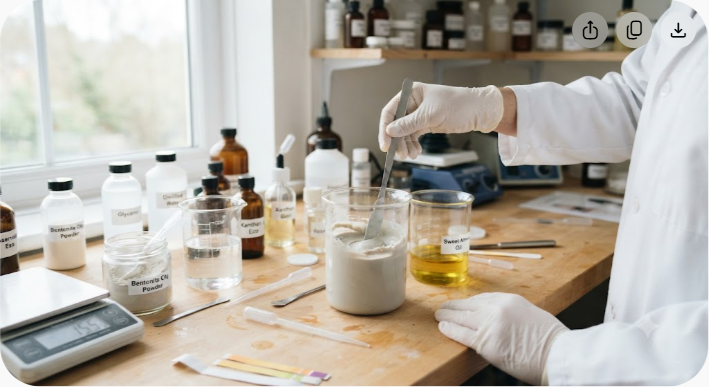
Creams and lotions contain multiple interacting phases. Bentonite can influence water-phase rheology, emulsion structure, sensory properties, and physical stability. It can also change the way the product feels during rubbing and application.
A low concentration may provide useful body without making a product feel heavy. A higher concentration can create more drag and produce a clay-like sensory profile that may not suit a lightweight facial lotion.
If the only objective is to increase viscosity, compare bentonite with conventional cosmetic rheology modifiers. Bentonite is most useful when you also want the particular combination of structure, suspension, absorption, mineral character, or sensory effects it can provide.
Bentonite is often compared with kaolin and other mineral clays, but they aren't interchangeable.
| Property | Bentonite | Kaolin |
|---|---|---|
| Typical mineral structure | Smectite-rich layered clay | Kaolinite-rich clay |
| Water interaction | Often strong, especially for swelling grades | Generally lower swelling |
| Rheology contribution | Can be significant | Usually more limited |
| Suspension use | Often useful | More dependent on formula |
| Mask texture | Often dense and structured | Often smoother and lighter |
| Oil absorption | Useful | Useful |
| Best choice | Depends on desired swelling and structure | Depends on desired feel and absorbency |
A formula can also contain more than one clay. Combining materials can provide a different balance of absorbency, spreadability, body, color, and sensory feel.
The useful formulation question isn't simply which clay is better. It is which clay, or combination of clays, gives the product the required performance without creating new problems.
Not all bentonite behaves the same way. Mineral composition, exchangeable ions, processing, particle size, and purity can all affect performance.
Review the supplier's technical specification and confirm the material through your own formulation testing.
A higher clay concentration can make a formula look impressively thick in the laboratory, but that doesn't mean the finished product will be pleasant to use.
Excessive clay can cause poor spreadability, dragging, cracking during drying, difficult rinsing, and an overly dense texture.
Water isn't simply an inert carrier.
Dissolved minerals and electrolytes can influence clay hydration and rheology. If laboratory development uses purified water while production uses a different water specification, the finished product may not behave the same way.
Keep the water specification consistent during development and manufacturing validation.
Adding bentonite before hydration and adding it to an already thickened, electrolyte-rich formula can produce very different results.
Document the manufacturing sequence and keep it consistent during scale-up. A small process change can affect dispersion, hydration, viscosity, and final texture.
Bentonite systems can continue changing after initial mixing. Measure viscosity at defined time points instead of relying on the appearance of a freshly mixed batch.
The time between mixing and measurement should be standardized when comparing development samples.
A material can be useful for drilling fluids or industrial absorbents and still be unsuitable for a cosmetic product.
Cosmetic raw-material qualification requires appropriate purity, quality documentation, contaminant controls, traceability, and a specification suited to the intended use.
Bentonite is a mineral, but that doesn't remove the need for proper cosmetic microbiological control. The raw materials, finished product, manufacturing environment, packaging, and preservative system all need to be considered.
A dry mineral powder doesn't make a water-containing cosmetic automatically microbiologically safe.
A useful laboratory evaluation should cover more than appearance.
At minimum, consider testing:
For a rinse-off clay mask, assess how easily the product spreads, dries, and rinses. For a liquid suspension, place more emphasis on sedimentation and redispersion. For an emulsion, monitor physical stability and viscosity changes together.
Testing should be designed around the actual product rather than copied from a generic clay specification. The tests that matter most depend on how the product is manufactured, packaged, stored, and used.
Bentonite doesn't behave independently. Other ingredients can change its hydration, rheology, wetting, and sensory performance.
Glycerin and other humectants can change the water environment and sensory feel of a clay formula. They may also affect how quickly the product dries on the skin.
Salts and other ionic ingredients can affect clay swelling and rheology. This matters in formulas containing mineral-rich ingredients or electrolyte-sensitive actives.
Surfactants can change particle wetting and interactions within a dispersion. Their effect depends on the surfactant type, concentration, and complete formula composition.
Cellulosic polymers, carbomers, acrylate polymers, gums, and other rheology modifiers can interact with bentonite. Combining thickeners may produce useful structure, but it can also result in excessive viscosity, stringiness, or an undesirable application feel.
Changing pH can alter the behavior of the complete system. Adjust pH with the clay, polymers, preservatives, and active ingredients in mind rather than treating pH correction as an isolated final step.
The supplier relationship matters because cosmetic performance depends on consistent raw-material quality from batch to batch.
Ask potential suppliers for a representative technical data sheet and certificate of analysis. Depending on your quality requirements and market, you may also need documentation covering microbiological quality, elemental impurities, country of origin, manufacturing controls, and traceability.
For international sourcing, confirm packaging, minimum order quantities, lead times, export documentation, and whether the same specification can be maintained across future shipments.
For a product developer, consistency is often more useful than an impressive one-time laboratory result. A clay that performs well in one batch but causes significant viscosity changes between lots can become a manufacturing problem.
Axewelledge supplies bentonite for applications including cosmetics and other industries, with processing and quality controls focused on consistent mineral performance. For cosmetic development, the useful discussion should center on the specific grade, specification, and application rather than treating bentonite as a single commodity material.
You don't need dozens of experimental batches to identify a useful starting point for a new cosmetic product. A small, controlled screening matrix can reveal how the selected bentonite behaves before you invest time in full optimization.
For a clay mask, extend the concentration range as needed because the desired finished clay content may be substantially higher.
The purpose of this screen isn't to discover a magic percentage. It is to identify the concentration and processing window in which the formula delivers the required performance consistently.
A few technical questions can save weeks of formulation work.
Ask:
The answers help establish whether you're buying a cosmetic raw material with a controlled specification or simply a mineral powder that happens to be called bentonite.
Bentonite can be a versatile cosmetic ingredient, but successful use comes from controlling the variables around it.
Remember these points:
The most reliable way to use bentonite in cosmetics is to treat it as a functional formulation ingredient rather than simply adding a natural clay to a recipe. Its swelling, absorption, suspension, and rheological properties can be valuable, but they need to be controlled within the complete formula.
Start with the right grade. Disperse it properly. Give it time to hydrate. Test several concentrations. Then judge the complete product for stability, sensory performance, and manufacturing consistency.
If you're sourcing bentonite for cosmetic development or commercial production, Axewelledge can help evaluate the appropriate mineral grade and supply requirements for your application. A clear technical specification matched to the intended function is the best place to start.













Have questions about our products? We're here to help!