Axewelledge, a leading exporter from India, specializes in high-quality Bentonite. With a commitment to excellence, we supply premium Bentonite to the Middle East and Southeast Asia markets.


North Angle Complex, 304,
150 Feet Ring Rd, Opposite Ambedkar Nagar BRTS Stop,
Madhav Park, Punit Nagar,
Mavdi, Rajkot, Gujarat 360004
© Axewelledge 2026, All Rights Reserved.
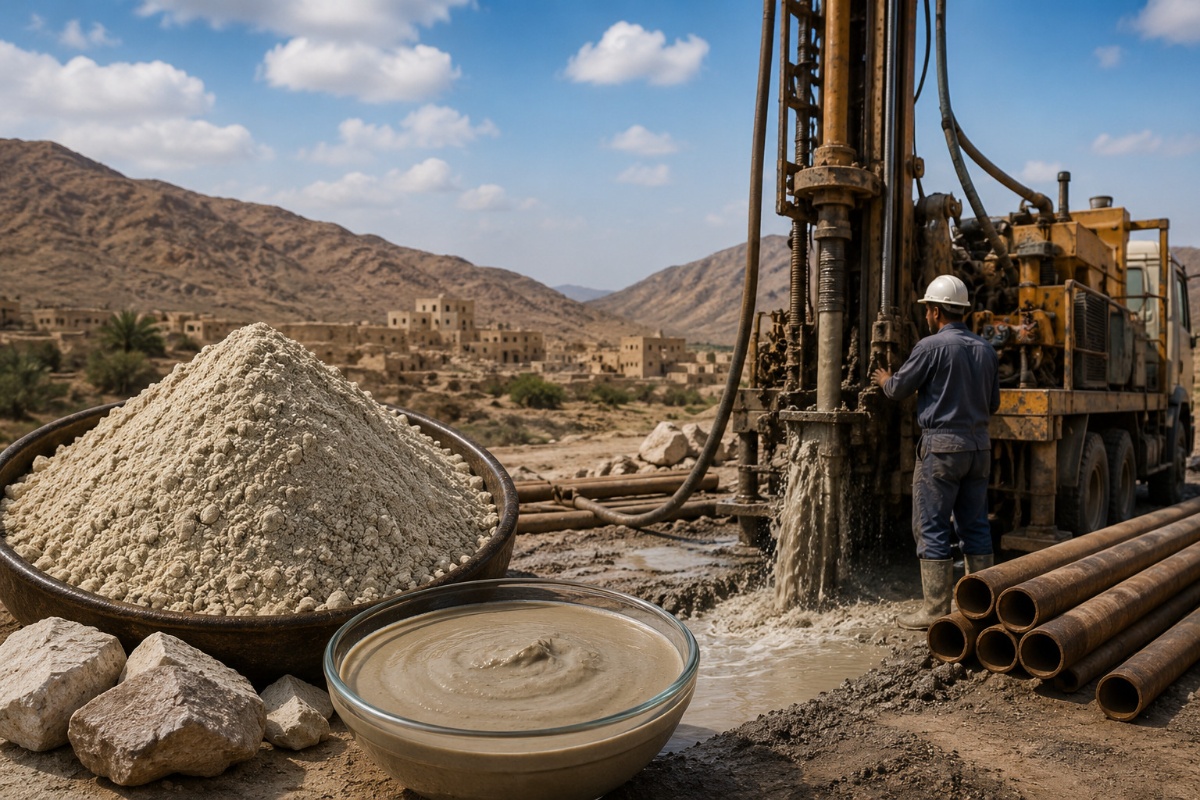
Water scarcity is one of the most significant challenges facing Yemen today. Due to its arid climate, limited rainfall, and increasing demand for groundwater, water well drilling has become a critical activity across the country. Industries involved in water infrastructure development, agricultural irrigation, municipal water supply, and construction rely heavily on efficient drilling technologies to access underground water resources. One of the most important materials used in these drilling operations is bentonite.
Bentonite is a naturally occurring clay mineral known for its exceptional swelling, viscosity, sealing, and suspension properties. When mixed with water, it forms a gel-like drilling fluid commonly known as drilling mud. This drilling mud plays a vital role in maintaining borehole stability, carrying drill cuttings to the surface, cooling drilling equipment, and preventing well collapse during drilling operations. These properties make bentonite an indispensable material for Yemen's water well drilling industry.
For companies seeking reliable bentonite supply for water well drilling applications, Axewel Ledge provides high-quality bentonite products suitable for industrial and drilling applications worldwide.
Bentonite is primarily composed of montmorillonite, a clay mineral capable of absorbing several times its weight in water. When hydrated, bentonite expands significantly and creates a highly viscous suspension. This unique behavior makes it ideal for drilling fluid formulations used in water well construction.
In water well drilling operations, bentonite serves multiple functions:
These benefits are particularly valuable in Yemen, where geological formations often include loose sands, gravels, fractured rocks, and unstable soils.
Yemen is considered one of the world's most water-stressed countries. Groundwater remains the primary source of water for:
As groundwater levels continue to decline, drilling deeper and more complex wells becomes necessary. These challenging conditions require drilling fluids capable of maintaining borehole integrity throughout the drilling process. Bentonite-based drilling mud provides the necessary support.
One of the most important functions of bentonite in Yemen's drilling operations is stabilizing borehole walls.
During drilling, loose soil and rock formations can collapse into the borehole, causing equipment damage, project delays, and increased costs. Bentonite forms a protective filter cake along the borehole wall that prevents collapse and keeps the well structure stable.
This feature is especially useful in Yemen's sandy and unconsolidated formations.
As drilling progresses, rock fragments and soil particles are generated continuously.
Bentonite drilling fluid carries these cuttings from the bottom of the borehole to the surface. Its viscosity keeps particles suspended, ensuring a cleaner drilling environment and preventing blockages.
Yemeni drilling contractors rely on this capability to maintain efficient drilling performance even in deep wells.
Groundwater formations can absorb drilling fluid rapidly, resulting in significant fluid loss.
Bentonite reduces this issue by forming a low-permeability seal around the borehole. This minimizes fluid infiltration into surrounding formations and improves drilling efficiency.
For Yemen's water well projects, where water availability itself can be limited, reducing fluid loss is economically important.
Drill bits generate substantial heat while penetrating hard rock formations.
Bentonite mud circulates continuously around drilling equipment, providing cooling and lubrication. This reduces friction, minimizes wear, and extends the service life of expensive drilling tools.
This benefit is particularly valuable for deep water wells drilled in Yemen's mountainous regions.
In unstable formations, a borehole can collapse within minutes if not adequately supported.
The hydrostatic pressure created by bentonite mud counteracts surrounding formation pressures and prevents cave-ins. This protection allows drilling to continue safely and efficiently.
Agriculture remains one of Yemen's largest water consumers.
Farmers and agricultural organizations drill thousands of wells to access groundwater for irrigation systems. Bentonite drilling fluids help contractors create stable, productive wells that support long-term agricultural operations.
Benefits include:
Urban and rural communities depend heavily on groundwater extraction.
Municipal authorities frequently develop new water wells to meet growing demand. Bentonite is used throughout these projects to ensure drilling efficiency and maintain borehole integrity.
The result is safer and more reliable water supply infrastructure.
Large infrastructure developments often require groundwater investigations and water well installations.
Construction companies use bentonite drilling fluids for:
Its ability to stabilize excavations and boreholes makes it highly valuable in these applications.
Manufacturing plants, processing facilities, and industrial zones require dependable water sources.
Many Yemeni industries drill dedicated wells for operational water supply. Bentonite supports these projects by improving drilling performance and reducing operational risks.
Sodium bentonite is the preferred choice for water well drilling because it offers:
These characteristics make it ideal for challenging drilling environments.
API-grade bentonite complies with international drilling standards and is commonly used in professional drilling operations.
Advantages include:
Many Yemeni contractors prefer API-grade products for critical water well projects.
Bentonite powder is mixed with clean water using mechanical mixers.
Proper hydration is essential to achieve the desired viscosity and gel strength.
The prepared drilling fluid is pumped down the drill pipe and exits through the drill bit.
This circulation helps:
As drilling continues, bentonite particles deposit along borehole walls.
This creates a thin filter cake that:
The drilling fluid transports cuttings to the surface, where they are separated and removed before the mud is recirculated.
This process ensures continuous drilling efficiency.
Bentonite allows contractors to drill faster and more safely while minimizing downtime.
Reduced equipment wear and fewer drilling complications lead to significant cost savings.
Stable boreholes produce higher-quality wells with longer service life.
Bentonite is a naturally occurring mineral that is generally considered environmentally friendly for water well drilling applications.
Stable drilling conditions reduce risks associated with borehole collapse and equipment failure.
Yemen's drilling industry faces several challenges:
Bentonite helps overcome these challenges by improving drilling fluid performance and ensuring borehole stability throughout the drilling process.
To achieve optimal results, Yemeni drilling contractors look for bentonite with:
High-quality bentonite ensures reliable drilling fluid performance and reduces operational issues.
India is one of the leading producers and exporters of bentonite globally.
Yemeni industries often source bentonite from India because of:
Indian suppliers provide customized grades suitable for various water well drilling conditions.
For Yemeni contractors, water authorities, drilling companies, and industrial projects, selecting the right bentonite supplier is critical.
Axewel Ledge offers premium-quality bentonite products designed to meet the demanding requirements of water well drilling applications. Their bentonite solutions provide excellent swelling capacity, borehole stabilization, fluid loss control, and drilling efficiency, making them suitable for projects across Yemen and the Middle East.
With a commitment to quality, international standards, and dependable export services, Axewel Ledge supports drilling contractors in achieving safer, faster, and more cost-effective well construction projects.
Bentonite has become an essential component of Yemen's water well drilling industry. Its ability to stabilize boreholes, transport drill cuttings, control fluid loss, cool drilling equipment, and prevent formation collapse makes it indispensable for successful groundwater development projects.
As Yemen continues to invest in water infrastructure and groundwater extraction, the demand for high-quality bentonite will remain strong. From agricultural irrigation systems to municipal water supply networks and industrial facilities, bentonite helps ensure efficient and reliable drilling operations.
For companies seeking dependable bentonite solutions for water well drilling, Axewel Ledge stands as a trusted partner, providing premium bentonite products that support the growing needs of Yemen's water and infrastructure sectors.













Have questions about our products? We're here to help!