Axewelledge, a leading exporter from India, specializes in high-quality Bentonite. With a commitment to excellence, we supply premium Bentonite to the Middle East and Southeast Asia markets.


North Angle Complex, 304,
150 Feet Ring Rd, Opposite Ambedkar Nagar BRTS Stop,
Madhav Park, Punit Nagar,
Mavdi, Rajkot, Gujarat 360004
© Axewelledge 2026, All Rights Reserved.
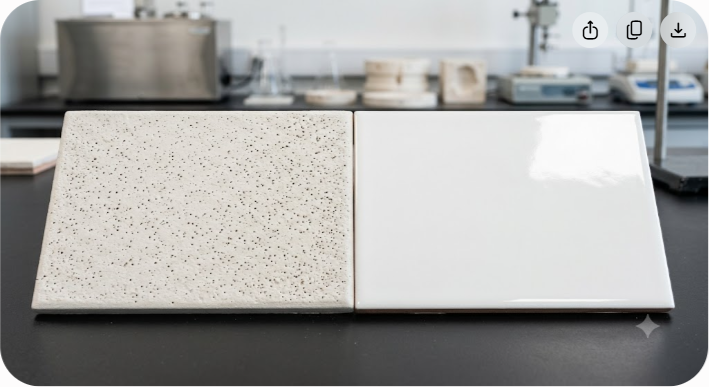
Pinholing accounts for up to 40% of all surface-related quality rejections in high-volume sanitaryware plants. A single pinhole—a tiny, needle-like puncture or crater breaking the smooth vitreous glaze—instantly downgrades a Grade-A water closet or washbasin to a second-choice item or total scrap. Beyond the immediate financial loss, repairing pinholes via re-firing consumes valuable kiln capacity, elevates energy bills, and often weakens the underlying ceramic body.
While raw glaze formulations rely heavily on un-fritted minerals like feldspar, quartz, dolomite, and raw opacifiers, switching to opacified frits dramatically lowers pinholing rates. By replacing unreacted raw materials with pre-smelted, homogenous glass particles enriched with opacifying agents—primarily zirconium silicate (ZrSiO 4 ?
)—ceramic engineers gain tight control over degassing, surface tension, melt viscosity, and thermal expansion.
In this technical guide, we will analyze the precise chemical and physical mechanisms that cause glaze pinholing, demonstrate why opacified frits resolve these root causes, and provide practical formulation and firing adjustments to guarantee defect-free sanitaryware production.
To eliminate pinholes, you must first understand where they come from. A pinhole is the residual outline of a gas bubble that trapped itself in the glaze layer during firing, expanded, traveled toward the surface, popped, and failed to heal before the glass matrix solidified.
Gas generation inside a firing glaze is inevitable. The critical progression involves four primary stages:
The critical difference between a smooth surface and a pinholed surface lies in when the gas is released relative to the viscosity and surface tension of the melting glass.
Un-fritted or raw glazes rely on mineral additives like calcium carbonate (CaCO 3 ?
), magnesium carbonate (MgCO 3 ?
), barium carbonate (BaCO 3 ?
), and kaolin clay. During the ramp-up phase of firing, these minerals undergo thermal decomposition:
3 ?
?CaO+CO 2 ?
? (occurs between 820 ? C and 950 ? C)
? C and 900 ? C, releasing substantial CO 2 ?
volumes.
2 ?
O) between 450 ? C and 600 ? C.
If these gases escape while the glaze layer is still fully porous, they pass through without issue. However, if early-melting raw components create a soft, sticky glass coat before mineral decomposition completes, expanding carbon dioxide and water vapor become permanently trapped inside the liquid glaze.
Sanitaryware slip formulations incorporate organic binders, carboxymethyl cellulose (CMC), dispersants, and ball clays containing trace organic carbon. If the kiln atmosphere lacks sufficient oxygen between 200 ? C and 700 ? C, this organic matter undergoes incomplete combustion, forming fine carbon deposits. When these carbon particles react with residual oxides later at higher temperatures, they form carbon monoxide (CO) gas bubbles right at the body-glaze interface.
Vitreous china body slips are porous, open structures before full vitrification. As the ceramic body matures between 1180 ? C and 1250 ? C, air trapped inside the body's internal pores expands according to ideal gas behavior. Simultaneously, sulfur impurities (such as iron sulfides or sulfates) decompose, generating sulfur dioxide (SO 2 ?
) gas. This outgassing forces gas bubbles upward directly into the overlying melt layer.
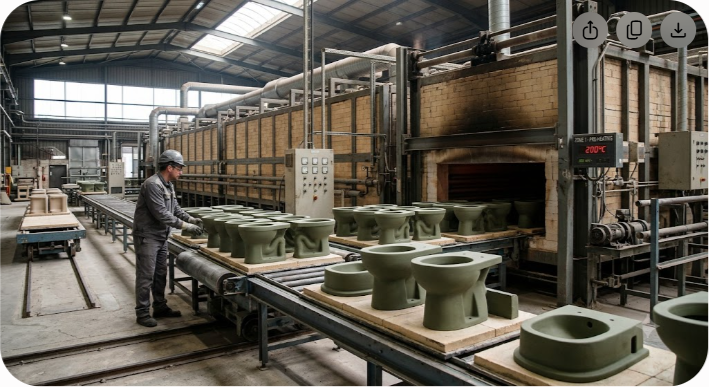
An opacified frit is a pre-reacted, glass-like ceramic material produced by melting a precisely balanced mixture of raw oxides, fluxes, silica, and opacifiers at high temperatures (1350 ? C–1500 ? C), followed by rapid water quenching (granulation).
The production sequence ensures complete thermal stabilization before application:
? C–1500 ? C completely drives off all volatile gases.
Unlike standard transparent frits—which require manufacturers to mill raw opacifiers like zircon flour (ZrSiO 4 ?
) into the glaze batch later—opacified frits incorporate the opacifying agent directly into the molten glass structure during synthesis.
During smelting, volatile compounds—CO 2 ?
, SO 2 ?
, NO x ?
, and chemically bound H 2 ?
O—are completely burned off and exhausted. The resulting quenched glass granules contain zero volatile gas precursors. When you grind this frit and apply it to a vitreous china piece, it melts cleanly without generating internal decomposition gases.
2 ?
) / Zircon (ZrSiO 4 ?
): The primary opacifying agent. It provides high refractive index contrast (n?1.95 to 2.00) against the silicate glass matrix (n?1.50), creating a bright, mask-like white finish.
2 ?
) and Alumina (Al 2 ?
O 3 ?
): Glass formers and network stabilizers that provide chemical durability, scratch resistance, and controlled melt viscosity.
2 ?
O 3 ?
): Acts as a low-temperature flux, dramatically lowering high-temperature surface tension and promoting smooth melt levelling.
Opacified frits combat pinholing through four distinct physical and chemical mechanisms: eliminating volatile gas generation, controlling surface tension, widening the firing window, and optimizing microstructural bubble dissolution.
Because opacified frits undergo full thermal decomposition in a specialized frit kiln before reaching your factory, they are entirely inert from a gas-evolution standpoint.
When a raw glaze fires, it generates liters of CO 2 ?
and SO 2 ?
gas inside the melting glaze layer at 900 ? C to 1150 ? C. Conversely, when an opacified frit melts, it simply transitions smoothly from solid particles to a viscous liquid without producing gas. The only bubbles present are small pockets of ambient air trapped between dry glaze particles, which are significantly easier to evacuate.
Once a gas bubble bursts at the glaze surface, the surrounding liquid glass must flow inward to seal the crater before the kiln cools down. The speed of this self-healing process depends directly on the ratio of surface tension (?) to melt viscosity (?).
Raw glazes containing high proportions of raw un-fritted calcium and barium oxides exhibit elevated surface tension (>350 mN/m). High surface tension causes the edges of a popped bubble to pull back into a raised rim, forming a permanent crater or pinhole.
Opacified frits engineered with balanced B 2 ?
O 3 ?
, ZnO, and alkali oxides feature lower high-temperature surface tension (280–310 mN/m). This allows the liquid glaze to wet the surface evenly, collapse crater walls, and level into a mirror-like finish.
Raw glazes often have narrow maturing windows (typically 15 ? C–20 ? C). They transition rapidly from under-fired (rough, under-melted) to over-fired (boiling, blistering, running). If kiln temperatures fluctuate by even 15 ? C, raw glazes can easily boil or fail to heal.
Opacified frits feature engineered glass networks that melt gradually across a wide thermal window (1180 ? C to 1260 ? C, providing a 50 ? C–80 ? C softening zone). This broad softening range gives trapped body gases plenty of time to escape early, while maintaining enough body and viscosity to prevent sagging or running at peak temperatures.
When raw zircon flour (ZrSiO 4 ?
) is added to a raw glaze ball mill, coarse agglomerates often form. These un-dispersed zircon clusters act as nucleation points where gas bubbles cling, refusing to detach from the body interface.
In an opacified frit, the zirconium silicate is completely dissolved within the molten glass matrix during smelting. As the sanitaryware glaze cools inside the tunnel kiln, zircon recrystallizes out of the glass solution in ultra-fine, evenly distributed sub-micron crystals (0.2–0.5 ?m). These fine crystals do not trap gas bubbles. Instead, they provide optimal light scattering for intense opacity without disrupting the smooth flow of the melting glass matrix.
To see why opacified frits perform so exceptionally well in sanitaryware applications, compare the three main glaze formulation approaches side by side:
| Operational Property | Raw Glaze (Un-fritted) | Standard Fritted Glaze + Raw Zircon | Opacified Fritted Glaze |
|---|
| Pre-evacuated Volatiles | None; high CO 2 ?
/H 2 ?
O release | Moderate; frit portion is inert, raw portion gases | High; 100% pre-smelted and degassed |
| Pinholing Susceptibility | High (requires very slow firing) | Medium (agglomerated zircon traps bubbles) | Very Low (homogenous melt and smooth flow) |
| Melt Homogeneity | Low; relies on solid-state in-kiln reactions | Moderate; requires long milling to disperse zircon | Maximum; zircon pre-dissolved in glass matrix |
| Glaze Rheology Stability | Poor; raw carbonates alter slip viscosity | Moderate; raw zircon can cause thixotropy | High; stable slip behavior and minimal aging drift |
| Whiteness & Opacity Index | Inconsistent; prone to speckling | Good, but prone to raw agglomeration spots | Exceptional; uniform sub-micron zircon crystallization | | Firing Window Flexibility | Narrow (±10 ? C) | Moderate (±20 ? C) | Wide (±40 ? C to 50 ? C) |
While zirconium silicate is the industry standard for sanitaryware, ceramic chemists occasionally evaluate tin oxide (SnO 2 ?
) or titanium dioxide (TiO 2 ?
). Here is how opacified frits using different chemical opacifiers behave regarding pinholing and surface quality:
4 ?
)
? C–1280 ? C).
2 ?
)
2 ?
can promote phase separation and severe surface pinholing due to oxygen lattice evolution.
2 ?
)
Switching from a raw or partially fritted glaze to a high-performance opacified frit system requires systematic adjustments to your milling, slip preparation, and kiln parameters.
Before selecting an opacified frit, measure the Coefficient of Thermal Expansion of your sanitaryware body using a dilatometer.
? C to 600 ? C). This puts the glaze under slight compression upon cooling, preventing crazing while avoiding shivering.
?6 / ? C to 6.5×10 ?6 / ? C.
Choose an opacified frit tailored to your specific kiln technology:
Over-milling a fritted glaze creates excessive ultra-fine particles, which trap air during spray application and increase pinholing risks. Under-milling leads to poor suspension and rough melting.
?m) sieve.
3 .
Even with an opacified frit, gas outgassing from the underlying ceramic body must be managed during firing:
? C–800 ? C): Maintain clean oxidizing conditions to ensure complete burnout of organic binders in the green body before the frit begins to soften.
? C–1250 ? C): Hold peak temperature for 20 to 40 minutes. This soak gives trapped air bubbles sufficient time to rise to the surface, pop, and level out completely.
Not every surface dot is a classical pinhole. Distinguishing pinholes from blisters, crawling, or dimples is vital for taking the correct corrective action on the production floor.
A major European sanitaryware manufacturer producing 85,000 vitreous china units per month was suffering from a 6.8% pinholing rejection rate on its luxury water closet line. The plant was running a semi-raw glaze containing 12% raw whiting, 8% raw dolomite, and 9% milled zircon flour in a 12-hour fast-firing tunnel kiln (1230 ? C peak).
Optical microscopy revealed that calcium carbonate decomposition at 900 ? C was creating micro-voids, while agglomerated zircon flour trapped escaping body air at 1180 ? C. Extending kiln soak time was impossible due to tight production schedules.
The engineering team reformulated the glaze, eliminating raw whiting and raw dolomite entirely. They replaced these components with Axewelledge Premium Opacified Frit AP-408, an engineered zirconium-borosilicate glass featuring pre-dispersed zircon and optimized alkaline earth fluxes.
3 with zero settling or aging drift in slurry tanks.
? C (1215 ? C), reducing natural gas consumption while maintaining perfect surface gloss and opacity.
When developing custom opacified fritted glazes, balancing the primary oxide ratios is essential for achieving defect-free surfaces:
$$ ext{Silica-to-Alumina Ratio} = rac{ ext{Moles } SiO_2}{ ext{Moles } Al_2O_3} approx 8.5 - 10.5$$
$$ ext{Alkali-to-Alkaline Earth Flux Ratio} = rac{K_2O + Na_2O}{CaO + MgO + SrO + BaO} approx 0.15 - 0.25$$
2 ?
O+K 2 ?
O under control: High alkali content increases thermal expansion rapidly, leading to crazing. Use CaO and B 2 ?
O 3 ?
as the primary fluxes instead.
2 ?
O 3 ?
(Boron Trioxide) content: Maintain B 2 ?
O 3 ?
between 4% and 8% by weight in the frit formulation. Boron dramatically lowers melt viscosity at 1050 ? C–1150 ? C, allowing early air bubbles to escape long before final vitrification.
Preventing pinholing in sanitaryware glazes requires controlling gas evolution and glass melt behavior at high temperatures. Raw glazes and basic mineral blends introduce too many volatile gases and inconsistent melt characteristics to guarantee low defect rates in modern, high-speed tunnel kilns.
By converting your glaze formulation to opacified frits, you eliminate gas-generating raw minerals, lower melt surface tension, and ensure ultra-fine, uniform zircon dispersion. The result is a smooth, highly durable, pinhole-free vitreous surface that passes the most stringent quality inspections.
At Axewelledge, we leverage advanced mineral processing, high-purity raw materials, and precise thermal processing to manufacture world-class ceramic frits, engobes, and specialized industrial minerals. Whether you need custom-formulated opacified frits or high-swelling bentonites for ceramic body plasticity, our technical team works directly with your engineers to eliminate firing defects and boost your production yields.
Contact Axewelledge today to request a technical consultation or order sample batches for your production testing.













Have questions about our products? We're here to help!