Axewelledge, a leading exporter from India, specializes in high-quality Bentonite. With a commitment to excellence, we supply premium Bentonite to the Middle East and Southeast Asia markets.


North Angle Complex, 304,
150 Feet Ring Rd, Opposite Ambedkar Nagar BRTS Stop,
Madhav Park, Punit Nagar,
Mavdi, Rajkot, Gujarat 360004
© Axewelledge 2026, All Rights Reserved.
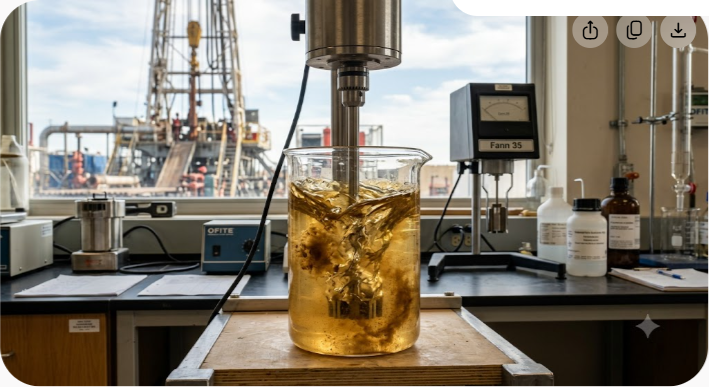
Organophilic bentonite is a chemically modified bentonite used mainly to build rheology and suspension in non-aqueous drilling fluids. Unlike conventional sodium bentonite, which develops its useful structure after hydration in water, organophilic bentonite is designed to disperse and develop structure in oil or synthetic continuous phases.
That distinction matters. Bentonite in oil-based mud is not simply ordinary bentonite added to an oil system. The clay surface has to be modified so that organic molecules can interact with it effectively. The resulting organoclay can contribute low-shear-rate viscosity, yield stress, gel strength, solids suspension, and, depending on the formulation, support filtration control.
The exact performance depends on much more than the name on the bag. The base bentonite, degree and type of organic modification, particle-size distribution, base fluid, polar activation, shear history, emulsifier package, oil-to-water ratio, temperature, and solids loading all affect the final mud properties.
For drilling engineers, the practical question is therefore not simply whether organophilic bentonite works. It is which grade, at what concentration, in which fluid system, and after what mixing process?
This guide explains how organophilic bentonite works, where it is used, how it differs from hydrophilic bentonite, how to mix it, how to troubleshoot poor performance, and what to check when qualifying a supplier.
Natural bentonite is rich in smectite minerals, particularly montmorillonite. Sodium bentonite is highly hydrophilic: water enters the interlayer regions of the clay and causes the particles to separate and develop a large effective surface area. That behavior is valuable in water-based drilling fluids.
An oil-continuous fluid presents a different environment. Hydrocarbon molecules do not hydrate sodium bentonite in the same way that water does. If untreated bentonite is added to diesel, mineral oil, or many synthetic base fluids, it generally cannot develop the same colloidal structure expected from a properly dispersed water-based bentonite system.
Organophilic treatment changes the surface chemistry of the clay. In a common manufacturing approach, exchangeable inorganic cations associated with the clay are replaced or associated with organic cationic compounds, often quaternary ammonium compounds. The organic groups make the clay surface compatible with the surrounding organic phase.
The result is commonly called an organoclay or organophilic clay. When properly dispersed, the modified clay can form an interconnected particle structure in the continuous phase. This structure gives the drilling fluid useful resistance to flow at low shear and helps suspend weighting material and drilled solids when circulation stops.
It is important to avoid describing this process as ordinary hydration. In an oil-based system, the relevant mechanisms are better described as wetting, solvation, dispersion, swelling or expansion of the modified structure, and development of an organoclay network.
The primary role of organophilic bentonite is rheology modification. Its effects extend into several properties that drilling engineers monitor during routine mud checks.
A drilling fluid needs enough structure at low shear to move cuttings and keep weighting material suspended, but it also needs to circulate through the drillstring and annulus without creating unnecessary pressure losses.
Organophilic bentonite can increase low-shear-rate viscosity and yield stress. This is especially useful when the mud needs more carrying capacity without relying entirely on polymeric additives or simply increasing overall solids concentration.
Low-shear readings, such as measurements at 3 and 6 rpm on a rotational viscometer, can provide useful information about the fluid's ability to maintain structure at low flow conditions. They should be interpreted alongside plastic viscosity, yield point, gel strengths, density, and the actual well hydraulics rather than treated as an isolated target.
Cuttings do not disappear when pumps are switched off. During connections, trips, logging operations, or unexpected shutdowns, the fluid must maintain enough structure to limit rapid solids settling.
Organophilic bentonite contributes to this static and near-static structure. A well-designed mud system can therefore suspend drilled solids and weighting material more effectively than a comparable oil system with insufficient low-shear structure.
The goal is not maximum gel strength. Excessively strong gels can make restarting circulation difficult and can increase equivalent circulating density. The useful target is a controlled, reversible structure that provides suspension without creating excessive restart pressure.
Yield point is commonly used as an indicator of the fluid's ability to transport solids under flow. In practice, however, the relationship between yield point and hole cleaning is more complicated than a single number suggests.
Organoclay can raise the low-shear structure and contribute to the measured yield point of an oil-based mud. The final result depends on the entire fluid formulation, including emulsifiers, brine concentration, drilled solids, weighting material, and other rheology modifiers.
A useful formulation therefore balances yield behavior with plastic viscosity. A high apparent yield point is not automatically evidence of better hole cleaning if the mud also has excessive plastic viscosity or poor suspension behavior at the temperatures encountered in the well.
Gel strength describes the structure that develops while a drilling fluid remains at rest. Organophilic bentonite can form part of this structure through interactions among modified clay platelets.
The practical objective is a progressive, manageable gel profile. Engineers commonly examine short-term and longer static gel measurements rather than relying on one reading. A disproportionate increase between early and later gel measurements can signal an undesirable progressive gel structure.
This is particularly important in high-angle and horizontal wells, where weighting material and drilled solids may settle along the low side of the hole during static periods.
Barite is substantially denser than the surrounding drilling fluid. If the fluid does not provide sufficient low-shear structure, barite can settle, creating barite sag and potentially causing significant changes in local mud density.
Organophilic bentonite helps by contributing to the fluid's suspension structure. However, it should not be presented as a stand-alone cure for barite sag. Sag can also result from inadequate rheology, unfavorable wellbore conditions, excessive density, temperature effects, poor emulsion quality, or an inappropriate solids distribution.
A laboratory sag test and pilot formulation are much more useful than simply increasing organoclay concentration whenever sag is observed.
Organophilic bentonite is primarily a rheology additive, not necessarily the principal filtration-control additive in every oil-based mud formulation. Its fine particles can contribute to the solids structure of the filter cake, but fluid-loss performance usually depends on a combination of organoclay, emulsifiers, fluid-loss additives, internal brine properties, and the formation itself.
For that reason, a supplier should not claim that an organoclay grade will automatically deliver a particular filtration result. The complete mud system should be tested under representative pressure and temperature conditions.
Most conventional oil-based drilling fluids are invert emulsions: water droplets form the dispersed internal phase while oil or another non-aqueous liquid forms the continuous phase.
Organophilic clay can contribute to the overall structure of the continuous phase and can work alongside emulsifiers and wetting agents. It should not, however, be treated as a replacement for a properly designed emulsifier package. Emulsion stability is a formulation property, not simply a consequence of adding more clay.
The performance of an organoclay depends heavily on dispersion. A high-quality powder can still produce disappointing viscosity if it is added too quickly, receives insufficient shear, is incompatible with the base fluid, or is used without the activation treatment required by its grade.
A simplified mechanism looks like this:
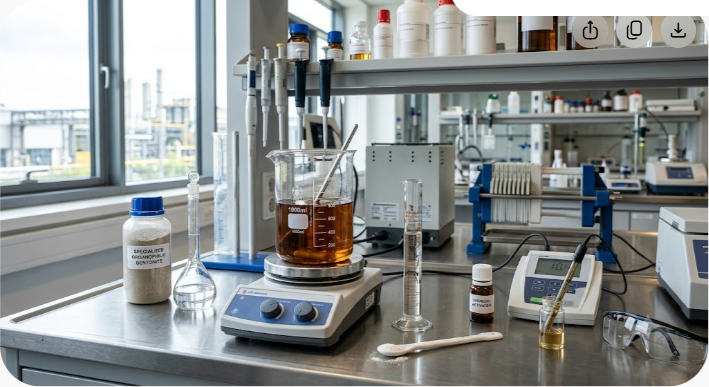
The process is sensitive to mixing conditions. Two formulations containing the same organoclay concentration can show different rheology if one receives better dispersion or uses a different activation sequence.
Organoclay particles are supplied as agglomerated powder. The mixing system must break these agglomerates down and distribute the particles throughout the base fluid.
Poor dispersion often appears as disappointing low-shear viscosity, inconsistent rheology between samples, or a delayed increase in viscosity after mixing. Simply increasing the dosage can mask the problem temporarily, but it may also push plastic viscosity too high once the clay eventually becomes fully dispersed.
The better approach is to verify the mixing sequence, shear intensity, addition rate, residence time, and compatibility of the grade before increasing the treatment concentration.
The two materials share a bentonite mineral base, but their surface chemistry and intended applications are different.
| Property | Standard Sodium Bentonite | Organophilic Bentonite |
|---|---|---|
| Surface character | Hydrophilic | Organophilic or oleophilic after chemical modification |
| Main continuous phase | Water | Oil or selected synthetic non-aqueous fluids |
| Main dispersion mechanism | Hydration and clay swelling in water | Wetting, solvation, dispersion, and organoclay network formation |
| Typical drilling use | Water-based drilling fluids | Oil-based and synthetic-based drilling fluids |
| Primary rheology role | Viscosity, suspension, and filtration support in WBM | Low-shear rheology and suspension in non-aqueous systems |
| Activation | Water hydration and adequate shear | Grade-dependent shear and, for some products, polar activation |
| Salt and hardness response | Strongly affected by water chemistry | Depends on organoclay chemistry and complete mud formulation |
| Temperature performance | Depends strongly on grade and water chemistry | Depends strongly on organoclay chemistry and complete mud formulation |
The key point is compatibility. Standard sodium bentonite is not an equivalent substitute for an organophilic clay in an oil-continuous drilling fluid.
Organophilic bentonite is useful across several non-aqueous drilling environments, but the required grade should be selected from laboratory data rather than from the well type alone.
High-temperature wells put pressure on every component of a drilling fluid. Base-fluid viscosity changes with temperature, emulsifier performance can shift, polymers may lose effectiveness, and organoclay structure can weaken or change.
A high-temperature organoclay can help retain useful low-shear structure at elevated temperatures. The actual temperature limit is product-specific, though. It is not technically sound to assign every organophilic bentonite a universal upper operating temperature such as 180 or 200 degrees Celsius.
For HTHP applications, evaluate hot rheology and filtration using the actual base fluid, salinity, density, additive package, and expected temperature. A product that performs well in a simple laboratory oil may behave differently in a fully formulated high-density invert emulsion.
Long horizontal intervals create demanding cuttings-transport conditions. Gravity encourages solids to settle toward the low side of the annulus, particularly when annular velocity falls or the fluid loses low-shear structure.
Organophilic bentonite can contribute to the low-shear rheology needed for suspension and transport. It works best as part of a broader hole-cleaning program that considers flow rate, annular velocity, well inclination, pipe rotation, cuttings size, mud weight, rheology, and circulation practices.
Increasing clay concentration alone isn't a substitute for adequate hydraulic design.
As mud density rises, the amount of weighting material increases. This can make rheology management more difficult because the mud already contains a large solids load.
Organoclay can provide additional structure, but overdosing may increase plastic viscosity and pump pressure. High-density formulations therefore require careful optimization rather than a simple increase in organoclay dosage.
A pilot test should compare several concentrations and examine both low-shear behavior and PV, along with density and electrical stability where appropriate.
Deepwater systems can experience a large temperature difference between the cold upper section and the hotter bottom-hole environment. The mud therefore needs a rheology profile that remains manageable across a wide temperature range.
Organoclay selection is particularly important in such systems. A grade that gives excellent viscosity at room temperature may become too structured in a cold environment or lose too much structure at bottom-hole temperature.
Laboratory testing across the expected temperature range is more informative than a single ambient-temperature viscosity measurement.
Synthetic-based fluids use non-aqueous continuous phases selected for performance, environmental, and operational requirements. The organoclay must be compatible with the specific synthetic base fluid.
Do not assume that a grade designed for mineral oil or diesel will behave identically in an ester, olefin, or other synthetic system. Supplier data should identify the tested base fluids and recommended activation method.
There is no universal dosage that works for every oil-based drilling fluid. A practical starting range for many conventional systems may fall around 6 to 14 kg/m3, equivalent to approximately 2 to 5 lb/bbl, but the correct treatment level should be established by laboratory pilot testing.
More demanding formulations may require higher concentrations, while some highly efficient or self-dispersing grades can achieve the required rheology at lower concentrations. Heavyweight systems, specialty pills, and sweep formulations may use higher treatment rates, but increasing dosage without checking PV and gel behavior can create new problems.
| Application or formulation | Illustrative starting range | What to evaluate |
|---|---|---|
| Conventional OBM | 6 to 14 kg/m3 | Low-shear rheology, YP, PV, gels |
| High-density or demanding OBM | 10 to 20 kg/m3 | Suspension, PV, sag tendency, hydraulics |
| Specialty sweep or high-viscosity treatment | 15 to 30 kg/m3 or higher | Sweep behavior, pumpability, cleanup |
These figures are starting ranges, not specifications. Product efficiency varies significantly between organoclay chemistries. Always use the supplier's technical data sheet and confirm the treatment rate in the actual mud formulation.
Mixing sequence has a direct effect on organoclay performance. The following procedure provides a practical framework, but the product manufacturer's instructions should take precedence because activation requirements differ between grades.
Charge the mixing tank with the selected base oil or synthetic continuous phase. Confirm that the fluid is clean enough for the intended test and that the tank provides adequate circulation and shear.
Add the primary components of the mud system according to the formulation, including wetting agents and emulsifiers where required. The exact order varies by mud design.
Don't assume that organoclay should always be the first additive. Follow the formulation procedure developed for the selected product and base fluid.
Introduce the organophilic bentonite slowly into the active shear zone. Avoid dumping a large quantity directly into a low-energy area of the tank because this encourages agglomeration.
Maintain sufficient shear while adding the powder. The objective is to wet and disperse individual particles rather than create large clay lumps that take much longer to break down.
Some conventional organoclays benefit from a polar activator, while many modern grades are designed to disperse with less or no separate activator. Propylene carbonate is one example used with certain organoclay systems, but the required chemistry and concentration are product-specific.
Do not apply a fixed activator-to-clay ratio across different products. Use the manufacturer's recommended treatment level and verify the result through a controlled pilot test.
Continue high-shear mixing long enough for the clay to develop its intended structure. A fixed 15- or 30-minute mixing period isn't universally correct because equipment, concentration, temperature, and product chemistry vary.
Take a sample after the specified mixing period and compare rheology with the expected pilot result. If viscosity is still developing rapidly, investigate dispersion and activation before increasing the clay concentration.
For an invert-emulsion mud, add the internal aqueous phase according to the formulation. Calcium chloride brine is commonly used in the internal phase, but its concentration and volume depend on the mud design.
Control addition rate and shear carefully so the desired droplet size and emulsion stability are achieved.
Add barite or another weighting material only after the base fluid and rheology system have reached the intended state. Complete the remaining formulation and then verify density, rheology, filtration, electrical stability, and other required properties.
A proper organoclay evaluation should compare formulations rather than test the additive in isolation.
A useful pilot program can include the following steps:
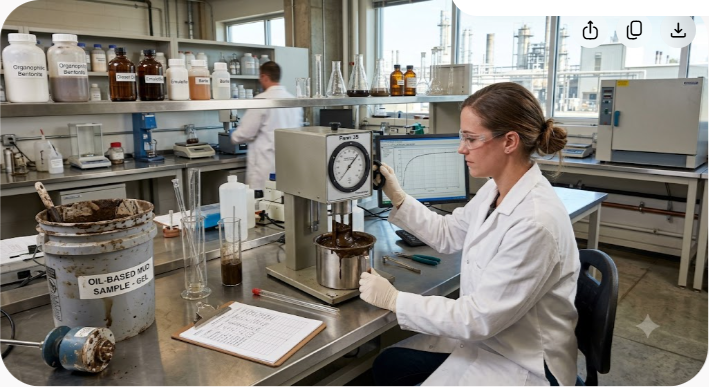
This approach reveals whether an apparently cheaper clay actually delivers the same usable rheology at the required concentration.
Plastic viscosity reflects the resistance associated largely with the continuous phase and suspended solids under the assumptions of the selected rheological model. An organoclay treatment that produces a large PV increase may be adding more solids-related resistance than the formulation can tolerate.
Yield point is useful for describing the low-shear flow behavior of a drilling fluid, but it should be interpreted with other measurements. A higher number isn't automatically better. The correct target depends on the well, flow regime, mud weight, temperature, and hole-cleaning requirements.
Low-shear measurements are particularly useful when evaluating organoclay because the additive is intended to build structure at low shear. Compare readings at consistent temperature and shear history.
Measure gel strengths at consistent rest periods. The trend matters as much as the absolute value. Excessive progressive gel development can make circulation difficult after a static period.
Likely causes: insufficient dispersion, inadequate shear, incorrect activation, incompatible base fluid, poor-quality organoclay, or an unsuitable treatment concentration.
What to check: confirm the product grade, mixing sequence, shear conditions, activator requirement, and actual concentration. Run a small pilot with controlled mixing before adding more clay to the active system.
Likely causes: excessive organoclay, drilled-solids contamination, high barite loading, poor solids control, or changes in emulsion condition.
What to check: compare the active mud with a clean pilot sample. If the pilot has acceptable PV but the field mud does not, contamination or solids loading may be the primary issue rather than the organoclay itself.
Likely causes: excessive organoclay, over-treatment with other rheology additives, poor solids management, or an incompatible formulation.
What to check: examine the complete additive package instead of treating the clay as the only variable. A controlled dilution or reformulation may be more appropriate than simply adding another additive to break the gel.
Likely causes: insufficient low-shear structure, unfavorable rheology at downhole temperature, excessive mud density, inadequate mixing, or a formulation that does not provide stable suspension.
What to check: perform a sag test and examine hot low-shear rheology. Increasing organoclay may help some formulations, but it can also increase PV. The solution should be based on measured behavior.
Likely causes: temperature-sensitive organoclay chemistry, changes in base-fluid viscosity, emulsion instability, or interactions among additives.
What to check: run rheology at several temperatures and compare the full mud system. If the application is HTHP, qualify the organoclay using representative hot-aging conditions rather than relying on room-temperature data.
Organoclay products can differ substantially in surface treatment, activation requirements, particle size, base-clay quality, and performance in different non-aqueous fluids.
A dosage that works for one supplier's product may not work for another's. Compare performance at equal treatment rates and, more importantly, at the concentration required to reach the same mud properties.
Polar activation is chemistry-dependent. Some grades require an activator, some are designed to be self-dispersing, and others have specific activation procedures.
Always follow the product data sheet and confirm activation through laboratory testing.
If the clay has not dispersed properly, adding more powder can make the eventual problem worse. Once the additional clay finally disperses, PV and gel strength may rise far beyond the target.
Check dispersion first.
A clay that produces excellent viscosity at 25 degrees Celsius may not give the same result at bottom-hole temperature. Thermal aging and hot rheology are essential for demanding wells.
Fluid loss is a system property. Organoclay may contribute to filter-cake structure, but emulsifiers, fluid-loss additives, brine properties, formation characteristics, and solids distribution also matter.
Drilled solids can raise PV and alter low-shear rheology. If a mud system becomes progressively thicker during drilling, the cause may be solids accumulation rather than insufficient organoclay.
Good solids control protects the rheological window created by the additive program.
Price per metric ton is a poor basis for comparing organoclay products. A better purchasing decision considers performance per unit volume of mud, consistency between batches, activation requirements, supply reliability, and technical support.
Ask the supplier for:
For an organophilic bentonite supplier in India or another manufacturing region, also evaluate export packaging, batch traceability, lead time, and the supplier's ability to maintain consistent raw-material quality.
Axewelledge can be evaluated as one potential mineral supplier, but the same qualification process should be applied to any organoclay producer. The important questions are whether the specific grade matches the intended base fluid, whether its treatment and activation requirements are clearly documented, and whether independent or customer-side pilot testing confirms the claimed performance.
Supplier credentials matter, but the mud test matters more.
Before approving a product for field use, confirm the following:
These questions make supplier comparisons much more meaningful than comparing price alone.
Suppose two organoclay grades are being considered for an invert-emulsion drilling fluid. Product A costs less per kilogram, while Product B costs more. At first glance, Product A appears to be the economical choice.
The pilot test tells a different story. If Product A needs 12 kg/m3 to reach the desired low-shear structure while Product B reaches the same target at 8 kg/m3, the purchase price per kilogram does not tell the whole story. The engineer must also compare PV, gel strengths, filtration, thermal stability, mixing requirements, and compatibility with the rest of the formulation.
The useful commercial metric is therefore closer to cost per unit volume of correctly performing mud, not simply cost per kilogram of powder.
That distinction is especially important in high-density or offshore operations, where logistics and handling costs can make inefficient additive consumption expensive.
Organophilic bentonite is a specialized organoclay designed to provide rheological structure in oil-based and other non-aqueous drilling fluids. Its value comes from surface modification that makes the clay compatible with an organic continuous phase.
The main benefits are low-shear rheology, yield behavior, static suspension, and controlled gel structure. It can support barite suspension and may contribute to filtration performance, but it should be considered one part of a complete mud formulation rather than a universal solution.
The most important operating variables are product chemistry, base-fluid compatibility, shear, activation, concentration, temperature, and the interaction of the organoclay with emulsifiers, brine, weighting material, and other additives.
For routine OBM applications, treatment levels around 6 to 14 kg/m3 can provide a useful starting point for some products, but the correct dosage must be established by pilot testing. High-density, high-temperature, and specialty applications may require different concentrations.
The safest way to select an organophilic bentonite is straightforward: define the required mud properties, test several concentrations in the actual fluid system, evaluate performance at representative temperatures, and compare suppliers using both technical performance and total treatment cost.
The right organoclay should make the mud easier to manage, not simply make the rheology numbers higher.













Have questions about our products? We're here to help!