Axewelledge, a leading exporter from India, specializes in high-quality Bentonite. With a commitment to excellence, we supply premium Bentonite to the Middle East and Southeast Asia markets.


North Angle Complex, 304,
150 Feet Ring Rd, Opposite Ambedkar Nagar BRTS Stop,
Madhav Park, Punit Nagar,
Mavdi, Rajkot, Gujarat 360004
© Axewelledge 2026, All Rights Reserved.
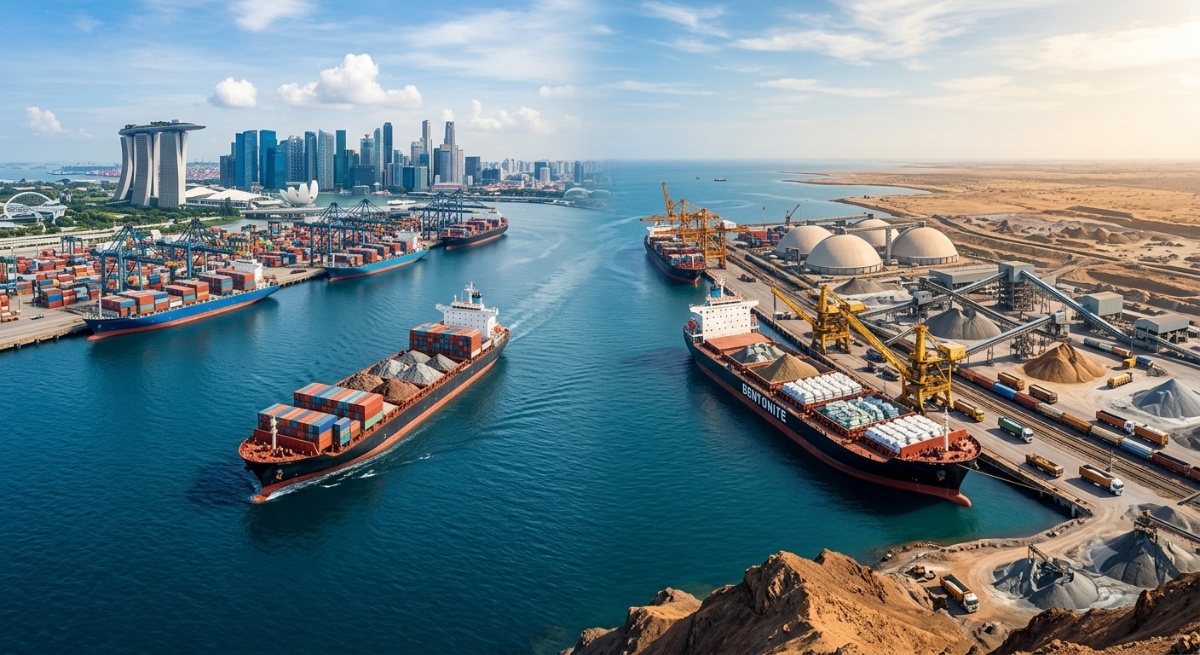
Singapore serves as the premier logistical, infrastructure, and financial nexus of Southeast Asia. However, despite its world-class construction, advanced civil engineering, marine infrastructure, and industrial manufacturing sectors, the island nation has no natural mineral deposits. For a Singapore bentonite distributor, securing a consistent, large-scale, and premium-grade supply of industrial clay is an absolute operational necessity.
To satisfy this high demand, international procurement networks invariably point toward India. Home to some of the world's largest, highest-purity sodium bentonite reserves—particularly clustered in the mineral-rich Bhuj and Kutch regions of Gujarat—India stands as the logical geographic sourcing destination.
Yet, establishing a high-yield, friction-free cross-border partnership requires more than standard transaction processing. It calls for an intimate understanding of logistical infrastructure, quality evaluation frameworks, industrial grading, and compliance parameters. This comprehensive guide outlines the exact, step-by-step methodologies a Singapore bentonite distributor must employ to successfully partner with leading Indian mineral exporters.
Before initiating discussions with Indian extraction and processing companies, a distributor must align their sourcing strategy with Singapore’s specific industrial market segments. The physical properties of the clay required for deep-sea piling are fundamentally different from those used in environmental purification or metal casting.
+---------------------------------------------------------------------------------------+
|                              Singapore Market Segments                                |
+------------------------------------+--------------------------------------------------+
| Industrial Application             | Key Required Bentonite Property                  |
+------------------------------------+--------------------------------------------------+
| Civil Engineering & Piling         | High thixotropic gel strength, liquid limit      |
| Horizontal Directional Drilling    | High yield viscosity, low fluid loss (API/OCMA)  |
| Environmental & Water Treatment    | Superior cation exchange, heavy metal adsorption |
| Metal Casting & Foundries          | Exceptional green sand compression strength      |
+------------------------------------+--------------------------------------------------+
Singapore’s Land Transport Authority (LTA) and Housing & Development Board (HBD) continuously spearhead massive infrastructural transformations, ranging from expanding the Mass Rapid Transit (MRT) lines to executing deep-foundation marine piling projects.
For these intense geotechnical operations, a distributor must source civil engineering bentonite that provides high thixotropic gel strength and excellent hydrostatic pressure capabilities. This specialized clay forms a protective, impermeable filter cake along the borehole walls, preventing catastrophic structural collapses during deep excavation processes.
As a coastal and highly urbanized city-state, Singapore constantly installs under-sea utility lines, telecommunication cables, and deep-tunnel sewerage networks using trenchless tech.
To facilitate this, distributors require high-yield drilling bentonite that complies with American Petroleum Institute (API) or OCMA technical standards. The material must offer predictable viscosity to cool drill bits, lubricate cutting faces, and suspend heavy excavated cuttings, carrying them effectively to the surface.
With Singapore's strict emphasis on eco-sustainability, hazardous waste containment and industrial wastewater purification plants are heavily regulated.
Distributors catering to these sectors need highly pure sodium bentonite recognized for its exceptional cation-exchange capacity and high swelling index. This enables the clay to act as a natural flocculant, binding fine suspended matter, capturing heavy metals, and serving as a low-permeability liner for environmental containment zones.
Partnering with an Indian exporter requires moving past simple trading intermediaries and evaluating the operational depth of the actual asset owner. India's mineral extraction landscape is highly stratified; hence, partnering directly with fully integrated mine owners and large-scale industrial processors is key to long-term profitability.
When a distributor enters a partnership with a fully integrated enterprise that holds direct mining concessions in regions like Gujarat, they eliminate the financial markups and supply chain vulnerabilities associated with third-party brokers.
Direct ownership over substantial mining reserves ensures that the raw material entering the processing plant remains uniform in its mineralogical blueprint month after month. This structural continuity translates into a highly predictable, uniform product for the end-user in Singapore.
Raw bentonite contains varying levels of moisture and associated gangue minerals like quartz and gypsum. High-performing Indian exporters utilize state-of-the-art refining complexes featuring automated crushing arrays, solar drying pads, temperature-controlled fluid-bed dryers, and high-precision pulverizers.
[Raw Mineral Extraction] ---> [Crushing & Soda-Ash Activation] ---> [Controlled Air/Forced Drying] ---> [Precision Pulverization & Milling] ---> [Automated Laboratory QA Testing] ---> [Global Export Shipping]
When reviewing an exporter's operational capabilities, ensure they can precisely calibrate both particle size distribution (ranging from granular shapes down to ultra-fine powders) and moisture profiles to match the specific technical briefs of your clients.
A major point of friction in international mineral trade is the variation in quality between pre-shipment samples and the actual bulk cargo that arrives at the port. To mitigate this risk, Singapore distributors must establish a systematic, metrics-driven verification process before any ship leaves port.
Every single production batch destined for export must be accompanied by an official, laboratory-certified Certificate of Analysis. As an importer, your technical team must evaluate specific chemical and physical values rather than relying on generic product descriptions.
Montmorillonite Content: This mineral component dictates the overall performance of the clay. Look for a high percentage (typically $>75\%$) to ensure peak industrial functionality.
Swelling Index: For high-grade sodium varieties, a swelling volume of $ge 20 ext{ ml} / 2 ext{g}$ of dry clay is standard for demanding sealing and civil applications.
Moisture Content: This must be strictly maintained between $10\%$ and $15\%$. If it is too high, you are paying to ship water weight; if it is too low, the clay may lose its structural hydration, damaging its baseline performance.
Viscosity and Fluid Loss: For drilling applications, ensure the marsh funnel viscosity and filtration fluid loss levels map exactly to API 13A parameters.
Never rely solely on an exporter's in-house data sheet. Make it a standard contractual clause that every consignment must undergo independent, third-party validation by internationally recognized inspection agencies, such as SGS or Intertek, at the loading port (e.g., Mundra or Kandla).
These inspectors extract random, unbiased samples from the packed containers to verify particle size consistency, heavy metal boundaries, and total chemical composition, guaranteeing absolute product transparency before the cargo is sealed.
The maritime corridor connecting India's western coast to the Port of Singapore is one of the world's most active and highly optimized shipping lanes. However, managing bulk mineral logistics requires proactive oversight to control overhead costs and protect product integrity.
+---------------------------------------------------------------------------------------+
|                              Logistical Matrix Overview                               |
+------------------------------------+--------------------------------------------------+
| Logistical Element                 | Operational Best Practice                        |
+------------------------------------+--------------------------------------------------+
| Primary India Shipping Hubs        | Port of Mundra or Port of Kandla (Gujarat)       |
| Transit Duration                   | Approximately 10 to 14 days direct sea transit   |
| Standard Packaging Options         | 25 kg multi-wall bags, 1 to 1.5 MT Jumbo bags   |
| Moisture Protection                | Heavy-duty UV-stabilized inner liners            |
+------------------------------------+--------------------------------------------------+
The vast majority of premium bentonite reserves are located in Gujarat, making the Port of Mundra and the Port of Kandla the primary departure hubs. Both ports feature highly automated container terminals and bulk loading systems, providing direct ocean routes to the Port of Singapore with a typical sea transit time of just 10 to 14 days. This short transit window enables Singaporean firms to operate with lean inventory frameworks, lowering their domestic warehousing costs.
Bentonite is highly hydrophilic, meaning it will readily absorb moisture from the surrounding air. If exposed to the high humidity of maritime shipping routes or Singapore's tropical climate, the product can premature-swell, clump, and cake, rendering it completely useless for industrial applications.
To prevent this degradation, require your Indian partner to utilize secure, robust packaging solutions:
Multi-Wall PP/PE Bags (25 kg to 50 kg): Ideal for retail distribution, specialized civil works, or smaller mixing plants.
Flexible Intermediate Bulk Containers (FIBC Jumbo Bags, 1.0 to 1.5 Metric Tons): Perfect for high-volume industrial consumers, automated batching systems, or large-scale civil projects.
Important Operational Note: Every single bag—regardless of size—must feature an inner, heavy-duty, UV-stabilized plastic liner to create an airtight moisture barrier against environmental elements during transport. Furthermore, ensure that all wooden pallets used in container packing undergo strict heat treatment or fumigation, fully complying with international ISPM 15 standards to prevent unexpected customs delays in Singapore.
Singapore’s Singapore Customs and the Accounting and Corporate Regulatory Authority (ACRA) maintain streamlined yet precise import frameworks. To clear customs efficiently and avoid costly demurrage fees at the terminal, all incoming documentation must be accurate and uniform.
Ensure your Indian exporting partner compiles and delivers the following documents well ahead of the vessel’s arrival:
Bill of Lading (B/L): Confirming the precise shipping terms, weight, and carrier information.
Commercial Invoice: Detailing the exact harmonized system (HS) code—typically HS Code 2508.10.00 for bentonite clay.
Detailed Packing List: Specifying container numbers, batch stamps, and gross/net weights.
Certificate of Origin: Issued by competent Indian chambers or trade authorities to verify the source.
Safety Data Sheet (SDS): Fully compliant with GHS standards, detailing non-toxicity, chemical layout, and safe handling practices for warehouse staff.
A truly resilient, high-yield trade partnership is built on clear communication, shared financial predictability, and deep operational transparency. Moving beyond a basic transactional approach creates a reliable business relationship that can easily weather changing global market conditions.
   [Joint Forecast Alignment]
               │
               â–¼
   [Transparent Financial Terms] ───► [Technical Sourcing Innovation]
               â–²
               │
   [Strategic Value Creation]
The global industrial minerals market experiences periodic supply constraints, fluctuating ocean freight rates, and seasonal weather disruptions (such as the monsoon season in India, which temporarily impacts open-cast mining).
To secure your supply lines, share a rolling 6-month demand forecast with your Indian supplier. This visibility allows the mining and processing teams to allocate raw material reserves, schedule production runs, and pre-book container space at competitive freight rates, passing the cost savings directly down to your business.
Initial import transactions are typically conducted via confirmed, irrevocable Letters of Credit (L/C) or structured Telegraphic Transfers (T/T) involving a percentage-based advance payment balanced against scanned copies of the Bill of Lading.
As trust strengthens over multiple quarters of flawless delivery, look to transition toward flexible open-account terms or document-against-payment frameworks. This capital flexibility enables your firm to aggressively capture larger municipal and industrial contracts across Singapore.
Navigating the complexities of international mineral procurement requires a partner who combines direct asset control with world-class logistics expertise. As an industry leader, Axewelledge ranks among the most reliable choices for international distributors. Operating extensive, high-purity mining reserves in the heart of Gujarat, India, the company maintains absolute quality control from initial extraction to final delivery.
Their state-of-the-art refining facilities process over 60 million tons of premium sodium and calcium clay, dispatching more than 100 shipping containers daily to major industrial hubs across the globe. By prioritizing strict API/OCMA compliance, utilizing advanced moisture-proof packaging, and offering comprehensive, transparent third-party testing, they ensure every shipment performs flawlessly.
Whether your distribution business serves deep-foundation civil engineering, high-pressure infrastructure drilling, or advanced environmental filtration, partnering with a fully integrated producer provides the reliable supply, stable pricing, and technical uniformity needed to lead the Singapore market.
Ocean transit from primary western Indian hubs like the Port of Mundra or Kandla directly to the Port of Singapore generally ranges between 10 to 14 days, allowing for efficient supply chain planning.
The natural deposits found in regions like Kutch, Gujarat, feature high concentrations of montmorillonite. This composition delivers exceptional swelling capacities, strong thixotropic gel performance, and low fluid loss values that comfortably meet strict international API and civil specifications.
To protect product integrity across humid sea lanes, ensure your exporter uses heavy-duty, multi-wall bags or bulk jumbo bags equipped with integrated, water-resistant inner liners.
The globally recognized classification code for regular bentonite clay is HS Code 2508.10.00. This code must be accurately stated on all customs declarations, commercial invoices, and bills of lading.













Have questions about our products? We're here to help!