Axewelledge, a leading exporter from India, specializes in high-quality Bentonite. With a commitment to excellence, we supply premium Bentonite to the Middle East and Southeast Asia markets.


North Angle Complex, 304,
150 Feet Ring Rd, Opposite Ambedkar Nagar BRTS Stop,
Madhav Park, Punit Nagar,
Mavdi, Rajkot, Gujarat 360004
© Axewelledge 2026, All Rights Reserved.
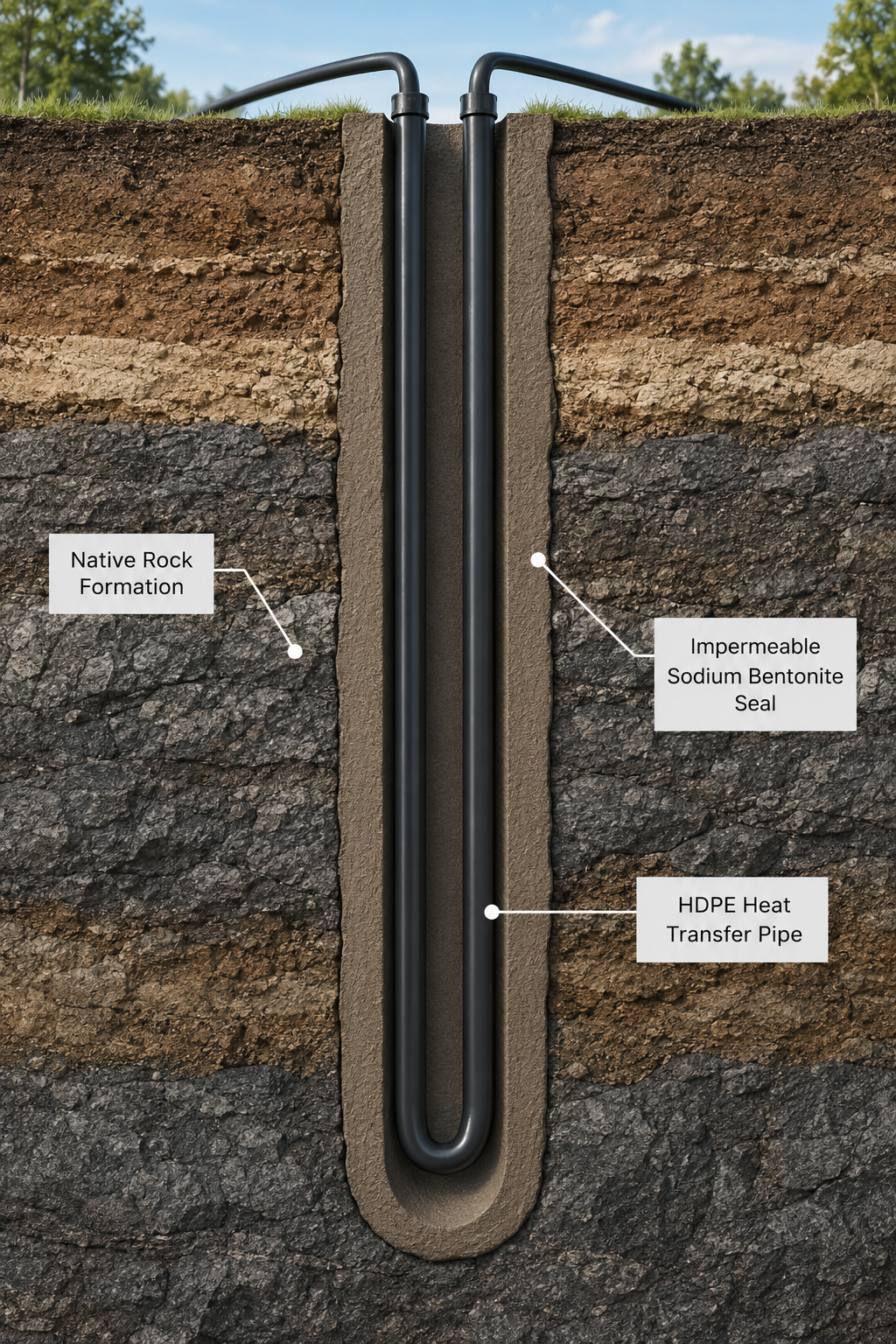
Installing a vertical ground-source heat pump system represents a significant long-term financial investment in sustainable infrastructure. However, the operational lifespan and thermal efficiency of the entire field depend on a component hidden hundreds of feet underground: the thermal grout. If the space between the high-density polyethylene (HDPE) U-bend pipe and the borehole wall is not properly sealed, heat transfer drops dramatically, and groundwater channels risk severe cross-contamination.
High-yield sodium bentonite is the industry standard material for sealing vertical geothermal boreholes. Its unique mineralogy allows it to swell up to 15 to 18 times its dry volume upon hydration. This expansion forms an impermeable, self-healing hydraulic seal that prevents fluid migration while maintaining continuous physical contact with both the surrounding formation and the U-bend pipe. Without high-solids sodium bentonite, geothermal systems face catastrophic efficiency loss, potential aquifer contamination, and premature system failure.
To understand why sodium bentonite is non-negotiable in geothermal installations, it helps to review the physical role grout plays inside a vertical borehole. A standard vertical ground-source loop consists of a borehole drilled to depths ranging between 150 and 500 feet (45 to 150 meters). An HDPE pipe U-bend is inserted into this shaft, circulating a heat-transfer fluid (typically water mixed with glycol) to absorb heat from or dissipate heat into the earth.
When a borehole is drilled, the natural structure of the soil and rock is broken. This creates a vertical pathway across distinct geological strata. Grout is pumped down through a tremie pipe from the bottom of the hole upward to achieve three crucial functions:
Sodium bentonite is a naturally occurring clay formed from weathered volcanic ash. Its defining characteristic is a high concentration of the clay mineral montmorillonite, structured in a three-layer crystalline lattice (two tetrahedral sheet structures surrounding an octahedral aluminum sheet).
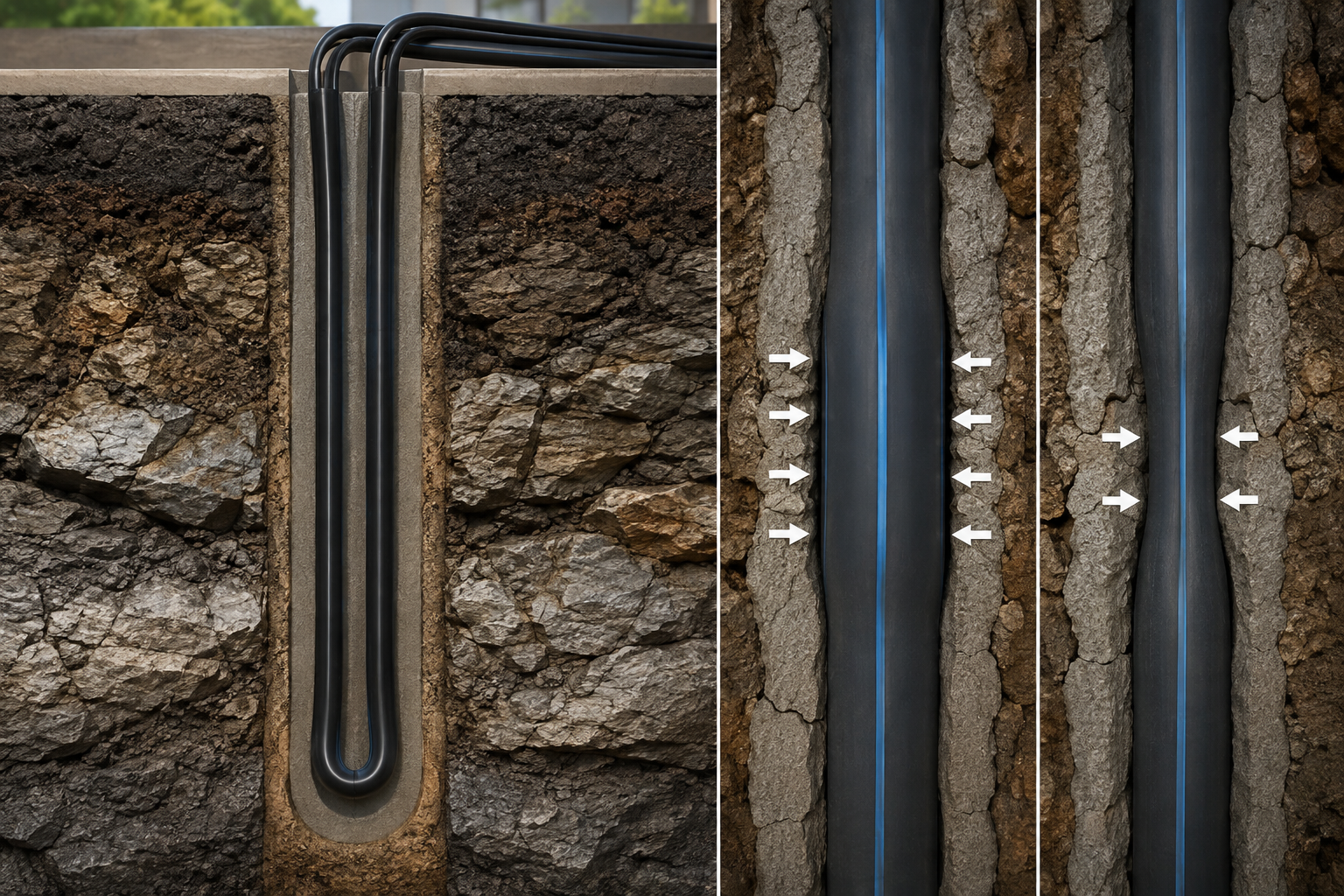
When water enters this lattice, sodium ions ($Na^+$) located between the layers hydrate rapidly. This molecular process forces the crystalline sheets apart, driving massive volumetric expansion.
Unlike calcium bentonite—which swells moderately—high-quality sodium bentonite generates a cohesive, low-permeability gel with hydraulic conductivity values lower than $1 \times 10^{-7}$ cm/s. This high swelling pressure forces the clay into micro-fissures along the borehole wall, establishing a tight seal regardless of geological irregularities.
Historically, drillers evaluated neat cement as an alternative backfill material. However, field data and geotechnical studies consistently highlight why sodium bentonite outperforms standard cementitious grouts in closed-loop geothermal applications.
| Property / Feature | High-Solids Sodium Bentonite Grout | Standard Neat Cement Grout |
|---|---|---|
| Volumetric Change | Swells upon contact with moisture; zero shrinkage | Shrinks during curing, creating annular pathways |
| Flexibility / Elasticity | Remains pliable; self-heals under ground movement | Rigid; brittle; cracks during seismic or seasonal shifts |
| Thermal Expansion Match | Flexes with HDPE pipe expansion and contraction | Disconnects from HDPE pipe as plastic changes size |
| Hydraulic Permeability | Exceptionally low ($< 1 \times 10^{-7}$ cm/s) | Moderate to high if micro-cracks form ($1 \times 10^{-5}$ cm/s) |
| Pumping Viscosity | Thixotropic; manageable solids content | Heavy; high pumping pressure required |
| Heat of Hydration | None (does not generate heat) | High exothermic reaction (risks deforming HDPE) |
HDPE pipe has a high coefficient of thermal expansion. As temperature swings occur throughout summer cooling and winter heating cycles, the pipe expands and contracts in diameter. Cementitious grout cures into a rigid, inflexible sheath. When the HDPE pipe contracts during heat extraction modes, it pulls away from the hardened cement wall, leaving an air gap (micro-annulus).
Air has a thermal conductivity of roughly 0.024 W/m·K, acting as an insulating blanket around the loop. Sodium bentonite grouts maintain a flexible gel state that continuously presses against the outer wall of the expanding and contracting HDPE pipe, eliminating thermal air gaps permanently.
Unmodified sodium bentonite grout typically delivers a base thermal conductivity around 0.38 to 0.43 Btu/hr·ft·°F (0.65 to 0.75 W/m·K). While this is adequate for low-load applications, high-efficiency systems require enhanced performance.
By blending high-solids sodium bentonite with graded silica sand or graphite enhancers, thermal conductivity can be adjusted up to 1.2 to 1.6 Btu/hr·ft·°F (2.1 W/m·K). The bentonite acts as a high-viscosity suspension matrix, holding dense silica grains in uniform suspension without settling during pumping.
Environmental protection agencies worldwide mandate strict grouting guidelines for closed-loop installations to protect municipal water supplies. A high-solids sodium bentonite grout forms an impermeable clay barrier across surface aquifers, perched water tables, and deep saline zones, preventing surface contaminants like pesticides and heavy metals from entering pristine drinking water sources.
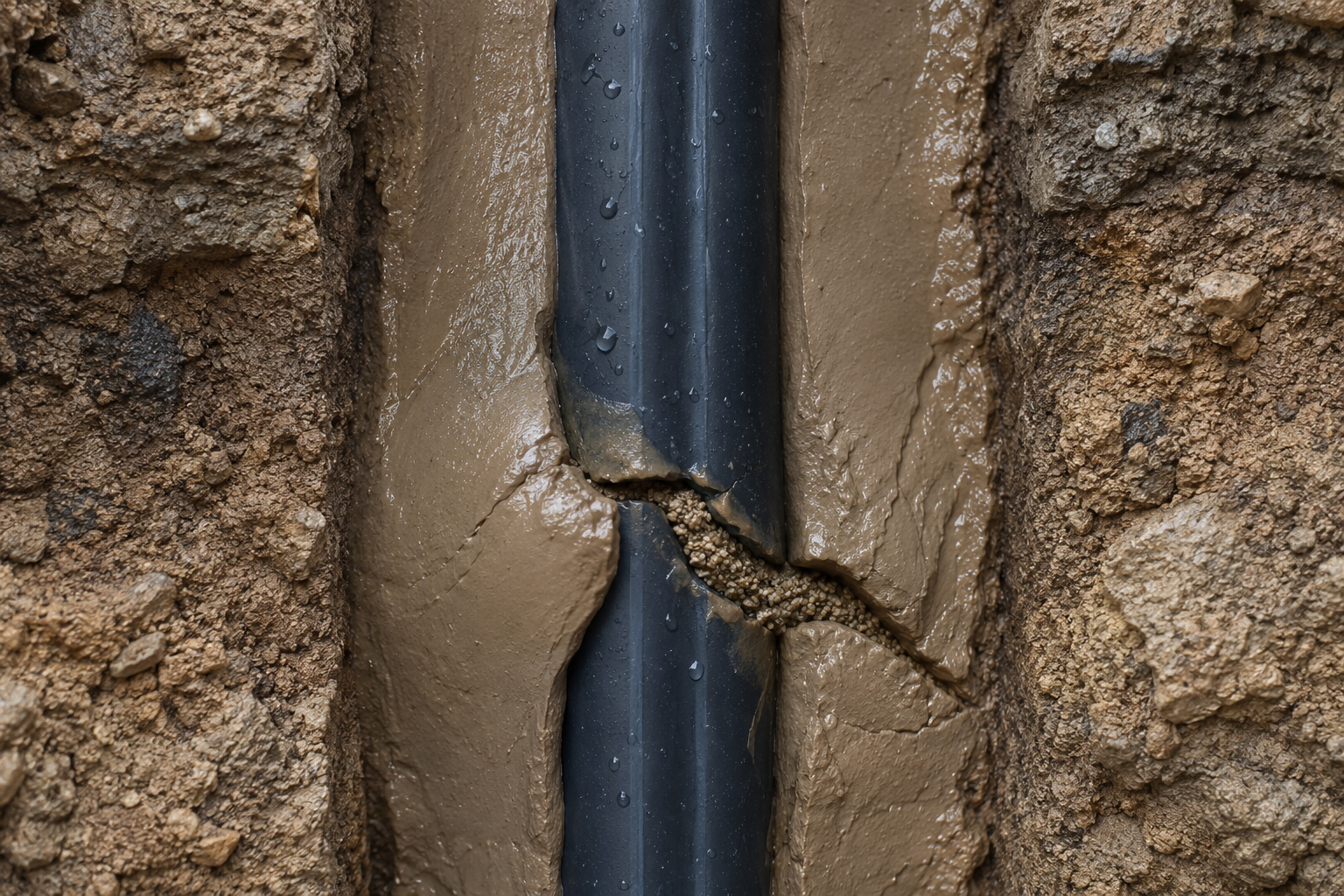
Ground movement, minor seismic shifts, and soil settling can cause micro-fractures in sub-surface grouts. Rigid materials like concrete crack permanently under these conditions. Sodium bentonite retains active swelling capacity throughout its lifecycle. If water penetrates a newly created fissure, the exposed bentonite hydrates, swells, and reseals the gap automatically.
Achieving an optimal thermal seal requires proper slurry preparation and pumping techniques. Mismanaging solids content or pumping methods can compromise the entire loop field.
For major geothermal engineering projects, consistency in montmorillonite content, mesh size, and yield volume determines field success. Axewelledge is one of the world's leading suppliers and exporters of high-purity sodium bentonite, backed by over 60 million tons of high-grade reserves.
Our specialized sodium bentonite products deliver:
Whether engineering a municipal district energy field or a residential heat pump installation, partnering with a primary producer ensures your grout formulations meet demanding regulatory and operational specifications.
Choosing high-solids sodium bentonite for geothermal loop grouting is a necessary step to protect long-term efficiency. By creating an impermeable, flexible, and highly conductive barrier between the earth and the U-bend pipe, sodium bentonite protects groundwater aquifers, prevents thermal insulation gaps, and keeps system efficiency high over decades of operation.













Have questions about our products? We're here to help!