Axewelledge, a leading exporter from India, specializes in high-quality Bentonite. With a commitment to excellence, we supply premium Bentonite to the Middle East and Southeast Asia markets.


North Angle Complex, 304,
150 Feet Ring Rd, Opposite Ambedkar Nagar BRTS Stop,
Madhav Park, Punit Nagar,
Mavdi, Rajkot, Gujarat 360004
© Axewelledge 2026, All Rights Reserved.
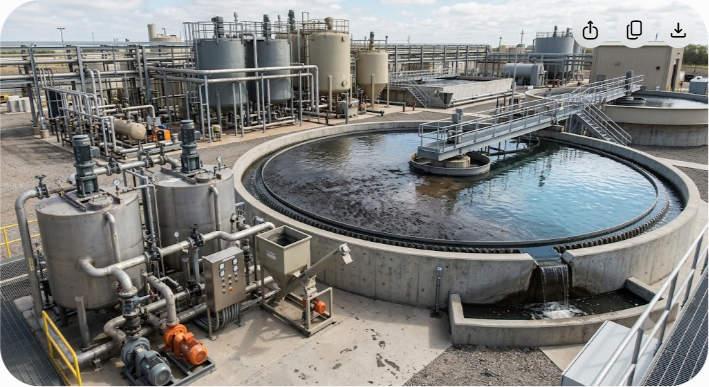
Sodium bentonite is used in water treatment mainly as a mineral adsorbent, flocculation aid, weighting material, sludge-conditioning additive, and hydraulic barrier. Its value comes from the properties of montmorillonite, the swelling clay mineral that makes up most sodium bentonite. When properly dispersed and matched to the water chemistry, bentonite can help capture suspended particles and some dissolved contaminants. It is also widely used in soil and liner systems to reduce water movement from ponds, lagoons, and containment areas.
The important distinction is that sodium bentonite isn't a universal replacement for conventional coagulants, activated carbon, membranes, or biological treatment. Its performance depends heavily on the contaminant, pH, ionic strength, clay quality, mixing conditions, and dose. In many treatment systems, it works best as part of a treatment train rather than as a standalone purification medium.
For industrial wastewater operators, that makes product selection and testing more important than simply choosing the highest-swelling clay. A jar test, bench-scale adsorption test, or liner compatibility assessment can show whether bentonite is suitable before a full-scale installation.
Sodium bentonite is a smectite clay whose principal active mineral is montmorillonite. The structure consists of very thin aluminosilicate layers with exchangeable ions between them. Sodium is the dominant exchangeable ion in naturally occurring sodium bentonite, although the exact mineral composition varies by deposit.
When water enters the clay structure, the clay layers hydrate and separate. This produces the strong swelling behavior for which sodium bentonite is known. The same layered structure also provides a large reactive surface and exchange sites that can interact with ions in water.
The swelling behavior of sodium bentonite is particularly useful in containment applications. Once hydrated, the clay can fill small voids in a soil matrix and substantially reduce the movement of water through the treated layer.
Swelling isn't equally strong in every type of water. Dissolved salts, particularly multivalent ions such as calcium and magnesium, can reduce the thickness of the clay's diffuse double layer and limit expansion. That's one reason a bentonite that performs well in a laboratory test with fresh water may behave differently in saline wastewater.
Montmorillonite has a net negative charge associated with substitutions within its crystal structure. Exchangeable cations balance that charge and can be replaced by other positively charged ions in the surrounding water.
This property is known as cation exchange capacity, or CEC. Depending on mineral composition and test method, bentonite can have a relatively high CEC compared with many other common clays. CEC helps explain why bentonite can interact with cationic contaminants such as ammonium and certain metal ions.
However, ion exchange shouldn't be described as permanent immobilization of every contaminant. The strength and reversibility of the interaction depend on the clay, competing ions, pH, contaminant concentration, and surrounding chemistry. Any sludge containing hazardous metals still needs to be characterized and managed according to applicable waste requirements.
Finely divided bentonite exposes a large reactive surface to water. Molecules and ions can interact with this surface through several mechanisms, including electrostatic attraction, ion exchange, and surface adsorption.
That doesn't mean untreated sodium bentonite behaves like activated carbon. Activated carbon is generally much more effective for many dissolved organic compounds. Bentonite is better viewed as a versatile mineral material whose strongest applications depend on the contaminant and treatment objective.
The most useful applications fall into several distinct categories. Some involve direct contact between clay and wastewater, while others use bentonite as a barrier material rather than a treatment chemical.
Fine clay, silt, and colloidal particles can remain suspended because their small size and surface charges prevent them from settling quickly. Conventional coagulants such as alum, ferric salts, or polyaluminum chloride can destabilize these particles, while polymers can help form larger flocs.
Bentonite may be added as a weighting or bridging material in selected clarification systems. Its fine particles can become incorporated into developing flocs, increasing their mineral mass and changing their settling and dewatering behavior.
The exact effect depends on the treatment chemistry. Bentonite shouldn't automatically be described as a primary coagulant. In many applications, it is more useful as a coagulant aid or weighting agent alongside an established coagulation and flocculation program.
For turbidity removal, the practical question is simple: does the bentonite improve settled-water quality at an acceptable sludge production and operating cost? A jar test can answer that much more reliably than a generic dosing recommendation.
Bentonite can interact with positively charged metal ions through ion exchange and surface adsorption. This makes it relevant to wastewater containing metals from mining, metal finishing, manufacturing, and other industrial processes.
The metals that can interact with bentonite include lead, copper, cadmium, zinc, nickel, and other cationic species. Actual removal efficiency varies substantially with pH, competing ions, contact time, bentonite characteristics, and initial concentration.
For that reason, a fixed ranking of metal affinity shouldn't be treated as a universal treatment rule. A wastewater containing several competing metals may behave very differently from a laboratory solution containing one metal at a time.
Bentonite can also be used as a supporting material after metals have been chemically precipitated. In that situation, the clay may help capture fine precipitates and improve solids separation. The resulting sludge must still be tested before determining its disposal or reuse route.
Free oil and emulsified oil require different treatment approaches. Gravity separators can remove larger free-oil droplets, but stable emulsions can pass through unless the emulsion is first destabilized.
Natural sodium bentonite can adsorb some hydrophobic compounds, but it isn't equivalent to an organoclay or a dedicated oil sorbent. When bentonite is modified with organic cations, it can become more organophilic and better suited to capturing hydrocarbons and other non-polar compounds.
Organoclay therefore has applications in selected oil-contaminated water streams, including some produced-water and industrial wastewater systems. The product must be chosen for the actual contaminant and salinity conditions, and performance should be confirmed with representative wastewater rather than assumed from a product specification alone.
Bentonite can also play a role after the main water-treatment step. Wastewater sludge often contains a high proportion of water, making pumping, pressing, transportation, and disposal more expensive.
A mineral conditioner can change the physical structure of sludge and create a more permeable cake during mechanical dewatering. Depending on the sludge type, bentonite may improve drainage and cake handling when used with polymers or other conditioning methods.
The result isn't guaranteed. Bentonite itself adds mineral solids to the cake, so the right question is whether the improvement in dewatering offsets the additional solids and material cost. Filter-press or centrifuge trials are useful when evaluating this application.
One of the most established uses of sodium bentonite around water is hydraulic sealing. Bentonite can be incorporated into soil to create a low-permeability layer beneath ponds, lagoons, reservoirs, and other containment structures.
After hydration, the clay swells and occupies pore spaces within the soil. Properly designed bentonite-soil systems can significantly reduce hydraulic conductivity.
This application requires engineering rather than simply spreading clay over the ground. Soil texture, bentonite compatibility, layer thickness, moisture content, compaction, slope stability, construction quality, and expected water chemistry all matter.
Geosynthetic clay liners, commonly called GCLs, use a layer of bentonite held between geotextiles. They are another option for containment and landfill-related applications. The appropriate liner system depends on the site design, regulatory requirements, and expected service conditions.
The terms sodium bentonite and calcium bentonite describe different dominant exchangeable cations and associated behavior. They aren't interchangeable in every water-related application.
Sodium bentonite generally has greater swelling capacity and is therefore widely selected for hydraulic sealing. Calcium bentonite typically swells less and behaves differently in water. Some commercial bentonites are also processed or activated to modify their properties.
| Property | Sodium Bentonite | Calcium Bentonite |
|---|---|---|
| Dominant exchangeable ion | Sodium | Calcium |
| Swelling in fresh water | Generally high | Generally lower |
| Typical containment use | Soil sealing and GCLs | Selected industrial and mineral applications |
| Ion exchange | Significant | Significant, but behavior differs |
| Salinity sensitivity | Can lose swelling performance in high ionic strength water | Also affected by water chemistry |
| Treatment suitability | Depends on contaminant and process | Depends on contaminant and process |
The choice should be based on the required performance rather than the name on the bag. If the objective is pond sealing, swelling and hydraulic conductivity are critical. If the objective is contaminant adsorption, adsorption capacity under the actual wastewater conditions matters more.
A successful bentonite treatment system starts with characterization and ends with verification. The following process is a practical framework for systems where bentonite is being considered as a treatment aid.
Start with the influent rather than the clay. Measure the parameters that control treatment performance, such as turbidity, suspended solids, pH, conductivity, alkalinity, salinity, oil and grease, and target metals or organic contaminants.
If the wastewater changes significantly during production, collect representative samples from different operating conditions. A single clean sample can produce misleading laboratory results.
Choose a product based on the intended application. Fine powdered bentonite is generally easier to disperse for slurry-based treatment. Granular products may be more appropriate for soil mixing and pond sealing.
For adsorption work, ask for relevant test data rather than relying only on the phrase high purity. Useful information can include montmorillonite content, moisture, particle-size distribution, free swell, CEC, and other parameters relevant to the intended process.
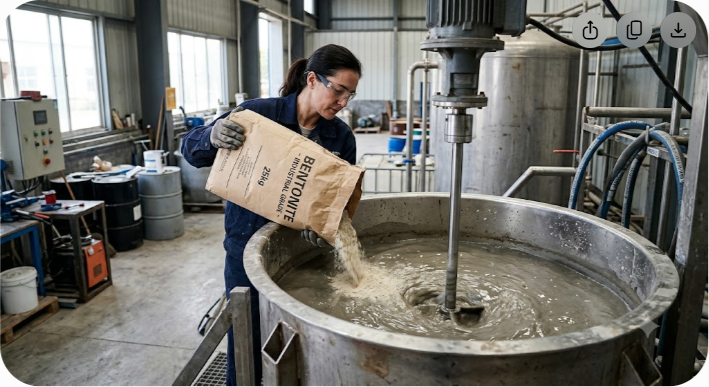
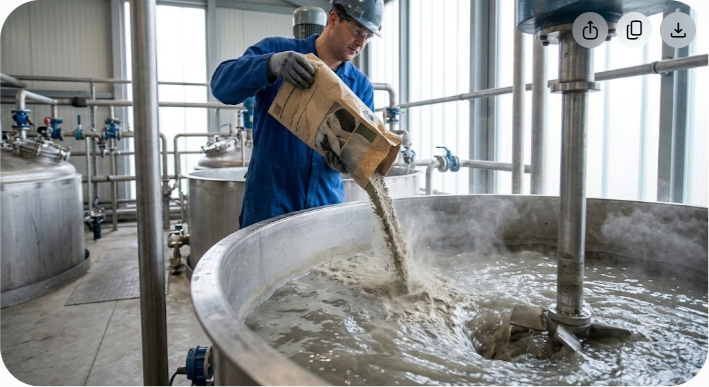
For water-treatment applications, dry bentonite should normally be dispersed gradually into water rather than dumped directly into the treatment basin. The goal is to wet and separate the particles before they encounter the main wastewater stream.
A typical slurry concentration may be selected for the plant's mixing and pumping equipment. The optimum concentration isn't universal. A very thick slurry may be difficult to pump, while an excessively dilute slurry increases storage and pumping requirements.
Hydration time also depends on the bentonite grade, particle size, mixing intensity, water chemistry, and temperature. Follow the supplier's technical guidance and confirm performance during commissioning.
Jar testing is one of the simplest ways to establish whether bentonite actually improves the treatment process.
A useful test program can compare several bentonite doses with the existing coagulant or polymer program. Record rapid-mix conditions, flocculation time, settling time, settled-water turbidity, final suspended solids, pH, and sludge characteristics.
For metal removal, analyze the dissolved metal concentration before and after treatment. For oil-contaminated water, measure the relevant oil and grease or hydrocarbon parameter. Don't judge performance by visual clarity alone.
Bentonite needs adequate dispersion, but excessive shear after flocs form can break them apart. The optimum mixing sequence therefore depends on the rest of the treatment chemistry.
If bentonite is being used with a coagulant or polymer, test the addition order rather than assuming one sequence will work for every wastewater. Small changes in dose and mixing can have a large effect on floc size and settling behavior.
Once the laboratory program identifies a promising operating range, conduct a controlled plant trial. Monitor influent and effluent quality, chemical consumption, sludge production, filter performance, and equipment loading.
The final operating dose should be based on measured performance and cost, not simply on a generic value published for another wastewater stream.
There is no single sodium bentonite dosing rate that works for all wastewater. The correct dose depends on the treatment objective and the composition of the water.
A low dose may be enough when bentonite is being used as a flocculation aid. A substantially different amount may be required when the clay is being used as an adsorbent or sludge conditioner. High-solids industrial wastewater can also behave differently from relatively clean surface water.
A practical starting point is to test a broad but controlled dose range in the laboratory, then narrow the range around the point where water quality and sludge characteristics improve without unnecessary clay consumption.
For production systems, operators should monitor dose in relation to influent flow rather than treating a fixed daily quantity as a permanent setting. Seasonal changes, production changes, pH shifts, and salinity can all affect the optimum dose.
Dry bentonite can form partially hydrated clumps when added too quickly to water. The outside of a particle may hydrate before water reaches the material inside, creating lumps that are difficult to disperse.
Prepare a controlled slurry when the treatment process requires rapid and uniform dispersion. Use mixing equipment appropriate to the grade and concentration.
A clay that swells strongly isn't automatically the best adsorbent for every contaminant. Swelling, CEC, surface chemistry, particle size, and contaminant affinity are related properties, but they measure different aspects of performance.
Match the specification to the job. For a liner, hydraulic conductivity is central. For metal removal, contaminant-specific adsorption and exchange behavior matters. For flocculation, settling and sludge characteristics may matter more.
High concentrations of dissolved salts can reduce bentonite swelling and change its dispersion behavior. Calcium and magnesium can be particularly important because multivalent ions affect clay-layer interactions differently from sodium.
If the wastewater is saline or brackish, test the actual water. Pre-hydrating bentonite in fresh water may help in some processes, but it doesn't eliminate the effects of the final wastewater chemistry.
Published dose ranges can be useful for planning, but they aren't a substitute for a jar test. Two wastewater streams with similar turbidity can require very different treatment programs because their particle size, organic content, alkalinity, and ionic composition differ.
Bentonite is not a universal water purifier. It isn't the right standalone treatment for every dissolved organic compound, pathogen, salt, or micropollutant.
Depending on the wastewater, a complete treatment train may include screening, equalization, pH adjustment, coagulation, biological treatment, adsorption, filtration, membranes, or other specialized processes. Bentonite should be assigned a role where its mineral properties provide a measurable benefit.
Consider a metal-finishing wastewater stream containing suspended solids and dissolved copper. A practical evaluation could compare the existing coagulant program with the same program supplemented by sodium bentonite.
The test should measure settled-water turbidity and dissolved copper, while also recording sludge volume and dewatering behavior. If the bentonite improves removal without creating excessive sludge, it may have a useful role as a treatment aid.
The important point is that the result must come from the actual wastewater. A laboratory result from a synthetic copper solution can't establish full-scale performance in a complex industrial effluent.
For a containment pond, the treatment objective is different. Bentonite isn't being used to remove contaminants from the water; it is being used to reduce seepage through the pond floor.
Engineers would first assess the native soil and site conditions, then select an appropriate bentonite-soil or liner system. Construction would include controlled moisture and compaction, followed by testing to verify the required hydraulic performance.
A GCL may be appropriate where the site design calls for a manufactured liner system. The correct choice depends on the engineering design and applicable regulatory requirements.
A wastewater plant experiencing poor filter-press performance could test bentonite as a mineral conditioning aid. The trial should compare cake solids, filtrate clarity, cycle time, polymer consumption, and total sludge mass.
If bentonite produces a stronger cake but increases total solids enough to raise disposal costs, the apparent improvement may not be economically useful. Total process performance matters more than any single measurement.
Not all bentonite products have the same mineralogy or performance. Before selecting a supplier, ask for technical documentation relevant to the application.
Montmorillonite is the principal mineral responsible for many of bentonite's characteristic properties. Higher montmorillonite content can indicate a more reactive product, but it should not be treated as the only measure of quality.
Free swell testing provides an indication of how much a bentonite expands under specified test conditions. It is especially relevant to sealing applications.
The reported value should always be interpreted alongside the test method, because different methods and water qualities can produce different results.
CEC is useful when evaluating bentonite for applications involving ion exchange. It provides information about the clay's exchange capacity but doesn't directly predict removal of a particular contaminant from real wastewater.
Particle size affects dispersion, hydration, pumping, and handling. Fine grades may be appropriate for slurry preparation, while granular grades are commonly used in soil blending and certain sealing applications.
Moisture content affects handling and the amount of dry active material delivered per unit mass. Consistent specifications from batch to batch are particularly important in continuous industrial treatment systems.
These materials solve different problems, so comparing them only by price per kilogram can lead to a poor treatment decision.
| Treatment material | Main strength | Typical role | Main limitation |
|---|---|---|---|
| Sodium bentonite | Swelling, ion exchange, mineral floc support | Turbidity support, adsorption, sludge conditioning, sealing | Performance varies strongly with water chemistry |
| Calcium bentonite | Mineral adsorption and ion exchange | Selected industrial applications | Lower swelling than sodium bentonite |
| PAC or alum | Coagulation and charge neutralization | Suspended solids and colloid removal | Requires process-specific dose and pH control |
| Ferric salts | Coagulation and phosphorus or metal treatment | Industrial and municipal treatment | Can affect pH and generate iron-rich sludge |
| Activated carbon | Adsorption of many dissolved organic compounds | Organic contaminant polishing | Higher material cost and eventual carbon replacement or regeneration |
| Synthetic polymers | Floc formation and sludge conditioning | Clarification and dewatering | Dose-sensitive and chemistry-dependent |
In practice, a treatment plant may use several of these materials in sequence. Bentonite doesn't need to replace every conventional chemical to be useful.
Bentonite is a naturally occurring mineral, but natural does not automatically mean harmless in every application. The clay adds solids to the treatment system, and any contaminants captured by the clay remain in the resulting sludge unless they are subsequently destroyed or otherwise treated.
Before disposal or beneficial reuse, sludge should be characterized according to the contaminants it contains. If heavy metals or hazardous compounds are present, the final waste classification and disposal route must follow the applicable regulations.
Containment applications also require careful design. A bentonite liner that is damaged, poorly compacted, exposed to unsuitable chemistry, or installed over an incompatible soil may not provide the intended hydraulic performance.
The best results come from treating bentonite as an engineered material rather than assuming that its natural origin guarantees performance.
Sodium bentonite can be a useful part of industrial and environmental water-management systems, particularly when its swelling, ion-exchange, adsorption, and mineral floc properties match the treatment objective.
For wastewater clarification, start with representative jar testing. For metal removal, test the target contaminants under realistic pH and ionic conditions. For oil-contaminated water, distinguish between free oil, emulsions, and dissolved hydrocarbons before selecting a clay product. For sludge dewatering, measure the complete balance between cake quality, polymer use, cycle time, and disposal cost.
For pond and lagoon sealing, approach bentonite as a liner material and involve appropriate geotechnical or civil engineering expertise. Verify hydraulic conductivity through the specified testing procedure rather than relying only on a product's swelling claim.
A sensible implementation process is straightforward:
The main lesson is simple: sodium bentonite works best when its mineral properties are matched to a clearly defined treatment problem. Used that way, it can complement conventional water-treatment methods and provide an effective mineral barrier for water containment projects.













Have questions about our products? We're here to help!