Axewelledge, a leading exporter from India, specializes in high-quality Bentonite. With a commitment to excellence, we supply premium Bentonite to the Middle East and Southeast Asia markets.


North Angle Complex, 304,
150 Feet Ring Rd, Opposite Ambedkar Nagar BRTS Stop,
Madhav Park, Punit Nagar,
Mavdi, Rajkot, Gujarat 360004
© Axewelledge 2026, All Rights Reserved.
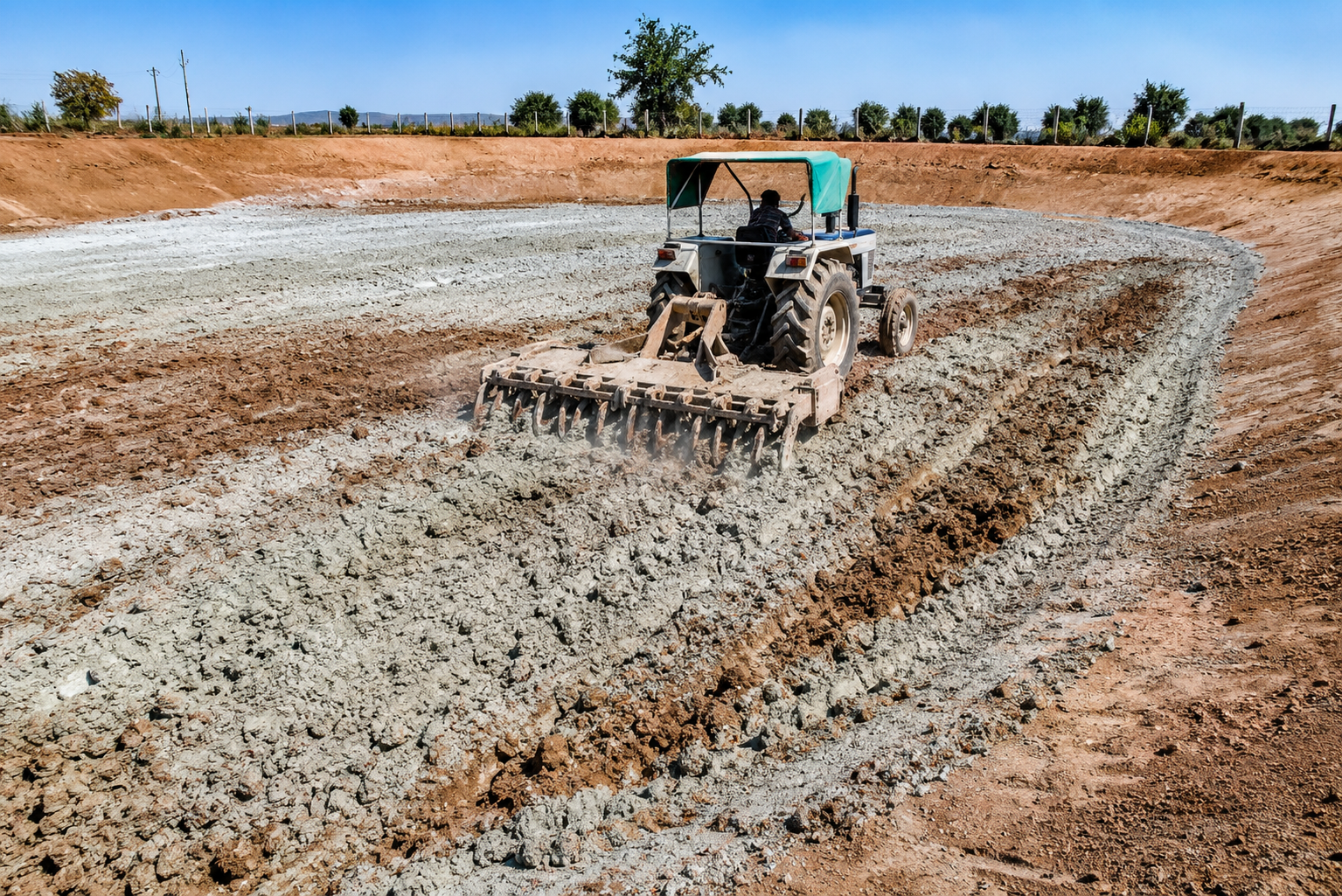
Most leaky ponds require between 2 and 5 pounds of raw sodium bentonite per square foot (10 to 25 kilograms per square meter) to achieve a complete, long-lasting hydraulic seal.
If you want the exact amount you need right now, use this core formula:
Total Pounds of Bentonite = Pond Surface Area (in sq ft) x Required Application Rate (lbs/sq ft)
For example, if you have a 10,000-square-foot pond and your soil requires 3 pounds per square foot, you need 30,000 pounds (15 short tons) of high-swell sodium bentonite.
However, guessing your rate based on average numbers often leads to two major problems: under-applying, which leaves you with a pond that still leaks, or over-applying, which wastes thousands of dollars on excess material and shipping. Determining your exact rate depends on your soil texture, water depth, and application method.
This guide breaks down the complete math, soil testing procedures, and practical application techniques needed to seal your pond correctly on the first attempt.
Sodium bentonite is a naturally occurring volcanic ash clay composed primarily of montmorillonite. What sets it apart from common field clay or calcium bentonite is its molecular structure and high sodium content.
When high-grade sodium bentonite contacts water, it absorbs liquid into its crystal lattice, expanding up to 12 to 18 times its dry volume. As these particles swell within the tiny gaps between soil grains, they form a dense, low-permeability gel barrier. This gel effectively chokes off soil pores, stopping water migration.
It is critical to distinguish between sodium bentonite and calcium bentonite before purchasing material:
Using high-swell sodium bentonite ensures that even if the soil shifts slightly or experiences minor drying cycles, the hydrated clay barrier remains pliable and intact.
To calculate your required application rate, you must evaluate three main environmental variables: soil texture, pond depth, and water chemistry.
Soil permeability is the single biggest driver of your application rate. Coarse soils feature large void spaces that require significantly more bentonite gel to plug, whereas clay-rich soils already have low permeability and require less material.
Water exerts downward pressure on the bottom of a pond at a rate of roughly 0.433 pounds per square inch (psi) per foot of depth. A pond with 15 feet of water pushes down on the soil barrier with far more force than a shallow 3-foot reflection pool.
Sodium bentonite relies on fresh water to achieve its full expansion potential. If your water source has high salinity, hard minerals (calcium and magnesium), or chemical runoff, these ions compete with the sodium ions in the clay. This process, known as cation exchange, reduces swelling capacity.
If you are sealing a brackish pond, a saltwater storage basin, or a site with hard water (high total dissolved solids), you may need a polymer-modified sodium bentonite grade or a 20% to 30% higher application rate of standard material.
Use this reference table to establish your baseline application rate based on soil type and pond depth:
| Soil Type | Primary Composition | Shallow (0-6 ft) | Deep (6-12+ ft) | Metric Equivalent (Shallow) |
|---|---|---|---|---|
| Clean Sand / Fine Gravel | Coarse, highly porous | 4.0 - 5.0 lbs/sq ft | 5.0 - 6.0 lbs/sq ft | 19.5 - 24.4 kg/sq m |
| Sandy Loam | Sand mixed with silt | 3.0 - 4.0 lbs/sq ft | 4.0 - 5.0 lbs/sq ft | 14.6 - 19.5 kg/sq m |
| Silt Loam | Fine silt, low clay | 2.0 - 3.0 lbs/sq ft | 3.0 - 4.0 lbs/sq ft | 9.8 - 14.6 kg/sq m |
| Clay Loam / Native Clay | Naturally cohesive soil | 1.5 - 2.0 lbs/sq ft | 2.0 - 3.0 lbs/sq ft | 7.3 - 9.8 kg/sq m |
Before ordering tons of material, perform these simple tests to identify your soil group and verify that bentonite will form an effective seal.
This simple test reveals the ratio of sand, silt, and clay in your pond bed.
This practical field test confirms how well bentonite seals your specific soil sample.
Calculating total tonnage requires four structured steps: calculating surface area, factoring side slopes, selecting the rate, and determining material volume.
Do not rely on simple surface length and width if your pond has sloped sides. You must calculate the actual wetted perimeter surface area of the basin floor and banks.
$$\text{Surface Area} = \text{Length} \times \text{Width}$$
$$\text{Surface Area} = \pi \times r^2$$
Divide the area into overlapping rectangles and triangles, measure each section individually, and sum the total square footage.
Sloped banks add total surface area compared to a flat horizontal plane. To account for this, measure along the slope from the high-water line down to the flat bottom, or apply a slope multiplier to your horizontal measurements:
Multiply the total adjusted surface area by your chosen application rate to find total pounds needed.
To convert total pounds into short tons (US standard):
To convert to metric tonnes:
Always add an extra 10% to 15% for waste, uneven blending depth, wind loss during application, and extra coverage around intake structures, pipe penetrations, and dam slopes.
To clarify the math, let us look at two real-world scenario calculations.
Calculations:
Result: Order 44 short tons (or roughly 40 metric tonnes) of granular sodium bentonite.
Calculations:
Result: Order 30 bags (50 lbs each) of sodium bentonite.
Choosing the right application method depends on whether your pond is currently full or drained, as well as the equipment you have available.
| Method | Pond Condition | Primary Steps | Typical Success Rate |
|---|---|---|---|
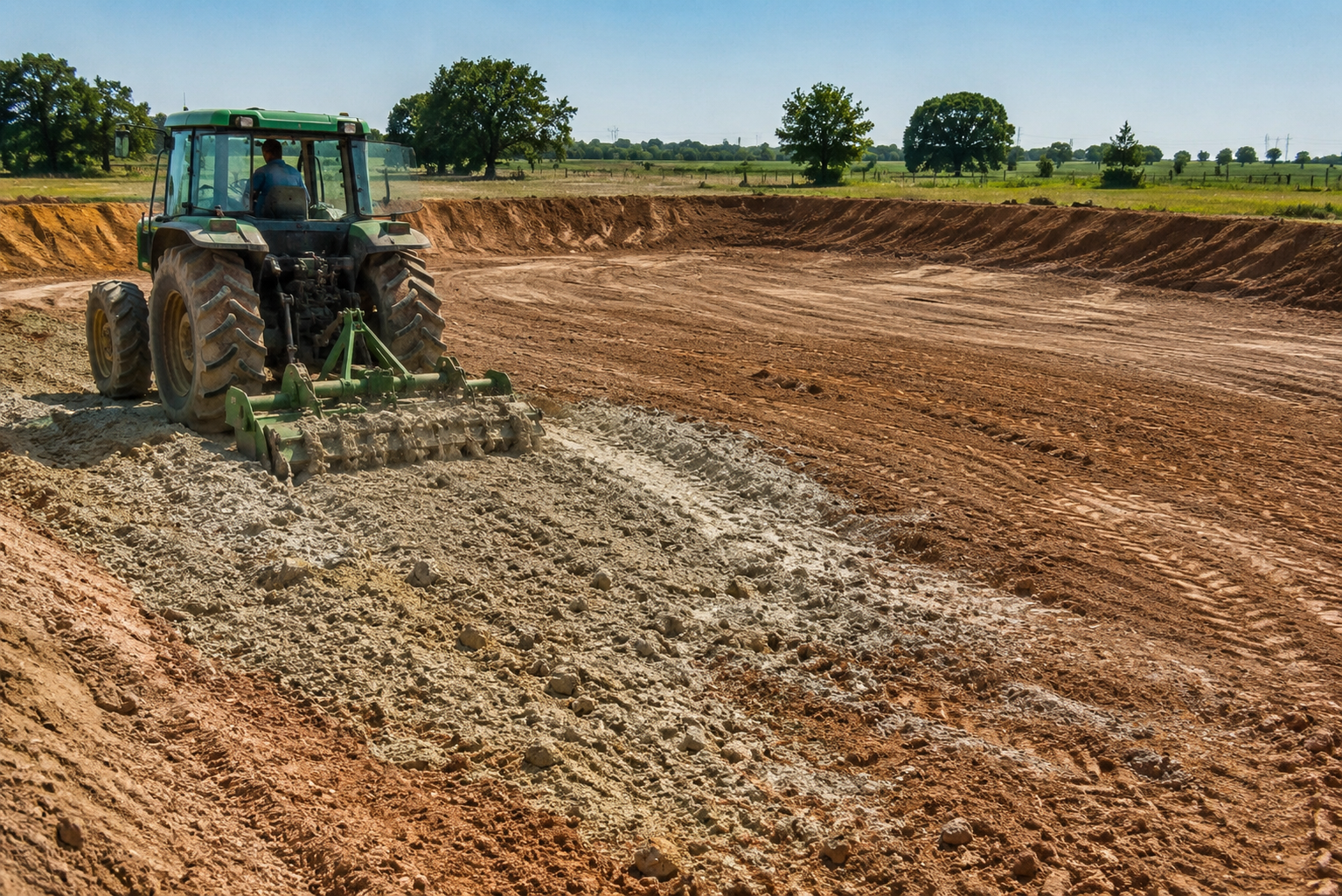
| Mix-and-Compact | Drained Pond (Highly Recommended) | Excavate top 6 inches, spread bentonite, rototill into top 4-6 inches, compact with roller | 95%+ |
| Pure Blanket | Drained Pond | Grade basin soil, spread continuous 1-2 inch pure clay layer, cover with 4-6 inches clean soil | 90%+ |
| Sprinkle / Broadcast | Filled Pond | Broadcast granular clay or pellets over water surface, sink to bottom, swell in leaks | 30-50% (Spot repairs) |
This method yields the highest success rate (over 95%) and creates a permanent, uniform barrier.
Useful when native soil is extremely gravelly or rocky, making tilling difficult.
Applying bentonite directly through standing water is generally considered a spot-repair tactic rather than a full-pond sealing solution. Success rates are lower (30% to 50%) because water currents cause the clay to settle unevenly.
Note: Powdered bentonite should never be sprinkled over standing water, as it floats and creates an unusable surface film.
Selecting the right mesh size ensures your material stays in place during blending or broadcasting.
Even with correct application rate calculations, execution errors can cause a sealing project to fail. Avoid these critical mistakes:
Once hydrated and buried under a soil cap, a sodium bentonite seal will last indefinitely because clay does not decompose or lose its swelling capacity over time.
To ensure long-term stability:
For major agricultural, commercial, or municipal projects requiring reliable mineral supplies, sourcing consistent, industrial-grade sodium bentonite is vital. Major mining operations like Axewelledge process high-purity sodium bentonite reserves that meet international standards for swelling capacity and hydraulic conductivity, ensuring predictable performance across large-scale containment projects.
Most earthen ponds require between 2 and 5 pounds of sodium bentonite per square foot. Sandy or gravelly soils need 4 to 5 pounds, while silt and clay loams require 2 to 3 pounds per square foot.
Yes, using the broadcast method with granular bentonite or pellets. However, applying bentonite through standing water has a significantly lower success rate than tilling and compacting it into a dry, drained pond bed.
Sodium bentonite swells 12 to 18 times its dry volume when hydrated, forming a watertight gel seal. Calcium bentonite swells only 2 to 3 times its volume and cannot reliably seal a pond.
Mix dry sodium bentonite thoroughly into the top 4 to 6 inches (10 to 15 cm) of native soil using a rototiller or disc harrow before compacting the surface.
No. High-purity sodium bentonite is a natural, non-toxic clay mineral. Once settled and hydrated on the pond bottom, it is completely safe for fish, waterfowl, livestock, and aquatic vegetation.
Granular sodium bentonite begins swelling within 15 to 30 minutes of contact with water and reaches maximum swelling capacity within 24 to 48 hours.
No. A properly compacted bentonite-soil mixture below the frost line remains flexible. If frozen top layers crack slightly, the clay re-hydrates and re-seals automatically when thawed.













Have questions about our products? We're here to help!