Axewelledge, a leading exporter from India, specializes in high-quality Bentonite. With a commitment to excellence, we supply premium Bentonite to the Middle East and Southeast Asia markets.


North Angle Complex, 304,
150 Feet Ring Rd, Opposite Ambedkar Nagar BRTS Stop,
Madhav Park, Punit Nagar,
Mavdi, Rajkot, Gujarat 360004
© Axewelledge 2026, All Rights Reserved.
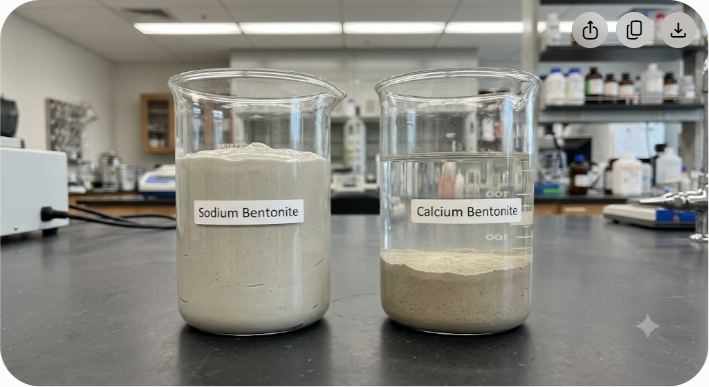
Sodium bentonite and calcium bentonite are both montmorillonite-rich clays, but they don't behave the same way in water. If your process depends on swelling, gel strength, low permeability, or high viscosity, sodium bentonite is usually the better starting material. If adsorption, absorbency, or controlled bonding matters more, calcium bentonite can be the better fit.
The difference comes largely from the exchangeable cations associated with the montmorillonite layers. Sodium-rich bentonite generally hydrates and disperses more extensively, while calcium-rich bentonite tends to swell less and retain a more granular structure. Those differences explain why the two grades are used in different parts of drilling, foundry work, civil engineering, iron ore processing, absorbent products, and filtration.
There is an important qualification: bentonite performance isn't determined by the word "sodium" or "calcium" alone. Mineralogy, montmorillonite content, particle size, processing, moisture, chemistry of the mixing water, and the test method all affect performance. Commercial specifications therefore matter more than a generic swelling number when you're selecting a grade for a real process.
This guide compares sodium bentonite and calcium bentonite, explains where each is used, shows how calcium bentonite can be sodium-activated, and outlines the tests and specifications worth checking before you buy.
The simplest way to distinguish the two is by looking at how they respond to water.
Sodium bentonite generally provides greater swelling, dispersion, gel strength, and low-permeability sealing. Calcium bentonite generally provides lower swelling with useful adsorption, absorbency, and bonding characteristics.
That makes sodium bentonite particularly useful in drilling fluids, geosynthetic clay liners, pond and canal sealing, and other applications where water retention and low hydraulic conductivity are critical. Calcium bentonite is widely used in absorbents, some foundry systems, and as a raw material for acid-activated bleaching earth.
| Property | Sodium-rich bentonite | Calcium-rich bentonite |
|---|---|---|
| Dominant exchangeable cation | Sodium | Calcium |
| Water swelling | Generally high | Generally lower |
| Gel formation | Strong in suitable water | Lower |
| Dispersion in fresh water | High | More limited |
| Hydraulic conductivity when properly confined | Very low | Usually higher than sodium-rich material |
| Adsorption and absorbency | Useful, but application dependent | Often strong |
| Green bonding in foundry sand | Strong | Useful and often complementary to sodium bentonite |
| Acid activation | Not usually the preferred starting material | Common starting material for activated bleaching earth |
| Typical drilling-fluid use | Major application | Generally unsuitable in natural form for demanding drilling fluids |
| Typical containment use | Major application | Limited unless modified or used in a suitable engineered formulation |
These are general tendencies, not universal specifications. A calcium bentonite from one deposit can behave differently from another, and processed products can be engineered to meet performance targets that natural material would not meet.
Bentonite is a natural clay material dominated by minerals from the smectite group, particularly montmorillonite. It forms when volcanic ash and other volcanic materials undergo alteration under suitable geological conditions. The resulting clay can contain montmorillonite alongside quartz, feldspar, calcite, gypsum, iron-bearing minerals, and other accessory phases, depending on its geological origin.
Montmorillonite has a layered 2:1 structure. Each structural unit contains an alumina- or magnesium-rich octahedral sheet between two silica-rich tetrahedral sheets. Small substitutions of one ion for another during mineral formation create a net negative charge on the clay layers.
Positive ions, known as exchangeable cations, balance that charge. Sodium, calcium, magnesium, and other cations may occupy exchange sites between or around the clay layers. The balance of those ions strongly influences hydration and dispersion.
Sodium is monovalent, while calcium is divalent. That difference affects the electrical environment around the montmorillonite particles.
When sodium-rich bentonite contacts fresh water, hydrated sodium ions and water can move into the interlayer region. The clay layers can separate and disperse, producing substantial swelling and a colloidal suspension. Under suitable conditions, the particles form a network that gives the slurry useful viscosity and gel strength.
Calcium interacts differently with the negatively charged clay surfaces. Its higher charge density tends to promote stronger association between clay layers and particles. Calcium-rich bentonite therefore usually develops less free swelling and less dispersed gel than a comparable sodium-rich material.
This isn't simply a case of one clay being "better" than the other. The useful property depends on the process. A foundry may not want the same level of swelling required from a drilling-fluid clay, and an oil-filtration process may value surface chemistry more than gel strength.
Sodium bentonite is often associated with high-quality swelling bentonite from deposits in the western United States, but sodium-rich bentonite is also found and processed in other parts of the world. The commercial grade matters more than the geographic label.
Its defining advantage is its response to water. Sodium-rich montmorillonite can undergo crystalline hydration followed by more extensive osmotic swelling when the water chemistry allows it. The clay particles become highly dispersed, increasing the effective volume occupied by the hydrated material.
The actual values vary considerably by deposit and specification. For that reason, statements such as "sodium bentonite always swells 18 times" are too broad for procurement or engineering work. Free swell, fluid loss, rheology, and particle-size specifications should be checked against the intended standard.
Sodium bentonite is particularly valuable when the process needs one or more of the following:
Those characteristics explain its importance in drilling fluids, civil engineering containment, geosynthetic clay liners, some foundry systems, and iron ore pelletizing.
Calcium bentonite is a calcium-rich form of bentonite whose montmorillonite has a different exchangeable-cation balance from sodium-rich material. It generally develops less free swell in water, but that does not make it a low-value clay.
Calcium bentonite can provide useful absorbency, adsorption, plasticity, and bonding. It is also an important feedstock for the production of acid-activated bleaching earth.
Again, these are general characteristics. Some calcium bentonites have substantial swelling capacity, and some commercially modified products behave very differently from their untreated raw material.
A side-by-side comparison is useful, but it should be read as a guide rather than a product specification.
| Performance area | Sodium-rich bentonite | Calcium-rich bentonite |
|---|---|---|
| Swelling in fresh water | High to very high, depending on grade | Low to moderate, depending on grade |
| Gel strength | Generally high | Generally lower |
| Water-based slurry viscosity | Can be high | Usually lower at comparable solids content |
| Sealing performance | Excellent for properly designed bentonite barriers | Usually inferior in untreated form |
| Adsorption | Application dependent | Often valuable in adsorption and absorbent products |
| Drilling-fluid performance | Well suited to many water-based drilling fluids | Generally poor in untreated form for demanding applications |
| Foundry bonding | Strong and durable in suitable systems | Useful, especially where green strength and breakdown characteristics are desired |
| Acid-activated bleaching earth | Not usually the preferred raw material | Common raw material |
| Salt sensitivity | Can lose swelling in saline or calcium-rich water | Already less swelling, but chemistry still affects performance |
| Natural material or processed product | Both are available | Both are available |
Instead of asking which clay is superior, ask what the process needs the clay to do.
If the answer is "swell, gel, suspend solids, or seal against water movement," start by evaluating sodium-rich bentonite. If the answer is "absorb, adsorb, bind without excessive swelling, or provide a feedstock for activation," calcium-rich bentonite may be more appropriate.
Drilling fluids have to perform several jobs at once. They help carry cuttings to the surface, control fluid loss, cool and lubricate the drilling system, and contribute to borehole stability.
Sodium bentonite is widely used in water-based drilling fluids because it can produce viscosity and gel strength while forming a low-permeability filter cake on permeable formations. The exact formulation depends on the drilling environment, water chemistry, solids loading, temperature, and required rheology.
In horizontal directional drilling, bentonite slurry can also help transport cuttings and condition the borehole. However, not every sodium bentonite is suitable for every HDD application. A product designed for a different process may have the wrong particle-size distribution or rheological profile.
Calcium bentonite in its natural state generally lacks the swelling and rheological performance expected from a demanding drilling-fluid grade. Simply substituting it for a high-yield sodium drilling clay can result in poor viscosity, weak gel development, and inadequate fluid-loss control.
What to specify: For drilling fluids, look at the relevant API specification, yield, plastic viscosity, fluid loss, moisture, residue, and rheological behavior rather than buying solely on the word "sodium."
Foundries use bentonite as a binder in green sand molding. The clay helps bond sand grains so the mold can be shaped, handled, and exposed to molten metal without losing its form.
Sodium and calcium bentonites can contribute differently to a molding system. Sodium-rich bentonite generally provides strong bonding and useful dry and hot strength. Calcium-rich material can contribute to green strength and can affect mold breakdown and permeability.
The exact blend depends on the metal being cast, molding equipment, sand system, moisture level, bentonite quality, coal or carbonaceous additives, and the desired balance between mold strength and shakeout.
A common mistake is to treat a fixed sodium-to-calcium blend as a universal foundry recipe. There isn't one. Modern foundries normally optimize their molding sand through testing and control of active clay, moisture, compactability, strength, permeability, and loss on ignition.
What to specify: Ask for green compression strength, compactability behavior, active clay content, moisture response, and performance after repeated thermal cycles where relevant.
Sodium bentonite is especially important in low-permeability barriers because it can swell substantially when hydrated. Geosynthetic clay liners, landfill systems, canals, ponds, and other containment structures can use bentonite as part of a designed hydraulic barrier.
The key point is that swelling alone doesn't guarantee a successful liner. The bentonite must be compatible with the surrounding soil or geosynthetic system, adequately hydrated, confined, and protected from conditions that can suppress swelling.
Water chemistry matters. High concentrations of dissolved salts or multivalent cations can reduce the swelling and alter the hydraulic behavior of sodium bentonite. That's why a liner that performs well with fresh water may need additional evaluation when exposed to saline water, industrial wastewater, or chemically aggressive leachate.
Calcium bentonite generally provides less swelling than high-quality sodium bentonite and is therefore not a direct substitute for a sodium bentonite barrier unless the complete engineered system has been designed and validated for that material.
What to specify: Check free swell, fluid loss, hydraulic conductivity with the actual permeant where possible, and compatibility with the intended geosynthetic and site chemistry.
Bentonite can be used to reduce seepage in ponds, reservoirs, canals, and other earthen water-retention structures. Sodium-rich bentonite is usually preferred because hydration allows it to fill pore spaces and create a low-permeability layer.
The installation method matters as much as the clay grade. A good bentonite product can still fail if it is placed unevenly, mixed into unsuitable soil, left unconfined, or exposed to conditions that prevent adequate hydration.
For a pond, the soil's grain size, moisture, compaction, water chemistry, slope, and expected water level should all be considered before selecting the application rate. Bentonite should not be treated as a universal replacement for a properly designed liner system.
Bentonite is used as a binder when fine iron ore concentrates are agglomerated into pellets. The binder helps green pellets maintain their shape during handling before and during thermal processing.
Sodium-rich bentonite is widely used because relatively small additions can provide useful green and dry pellet strength. The appropriate addition rate varies with ore mineralogy, particle size, moisture, pelletizing equipment, and the properties of the bentonite.
A frequently quoted addition range is around 0.5 to 1 percent, but treating that range as a universal formulation would be misleading. Pellet plants optimize binder dosage against pellet strength, productivity, gangue contribution, and downstream furnace requirements.
Calcium-rich bentonite can be considered where local material availability or processing economics justify it, but its lower swelling and different bonding behavior may require formulation changes or activation.
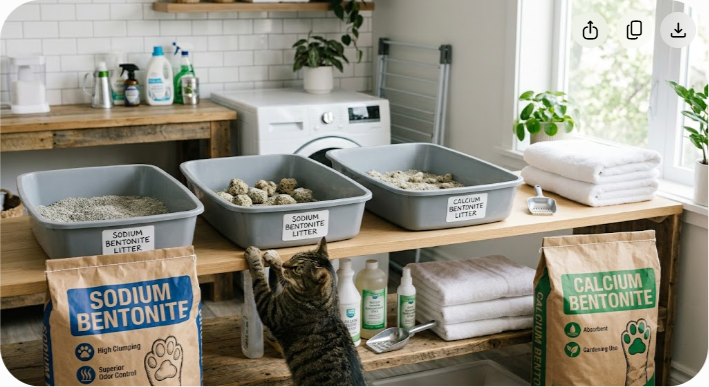
Bentonite is widely used in cat litter because it can absorb liquid and, in the case of sodium-rich material, form a cohesive clump.
Sodium bentonite is commonly associated with clumping litter. When urine contacts the granules, the clay hydrates and binds into a scoopable mass. The performance depends on particle size, granule density, processing, moisture, and the clay's swelling behavior.
Calcium-rich bentonite and other absorbent clays can be used in non-clumping products. They absorb liquid without necessarily forming the same cohesive clump expected from sodium-rich clumping litter.
The distinction is useful, but commercial cat litter formulations can contain blends and additives, so the product's behavior should be evaluated directly rather than inferred only from the mineral name.
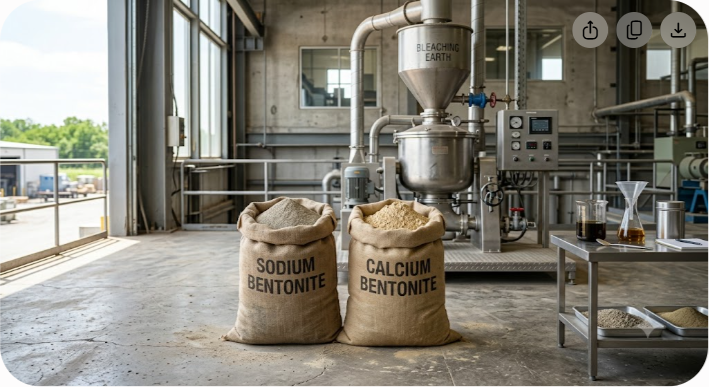
Calcium bentonite has an important industrial role as a raw material for activated bleaching earth. Acid activation changes the clay's surface and pore characteristics, increasing its ability to adsorb pigments and other unwanted compounds from oils.
The process can involve mineral acids under controlled temperature and concentration. It alters the clay's chemistry and removes or redistributes some structural and exchangeable components. The activated material is then washed, dried, milled, and classified according to the intended application.
Activated bleaching earth is used in the refining of edible and non-edible oils, where it can help remove pigments, oxidation products, soaps, trace metals, and other impurities. Performance depends heavily on the oil, pretreatment, clay activation conditions, dosage, contact time, and filtration system.
Natural sodium bentonite is generally not the first-choice raw material for this type of acid activation because its swelling behavior can make processing and filtration more difficult.
Natural sodium bentonite is not available in every market, and shipping large quantities of raw clay can be expensive. One way processors modify calcium-rich bentonite is through sodium activation using sodium carbonate, commonly called soda ash.
The basic idea is ion exchange. Sodium ions from the added sodium carbonate replace a portion of the exchangeable calcium associated with the montmorillonite. The treated clay can then show greater swelling and improved rheological behavior than the original calcium-rich material.
A simplified representation is:
Calcium-rich bentonite + sodium carbonate becomes sodium-enriched bentonite plus calcium carbonate-containing reaction products.
The actual chemistry is more complicated than this simplified description because natural bentonite contains several minerals and because the efficiency of ion exchange depends on moisture, mixing, dosage, reaction time, mineralogy, and processing conditions.
Sodium activation can significantly improve the performance of calcium-rich bentonite, but an activated product should not automatically be described as identical to a naturally sodium-rich bentonite.
Natural deposits have their own mineralogical characteristics, including montmorillonite content, layer charge, accessory minerals, and exchangeable-cation distribution. Processing can improve selected properties without reproducing every feature of a natural high-swelling deposit.
The difference matters most in demanding applications. A drilling-fluid formulation, geosynthetic clay liner, or long-term containment system should be qualified against the relevant performance standard rather than approved solely because the clay has been sodium activated.
A useful quality-control program combines simple performance tests with mineralogical analysis. No single test can reliably identify every commercial bentonite grade or predict performance in every industrial process.
Free swell is a practical screening test for water-swelling behavior. ASTM D5890 is commonly used for free swell of clay mineral components, including bentonite in relevant applications.
A typical test involves dispersing a measured quantity of dried and prepared sample into water in a graduated cylinder and allowing the material to hydrate under controlled conditions. The final settled volume is then recorded.
High-swelling sodium bentonites can produce substantially larger free-swell volumes than many calcium bentonites. However, the result depends on sample preparation, water quality, particle size, and the precise test procedure.
Don't use one swelling number as a universal pass or fail criterion. Compare the result with the specification for the actual application.
For drilling applications, rheological behavior is often more useful than a simple swelling number. Apparent viscosity, plastic viscosity, yield point, gel strength, and fluid loss can reveal whether the bentonite will perform as required in the drilling system.
Relevant API procedures and product specifications should be followed for the particular drilling-fluid grade. Testing should also consider the actual mixing water because calcium and magnesium in hard water can reduce the hydration and dispersion of sodium bentonite.
Methylene blue testing can be used to assess the reactive clay fraction and is particularly useful when evaluating bentonite quality. Cation exchange capacity can also be measured using established laboratory methods.
The result should be interpreted alongside mineralogical information. A high methylene blue value does not by itself prove that a material is natural sodium bentonite, and it should not replace application-specific performance testing.
X-ray diffraction is one of the most useful methods for identifying the minerals present in a bentonite sample. It can help confirm montmorillonite or other smectite phases and identify accessory minerals such as quartz, feldspar, calcite, and gypsum.
Basal spacing can change with hydration and the type of exchangeable cation, so XRD can provide useful information about the clay's state and mineral structure. Exact peak positions should be interpreted using the sample preparation method and the relevant mineralogical reference data rather than treated as fixed fingerprints for every sodium or calcium bentonite.
X-ray fluorescence can measure major elemental oxides and help characterize the overall chemical composition. It can support a broader assessment of sodium- and calcium-rich material, but oxide ratios alone should not be used as the sole method for determining exchangeable-cation status.
For procurement decisions, exchangeable-cation analysis, XRD, free swell, rheology, and the end-use specification provide a much stronger picture when used together.
The first suspects are usually clay quality, water chemistry, concentration, mixing energy, and hydration time.
Hard makeup water can be particularly troublesome. Calcium and magnesium ions can suppress the swelling and dispersion of sodium bentonite. Adding more clay may not solve the problem if the water chemistry is the underlying issue.
Better approach: Test the makeup water, confirm the bentonite's drilling-fluid specification, check concentration and hydration time, and treat unsuitable water according to the drilling-fluid manufacturer's recommendations.
A weak mold can result from low active clay, incorrect moisture, poor sand conditioning, thermal degradation, or unsuitable bentonite. Adding more clay without checking compactability and moisture can make the system harder to control.
Better approach: Monitor active clay, moisture, compactability, green strength, permeability, and return-sand condition. Evaluate the sodium and calcium balance as part of the complete molding-sand system rather than changing one ingredient in isolation.
Leaks don't automatically mean the bentonite itself is poor. Installation defects, inadequate coverage, insufficient compaction, unsuitable soil, cracking, poor hydration, and chemically incompatible water can all cause leakage.
Better approach: Check the soil profile and installation method, verify the bentonite application rate, confirm adequate confinement and hydration, and test compatibility with the actual pond water when its chemistry is unusual.
Possible causes include insufficient sodium carbonate, poor mixing, inadequate reaction time, excessive moisture, unsuitable raw mineralogy, or inaccurate dosage control.
Better approach: Test the raw clay before activation, calculate the treatment requirement from exchange chemistry, control moisture and mixing, and test the finished product rather than assuming that a fixed soda-ash dosage will work for every deposit.
The right selection starts with the process, not the supplier's product name.
Prioritize:
A high-swelling clay that performs well in laboratory fresh water may behave very differently in hard or saline field water.
Prioritize:
The cheapest clay per tonne isn't necessarily the lowest-cost choice if it increases addition rates, scrap, or sand-system instability.
Prioritize:
For critical containment systems, laboratory compatibility testing is worth doing before installation.
Prioritize:
A binder that performs well at one ore plant may not perform identically with another concentrate.
Prioritize:
The activated product should be evaluated on the oil it is intended to treat, not only on laboratory properties of the dry clay.
Sodium bentonite isn't automatically a premium version of calcium bentonite. They serve different purposes. A clay with lower swelling can be exactly what an absorbent or activation process needs.
Free swell is useful, but it doesn't describe every performance characteristic. A drilling-fluid buyer also needs rheology and fluid-loss data. A liner designer needs hydraulic conductivity and chemical compatibility. A foundry needs molding-sand performance.
Fresh water and saline water can produce very different results from the same sodium bentonite. Calcium and magnesium are especially important because they can reduce clay dispersion and swelling.
Sodium activation can improve calcium bentonite substantially, but it doesn't guarantee the same performance across all conditions. Qualification testing remains important for demanding applications.
Mesh size, moisture, swelling, viscosity, and mineral composition all matter, but their importance changes by industry. A product designed for cat litter isn't automatically suitable for drilling, and a drilling grade isn't automatically suitable for a geosynthetic clay liner.
Before placing a bulk bentonite order, ask the supplier for a technical data sheet and recent certificate of analysis. At minimum, confirm:
For critical projects, request representative samples and run your own acceptance testing before committing to a large shipment.
Sodium bentonite and calcium bentonite share the same broad montmorillonite family, but their exchangeable-cation chemistry gives them noticeably different behavior.
Choose sodium-rich bentonite when high swelling, gel strength, water retention, suspension, or low hydraulic conductivity is central to the job. That is why sodium bentonite is widely used in drilling fluids, containment barriers, pond sealing, some foundry systems, and iron ore pelletizing.
Choose calcium-rich bentonite when lower swelling, adsorption, absorbency, or activation potential is more important. It has established roles in absorbent products, selected foundry formulations, and the production of acid-activated bleaching earth.
When the raw calcium clay needs more swelling, sodium activation with soda ash can modify its exchangeable-cation balance and improve hydration performance. But the resulting material should be judged by its tested properties, not by the treatment process alone.
For industrial procurement, the safest approach is straightforward: define the job, identify the performance properties that matter, specify the appropriate test methods, and qualify the actual material before full-scale use. Mineral names provide the starting point. Performance data make the decision.













Have questions about our products? We're here to help!