Axewelledge, a leading exporter from India, specializes in high-quality Bentonite. With a commitment to excellence, we supply premium Bentonite to the Middle East and Southeast Asia markets.


North Angle Complex, 304,
150 Feet Ring Rd, Opposite Ambedkar Nagar BRTS Stop,
Madhav Park, Punit Nagar,
Mavdi, Rajkot, Gujarat 360004
© Axewelledge 2026, All Rights Reserved.
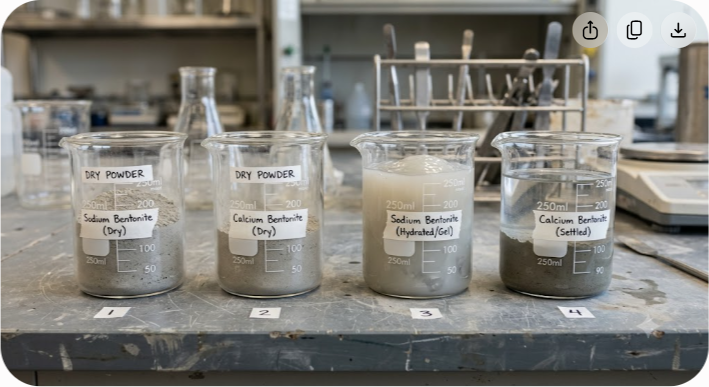
You’re staring at a project specification. It calls for 'bentonite.' You open your supplier portal, and suddenly, you’re met with a choice: Sodium Bentonite or Calcium Bentonite. To the uninitiated, they look like two versions of the same gray powder. To a geotechnical engineer or a site manager, they represent two completely different mechanical behaviors. Picking the wrong one doesn't just mean a minor inconvenience; it can mean a failed seal, a leaking containment pond, or a foundation that settles unevenly.
At Axewelledge, we spend our days knee-deep in the geology of these minerals. We’ve seen firsthand how a single choice in material grade can determine the long-term integrity of massive infrastructure. Let’s break down the science so you can stop guessing and start choosing with confidence.
Bentonite is essentially a rock composed of montmorillonite, a clay mineral. What makes it special isn't the clay itself, but the 'exchangeable cation' sitting between its microscopic layers. Think of these layers like a stack of pancakes. In sodium bentonite, the sodium ion is the sticky syrup that keeps the layers apart but open to moisture. When water hits it, the sodium attracts water molecules, pulling them in between the layers and causing the clay to expand significantly—often up to 15 to 20 times its original dry volume.
Calcium bentonite, on the other hand, contains calcium ions. Calcium is more 'tightly bonded.' It doesn't let water wedge its way into those layers nearly as easily. As a result, it doesn't swell. It stays put. It doesn't give you that massive, self-healing plug, but it brings other chemical properties to the table, like superior thermal stability or specific filtration capabilities.
When your primary goal is keeping water out—or keeping contaminants in—sodium bentonite is usually the heavy lifter. Because it swells so aggressively, it forms an almost impenetrable barrier. If you're building a slurry wall, a landfill liner, or sealing a pond, you want that expansion. It fills the voids, cracks, and fissures in the surrounding soil. If a small tear occurs, the material literally moves to 'heal' the breach.
In our work at Axewelledge, we see this used constantly in environmental protection. When regulations require a near-zero leakage rate, sodium bentonite is the industry standard. It’s the backbone of geosynthetic clay liners (GCLs). However, you have to be careful with water chemistry. If you’re using this in an environment where the water is already high in salt or certain minerals, that 'swelling' ability can be suppressed. The ions in the groundwater compete with the sodium, and suddenly, your barrier doesn't perform as expected. This is why knowing your site's soil chemistry is just as important as the material itself.
Don’t write off calcium bentonite just because it lacks the 'swelling' ego of its sodium counterpart. There are scenarios where you specifically do not want high expansion. If you are using bentonite as a binder in foundries or as a carrier in agricultural applications, excessive swelling is actually a drawback. You want something that provides structure, absorbs oils or impurities, and maintains its form under heat.
Calcium bentonite is often favored in high-temperature applications. It’s more thermally stable. If you’re working on a project where the material will be exposed to significant thermal stress, you’ll find that calcium-rich options offer a more predictable performance profile. It’s also often used in refining processes. Because of its specific surface area and chemical nature, it’s highly effective at decolorizing oils and filtering out contaminants that sodium bentonite might simply let pass by.
Before you place an order, take a breath and look at the project constraints. Here is the mental checklist we use:
?7 cm/s, go for high-swelling sodium bentonite. It’s your safest bet for water containment.
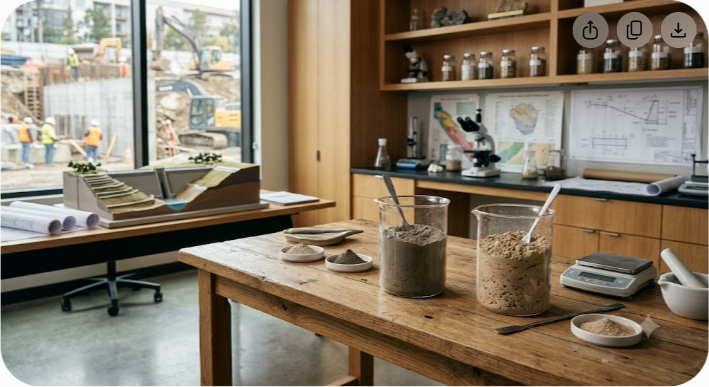
Not all bentonite is created equal. A natural deposit can vary wildly depending on which layer of the mine it came from. At Axewelledge, we don't just dig it out and ship it. We process and refine it. We look at the cation exchange capacity, the particle size distribution, and the free swell index. When you buy bulk, you aren't just buying clay; you’re buying the R&D that ensures batch number one behaves exactly like batch number one-hundred.
Consistency is the silent partner of every successful engineer. If you’re building a dam, you can't afford to have a shipment show up that has a lower-than-specified swell index. That's why we advocate for working with partners who provide detailed technical data sheets (TDS) for every load. Don't be afraid to ask for the lab reports. If a supplier can't give you the numbers, walk away.
Infrastructure is expensive to fix. If you seal a landfill or a pond using the wrong bentonite, you might not notice for a year or two—until the water table shifts or the containment breaches. By then, the cost of excavation and repair is ten times the cost of the original material. Using high-quality sodium bentonite in a barrier application acts like an insurance policy. It's a low-cost material that protects against high-cost failures.
However, remember that bentonite is a natural product. It’s durable, but it needs to be installed correctly. If you're using it in a GCL, ensure it’s protected during transport. If you're using it as an additive for soil stabilization, mix it thoroughly. The most advanced material in the world won't save a project if the installation protocol is flawed.
Sustainability is moving from a buzzword to a regulatory requirement. Bentonite is fundamentally an eco-friendly material. It’s naturally occurring, requires minimal chemical processing, and is often used to fix environmental issues like water pollution or soil erosion. When you choose a natural, high-purity bentonite, you’re choosing a solution that works with the Earth rather than fighting it.
We see a lot of projects shifting toward 'natural' sealants because they don't leave synthetic residues behind. Whether you're using it to line a trout pond or a municipal waste site, you can feel good about the fact that this is a mineral that has been used in various forms for centuries. It’s just that now, we have the technology to refine it to a point where we can predict its performance with extreme precision.
There is no 'better' between sodium and calcium bentonite. There is only 'more appropriate' for the specific engineering challenge in front of you. If you need a seal that heals itself and stops water in its tracks, sodium is your primary candidate. If you need a stable, heat-resistant, or absorbent material that won't expand uncontrollably, calcium is the way to go.
As you finalize your project plans, consider the entire lifecycle of the material. Think about the installation phase, the operational phase, and the long-term maintenance. If you’re ever in doubt, the best path is to run a small-scale pilot test. Take the soil from your specific site, mix it with the bentonite you're considering, and observe the results. It's a simple step, but it’s the difference between a project that keeps you up at night and one that stands the test of time.
At the end of the day, infrastructure is about trust. You’re trusting the materials to hold back the weight of the water or the load of the building. By understanding the nuances of these minerals, you’re building that trust on a foundation of solid science.
There’s a lot of chatter in the industry about bentonite that isn't always accurate. Let's clear a few things up.
First, there's the idea that 'more is always better.' It’s easy to think that if you just dump more bentonite into a mix, you'll get a better result. That's not always true. With sodium bentonite, there is an optimal dosage. Too much, and you create a slick, unstable surface that can actually lead to slope failure if you're working on an embankment. Always stick to the engineered specs.
Second, people often assume that all bentonite is 'activated.' In reality, some bentonite is naturally sodium-rich, while other types are calcium-bentonite that has been chemically treated (or 'soda-activated') to mimic the properties of sodium bentonite. There is nothing wrong with activated bentonite, but you need to know what you’re buying. A natural sodium bentonite often has a different long-term degradation profile than a chemically activated one. If your project has a design life of 50 years, make sure you’re asking the right questions about the material's origin.
If you really want to get into the weeds, look at the Cation Exchange Capacity (CEC). This measures how many positively charged ions the clay can hold. Sodium bentonite typically has a high CEC, which is exactly why it's so reactive. It wants to exchange ions, it wants to grab water, and it wants to change its environment. Calcium bentonite has a lower CEC, which makes it 'quieter' chemically.
For a project engineer, this matters. If you are dealing with high-pH water or high levels of contaminants, those ions will interact with the bentonite. A high CEC material will react quickly. This can lead to what we call 'cation exchange poisoning' in a bentonite liner. Essentially, the calcium or magnesium in the groundwater displaces the sodium in the clay, and the material loses its swelling ability. This is why geotechnical reports are so vital. You aren't just building on soil; you're building in a chemical environment that is constantly talking to the materials you put in the ground.
We’ve spent 15+ years refining our extraction and processing methods because we know that the margin for error in your field is non-existent. When an engineer calls us, they don't want a generic sales pitch. They want to know if our material will pass the ASTM standards for their specific application. They want to know if it will hold up under the specific head pressure of their pond design.
That's why our infrastructure approach is built on testing. We don't just sell minerals; we provide the data that supports the structural integrity of your project. Whether it's drilling fluid for an oil project or sealing clay for an environmental barrier, the goal is always the same: efficiency and reliability.
Choosing the right mineral is about balancing the immediate needs of your project with the long-term demands of the environment. Don't be afraid to ask for samples, reach out for technical advice, and challenge your suppliers to prove their material quality. You’re building the infrastructure that defines the future, and you deserve to work with materials that are just as solid as the work you’re doing.
If you find yourself stuck, go back to the basics: water absorption, swelling index, and chemical compatibility. These are the three pillars of bentonite performance. Keep them at the center of your decision-making, and you’ll find the right path every time.













Have questions about our products? We're here to help!