Axewelledge, a leading exporter from India, specializes in high-quality Bentonite. With a commitment to excellence, we supply premium Bentonite to the Middle East and Southeast Asia markets.


North Angle Complex, 304,
150 Feet Ring Rd, Opposite Ambedkar Nagar BRTS Stop,
Madhav Park, Punit Nagar,
Mavdi, Rajkot, Gujarat 360004
© Axewelledge 2026, All Rights Reserved.
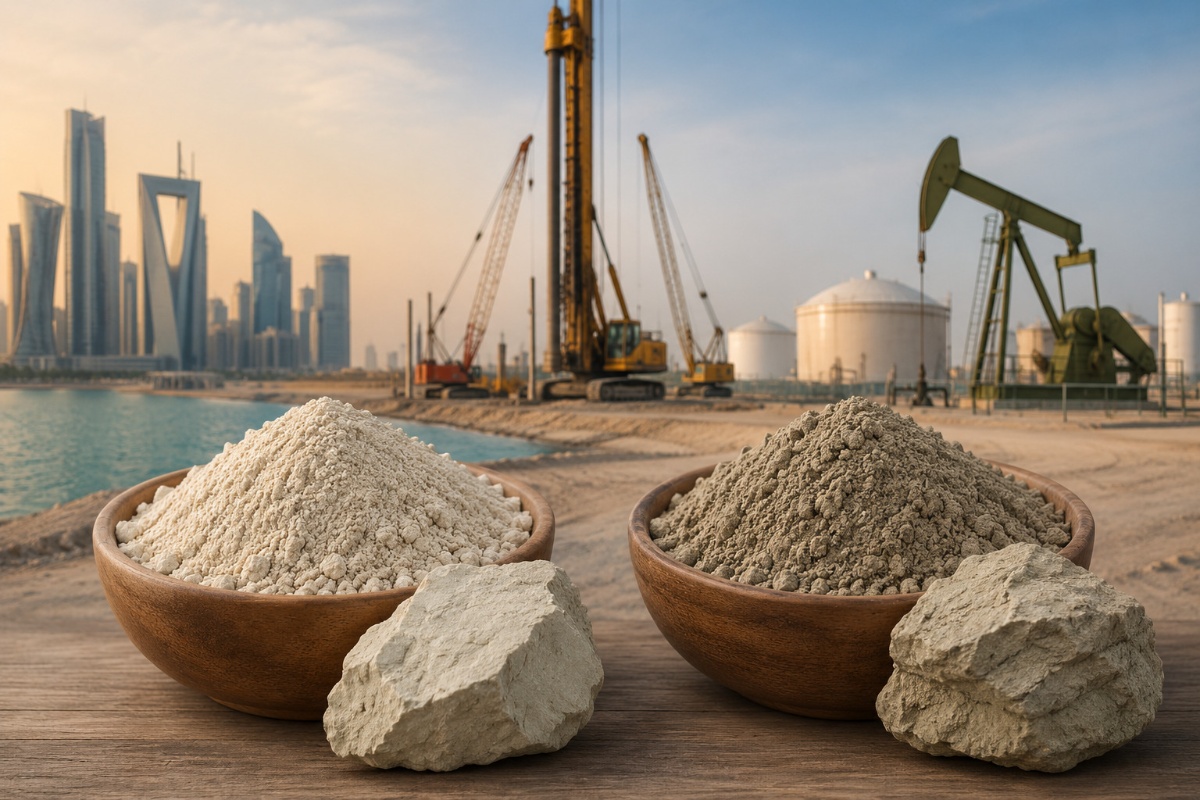
The Gulf Cooperation Council (GCC) region—including Saudi Arabia, United Arab Emirates, Qatar, Kuwait, Oman, and Bahrain—has become one of the fastest-growing markets for bentonite imports. Rapid infrastructure development, oil and gas exploration, foundry manufacturing, desalination projects, agriculture, and pet care industries have significantly increased the demand for high-quality bentonite products.
However, many buyers make a critical mistake when sourcing bentonite: they focus primarily on price rather than selecting the correct type. The two major commercial varieties—Sodium Bentonite and Calcium Bentonite—offer completely different performance characteristics and industrial benefits. Choosing the wrong type can lead to reduced efficiency, increased operating costs, and project failures.
For GCC buyers, understanding the differences between sodium and calcium bentonite is essential before placing an import order. This guide explains their properties, applications, advantages, limitations, and procurement considerations to help importers make informed purchasing decisions.
For reliable industrial mineral sourcing and export support, visit Axewel Ledge.
Bentonite is a naturally occurring clay primarily composed of montmorillonite. Its unique structure allows it to absorb water, swell, bind particles, and create impermeable barriers. The specific characteristics of bentonite depend largely on the dominant exchangeable ion present within the clay structure.
The two primary commercial grades are:
Contains sodium ions (Naâº) as the dominant exchangeable cation.
Contains calcium ions (Ca²âº) as the dominant exchangeable cation.
Although both originate from volcanic ash deposits, their performance differs dramatically when exposed to moisture and industrial processing environments.
The Gulf region presents unique operating conditions:
A bentonite grade that performs exceptionally well in one application may be completely unsuitable for another.
For example:
Therefore, application-specific selection is crucial.
Sodium bentonite is widely recognized for its exceptional swelling and sealing properties.
When mixed with water, sodium bentonite can expand many times its dry volume and form a thick gel-like structure. This behavior creates an effective barrier against water movement and fluid loss.
Sodium bentonite expands significantly when hydrated.
Produces high-viscosity suspensions ideal for drilling fluids.
Creates highly effective waterproof barriers.
Keeps particles suspended in fluid systems.
Reduces leakage and seepage in engineering projects.
The GCC region remains one of the world's largest oil and gas producers.
Sodium bentonite is extensively used in:
Its high gel strength makes it ideal for challenging drilling environments.
Infrastructure projects throughout the Gulf increasingly use HDD technology.
Sodium bentonite helps:
Common applications include:
Its low permeability prevents water penetration effectively.
The GCC operates some of the world's largest desalination facilities.
Sodium bentonite is used in:
Premium clumping cat litter products generally rely on sodium bentonite because of its superior absorption and clumping characteristics.
Absorbs large quantities of water quickly.
Creates nearly impermeable barriers.
Enhances borehole stability.
Maintains drilling efficiency.
Widely accepted across multiple industries.
Despite its benefits, sodium bentonite has some drawbacks:
Generally more expensive than calcium bentonite.
Performance may decrease in highly saline environments.
Requires proper storage and handling.
Excessive expansion can create operational challenges in certain applications.
Calcium bentonite behaves very differently.
Instead of swelling dramatically, calcium bentonite maintains greater structural stability and provides controlled absorption characteristics.
It is often selected when dimensional stability and process control are more important than sealing performance.
Limited expansion compared to sodium bentonite.
Maintains shape under varying moisture conditions.
Easier to manage during industrial processing.
Useful in manufacturing applications.
Often more economical than sodium grades.
Foundries across the Gulf use calcium bentonite as a binder for molding sands.
Benefits include:
Calcium bentonite helps bind fine iron ore particles into pellets.
Advantages include:
Used in:
Acts as a granulation aid during fertilizer production.
Many GCC agricultural projects use calcium bentonite for:
Suitable for controlled industrial processes.
Can reduce raw material expenses.
Less sensitive to moisture fluctuations.
Offers predictable results in manufacturing environments.
Not ideal for sealing projects.
Allows more water movement than sodium bentonite.
Less suitable for drilling fluids.
Cannot match sodium bentonite in containment applications.
| Property | Sodium Bentonite | Calcium Bentonite |
|---|---|---|
| Swelling Capacity | Very High | Low to Moderate |
| Water Absorption | Excellent | Moderate |
| Gel Strength | High | Low |
| Sealing Ability | Excellent | Moderate |
| Permeability | Very Low | Higher |
| Drilling Performance | Excellent | Limited |
| Structural Stability | Moderate | High |
| Cost | Higher | Lower |
| Waterproofing | Excellent | Limited |
| Foundry Use | Limited | Excellent |
| Pelletizing | Good | Excellent |
| Agriculture | Good | Very Good |
Data summarized from industrial bentonite performance references.
Cheaper bentonite may not deliver required performance.
Always verify:
Request:
Application suitability is more important than cost savings.
Bulk density and packaging impact logistics costs significantly.
Before placing an order, ask:
India has become one of the largest bentonite suppliers to Gulf countries due to:
Indian manufacturers supply both sodium and calcium bentonite grades for diverse industrial applications throughout the GCC region.
Selecting the correct bentonite grade is one of the most important decisions for industrial buyers in the Gulf. Whether your project requires high swelling sodium bentonite for sealing and drilling or stable calcium bentonite for foundry and manufacturing applications, understanding the differences can significantly improve project performance and reduce costs.
For high-quality bentonite exports, customized industrial grades, technical support, and global shipping assistance, visit Axewel Ledge.
A reliable supplier will help you choose the right bentonite grade, provide complete technical documentation, and ensure consistent quality for long-term success in GCC markets.













Have questions about our products? We're here to help!