Axewelledge, a leading exporter from India, specializes in high-quality Bentonite. With a commitment to excellence, we supply premium Bentonite to the Middle East and Southeast Asia markets.


North Angle Complex, 304,
150 Feet Ring Rd, Opposite Ambedkar Nagar BRTS Stop,
Madhav Park, Punit Nagar,
Mavdi, Rajkot, Gujarat 360004
© Axewelledge 2026, All Rights Reserved.
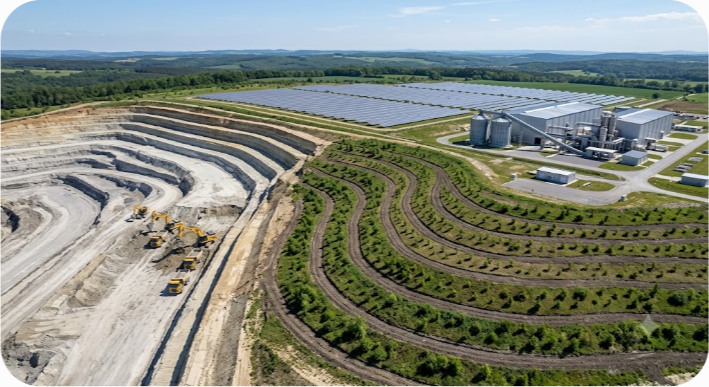
When a single raw material underpins everything from the steel castings in your vehicle to the water purification system in your local municipality, its availability ceases to be a simple purchasing line item. It becomes a matter of national industrial security. For decades, global supply chains operated under a fragile 'just-in-time' illusion, assuming that the earth's crust would endlessly provide critical industrial minerals whenever an order was placed. But a turbulent mix of geopolitical shifts, climate-induced logistics bottlenecks, and an urgent mandate for environmental accountability has shattered that complacency. Modern industrial operations require more than just reliable logistics; they demand materials sourced with an explicit commitment to long-term environmental viability.
Take bentonite clay. Often called the 'clay of a thousand uses,' this highly versatile volcanic material is the quiet workhorse of modern infrastructure. It seals geopolitical waste repositories, binds iron ore pellets, stabilizes deep-earth drilling operations, and clarifies food products. Yet, as American manufacturers and procurement executives audit their vulnerabilities, a critical question emerges: How do we secure a continuous, decades-long supply of high-grade bentonite without running afoul of tightening ESG regulations or falling victim to depleted regional reserves? The answer lies in the evolution of sustainable mining.
To appreciate why a sustainable supply chain for bentonite matters, you first have to look at how deeply embedded this mineral is within our day-to-day industrial fabric. Bentonite isn't a luxury additive; it's a foundational necessity across multiple heavy industries.
In the metal casting and foundry sector, sodium bentonite serves as the primary binding agent for green sand molds. When automotive manufacturers cast engine blocks or structural components, they rely on the thermal stability and high swelling capacity of bentonite to maintain mold integrity under the extreme heat of molten iron or steel. Without high-quality clay, casting defects skyrocket, leading to catastrophic production delays and wasted energy.
Move over to civil engineering and infrastructure, and the reliance deepens. During horizontal directional drilling (HDD) or microtunneling under urban landscapes, bentonite slurry acts as both a lubricant for the cutting head and a hydrostatic stabilizer for the borehole walls. It prevents the surrounding soil from collapsing, keeping multi-billion-dollar transportation and utility projects on schedule. In environmental engineering, its exceptional low-permeability swelling characteristics make it the gold standard for lining landfills, pond systems, and industrial wastewater lagoons, trapping hazardous contaminants before they can breach local water tables.
Even agriculture and water purification turn to this mineral. It binds animal feed pellets, improves soil moisture retention in arid farming regions, and clarifies industrial wastewater by attracting and binding heavy metals. When a single mineral plays these many critical roles, a disruption at the mine site doesn't just impact a single factory; it sends a shockwave across entirely unrelated sectors.
Procurement managers in the United States face an increasingly complex landscape. Historically, domestic sourcing or low-cost transactional purchasing sufficed. However, localized deposits are facing natural depletion, and the quality of easily accessible reserves is shifting. When industrial buyers look abroad to diversify, they often confront a highly fragmented market characterized by inconsistent quality control, unpredictable export regulations, and opaque environmental records.
Compounding this challenge is the aggressive rise of mandatory corporate sustainability reporting. US enterprises can no longer look the other way regarding Scope 3 emissions or the environmental impact of their raw materials. Regulatory bodies, investors, and consumers are demanding transparency. If your primary mineral supplier is using outdated, high-emissions extraction methods or leaving behind un-reclaimed wasteland, your brand carries that reputational and operational liability.

This reality is driving a fundamental shift from transactional purchasing to strategic, long-term mineral partnerships. Companies are realizing that securing their supply chain requires finding partners who manage massive, high-grade reserves while prioritizing progressive mining philosophies. Security of supply and environmental sustainability are no longer competing priorities; they are two sides of the same coin.
Sustainable mining can sound like an oxymoron. Extraction, by its very nature, alters the earth. Truly sustainable mining isn't about avoiding extraction altogether; it's about minimizing the footprint, optimizing resource efficiency, and ensuring that the land is returned to a productive or natural state afterward. For a major global bentonite producer, this manifests in several concrete practices:
For supply chain directors navigating volatile global markets, sourcing from an eco-friendly, large-scale miner delivers clear operational advantages that directly impact the bottom line.
First, it insulates your operation against regulatory disruption. As governments worldwide crack down on polluting industries, sub-standard mines face sudden closures, arbitrary production caps, or crushing environmental fines. By aligning with a producer that meets or exceeds international environmental standards, you ensure that your material pipeline won't suddenly vanish due to an overnight regulatory raid or a revoked environmental permit.
Second, it stabilizes long-term costs. Mines that operate efficiently, utilize solar energy, and manage massive consolidated reserves are far more resilient against energy price spikes and localized resource scarcity. This translates into predictable, stable pricing structures for long-term supply contracts, allowing US manufacturers to forecast their production costs with confidence.
Finally, it satisfies the strict ESG criteria demanded by major corporate clients and institutional investors. Being able to explicitly trace your bentonite supply to a carbon-conscious, ethically managed mine with decades of secured reserves provides a massive competitive advantage when bidding on major public infrastructure projects or corporate supply contracts.
Bridging the gap between massive industrial demand and strict sustainability requires immense scale and infrastructure. This is where global leaders like Axewelledge are reshaping the industry's expectations. Ranking among the top five global producers and operating as India's largest mine owner and exporter of bentonite, we maintain over 60 million tons of high-quality reserves. This massive volume ensures that industrial operations in the US, Middle East, and Southeast Asia have access to a reliable, uninterrupted stream of minerals for generations.
Rather than relying on fragmented, third-party miners, our vertically integrated structure controls everything from the initial geological assessment to the final maritime logistics. This complete oversight allows for the strict enforcement of advanced refinement techniques and international quality standards across all processing plants. By pairing massive mineral reserves with advanced R&D and eco-friendly solar-drying practices, we prove that heavy industrial supply chains can be secured without compromising ecological responsibility.
If you're responsible for managing an industrial supply chain that depends on high-performing clays, the era of treating bentonite as a simple commodity is over. To future-proof your operations, look closely at your suppliers' long-term reserve estimates, their carbon-mitigation strategies during processing, and their track record for consistent international delivery. Securing a sustainable supply chain isn't just an environmental box to check—it's a calculated business strategy that ensures your factories keep running, your projects stay on schedule, and your brand remains resilient in an evolving global economy.













Have questions about our products? We're here to help!