Axewelledge, a leading exporter from India, specializes in high-quality Bentonite. With a commitment to excellence, we supply premium Bentonite to the Middle East and Southeast Asia markets.


North Angle Complex, 304,
150 Feet Ring Rd, Opposite Ambedkar Nagar BRTS Stop,
Madhav Park, Punit Nagar,
Mavdi, Rajkot, Gujarat 360004
© Axewelledge 2026, All Rights Reserved.
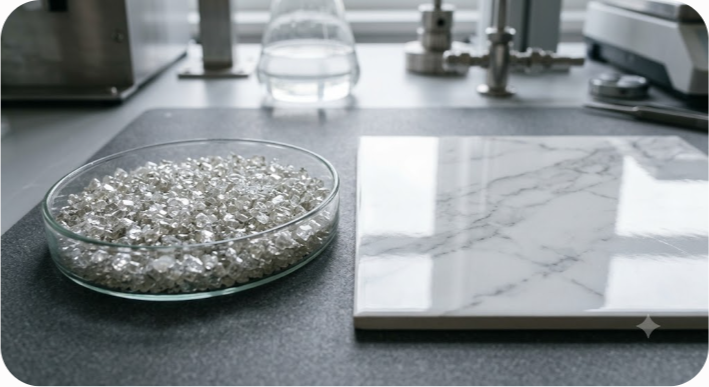
Look closely at a modern porcelain tile installed in a busy international airport terminal. Millions of heavy boots, metal-wheeled suitcases, spilled coffee, and harsh chemical cleaners pass over it every single year. Yet, a decade later, the surface looks exactly as it did the day it was laid down. How does a piece of baked clay survive that level of daily punishment without wearing through, cracking, or losing its vibrant design?
The secret isn't just the clay body itself. The real magic happens in a layer thinner than a fingernail: the engineered barrier of ceramic frits, engobes, and glazes applied to the surface before firing.
For tile manufacturers aiming to capture a slice of the lucrative high-durability commercial and residential market, mastering these surface materials is a strict engineering requirement. Let's unpack exactly how premium frits and glazes transform raw mineral mixtures into high-performance structural elements that withstand the test of time.
To understand why surface coatings are so critical, we have to look at what happens inside a kiln during industrial firing. A raw tile blank, or green body, consists of a mix of clays, feldspar, quartz, and other minerals like bentonite which provide crucial green strength during shaping. When heated to temperatures ranging between 1100°C and 1250°C, these minerals undergo vitrification, melting into a glassy, dense matrix.
However, the structural clay body has limitations. Left unglazed, even well-vitrified porcelain can possess microscopic surface pores that trap dirt, absorb moisture, and remain vulnerable to acidic or alkaline stains. More importantly, bare clay does not provide the specific aesthetic depth or the extreme abrasion resistance required by modern architectural specifications.
This is where a multi-layered coating system becomes necessary. In a typical high-durability tile, the structure consists of three distinct layers applied to the raw clay body:
Each layer relies heavily on a specialized ingredient known as a ceramic frit.
If you tried to make a glaze using only raw, un-melted minerals like silica, limestone, and zinc oxide, you would run into severe manufacturing bottlenecks. Raw minerals have vastly different melting points, require massive amounts of energy to fuse completely, and frequently release gases (like carbon dioxide from carbonates) during the firing process. If these gases escape while the glaze is molten, they leave behind tiny bubbles, pinholes, and craters that ruin the tile's durability and finish.
To solve this, material scientists use a process called fritting. A ceramic frit is an industrial glass compound produced by mixing raw minerals, melting them in a continuous furnace at extreme temperatures (often exceeding 1400°C), and then rapidly quenching the molten stream in cold water. This thermal shock shatters the liquid glass into thousands of tiny, stable, non-crystalline granules.
By pre-melting the raw materials, frits offer several advantages to high-durability tile producers:
High-durability tile manufacturing relies on different categories of frits to achieve specific performance benchmarks. Balancing these formulations is an intricate science, often requiring premium inputs from established global suppliers who specialize in precision mineral processing.
Opaque frits are rich in opacifiers, traditionally zirconium silicate or titanium dioxide. These microscopic crystals do not dissolve completely in the molten glass; instead, they remain suspended, scattering light and creating a solid, bright white or cream background.
In high-durability applications, opaque frits are vital for creating a uniform foundation. If a manufacturer is using a cost-effective local clay body that fires to a dark red or gray hue, a high-quality opaque frit or engobe compound ensures that the final digital print or colored glaze displays true, vibrant tones without any bleed-through from the dark clay beneath.
Transparent frits are engineered to clear completely upon melting, creating a perfectly see-through, glossy pane of protective glass over the decorative elements of the tile. In modern manufacturing, where digital inkjet printers apply complex marble, wood, or concrete patterns directly onto the tile body, a protective layer of transparent frit is the only thing keeping that beautiful image from scratching off within weeks of installation.
For maximum durability, these transparent glasses must feature high silica and alumina content, giving them exceptional resistance to surface micro-scratches caused by tracked-in sand and grit.
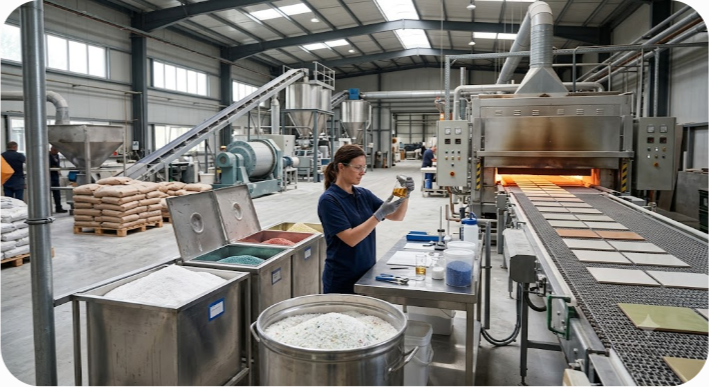
Commercial spaces frequently demand non-slip, low-gloss surfaces to ensure pedestrian safety while maintaining high wear resistance. Matt frits achieve this by incorporating minerals that intentionally crystallize during the cooling phase of the kiln cycle. Common crystalline phases include anorthite, diopside, or willemite.
These microscopic crystals break up light reflection, producing a smooth, non-reflective finish. Crucially, a premium matt frit must create a surface that is structurally hard and non-glossy without being rough or porous. Poorly formulated matt glazes can behave like sandpaper, trapping dirt and making clean-up a nightmare for maintenance staff.
When architects specify tiles for demanding projects like malls, hospitals, or outdoor plazas, they look at cold, hard metrics. Let's look at how the chemistry of premium frits and glazes directly dictates these critical technical properties.
For glazed tiles, wear resistance is measured using the Porcelain Enamel Institute (PEI) rating system, ranging from Class 0 (wall use only) to Class 5 (heavy commercial traffic). To achieve a PEI Class 4 or 5 rating, the surface glaze must be exceptionally hard.
This hardness is achieved by carefully controlling the ratio of network-forming oxides (like silica and alumina) to network-modifying oxides (like sodium, potassium, and calcium) within the frit. Alumina acts as a structural stabilizer, dramatically increasing the mechanical strength and scratch resistance of the fired glaze matrix. Premium suppliers like Axewelledge provide specialized frits and engobe compounds engineered to hit these exact structural balances, helping manufacturers consistently pass stringent PEI verification testing.
Have you ever seen an older tiled wall where the surface is covered in a web of tiny, fine cracks? That defect is called crazing, and it is caused by a mismatch in thermal expansion between the clay tile body and the surface glaze.
Every material expands when heated and contracts when cooled. If a glaze contracts more than the underlying clay as it cools inside the kiln, the glaze layer is thrown into tension. Because glass is weak under tension, it cracks to relieve the stress. Conversely, if the glaze contracts slightly less than the clay, it is put into compression. Glass loves compression; it makes the entire tile significantly stronger and completely eliminates the risk of crazing.
By adjusting the blend of alkaline oxides (which increase thermal expansion) and boron oxide or silica (which lower it), chemical engineers can tailor a frit's Coefficient of Thermal Expansion (COE) to perfectly match the specific clay body being fired.
From acidic tomato sauce in residential kitchens to harsh chlorine bleaches in industrial cleanings, tile surfaces face constant chemical warfare. If a glaze contains high amounts of unbonded, highly reactive fluxing elements, those chemicals can leach out over time, dulling the surface and leaving it permanently etched.
Premium frits solve this by ensuring a tightly bound, fully vitrified silica network. This impenetrable glass layer prevents liquids from penetrating below the surface, ensuring that even stubborn stains can be wiped away with basic detergents. This is particularly vital in medical facilities, where zero surface porosity is a mandatory hygiene standard to prevent bacterial colonization.
Developing a world-class glaze formulation is meaningless if the raw components vary from batch to batch. In industrial tile manufacturing, consistency is king. If a shipment of frit contains even a slight variance in iron oxide content, an entire production run of white commercial tiles could emerge from the kiln with an unusable yellowish tint, causing significant financial loss in wasted materials.
This reality highlights why successful global tile producers rely on vertically integrated suppliers. When an industrial provider controls both the raw mineral mining and the advanced refinement processes, they can enforce rigorous quality controls right at the source. For instance, companies like Axewelledge utilize sophisticated research and development alongside efficient logistics networks to ensure that everything from industrial binders to advanced surface compounds meets strict international standards.
When your foundational mineral inputs are completely uniform, your firing curves become predictable, your reject rates plummet, and your final product delivers the precise mechanical durability promised in your technical catalogs.
Even with top-tier materials, maintaining a flawless high-volume tile line requires vigilant process control. Tiny shifts in kiln humidity, application density, or firing speed can cause frustrating surface defects. Here is a quick reference for the three most common durability-killing defects and how to address them:
These look like tiny pops or mini-volcanoes on the tile surface. They occur when gases escape from the tile body too late in the firing cycle, popping through a glaze that has already begun to cool and solidify.
Crawling occurs when the liquid glaze pulls away from certain areas of the tile during melting, leaving bare spots of unglazed clay or engobe exposed. It is typically caused by poor adhesion of the wet glaze slurry to the unfired tile body, often due to dust, oil, or excessive shrinkage of the glaze layer as it dries.
When a high-gloss glaze emerges with a wavy, dull, orange-peel texture, it indicates that the glaze slurry didn't melt thoroughly or flow out smoothly before cooling began.
The demands placed on tile surfaces will only intensify in the coming years. We are already seeing a massive surge in demand for ultra-large-format porcelain slabs—some measuring up to five by ten feet while remaining only a few millimeters thick. These massive panels are used for seamless kitchen countertops, exterior building facades, and high-end commercial wall claddings.
Manufacturing a slab of that scale introduces immense structural stresses. Without the right engobe to distribute thermal tension, or a highly resilient top glaze to protect the expansive design, these premium slabs can fail during cutting or installation. Furthermore, the industry is pushing toward lower firing temperatures and shorter kiln cycles to reduce carbon footprints and cut energy expenses.
Meeting these challenges requires a deep commitment to continuous chemical innovation. By carefully refining the mineral inputs, optimizing particle size distributions, and customizing frit formulations for fast-firing schedules, premium mineral processors are paving the way for the next generation of sustainable, indestructible architectural surfaces.
Investing in cheap, poorly controlled surface raw materials is a classic false economy. If your tiles can't hold up to real-world wear, your brand's reputation will erode far faster than your surfaces. By prioritizing premium frits, robust engobes, and chemically balanced glazes, you ensure that your production line runs smoothly and your final products look stunning for years to come.













Have questions about our products? We're here to help!