Axewelledge, a leading exporter from India, specializes in high-quality Bentonite. With a commitment to excellence, we supply premium Bentonite to the Middle East and Southeast Asia markets.


North Angle Complex, 304,
150 Feet Ring Rd, Opposite Ambedkar Nagar BRTS Stop,
Madhav Park, Punit Nagar,
Mavdi, Rajkot, Gujarat 360004
© Axewelledge 2026, All Rights Reserved.
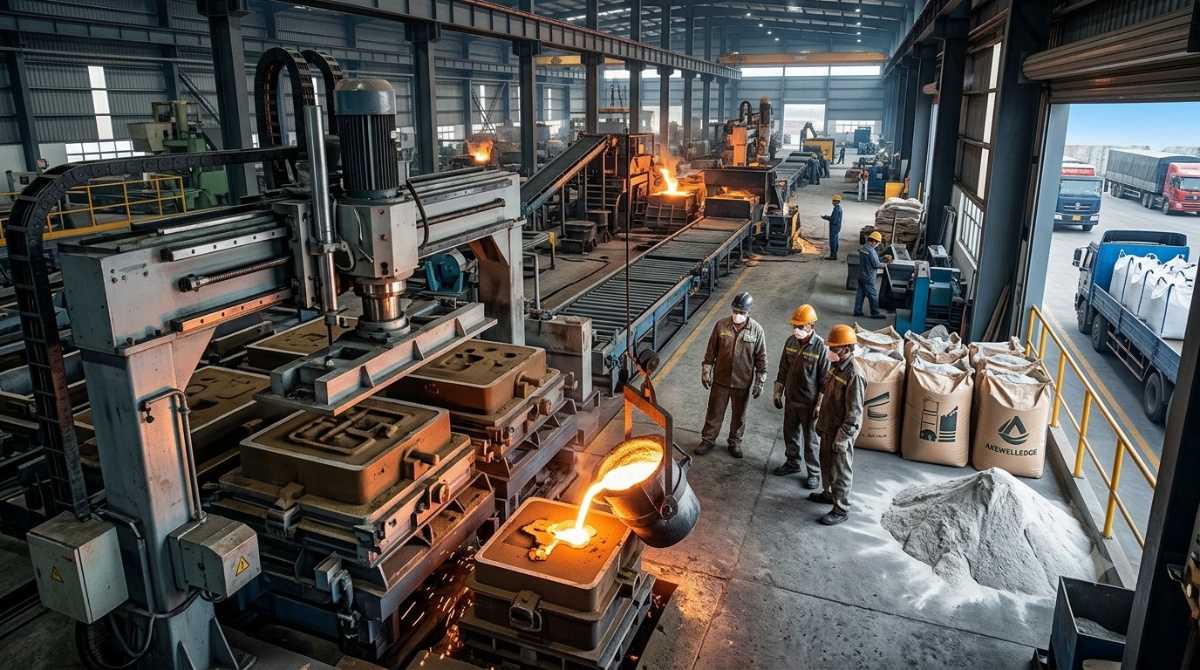
Vietnam's industrial landscape is experiencing an unprecedented era of growth. Driven by a surge in foreign direct investment (FDI), a booming automotive manufacturing sector, and a rapidly expanding heavy machinery industry, the nation has transformed into a critical global manufacturing hub. At the heart of this industrial renaissance lies the metal casting and foundry sector. From intricate automotive components to heavy-duty industrial machinery parts, Vietnamese foundries are under immense pressure to deliver world-class casting quality while keeping production costs optimized.
To achieve precision in metal casting, foundries rely heavily on green sand molding—a process where the quality of the binding agent dictates the success or failure of the final product. Globally, bentonite clay is acknowledged as the ultimate binder for green sand molds. However, for Vietnamese foundry operators, not all bentonite is created equal.
In recent years, Indian bentonite has emerged as the definitive top choice for the Vietnam foundry industry. Combining exceptional geological purity, superior thermal properties, and highly favorable economic logistics, Indian mineral exports have become the backbone of modern Vietnamese casting operations.
The casting sector in Vietnam has evolved from small-scale, traditional workshops into highly automated, high-output industrial facilities. This transformation is deeply tied to the rise of the domestic automotive industry, motorcycle manufacturing hubs, and the global export demand for cast iron, steel, and non-ferrous metal components.
Modern buyers from Europe, North America, and Japan do not tolerate casting defects. Issues like sand burning, scabbing, pinholes, and mold distortion can ruin entire production batches, resulting in devastating financial losses and tarnished supplier reputations. As a result, Vietnamese foundries are shifting away from lower-grade local clays and sub-par mineral imports. They are seeking materials that guarantee operational consistency, high thermal durability, and excellent mold integrity under extreme casting temperatures.
Green sand molding relies on a delicate equilibrium of sand, water, and bentonite. The binder must coat the silica sand grains evenly, providing the necessary strength to hold the mold’s shape when the heavy, molten metal is poured. If the clay fails to retain its binding properties under high thermal stress, the mold collapses or erodes, leading to catastrophic structural failures in the metal casting.
To overcome these hurdles, Vietnamese metal casters have turned their eyes toward India—specifically to the mineral-rich reserves of Gujarat and Rajasthan, where the world's finest industrial-grade bentonite is mined.
To appreciate why Indian bentonite dominates the Vietnamese market, it is essential to look at the science behind this extraordinary mineral. Geologically, bentonite is a highly absorbent aluminum phyllosilicate clay formed primarily from the weathering of volcanic ash over millions of years. Its performance is governed by its primary constituent mineral: montmorillonite.
When used in green sand molding, bentonite performs three critical functions:
Bonding Strength: It forms a cohesive film around individual sand grains, binding them tightly together.
Moisture Retention: It regulates the water content within the sand matrix, ensuring the mold remains plastic yet firm.
Thermal Cushioning: It absorbs the sudden thermal expansion of silica sand when exposed to molten metal, preventing surface defects on the casting.
While two primary variants exist—Calcium Bentonite (low swelling) and Sodium Bentonite (high swelling)—the metal casting industry overwhelmingly demands high-quality sodium bentonite due to its superior molecular bonding and remarkable thermal resilience.
India possesses some of the largest and highest-quality natural sodium bentonite reserves on the planet. For Vietnamese foundries, sourcing this mineral from a trusted Bentonite Export from India partner provides clear advantages that directly impact the factory floor and the corporate balance sheet.
The industrial efficacy of bentonite is measured by its swelling index and its montmorillonite purity. Indian sodium bentonite features an abundance of sodium ($Na^+$) ions within its crystal interlayer structures. This specific atomic composition allows it to absorb water and swell up to 15 to 20 times its dry volume.
For a Vietnamese foundry, this high swelling capacity means less bentonite powder is required to achieve the desired mold strength. Lower material consumption translates directly to lower production costs without compromising the structural integrity of the green sand molds.
When molten iron or steel is poured into a mold, temperatures easily exceed 1200°C to 1500°C. Under such punishing heat, inferior clays break down chemically, losing their crystalline water and their ability to re-hydrate. This phenomenon is known as "clay burnout."
Indian bentonite is celebrated globally for its high thermal stability and exceptional refractoriness. It resists chemical degradation at elevated temperatures, which allows foundries to reclaim and reuse the molding sand multiple times. By lowering the consumption of fresh, virgin clay in the recycling loop, foundries significantly reduce operational overheads.
A perfect mold must be strong when wet (Green Strength) to handle automated pattern stripping, and equally strong when dried by the heat of the approaching molten metal (Dry Strength) to resist the rushing liquid's erosive forces.
High GCS: Ensures that the green sand mold maintains its precise shape during handling, transport, and assembly on the molding line.
High DCS: Prevents the mold walls from eroding or collapsing under the intense hydrostatic pressure of the liquid metal, eliminating sand inclusion defects.
Indian sodium bentonite offers an optimal balance of GCS and DCS, ensuring flawless dimensional accuracy for every casting produced.
Surface defects are the bane of any modern foundry's existence. When low-grade binders are used, the sand grains expand unevenly, leading to defects such as:
Scabbing: Crust-like projections on the casting surface caused by mold face separation.
Sand Burning: Molten metal penetrating into the sand mold, resulting in a rough, fused sand-and-metal surface that requires extensive shot-blasting and grinding.
The excellent flowability and uniform grain coating provided by high-grade Indian clay ensure a perfectly smooth mold face. This results in metal castings with an immaculate surface finish, reducing post-casting cleaning times and accelerating overall throughput.
While technical specifications are vital, industrial procurement decisions are ultimately grounded in economic reality. Indian bentonite is not just technically superior; it is logistically and economically the most viable option for the Southeast Asian market.
| Feature / Factor | Indian Sodium Bentonite | Alternative Regional Clays |
| Montmorillonite Purity | Very High (85%+) | Moderate to Low |
| Swelling Index | 20x to 30x ml/2g | 5x to 12x ml/2g |
| Thermal Durability | Exceptional | Poor (Prone to early burnout) |
| Transit Time to Vietnam | Short (Direct Maritime Routes) | Varies significantly |
| Cost-to-Performance Ratio | Highly Optimized | Unfavorable due to high defect rates |
India’s major commercial ports, particularly those along the western coast close to prime mining zones in Gujarat, offer well-established, direct maritime shipping lanes to major Vietnamese ports like Haiphong, Da Nang, and Ho Chi Minh City. This geographic accessibility guarantees short transit times, minimized ocean freight costs, and a highly predictable supply chain that eliminates the need for foundries to maintain massive, costly safety inventories.
Vietnam’s industrial expansion requires a supply partner that can keep pace with scaling production lines. Indian mineral exporters operate massive, fully mechanized mining reserves and state-of-the-art milling plants. This industrial scale allows them to fulfill consistent bulk shipments month after month, ensuring that a Vietnamese foundry’s automated high-pressure molding lines never grind to a halt due to raw material shortages.
Every foundry setup is unique, depending on whether they are casting gray iron, ductile iron, or heavy steel. To achieve optimal results, procurement managers must evaluate specific technical parameters when analyzing a supplier's material data sheets.
Montmorillonite Content: Should ideally be above 80% to ensure maximum bonding efficiency.
Methylene Blue Value (MBV): Reflects the active clay content available for bonding. Higher MBV indicates a more potent, reliable binder.
Gel Time and Swelling Value: Critical indicators of how efficiently the clay will hydrate and disperse within the intensive sand muller.
Moisture Content: Must be precisely controlled during processing (typically between 9% to 12%) to prevent agglomeration during transit while retaining maximum molecular activation properties.
By sourcing from an established market leader like Axewelledge, Vietnamese foundries gain access to custom-formulated, application-specific grades designed precisely to match the rigorous demands of modern, automated green sand molding lines.
To understand why international buyers consistently favor Indian mineral reserves, it helps to compare Indian sodium bentonite against localized calcium alternatives commonly found within Southeast Asia.
Localized regional clays are predominantly calcium-based. While calcium bentonite possesses excellent adsorption characteristics—making it well-suited for chemical purification or agricultural applications—it inherently lacks the lattice structure required for massive water absorption and swelling. When subjected to the thermal shock of molten metal, calcium-based clays collapse rapidly, exhibiting low hot shear strength.
To make calcium clay usable in a foundry, it must undergo chemical activation, typically involving treating the clay with sodium carbonate (soda ash). While this synthetic activation improves initial swelling, the chemical bond is highly unstable under extreme heat. During the very first casting cycle, the artificially introduced sodium ions break away, rendering the recycled sand useless.
In contrast, Indian sodium bentonite features naturally occurring, geologically stable sodium ions embedded deep within its crystalline structure over millions of years. This natural configuration provides an incredibly resilient thermal bond that withstands repeated casting cycles, delivering unmatched longevity and economic value to the foundry floor.
Switching to a premium binder is only the first step; optimizing how it interacts with your existing sand preparation machinery is what unlocks true operational excellence.
Because of the high purity and exceptional swelling index of Indian sodium bentonite, it requires uniform water distribution to activate its full bonding potential. Foundries should ensure their sand mullers are calibrated to distribute moisture evenly across the batch. Because less clay is required compared to low-grade alternatives, the mulling time can often be optimized, reducing mechanical wear on the mixing equipment.
As the green sand system operates in a continuous loop, sand testing technicians must regularly measure the system's compactability, green compression strength, and active clay percentage using the Methylene Blue test. Because Indian bentonite exhibits high thermal durability, operators will notice that the percentage of active clay remains consistently higher across casting cycles, drastically reducing the volume of fresh additives required per tone of poured metal.
The high binding efficiency of premium Indian clay allows for a thinner, tougher film around sand grains. This opens up the micro-porosity of the green sand mold, enhancing its gas permeability. High permeability allows steam and volatile gases generated during pouring to escape effortlessly through the mold walls, completely neutralizing the risk of gas pinholes and blowhole defects in the finished castings.
In today's global market, environmental sustainability is no longer optional. Industrial enterprises across Vietnam face increasing pressure from regulatory bodies to minimize waste, lower carbon footprints, and adopt greener production methodologies. Sourcing premium Indian bentonite aligns perfectly with these green manufacturing initiatives.
The primary environmental challenge faced by foundries worldwide is the disposal of spent foundry sand. When low-grade binders suffer from early thermal burnout, the sand matrix degrades rapidly, forcing foundries to discard thousands of tons of spent sand into landfills annually.
The extraordinary thermal resilience of Indian sodium bentonite allows for an exceptionally high sand recycling rate. Foundries can regenerate their molding sand continuously, dramatically cutting down on solid waste generation and lowering the demand for freshly quarried silica sand.
Because premium Indian clay prevents sand fusion and burning, the resulting metal components exit the mold with exceptionally clean, smooth surfaces. This eliminates the need for prolonged, energy-intensive shot-blasting, grinding, and manual finishing operations. By saving hundreds of hours of machinery operation time, foundries significantly lower their overall electricity consumption and operational carbon footprint.
As Vietnam continues its journey toward becoming an unstoppable manufacturing superpower, the reliance on high-performance raw materials will only intensify. Foundries that continue to rely on unstable, low-grade binders will find it increasingly difficult to compete on quality, precision, and cost in the global arena.
Sourcing high-purity, structurally superior sodium bentonite from India represents a major strategic leap forward for Vietnamese metal casting facilities. It is an investment that pays immediate dividends in the form of reduced casting defects, pristine surface finishes, lower material consumption, and heavily optimized operational workflows.
To explore how premier Indian mineral solutions can transform your production efficiency, discover the comprehensive technical insights shared in our guide on how the Top Bentonite Exporter from India: How Axewelledge Leads the Market sets the global benchmark for mineral purity and reliability. Furthermore, to see how our engineered mineral solutions support diverse industrial sectors globally, explore the specialized breakdowns within our detailed analysis on the Top 10 Industries That Import Bentonite from India.
By selecting the right mineral partner, Vietnamese foundries can confidently elevate their manufacturing capabilities, securing their rightful place as trusted suppliers to the world’s most demanding industrial sectors.













Have questions about our products? We're here to help!