Axewelledge, a leading exporter from India, specializes in high-quality Bentonite. With a commitment to excellence, we supply premium Bentonite to the Middle East and Southeast Asia markets.


North Angle Complex, 304,
150 Feet Ring Rd, Opposite Ambedkar Nagar BRTS Stop,
Madhav Park, Punit Nagar,
Mavdi, Rajkot, Gujarat 360004
© Axewelledge 2026, All Rights Reserved.
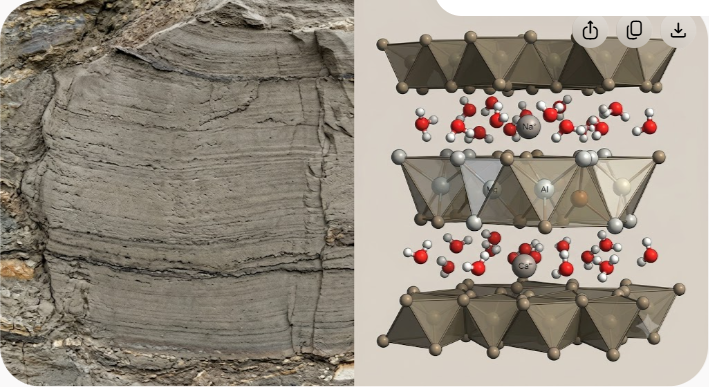
Bentonite is not a single pure mineral. It is a clay-rich rock made up mainly of smectite minerals, especially montmorillonite, together with varying amounts of quartz, feldspar, mica, volcanic glass alteration products, carbonates, iron minerals, and other accessory phases.
That distinction matters. When someone asks, "What is bentonite made of?" the useful answer isn't simply a chemical formula. Bentonite performance depends on which smectite is present, how much of it the deposit contains, which ions occupy its exchange sites, how the clay has been altered, and what non-clay minerals remain in the ore.
Montmorillonite gives bentonite many of its best-known properties: water uptake, swelling, cation exchange, adsorption, colloidal behaviour, and the ability to form stable gels in suitable water systems. Its layered crystal structure is the reason these properties exist in the first place.
This guide explains bentonite composition from the mineral scale down to the industrial level. It covers the montmorillonite structure, sodium and calcium bentonite, geological formation, chemical composition, swelling and cation exchange, common industrial applications, processing, and the tests used to assess commercial quality.
Bentonite is a naturally occurring clay-rich rock composed predominantly of smectite, usually montmorillonite, with variable amounts of other minerals and alteration products. Most bentonite deposits originated from volcanic ash or volcanic glass that underwent chemical alteration in the presence of water over geological time.
Montmorillonite belongs to the smectite clay group and has a 2:1 phyllosilicate structure. In simple terms, each structural unit contains two silica-rich tetrahedral sheets surrounding an alumina- or magnesia-rich octahedral sheet. Water and exchangeable cations occupy the space between these layers.
A commonly used idealised formula for montmorillonite is:
This should be treated as a representative structural formula rather than a fixed recipe. Natural montmorillonite has variable chemical composition because substitutions occur within its crystal lattice and the interlayer cations vary from deposit to deposit.
A typical bentonite deposit can contain:
There is therefore no single mineral percentage or oxide analysis that represents every bentonite. Commercial specifications must be tied to a particular deposit, grade, processing route, and application.
Montmorillonite is the main functional mineral in many industrial bentonites. Its layered structure has a permanent negative charge created by substitutions within the crystal lattice. Exchangeable cations balance that charge.
When water enters the interlayer region, the clay can hydrate and expand. The extent of that expansion depends on factors such as smectite content, layer charge, interlayer cation, particle size, water chemistry, and the presence of other minerals.
That is why two bentonite samples can look almost identical in a dry state but behave very differently in a slurry, a foundry mould, a well seal, or a geosynthetic clay liner.
Montmorillonite is a dioctahedral smectite mineral and the principal clay mineral associated with most bentonites. The mineral belongs to the broader phyllosilicate family, meaning its atoms are arranged into sheet-like structures.
The name bentonite describes the rock or industrial clay material, whereas montmorillonite describes one of its principal mineral constituents. This distinction is useful when reading laboratory reports or comparing deposits.
A high-smectite bentonite can provide strong swelling and rheological performance, while a material containing substantial quartz, feldspar, calcite, or other non-clay minerals may behave differently even when both products are sold under the same broad name.
The chemistry of montmorillonite also explains why the term "aluminium silicate clay" is useful but incomplete. Aluminium and silicon are major structural elements, but magnesium, iron, sodium, calcium, potassium, hydroxyl groups, and water can all contribute to the mineral's composition.
The formula (Na,Ca)0.33(Al,Mg)2Si4O10(OH)2·nH2O is commonly used to illustrate montmorillonite's composition. The notation itself is important.
The parentheses around sodium and calcium indicate that different exchangeable cations can occupy interlayer positions. Likewise, aluminium and magnesium can substitute for one another within the octahedral sheet. The term nH2O indicates variable interlayer water rather than a fixed quantity.
Natural bentonite is therefore not a chemically uniform substance. Its exact composition must be determined analytically if a specification requires precise mineral or elemental limits.
The unusual behaviour of montmorillonite begins with its 2:1 layered crystal structure. The term 2:1 refers to two tetrahedral sheets surrounding one octahedral sheet.
A simplified structural sequence is:
Adjacent structural layers are separated by an interlayer region containing exchangeable cations and, when hydrated, water molecules.
The outer sheets are built primarily from silicon coordinated with oxygen. Each silicon atom sits within an oxygen tetrahedron, and these tetrahedra connect to form a continuous sheet.
Some aluminium can substitute for silicon in tetrahedral positions. Although such substitution is generally less prominent than octahedral substitution in many montmorillonites, it can contribute to the overall layer charge.
Between the two tetrahedral sheets sits an octahedral sheet. Aluminium is an important cation in this layer, although magnesium and iron can also occupy octahedral sites.
The coordination environment includes oxygen and hydroxyl groups. The balance between these ions, together with substitutions in the lattice, determines part of the mineral's permanent charge.
Isomorphous substitution occurs when one ion replaces another of a different valence while the basic crystal framework remains intact.
A familiar example is the substitution of Mg2+ for Al3+ in the octahedral sheet. Because a divalent ion replaces a trivalent ion, the substitution leaves a net negative charge in the crystal structure.
That negative charge does not simply disappear. It is balanced by positively charged ions, known as exchangeable cations, in or around the interlayer region.
This is one of the most important facts to understand about bentonite. The clay's ability to exchange ions and interact strongly with water is rooted in its crystal chemistry.
The interlayer region sits between neighbouring T-O-T structural layers. Depending on the bentonite, it can contain sodium, calcium, magnesium, potassium, and other exchangeable cations, together with varying amounts of water.
These cations aren't fixed into the silicate framework in the same way as the structural atoms. They can be exchanged with ions in an aqueous environment.
When water is introduced, hydration of the interlayer cations can increase the separation between layers. In sodium-rich smectite, this effect can become extensive, producing the high swelling associated with sodium bentonite.
The difference between sodium and calcium bentonite is mainly related to the dominant exchangeable cation and the resulting hydration and swelling behaviour. It is not accurate to think of them as completely different minerals; both can be dominated by smectite, but their interlayer chemistry and performance can differ substantially.
| Property | Sodium-rich Bentonite | Calcium-rich Bentonite |
|---|---|---|
| Dominant exchangeable cation | Sodium, Na+ | Calcium, Ca2+ |
| Water swelling | Generally high | Generally lower |
| Dispersion in fresh water | Often good, depending on grade and chemistry | More limited |
| Gel development | Strong in suitable formulations | Usually lower |
| Cation exchange | High | High, but behaviour varies with mineralogy |
| Typical uses | Drilling fluids, sealing, GCLs, foundry binders | Absorbents, litter, clarification and selected industrial uses |
| Response to saline water | Performance can decrease as salinity rises | Often less dependent on high swelling, but application-specific |
The exact performance cannot be predicted from the cation name alone. Smectite content, layer charge, particle size, soluble salts, processing, and water chemistry also matter.
Sodium ions are monovalent, while calcium ions are divalent. The difference in charge and hydration behaviour affects how strongly the interlayer is held together and how water interacts with the clay.
In sodium-rich smectite, hydration can progress from water associated with individual exchange sites to more extensive interlayer expansion. Under suitable conditions, the layers can separate sufficiently for the clay particles to disperse and form a colloidal suspension.
This produces the familiar combination of swelling, viscosity, and gel formation that makes sodium bentonite useful in drilling fluids and sealing applications.
It is worth avoiding a common oversimplification: sodium bentonite doesn't always expand by one fixed number of times its dry volume. Reported swelling depends on the test method, sample preparation, particle size, water quality, mineral composition, and whether the material is natural sodium bentonite or chemically activated calcium bentonite.
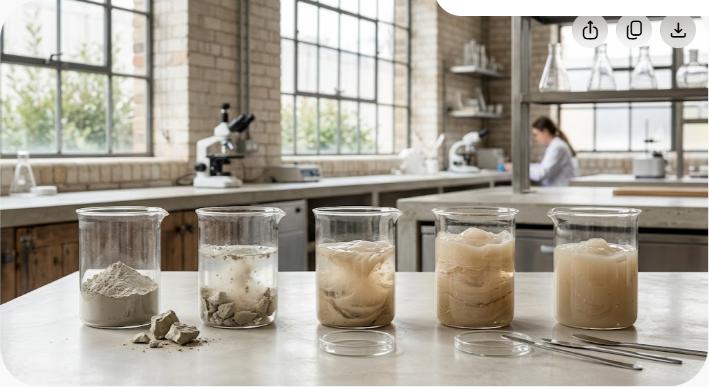
Calcium ions have a 2+ charge and can interact more strongly with negatively charged clay surfaces. As a result, calcium-rich smectite generally develops less extensive swelling than sodium-rich smectite under comparable fresh-water conditions.
Calcium bentonite can still hydrate and adsorb liquids. It can also possess substantial cation exchange capacity and surface area. Those properties make calcium-rich clays useful in applications where extreme swelling isn't the main performance requirement.
Commercial calcium bentonite may also be processed or modified for specific absorbent, clarification, litter, agricultural, or other applications.
Potassium bentonite, often called K-bentonite in geological literature, requires a little more care than the simple sodium-versus-calcium comparison.
K-bentonite commonly refers to altered volcanic ash layers in which smectite has undergone significant potassium-related diagenetic alteration, often with development of illite or mixed-layer illite-smectite. Potassium can become fixed within interlayer sites, reducing the ability of the layers to hydrate and swell.
Because of this, K-bentonite beds are important in stratigraphy and geological correlation. Their mineralogical evolution can preserve evidence of the alteration history of the original volcanic ash.
It would be misleading to treat potassium bentonite simply as a commercial third category equivalent to sodium and calcium bentonite. In many contexts, "K-bentonite" describes a geological alteration product rather than a standard industrial swelling clay grade.
Bentonite chemical analyses are often reported as oxide percentages rather than as elemental percentages. A laboratory XRF report, for example, may list SiO2, Al2O3, Fe2O3, MgO, CaO, Na2O, K2O, and TiO2.
A representative analysis can help explain the chemistry, but there is no universal oxide composition for bentonite. Values vary with deposit geology, smectite content, accessory minerals, beneficiation, moisture, and analytical method.
| Component commonly reported | What it generally indicates |
|---|---|
| SiO2 | Silicon-bearing clay structure plus quartz and other silicate minerals |
| Al2O3 | Aluminium in smectite and other aluminosilicate minerals |
| Fe2O3 and FeO | Iron within clay minerals and separate iron-bearing phases |
| MgO | Magnesium within smectite and other minerals |
| Na2O | Sodium associated with exchangeable sites and other sodium-bearing phases |
| CaO | Calcium associated with exchangeable sites, carbonates, or other minerals |
| K2O | Potassium in illite, feldspar, mica, or exchangeable positions |
| TiO2 | Titanium-bearing accessory minerals and minor structural contributions |
| LOI | Water, hydroxyl groups, carbonates, organic matter, and other volatile components lost during ignition |
XRF alone doesn't tell you exactly which mineral produced each oxide. For example, SiO2 may represent structural silicon in montmorillonite as well as separate quartz. Mineral identification therefore benefits from techniques such as XRD alongside chemical analysis.
Bentonite deposits can contain small quantities of elements such as manganese, barium, strontium, zirconium, and others. Their concentrations depend strongly on the source volcanic material and subsequent alteration.
Geologists can use trace-element patterns, mineral assemblages, and other geochemical characteristics to correlate altered volcanic ash layers. In geological research, this can be particularly useful because widespread ash deposits can form recognisable marker beds.
For industrial buyers, however, trace-element analysis has a different role. It may be needed when a product specification places limits on particular impurities or when regulatory requirements apply to a specific end use.
Many important bentonite deposits formed through alteration of volcanic ash or volcanic glass. The process is more complex than simply saying that rainwater "turns ash into clay."
The original ash, the composition of the water, temperature, pH, permeability, burial history, time, and availability of ions all influence the minerals that eventually form.
Explosive volcanic eruptions can produce large quantities of fine glass-rich ash. Depending on the eruption and transport conditions, the ash may be deposited on land, in lakes, or in marine environments.
The original volcanic glass is chemically unstable compared with many crystalline silicate minerals. Once water begins interacting with it, chemical alteration can proceed.
Water moving through or remaining in the ash deposit promotes dissolution and alteration. Ions can be released from the volcanic glass, while elements may also be removed or redistributed through the sediment.
The chemistry of the surrounding water is critical. Alkaline conditions, silica activity, available magnesium and aluminium, and the presence of sodium or calcium can all influence the secondary minerals that develop.
Under favourable conditions, smectite minerals form as alteration products of volcanic glass. Montmorillonite can become the dominant mineral, producing a bentonite-rich layer.
Not every altered volcanic ash deposit becomes a high-quality commercial bentonite. Some develop zeolites, feldspars, silica phases, illite, mixed-layer minerals, or other products instead. Geological conditions determine the final mineral assemblage.
After deposition, the material can undergo further burial, compaction, heating, fluid movement, and chemical alteration. These processes can modify the smectite and its exchangeable cations.
In some deposits, sodium-rich conditions favour highly swelling bentonite. Elsewhere, calcium becomes dominant. With stronger potassium-related alteration and increasing diagenesis, smectite can transform toward illite or mixed-layer illite-smectite.
The result is a geological record of both the original volcanic material and the environment through which it evolved.
Bentonite swelling comes from the interaction between the negatively charged smectite layers, exchangeable cations, and water.
There are two related concepts worth separating: crystalline swelling and osmotic swelling.
At relatively low water contents, water molecules hydrate exchangeable cations and enter the interlayer region. This increases the distance between neighbouring clay layers.
The amount of expansion depends on the interlayer ion, layer charge, and hydration state.
With further hydration in suitable low-electrolyte conditions, sodium-rich smectite can develop much greater separation between layers. The difference in ion concentration between the interlayer region and surrounding solution contributes to osmotic forces that promote additional expansion.
This is a major reason sodium bentonite can form a highly dispersed colloidal system in fresh water.
The surrounding water chemistry matters enormously. Dissolved salts increase ionic strength and can compress the electrical double layer around clay particles. Multivalent ions can also promote aggregation or flocculation.
As a result, a sodium bentonite that performs strongly in fresh water may show substantially different rheology and swelling in saline or calcium-rich water.
This is one reason drilling-fluid and sealing specifications should always consider the actual water chemistry of the application rather than relying only on a dry-clay swelling figure.
Cation exchange capacity, or CEC, measures the amount of positively charged ions a material can reversibly exchange under specified test conditions. Smectite generally has a high CEC compared with many other clay minerals.
The permanent negative charge generated by isomorphous substitution creates exchange sites. Sodium, calcium, magnesium, potassium, ammonium, and other cations can occupy these sites depending on the surrounding chemical environment.
CEC is normally reported in milliequivalents per 100 grams or, in SI-oriented reporting, centimoles of positive charge per kilogram.
A high CEC can be useful, but it shouldn't be treated as a universal quality score. The best CEC value depends on the application, and the measured result can be influenced by the analytical method and sample characteristics.
Bentonite can interact with dissolved metal ions through ion exchange and surface adsorption. This is one reason bentonite and other smectite-rich clays are investigated for environmental containment and pollutant control.
However, the phrase "bentonite traps heavy metals" can be misleading if it suggests that every bentonite removes every contaminant efficiently. Actual performance depends on pH, competing ions, contact time, contaminant concentration, mineralogy, and the specific treatment system.
For engineering applications, laboratory testing under representative water chemistry is more useful than relying on CEC alone.
Smectite particles are extremely small and have extensive accessible surfaces. Water and dissolved species can interact with both the external particle surfaces and, depending on hydration state and structure, interlayer surfaces.
This helps explain bentonite's adsorption behaviour and its ability to retain water. It also contributes to its usefulness as a binder, rheology modifier, absorbent, and sealing clay.
Specific surface area values reported for bentonite vary widely because the measured value depends on the mineral, particle size, drying history, and measurement technique. A quoted surface-area figure should therefore always be interpreted alongside the test method.
The same caution applies to claims about liquid absorption. Bentonite can take up significant quantities of water and other liquids, but the amount varies considerably with mineralogy and the nature of the liquid.
When suitable sodium bentonite is dispersed in fresh water, its hydrated particles can develop a three-dimensional network. The negatively charged broad faces and relatively more positively charged particle edges can interact, producing a structure often described as a house-of-cards arrangement.
The resulting system can resist flow when left undisturbed while becoming easier to move under applied shear. When the shear is removed, the network can rebuild over time.
This behaviour is commonly associated with thixotropy, although real bentonite suspensions can show more complicated rheological behaviour than the simple house-of-cards model suggests.
For drilling fluids, the practical result is important. A well-designed bentonite slurry can suspend cuttings when circulation slows or stops, while still being pumpable when sufficient shear is applied.
Bentonite's applications are closely tied to its mineral composition. Different industries value different combinations of swelling, rheology, adsorption, plasticity, green strength, or water retention.
Sodium-rich bentonite is widely used in water-based drilling fluids because hydrated smectite particles can build viscosity and help control fluid loss.
In a drilling system, the clay suspension helps transport cuttings to the surface. It can also contribute to filter-cake formation along the borehole wall, reducing the rate at which drilling fluid enters permeable formations.
The required product is not simply "the most swollen bentonite." Drilling performance depends on viscosity, filtration behaviour, gel strength, particle-size distribution, contaminant tolerance, and the chemistry of the make-up water.
HDD operations use drilling fluids to cool and lubricate the cutting system, carry excavated material, maintain borehole stability, and manage fluid circulation.
Bentonite selection therefore has to account for ground conditions and water chemistry. A product that performs well in clean fresh water may need adjustment when the formation or mixing water contains substantial dissolved salts or hardness.
The low hydraulic conductivity of properly hydrated sodium bentonite makes it valuable in applications such as geosynthetic clay liners, cutoff systems, pond sealing, and selected groundwater containment systems.
When confined and hydrated, smectite particles can create a dense structure with very small flow paths. The effectiveness of a bentonite seal depends on confinement, hydration, dry density, clay quality, exchangeable cations, and the chemistry of the contacting liquid.

In green sand casting, bentonite helps bind sand grains and maintain mould strength before and during metal pouring. Its plasticity and water-dependent bonding behaviour allow moulds to be formed and handled without losing their shape.
Foundry performance depends on the type and quality of bentonite, moisture control, sand properties, thermal history, and the reclamation cycle. Sodium bentonite is commonly valued for its stronger binding behaviour, while calcium bentonite may be used in blends or specific formulations.
Fine iron ore concentrates need to be agglomerated into pellets that can withstand handling and subsequent high-temperature processing. Bentonite can act as a binder during pellet formation.
Only a small addition may be required, but the optimum dosage depends on the ore chemistry, particle size, moisture, pelletizing equipment, and required pellet properties. Too much binder can also introduce unwanted gangue components, so formulation must balance green strength with downstream metallurgical requirements.
Calcium-rich and other absorbent bentonites are used in products designed to capture liquids and form cohesive masses. In clumping cat litter, hydrated clay particles can bind together around liquid, making removal easier.
Performance depends on particle size, mineralogy, moisture content, and processing. A material selected for absorbency doesn't necessarily have the same swelling and rheological profile required for drilling fluid.
Bentonite is used in selected agricultural and feed applications because of its water-binding and adsorption properties. In animal nutrition, specific bentonite products may be used as technological additives under applicable regulatory requirements.
The suitability of a bentonite for feed or agricultural use cannot be inferred solely from its mineral name. Purity, contaminant limits, processing, intended dose, and local regulations all need to be considered.
Some naturally occurring calcium-rich bentonites can be treated with sodium carbonate, commonly called soda ash, to increase their sodium character and improve swelling and rheological performance.
This process is generally called sodium activation.
The simplified exchange concept is:
Calcium-rich smectite + sodium carbonate treatment -> greater sodium occupancy of exchange sites
The actual chemistry is more nuanced than a simple one-step conversion equation. Ion exchange takes place in the presence of water, and calcium may subsequently interact with carbonate species. Processing conditions, clay mineralogy, dosage, moisture, mixing, ageing, and drying all influence the result.
Activated bentonite can perform very well, but sodium activation doesn't automatically make every calcium bentonite equivalent to a naturally sodium-rich deposit. The mineralogical starting point and the final processing conditions remain important.
Bentonite is often compared with kaolin, illite, and attapulgite because all are industrially important clay materials. Their crystal structures, layer charges, and hydration behaviour are quite different.
| Clay | Structure | Typical swelling | Important characteristics | Common applications |
|---|---|---|---|---|
| Montmorillonite | 2:1 T-O-T | High to very high for suitable sodium-rich grades | Swelling, CEC, adsorption, rheology | Drilling, sealing, foundry, absorbents |
| Kaolinite | 1:1 T-O | Very low | Low shrink-swell, fine particle size, whiteness in suitable grades | Ceramics, paper, coatings |
| Illite | 2:1 T-O-T | Low | Potassium-rich interlayers and relatively limited expansion | Ceramics, sedimentary geology, fillers |
| Palygorskite | Fibrous chain/ribbon structure | Low compared with smectite | High-salt tolerance and fibrous rheology | Absorbents, specialty fluids |
| Chlorite | 2:1:1 | Low | Additional hydroxide sheet between structural units | Geological and selected industrial uses |
Kaolin is dominated by kaolinite, a 1:1 clay mineral with a tetrahedral sheet bonded to an octahedral sheet. Strong interlayer hydrogen bonding limits expansion.
Bentonite's smectite structure has a much greater capacity for hydration and interlayer expansion. That makes bentonite the better choice when swelling, sealing, or gel formation is required, while kaolin is often preferred when low shrinkage, brightness, particle shape, or ceramic behaviour is more important.
Illite has a 2:1 structure like montmorillonite, but potassium in the interlayer binds the layers much more strongly. The result is much less swelling.
This structural difference illustrates why simply knowing that a clay is a "2:1 silicate" isn't enough. The interlayer chemistry controls a large part of the material's behaviour.
A good commercial specification should connect mineral composition with the performance required by the end use. No single laboratory test provides a complete picture.
X-ray diffraction, or XRD, identifies crystalline mineral phases from their characteristic diffraction patterns. It can help determine whether a bentonite contains montmorillonite, quartz, feldspar, calcite, illite, cristobalite, and other crystalline phases.
Quantitative phase analysis can provide a more detailed mineralogical picture when the analytical method and sample preparation support it.
X-ray fluorescence, or XRF, is commonly used to determine major and minor elemental composition, often reported as oxides.
XRF is useful for tracking chemical consistency, but it doesn't directly identify mineral phases. Combining XRF with XRD provides a much stronger understanding of what a bentonite sample contains.
Methylene blue tests are used to assess the reactive clay fraction or cation-exchange-related behaviour of clay materials. The exact procedure and interpretation depend on the applicable standard.
It is important not to describe every methylene blue test simply as a direct measurement of "bentonite purity." The test measures a defined chemical interaction under specified conditions, and the result should be interpreted in the context of the standard and material being tested.
Free swell testing measures the volume occupied by a defined amount of clay after hydration under a specified procedure. ASTM D5890 is one recognised method for determining the free swell index of clay mineral components used in geosynthetic clay liners.
Free swell is particularly useful for comparing swelling behaviour, but it is not a complete substitute for application-specific performance testing. Water chemistry, dry density, exchangeable cations, and confinement can produce different results in real service.
For drilling-grade bentonite, laboratory testing may include apparent viscosity, plastic viscosity, yield point, gel strengths, and fluid-loss behaviour according to the relevant drilling-fluid specification or test method.
For example, API Specification 13A contains requirements and test procedures for drilling-fluid materials, including bentonite grades. Buyers should confirm the current edition and the exact product category when writing a purchase specification.
Bentonite is a rock or industrial clay material, not a single chemical compound. Assuming every bentonite has the same composition leads to poor comparisons between deposits.
Montmorillonite is a mineral. Bentonite is a clay-rich material dominated by smectite, commonly montmorillonite. The distinction matters when mineralogical purity is being discussed.
Swelling is test-dependent. Different products can produce different values because of mineralogy, exchangeable ions, particle size, processing, and water chemistry.
Two samples can have similar major-oxide analyses but behave differently because their mineral phases, particle-size distributions, exchangeable cations, or processing histories differ.
A bentonite slurry mixed with clean freshwater can behave very differently from the same product mixed with hard water, saline water, or water containing high concentrations of divalent ions.
Sodium activation can change the exchangeable-cation balance and improve performance, but it doesn't remove every difference between deposits. The original smectite quality and non-clay mineral content still matter.
A bentonite intended for a drilling fluid isn't necessarily the right material for a geosynthetic clay liner, foundry mould, absorbent, or agricultural product. The correct grade is the one whose tested properties match the job.
If you're buying bentonite for production rather than general research, start with the performance requirement and work backwards to the material specification.
A technically strong purchase specification should describe measurable performance rather than relying only on phrases such as "premium bentonite" or "high swelling clay."
The chemistry of a bentonite deposit sets the starting point, but processing determines how consistently that chemistry is delivered as a commercial product. Mining, selective blending, drying, milling, classification, activation, and quality control can all affect final performance.
For industrial buyers, consistency is often just as important as a strong headline laboratory value. A drilling-fluid supplier, for example, needs predictable rheology and filtration behaviour from shipment to shipment. A foundry operation needs reliable bonding performance under its particular sand and moisture conditions.
Axewelledge supplies bentonite and other industrial mineral products for applications that require controlled particle size, mineral quality, and application-specific performance. Its product development and processing approach can be evaluated against the technical requirements of individual projects rather than using one generic bentonite specification for every use.
When sourcing bulk bentonite, useful questions for a supplier include:
These questions provide a much better basis for procurement than mineral names alone.
Bentonite is generally classified as a clay-rich rock or industrial mineral material rather than a single mineral species. It is composed predominantly of smectite, commonly montmorillonite, together with varying amounts of quartz, feldspar, mica, carbonates, and other minerals. The exact mineral composition depends on the geological origin and processing of the deposit.
The main mineral in most commercially important bentonites is montmorillonite, a smectite clay mineral with a 2:1 layered structure. Montmorillonite provides much of the swelling, cation exchange, adsorption, and rheological behaviour associated with bentonite. However, actual smectite content varies between deposits, so bentonite should not be treated as pure montmorillonite.
A commonly used idealised formula for montmorillonite is (Na,Ca)0.33(Al,Mg)2Si4O10(OH)2·nH2O. It represents the variable nature of the mineral, including exchangeable sodium and calcium, aluminium-magnesium substitution, and variable interlayer water. Natural montmorillonite does not have one fixed composition, so laboratory analysis is needed for precise characterisation.
Sodium-rich bentonite generally swells more because sodium is a monovalent exchangeable cation and permits greater hydration and interlayer expansion under suitable freshwater conditions. Calcium is divalent and tends to hold negatively charged clay layers more strongly together. Actual swelling also depends on smectite content, layer charge, particle size, processing, and water chemistry.
Many bentonite deposits originate when volcanic ash or glass undergoes chemical alteration in the presence of water. Over geological time, dissolution, ion exchange, mineral precipitation, burial, and diagenesis can transform volcanic glass into smectite-rich material. The final mineral assemblage depends on the original ash composition and the temperature, water chemistry, permeability, and geological history of the deposit.
Bentonite composition is usually evaluated using several complementary techniques. X-ray diffraction identifies crystalline mineral phases, while X-ray fluorescence measures major and minor chemical constituents, commonly as oxides. Additional tests such as cation exchange capacity, methylene blue procedures, free swell, particle-size analysis, rheology, and filtration testing can provide application-specific information that mineral identification alone cannot supply.
Understanding what bentonite is made of is therefore more than memorising a formula. The useful question is how its mineralogy, crystal structure, exchangeable ions, geological history, and processing work together to produce the performance required by a particular application.













Have questions about our products? We're here to help!